The situation in the Middle East is fueling inflation concerns; Kashkari emphasizes that the Federal Reserve needs to be wary of long-term price risks.
2026-05-27 16:10:28
Minneapolis Federal Reserve President Neal Kashkari said on Wednesday that the Fed must now focus on the accumulating inflation risks, especially given the ongoing tensions in the Middle East and the potential for rising energy prices to have a longer-term impact on the U.S. economy. Kashkari pointed out that the "inflationary shockwaves" from the Middle East wars may not be a short-term phenomenon but could potentially last much longer. These concerns are already beginning to be reflected in the U.S. bond market.
Kashkari believes that the current risk of inflation in the United States is higher than the risk of a deteriorating job market. However, he also emphasized that the Federal Reserve cannot focus on only one risk, but must take into account both inflation and changes in the labor market.
Recently, due to the continued tensions in the Strait of Hormuz, volatility in the international energy market has increased significantly. Market concerns exist that global energy supplies may be affected, potentially pushing up global inflation again. The Strait of Hormuz handles approximately 20% of global seaborne crude oil transport. Therefore, changes in the situation in this region have become one of the most critical risk factors in the current global financial markets.
With international oil prices remaining high, market expectations are gradually rising that major central banks around the world will maintain high interest rate policies. Kashkari stated that compared to the previously feared risk of an economic slowdown, the possibility of a resurgence in US inflation now seems more apparent.
In fact, since the Federal Reserve's April meeting, several Fed officials have begun to re-emphasize the risks of inflation. Although the April meeting ultimately decided to keep interest rates unchanged, some officials expressed reservations about continuing to use dovish forward guidance. Kashkari was one of the officials who opposed continuing to use dovish language. He believed that the Fed should adopt a more "neutral" policy guidance, meaning that the future path of interest rates would depend entirely on subsequent economic data, rather than hinting at an easing direction to the market in advance.
Kashkari stated that since the April meeting, the vast majority of economic data indicates that the risks to U.S. inflation are rising, not falling. The market is now beginning to reassess the likelihood of further interest rate hikes by the Federal Reserve.
Based on market pricing, traders have significantly reduced their bets on a Federal Reserve rate cut this year, while simultaneously increasing their expectations for continued high interest rates or even further rate hikes. The market is currently paying particular attention to the US core PCE price index data. Since the PCE is the Fed's most closely watched inflation indicator, its results will directly influence market judgments on future policy direction.
The market expects the US core PCE annual rate to rise to around 3.3% from the previous 3.2%. If the data continues to exceed expectations, it could further strengthen market expectations that the Federal Reserve will maintain high interest rates. Meanwhile, US Treasury yields have also seen significant volatility recently. Analysts believe the bond market has begun to gradually price in the possibility of a longer-term high-interest-rate environment.
Kashkari pointed out that it is still "far too early" to predict the timing of the next interest rate move. He emphasized that the Fed needs to continue observing more data to confirm whether the current inflationary pressures are merely temporary. However, he also stated that he still supports "neutral guidance" rather than immediately shifting to a more hawkish stance.
This means that while the Federal Reserve is increasingly concerned about inflation risks, it still wants to maintain a certain degree of policy flexibility in the short term, given the continued uncertainty surrounding economic growth and the job market. Looking at the dollar's performance, Kashkari's remarks were generally hawkish, providing some support for the dollar. The dollar index has recently remained relatively stable around 99, with the market awaiting US PCE data and further speeches from Fed officials.
High interest rate expectations remain a key factor supporting the US dollar. Meanwhile, the gold market continues to face pressure. Since gold itself does not generate interest income, its attractiveness is typically diminished in a high-interest-rate environment. Furthermore, persistently high international oil prices have reinforced market concerns about global "imported inflation." The market believes that if tensions in the Middle East continue, global energy prices may remain high, further compelling major central banks to maintain hawkish policies.
Looking at the US Treasury market, the yield on 10-year US Treasury bonds has recently remained high. Technical analysis suggests that the bond market is gradually forming expectations of "higher interest rates for a longer period."
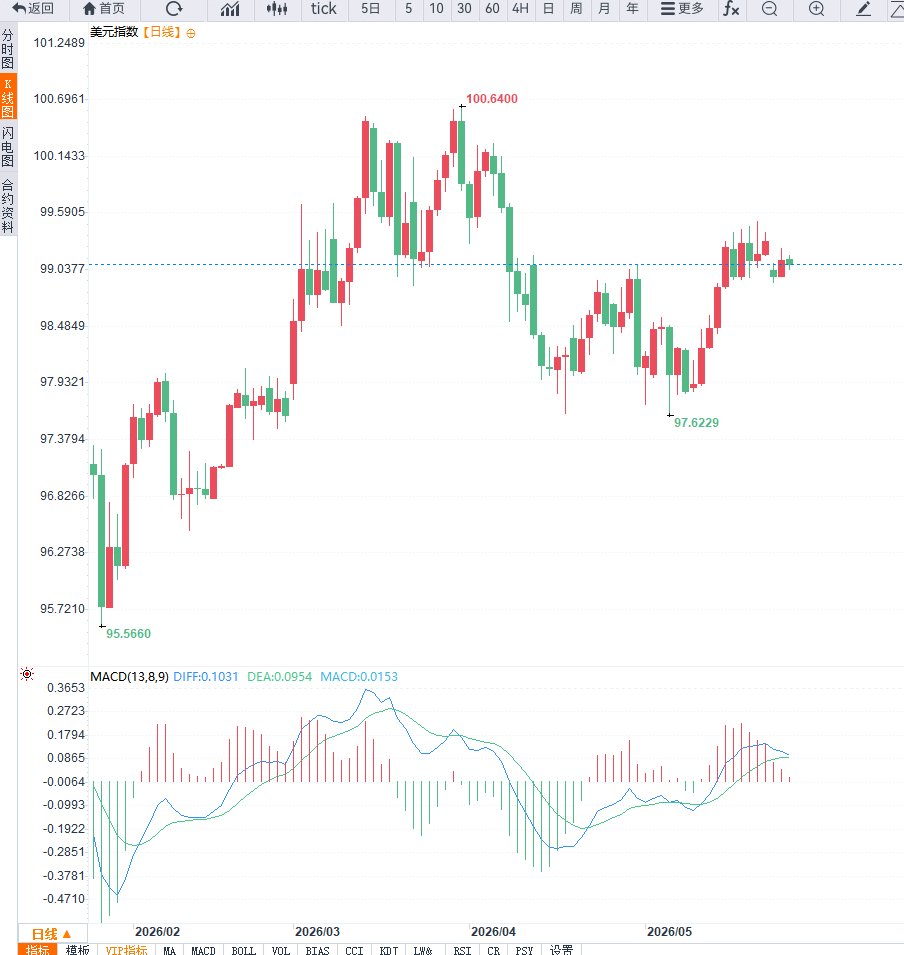
From the daily chart of the US Dollar Index, the dollar remains in a medium-term upward-biased consolidation pattern. The price continues to trade near the 20-day moving average, and the MACD indicator remains near the zero line, indicating that the overall bullish structure has not been completely broken. The RSI indicator remains around 55, suggesting that the dollar still has some upward momentum. Looking at the 4-hour chart, the dollar index has recently been consolidating around 99. Short-term moving averages are gradually flattening, indicating that the market is awaiting new directional drivers. If subsequent US PCE data remains strong, the dollar index may retest the 99.80 or even 100 level.
Overall, Kashkari's remarks further reinforced market expectations that "high interest rates will be maintained for longer." Against the backdrop of continued tensions in the Middle East and high international oil prices, concerns about inflation risks within the Federal Reserve are clearly intensifying.
Editor's Summary : Kashkari's latest speech released a relatively clear cautiously hawkish signal. While he did not directly support further interest rate hikes, he emphasized that inflation risks are re-accumulating, and that the energy price shock from the Middle East situation may last longer. From a market perspective, the core challenge facing the Federal Reserve has gradually shifted from the previous "risk of economic slowdown" to the "risk of renewed inflation." This means that the Fed's future policy path may continue to be highly dependent on data. In the short term, US PCE data, the Middle East situation, and international oil price trends will be the core variables determining the direction of the dollar, US Treasury bonds, and gold markets.
Kashkari believes that the current risk of inflation in the United States is higher than the risk of a deteriorating job market. However, he also emphasized that the Federal Reserve cannot focus on only one risk, but must take into account both inflation and changes in the labor market.
Recently, due to the continued tensions in the Strait of Hormuz, volatility in the international energy market has increased significantly. Market concerns exist that global energy supplies may be affected, potentially pushing up global inflation again. The Strait of Hormuz handles approximately 20% of global seaborne crude oil transport. Therefore, changes in the situation in this region have become one of the most critical risk factors in the current global financial markets.
With international oil prices remaining high, market expectations are gradually rising that major central banks around the world will maintain high interest rate policies. Kashkari stated that compared to the previously feared risk of an economic slowdown, the possibility of a resurgence in US inflation now seems more apparent.
In fact, since the Federal Reserve's April meeting, several Fed officials have begun to re-emphasize the risks of inflation. Although the April meeting ultimately decided to keep interest rates unchanged, some officials expressed reservations about continuing to use dovish forward guidance. Kashkari was one of the officials who opposed continuing to use dovish language. He believed that the Fed should adopt a more "neutral" policy guidance, meaning that the future path of interest rates would depend entirely on subsequent economic data, rather than hinting at an easing direction to the market in advance.
Kashkari stated that since the April meeting, the vast majority of economic data indicates that the risks to U.S. inflation are rising, not falling. The market is now beginning to reassess the likelihood of further interest rate hikes by the Federal Reserve.
Based on market pricing, traders have significantly reduced their bets on a Federal Reserve rate cut this year, while simultaneously increasing their expectations for continued high interest rates or even further rate hikes. The market is currently paying particular attention to the US core PCE price index data. Since the PCE is the Fed's most closely watched inflation indicator, its results will directly influence market judgments on future policy direction.
The market expects the US core PCE annual rate to rise to around 3.3% from the previous 3.2%. If the data continues to exceed expectations, it could further strengthen market expectations that the Federal Reserve will maintain high interest rates. Meanwhile, US Treasury yields have also seen significant volatility recently. Analysts believe the bond market has begun to gradually price in the possibility of a longer-term high-interest-rate environment.
Kashkari pointed out that it is still "far too early" to predict the timing of the next interest rate move. He emphasized that the Fed needs to continue observing more data to confirm whether the current inflationary pressures are merely temporary. However, he also stated that he still supports "neutral guidance" rather than immediately shifting to a more hawkish stance.
This means that while the Federal Reserve is increasingly concerned about inflation risks, it still wants to maintain a certain degree of policy flexibility in the short term, given the continued uncertainty surrounding economic growth and the job market. Looking at the dollar's performance, Kashkari's remarks were generally hawkish, providing some support for the dollar. The dollar index has recently remained relatively stable around 99, with the market awaiting US PCE data and further speeches from Fed officials.
High interest rate expectations remain a key factor supporting the US dollar. Meanwhile, the gold market continues to face pressure. Since gold itself does not generate interest income, its attractiveness is typically diminished in a high-interest-rate environment. Furthermore, persistently high international oil prices have reinforced market concerns about global "imported inflation." The market believes that if tensions in the Middle East continue, global energy prices may remain high, further compelling major central banks to maintain hawkish policies.
Looking at the US Treasury market, the yield on 10-year US Treasury bonds has recently remained high. Technical analysis suggests that the bond market is gradually forming expectations of "higher interest rates for a longer period."
From the daily chart of the US Dollar Index, the dollar remains in a medium-term upward-biased consolidation pattern. The price continues to trade near the 20-day moving average, and the MACD indicator remains near the zero line, indicating that the overall bullish structure has not been completely broken. The RSI indicator remains around 55, suggesting that the dollar still has some upward momentum. Looking at the 4-hour chart, the dollar index has recently been consolidating around 99. Short-term moving averages are gradually flattening, indicating that the market is awaiting new directional drivers. If subsequent US PCE data remains strong, the dollar index may retest the 99.80 or even 100 level.
Overall, Kashkari's remarks further reinforced market expectations that "high interest rates will be maintained for longer." Against the backdrop of continued tensions in the Middle East and high international oil prices, concerns about inflation risks within the Federal Reserve are clearly intensifying.
Editor's Summary : Kashkari's latest speech released a relatively clear cautiously hawkish signal. While he did not directly support further interest rate hikes, he emphasized that inflation risks are re-accumulating, and that the energy price shock from the Middle East situation may last longer. From a market perspective, the core challenge facing the Federal Reserve has gradually shifted from the previous "risk of economic slowdown" to the "risk of renewed inflation." This means that the Fed's future policy path may continue to be highly dependent on data. In the short term, US PCE data, the Middle East situation, and international oil price trends will be the core variables determining the direction of the dollar, US Treasury bonds, and gold markets.
- Risk Warning and Disclaimer
- The market involves risk, and trading may not be suitable for all investors. This article is for reference only and does not constitute personal investment advice, nor does it take into account certain users’ specific investment objectives, financial situation, or other needs. Any investment decisions made based on this information are at your own risk.