99.51 becomes a short-term watershed for the US dollar; the Goolsby framework reveals that the key is whether AI is a "surprise" or "hype based on expectations."
2026-05-28 11:38:05
On Thursday (May 28) during the Asian session, the US dollar index rose 0.2% to around 99.45, having fluctuated within the 98.91-99.50 range throughout the week.
As the US dollar index entered a narrow range of fluctuation, a speech by Chicago Federal Reserve President Goolsby provided an important analytical framework for understanding the current interest rate outlook and the direction of the US dollar.
Chicago Federal Reserve President Austan Goolsby pointed out at the Bank of Japan's Monetary and Economic Research Conference that the direction of the impact of productivity growth on interest rates depends on whether it is "unexpected" or "anticipated by the market." If it is the former, interest rates may need to be lowered; if it is the latter, interest rates may need to be raised before the productivity boom truly arrives to prevent the economy from overheating.
Furthermore, this problem will become even more complicated if there are supply shocks such as oil or supply chain disruptions in the short term.
Goolsby stated that over the past few years, he has consistently emphasized the accelerating pace of productivity growth and its potential to become a lasting phenomenon and a significant economic boon. This potential for productivity gains is receiving increasing attention, especially given the rapid development of new technologies such as artificial intelligence.
However, the impact on interest rates remains a hotly debated area, with differing opinions among economists and policymakers. Economics suggests that the answer largely depends on whether productivity growth is unexpected or anticipated. These two scenarios have drastically different transmission paths for inflation, consumption, investment, and central bank policy choices.
Some argue that the lesson learned from the U.S. experience of the 1990s is that faster productivity growth can mean lower interest rates, as this suppresses inflation. The context at the time was that, although productivity data had not yet shown significant improvement, the economy had already exhibited a "Goldilocks" combination of low inflation and high employment.
At the time, Federal Reserve Chairman Alan Greenspan believed that even if productivity growth itself wasn't yet reflected in the data, it was inevitably a driving force behind overall profits, employment, and inflation figures. This growth was unexpected—the market hadn't anticipated the acceleration in productivity—and in this situation, fundamentals called for lower interest rates. Low interest rates further supported investment and consumption, creating a positive cycle.
However, if people anticipate future productivity gains, this will alter their current behavior, thus complicating the interest rate outlook. This is particularly relevant in the current discussion about artificial intelligence—the market has widely anticipated a leap in productivity driven by AI in the future.
Anticipating future income increases, just like current wealth increases, can lead to higher consumer spending and potentially overheat the economy before a true productivity boom arrives. In other words, anticipated productivity growth itself can become a self-fulfilling inflationary force, in which case interest rates are likely to need to be raised.
Goolsby argues that we must pay close attention to signs of economic activity driven by expectations of future growth: the impact of the stock market wealth effect on consumer spending, and increased capital investment driven by market valuations.
The more hype surrounding future productivity grows, the more likely interest rates will need to be raised to prevent the economy from overheating. This could also impact other countries, as productivity gains or anticipated gains can spread across borders with the introduction of new technologies.
More importantly, short-term supply shocks—whether from oil prices, supply chain disruptions, or other factors—will exacerbate the problem.
Supply shocks reduce economic potential and limit growth, while also exacerbating inflation caused by anticipated future productivity growth.
Goolsby's core argument is that the impact of productivity growth on interest rates is not unidirectional, but rather depends on the "timing" of market perception of that growth. Unexpected growth helps suppress inflation and support low interest rates; however, growth anticipated in advance alters consumption and investment behavior, potentially pushing up interest rates and triggering overheating risks before the actual growth arrives. If this is compounded by short-term supply shocks (such as rising oil prices), inflationary pressures will be further amplified. This analysis offers important insights for global central banks currently addressing the dual challenges of inflation and growth.
The current US dollar index has not followed a linear trend of "rising interest rates equaling a stronger dollar" because the market is not trading on a single interest rate differential, but rather on a comprehensive risk premium encompassing inflation, growth, energy, and policy credibility. Goolsby's analytical framework reveals the root of this contradiction: if the increase in AI productivity is a "1990s-style" unexpected surprise, then the current high interest rates may not need to be maintained for long; however, if AI is more of a "hype" with slow actual implementation, while oil prices remain high, then the Federal Reserve may be forced to maintain higher interest rates for a longer period, thereby supporting the dollar.
The US dollar index is currently showing a generally strong but volatile trend on the daily chart, although its upward momentum has slowed down in the short term.
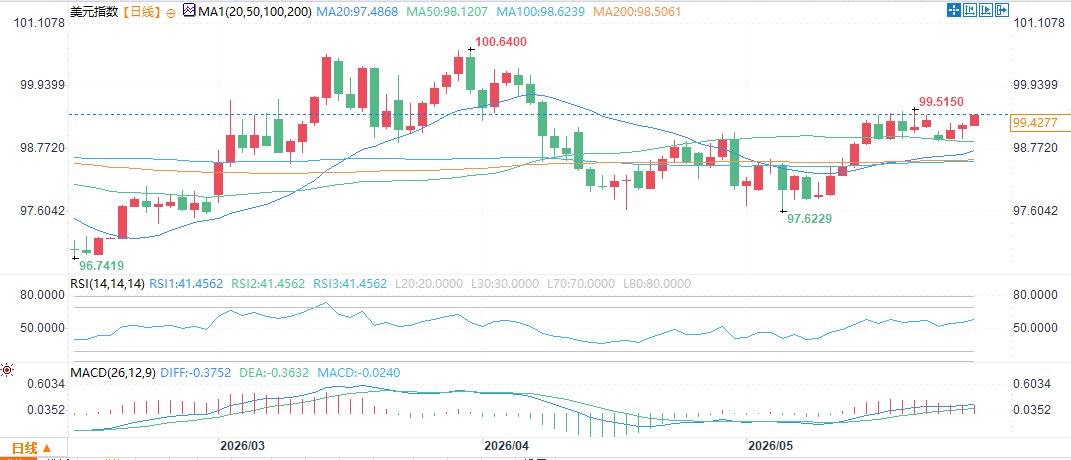
(US Dollar Index Daily Chart, Source: FX678)
In terms of moving averages, the current price is around 99.45, having risen above the 50-day, 100-day, and 200-day moving averages. The 20-day (97.48), 50-day (98.12), and 100-day (98.62) moving averages are in a bullish alignment, providing support for the price, indicating a bullish medium-term trend. However, the price encountered resistance near the previous high of 99.51, facing some upward pressure in the short term.
The RSI indicator is near the 50 neutral line and has not yet entered the overbought zone. While short-term momentum is weak, no clear overbought signal has appeared, indicating a clear oscillating pattern. As for the MACD indicator, the DIFF line (-0.3752) and DEA line (-0.3632) are nearly converging, and the MACD histogram is at -0.024, close to the zero line. Both bullish and bearish momentum are weak, indicating that the current market is in a consolidation phase and a clear trend signal has not yet formed. Overall, the US dollar index has a medium-term bullish bias, but has encountered resistance near previous highs and is currently in a consolidation phase. Key support lies near the 100-day moving average at 98.62; if this support holds, there is still a possibility of challenging previous highs. Resistance is at 99.51; a decisive break above this level would open up further upside potential.
At 11:35 AM Beijing time on May 28, the US dollar index was at 99.47.
As the US dollar index entered a narrow range of fluctuation, a speech by Chicago Federal Reserve President Goolsby provided an important analytical framework for understanding the current interest rate outlook and the direction of the US dollar.
Chicago Federal Reserve President Austan Goolsby pointed out at the Bank of Japan's Monetary and Economic Research Conference that the direction of the impact of productivity growth on interest rates depends on whether it is "unexpected" or "anticipated by the market." If it is the former, interest rates may need to be lowered; if it is the latter, interest rates may need to be raised before the productivity boom truly arrives to prevent the economy from overheating.
Furthermore, this problem will become even more complicated if there are supply shocks such as oil or supply chain disruptions in the short term.
Two scenarios for productivity growth: unexpected events vs. anticipated events
Goolsby stated that over the past few years, he has consistently emphasized the accelerating pace of productivity growth and its potential to become a lasting phenomenon and a significant economic boon. This potential for productivity gains is receiving increasing attention, especially given the rapid development of new technologies such as artificial intelligence.
However, the impact on interest rates remains a hotly debated area, with differing opinions among economists and policymakers. Economics suggests that the answer largely depends on whether productivity growth is unexpected or anticipated. These two scenarios have drastically different transmission paths for inflation, consumption, investment, and central bank policy choices.
The experience of the 1990s: Unexpected growth depresses interest rates
Some argue that the lesson learned from the U.S. experience of the 1990s is that faster productivity growth can mean lower interest rates, as this suppresses inflation. The context at the time was that, although productivity data had not yet shown significant improvement, the economy had already exhibited a "Goldilocks" combination of low inflation and high employment.
At the time, Federal Reserve Chairman Alan Greenspan believed that even if productivity growth itself wasn't yet reflected in the data, it was inevitably a driving force behind overall profits, employment, and inflation figures. This growth was unexpected—the market hadn't anticipated the acceleration in productivity—and in this situation, fundamentals called for lower interest rates. Low interest rates further supported investment and consumption, creating a positive cycle.
Expected growth may alter behavior: interest rates may need to be raised.
However, if people anticipate future productivity gains, this will alter their current behavior, thus complicating the interest rate outlook. This is particularly relevant in the current discussion about artificial intelligence—the market has widely anticipated a leap in productivity driven by AI in the future.
Anticipating future income increases, just like current wealth increases, can lead to higher consumer spending and potentially overheat the economy before a true productivity boom arrives. In other words, anticipated productivity growth itself can become a self-fulfilling inflationary force, in which case interest rates are likely to need to be raised.
Three signals to watch out for: the wealth effect of the stock market, and the intensity of capital investment and speculation.
Goolsby argues that we must pay close attention to signs of economic activity driven by expectations of future growth: the impact of the stock market wealth effect on consumer spending, and increased capital investment driven by market valuations.
The more hype surrounding future productivity grows, the more likely interest rates will need to be raised to prevent the economy from overheating. This could also impact other countries, as productivity gains or anticipated gains can spread across borders with the introduction of new technologies.
Supply shocks complicate the problem.
More importantly, short-term supply shocks—whether from oil prices, supply chain disruptions, or other factors—will exacerbate the problem.
Supply shocks reduce economic potential and limit growth, while also exacerbating inflation caused by anticipated future productivity growth.
Goolsby's core argument is that the impact of productivity growth on interest rates is not unidirectional, but rather depends on the "timing" of market perception of that growth. Unexpected growth helps suppress inflation and support low interest rates; however, growth anticipated in advance alters consumption and investment behavior, potentially pushing up interest rates and triggering overheating risks before the actual growth arrives. If this is compounded by short-term supply shocks (such as rising oil prices), inflationary pressures will be further amplified. This analysis offers important insights for global central banks currently addressing the dual challenges of inflation and growth.
The current US dollar index has not followed a linear trend of "rising interest rates equaling a stronger dollar" because the market is not trading on a single interest rate differential, but rather on a comprehensive risk premium encompassing inflation, growth, energy, and policy credibility. Goolsby's analytical framework reveals the root of this contradiction: if the increase in AI productivity is a "1990s-style" unexpected surprise, then the current high interest rates may not need to be maintained for long; however, if AI is more of a "hype" with slow actual implementation, while oil prices remain high, then the Federal Reserve may be forced to maintain higher interest rates for a longer period, thereby supporting the dollar.
US Dollar Index Daily Technical Analysis
The US dollar index is currently showing a generally strong but volatile trend on the daily chart, although its upward momentum has slowed down in the short term.
(US Dollar Index Daily Chart, Source: FX678)
In terms of moving averages, the current price is around 99.45, having risen above the 50-day, 100-day, and 200-day moving averages. The 20-day (97.48), 50-day (98.12), and 100-day (98.62) moving averages are in a bullish alignment, providing support for the price, indicating a bullish medium-term trend. However, the price encountered resistance near the previous high of 99.51, facing some upward pressure in the short term.
The RSI indicator is near the 50 neutral line and has not yet entered the overbought zone. While short-term momentum is weak, no clear overbought signal has appeared, indicating a clear oscillating pattern. As for the MACD indicator, the DIFF line (-0.3752) and DEA line (-0.3632) are nearly converging, and the MACD histogram is at -0.024, close to the zero line. Both bullish and bearish momentum are weak, indicating that the current market is in a consolidation phase and a clear trend signal has not yet formed. Overall, the US dollar index has a medium-term bullish bias, but has encountered resistance near previous highs and is currently in a consolidation phase. Key support lies near the 100-day moving average at 98.62; if this support holds, there is still a possibility of challenging previous highs. Resistance is at 99.51; a decisive break above this level would open up further upside potential.
At 11:35 AM Beijing time on May 28, the US dollar index was at 99.47.
- Risk Warning and Disclaimer
- The market involves risk, and trading may not be suitable for all investors. This article is for reference only and does not constitute personal investment advice, nor does it take into account certain users’ specific investment objectives, financial situation, or other needs. Any investment decisions made based on this information are at your own risk.