Institutions have lowered their year-end gold price forecasts to $5,500, but the long-term bullish logic remains unshaken.
2026-05-28 12:04:00
UBS lowered its gold price target for the end of 2026 due to high US Treasury yields and a stronger US dollar, but institutions remain optimistic about a long-term bull market for gold. Analyzing factors such as geopolitical tensions, monetary policy, and supply and demand fundamentals, short-term interest rate hike expectations are suppressing gold prices, while long-term supporting factors such as inflation hedging, central bank gold purchases, and de-dollarization remain stable.
Meanwhile, the conflict in the Middle East has led to a general rise in commodity prices, and institutions also advise investors to optimize their portfolio allocation and diversify investment risks.
UBS analysts Dominic Schnider and Wayne Gordon stated that with current real interest rates remaining high, the weakness of gold in not generating returns has been amplified, leading to a cooling of the risk aversion sentiment and a significant slowdown in inflows into gold ETFs and futures, resulting in insufficient upward momentum in the previous period.
Based on this, the institution lowered its year-end 2026 gold price forecast from $5,900 per ounce to $5,500. The two analysts emphasized that the structural bull market for gold has not ended, only faced short-term pressure, and gold prices are still expected to rise by $1,000 from current levels this year. The institution also predicts that after monetary policy becomes more neutral in 2027, a weaker dollar will drive a renewed recovery in gold prices.
On April 13, UBS commodities analyst Giovanni Staunovo stated that the ongoing situation in Iran and the risks in the Strait of Hormuz continue to disrupt the market, causing commodity prices and volatility to rise in tandem. Brent crude oil prices have increased from $72 per barrel before the conflict to $102. Year-to-date, commodities have risen by approximately 17%. While gold possesses safe-haven attributes, it has been dragged down by expectations of interest rate hikes, with its current price nearly 13% lower than its January historical high. Even as geopolitical risks gradually subside, fundamental factors such as low refined oil inventories and shortages in industrial metal supply will continue to support strong commodity prices.
Back on March 16, the UBS team predicted that gold prices could reach $6,200 per ounce by the end of the year.
Looking back at this round of market movements, gold prices have consistently failed to break through $5,200 per ounce since the outbreak of the Iranian conflict, indicating that safe-haven buying has fallen short of expectations. Historically, events such as the 2022 Russia-Ukraine conflict and the Gulf War saw gold prices surge briefly before retreating due to the impact of the Federal Reserve's interest rate hikes. This is because during geopolitical conflicts, funds tend to flow first to liquid assets such as energy, while gold is primarily used to hedge against long-term risks such as currency devaluation and economic downturns arising from the conflict, rather than the short-term impact of the conflict itself.
Analysts believe that while rising energy prices, increased inflation, rising market expectations of interest rate hikes, and a stronger dollar have indeed put downward pressure on gold prices, global central banks are unlikely to adopt aggressive interest rate hike strategies. As the conflict continues and its negative economic impact gradually emerges, gold's hedging value will become even more prominent. Data shows that for over a century, gold returns have been highly positively correlated with inflation, making it a classic anti-inflation asset.
Demand also remained strong, with gold ETF holdings gradually stabilizing and hedge funds slightly increasing their positions. This, coupled with continued gold purchases by global central banks and jewelry consumption driven by rising Asian household incomes, solidified the demand foundation. Furthermore, long-term trends such as the global high-debt environment, countries accelerating asset diversification, and reducing reliance on the US dollar continue to benefit gold.
Analysts offer the following suggestions regarding portfolio structure: A small allocation to gold can optimize asset allocation and mitigate systemic risks; investors who have heavily invested in gold and reaped substantial returns can increase their holdings in commodities such as copper, aluminum, and agricultural products to broaden their profit channels.
Overall, gold remains a high-quality portfolio diversification tool, suitable for medium- to long-term investment.
Currently, interest rates and the US dollar are the main factors suppressing gold prices, leading to increased short-term market volatility. However, gold's long-term bullish trend remains unchanged, supported by its core strengths as an inflation hedge, risk protector, and robust demand. The Middle East conflict has driven a general rise in commodities, with different categories showing divergent trends. Investors can flexibly adjust their commodity portfolio allocation based on their own needs.
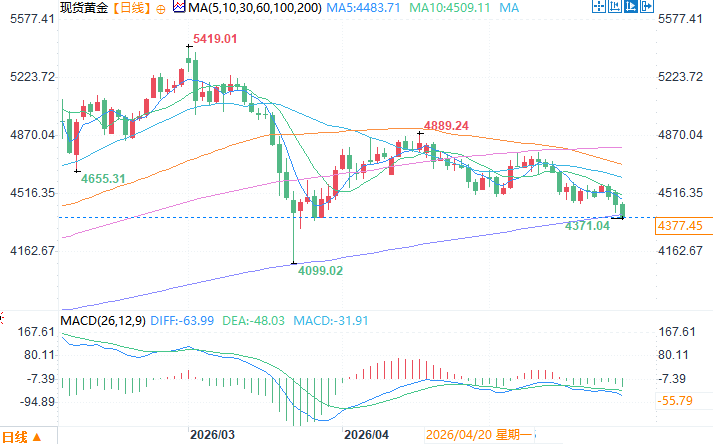
Spot gold daily chart source: EasyForex
At 12:03 Beijing time on May 28, spot gold was trading at $4375.45 per ounce.
Meanwhile, the conflict in the Middle East has led to a general rise in commodity prices, and institutions also advise investors to optimize their portfolio allocation and diversify investment risks.
Short-term resistance is evident, and year-end gold price forecasts have been revised downwards.
UBS analysts Dominic Schnider and Wayne Gordon stated that with current real interest rates remaining high, the weakness of gold in not generating returns has been amplified, leading to a cooling of the risk aversion sentiment and a significant slowdown in inflows into gold ETFs and futures, resulting in insufficient upward momentum in the previous period.
Based on this, the institution lowered its year-end 2026 gold price forecast from $5,900 per ounce to $5,500. The two analysts emphasized that the structural bull market for gold has not ended, only faced short-term pressure, and gold prices are still expected to rise by $1,000 from current levels this year. The institution also predicts that after monetary policy becomes more neutral in 2027, a weaker dollar will drive a renewed recovery in gold prices.
Geopolitical factors boosted commodities, while gold showed mixed performance.
On April 13, UBS commodities analyst Giovanni Staunovo stated that the ongoing situation in Iran and the risks in the Strait of Hormuz continue to disrupt the market, causing commodity prices and volatility to rise in tandem. Brent crude oil prices have increased from $72 per barrel before the conflict to $102. Year-to-date, commodities have risen by approximately 17%. While gold possesses safe-haven attributes, it has been dragged down by expectations of interest rate hikes, with its current price nearly 13% lower than its January historical high. Even as geopolitical risks gradually subside, fundamental factors such as low refined oil inventories and shortages in industrial metal supply will continue to support strong commodity prices.
Reviewing historical trends and interpreting gold's safe-haven characteristics
Back on March 16, the UBS team predicted that gold prices could reach $6,200 per ounce by the end of the year.
Looking back at this round of market movements, gold prices have consistently failed to break through $5,200 per ounce since the outbreak of the Iranian conflict, indicating that safe-haven buying has fallen short of expectations. Historically, events such as the 2022 Russia-Ukraine conflict and the Gulf War saw gold prices surge briefly before retreating due to the impact of the Federal Reserve's interest rate hikes. This is because during geopolitical conflicts, funds tend to flow first to liquid assets such as energy, while gold is primarily used to hedge against long-term risks such as currency devaluation and economic downturns arising from the conflict, rather than the short-term impact of the conflict itself.
With solid support from multiple sources, the long-term upward trend remains unchanged.
Analysts believe that while rising energy prices, increased inflation, rising market expectations of interest rate hikes, and a stronger dollar have indeed put downward pressure on gold prices, global central banks are unlikely to adopt aggressive interest rate hike strategies. As the conflict continues and its negative economic impact gradually emerges, gold's hedging value will become even more prominent. Data shows that for over a century, gold returns have been highly positively correlated with inflation, making it a classic anti-inflation asset.
Demand also remained strong, with gold ETF holdings gradually stabilizing and hedge funds slightly increasing their positions. This, coupled with continued gold purchases by global central banks and jewelry consumption driven by rising Asian household incomes, solidified the demand foundation. Furthermore, long-term trends such as the global high-debt environment, countries accelerating asset diversification, and reducing reliance on the US dollar continue to benefit gold.
Configuration strategy reference, enrich your investment portfolio
Analysts offer the following suggestions regarding portfolio structure: A small allocation to gold can optimize asset allocation and mitigate systemic risks; investors who have heavily invested in gold and reaped substantial returns can increase their holdings in commodities such as copper, aluminum, and agricultural products to broaden their profit channels.
Overall, gold remains a high-quality portfolio diversification tool, suitable for medium- to long-term investment.
Summarize
Currently, interest rates and the US dollar are the main factors suppressing gold prices, leading to increased short-term market volatility. However, gold's long-term bullish trend remains unchanged, supported by its core strengths as an inflation hedge, risk protector, and robust demand. The Middle East conflict has driven a general rise in commodities, with different categories showing divergent trends. Investors can flexibly adjust their commodity portfolio allocation based on their own needs.
Spot gold daily chart source: EasyForex
At 12:03 Beijing time on May 28, spot gold was trading at $4375.45 per ounce.
- Risk Warning and Disclaimer
- The market involves risk, and trading may not be suitable for all investors. This article is for reference only and does not constitute personal investment advice, nor does it take into account certain users’ specific investment objectives, financial situation, or other needs. Any investment decisions made based on this information are at your own risk.