Demand for artificial intelligence is driving up copper prices, while a surge in US imports exacerbates concerns about global supply shortages.
2026-05-28 14:48:57
International copper prices continued their rebound in early Asian trading on Thursday. Three-month copper on the London Metal Exchange (LME) rose about 0.2% to around $13,554 per tonne. The continued expansion of the global artificial intelligence (AI) industry has led to renewed optimism in the market regarding future copper demand, driving copper prices to remain strong overall.

In a recent report, ANZ research analysts pointed out that the artificial intelligence boom is significantly increasing global demand for power infrastructure construction, and copper, as a key industrial metal, continues to benefit from the new round of energy and technology investment cycle. Analysts stated that the current global construction of AI data centers, grid upgrades, and the expansion of high-voltage transmission systems are all substantially increasing copper demand. Particularly in resource-based economies such as Australia, the continued growth in copper usage in transmission lines, electrical equipment, and energy storage facilities further strengthens market expectations for medium- to long-term copper price increases.
Currently, many major economies worldwide are accelerating the upgrading of their energy infrastructure. With the increasing demand for artificial intelligence computing and the rapid rise in data center power consumption, governments and businesses are expanding their power grid investments to meet the future needs of energy-intensive industries. Market research institutions predict that global power infrastructure investment may continue to grow in the coming years, and copper's irreplaceable role in power transmission, electrical equipment, and new energy systems makes it a significant beneficiary of the global energy transition. Meanwhile, the recent rapid increase in copper imports in the US market has further exacerbated global concerns about tightening supply.
ANZ Bank points out that due to market concerns about potential new tariffs on copper products in the US, US companies are recently increasing copper imports in advance to avoid future increases in import costs. This "rush to import" is accelerating the decline in global spot market inventories. Analysts believe that increased US import demand is further compressing the global supply of copper available for trade. Especially given the limited new capacity additions at global mines, market concerns about a future supply gap continue to intensify.
Data shows that global copper inventories remain relatively low, while supply growth in some major copper-producing regions is slower than market expectations. Meanwhile, the situation in the Middle East continues to exert pressure on the overall base metals market. Although copper prices are supported by demand driven by artificial intelligence and the energy transition, market risk sentiment remains influenced by tensions between the US and Iran.
Peace talks between the US and Iran are progressing slowly, and market concerns about a prolonged conflict in the Middle East persist. Overall risk appetite among international capital is suppressed, leading to divergent price movements in some base metals. Analysts point out that if the situation in the Middle East continues to escalate, international oil prices may rise further, thereby increasing global industrial costs and fueling concerns about a global economic slowdown.
However, considering the current market structure, copper prices continue to outperform most base metals. Given that the global energy transition, AI infrastructure construction, and the expansion of the new energy industry all heavily rely on copper resources, the market maintains strong confidence in future copper demand growth. From a global supply and demand perspective, the copper market has gradually entered a phase where demand growth outpaces supply expansion. Especially against the backdrop of rapid development in the new energy, electric vehicle, and artificial intelligence industries, global copper consumption is expected to continue growing in the coming years.
Furthermore, the long development cycles of some large-scale mining projects mean that global copper supply is unlikely to increase rapidly in the short term. The market is concerned that the copper market may remain tight for the next few years.
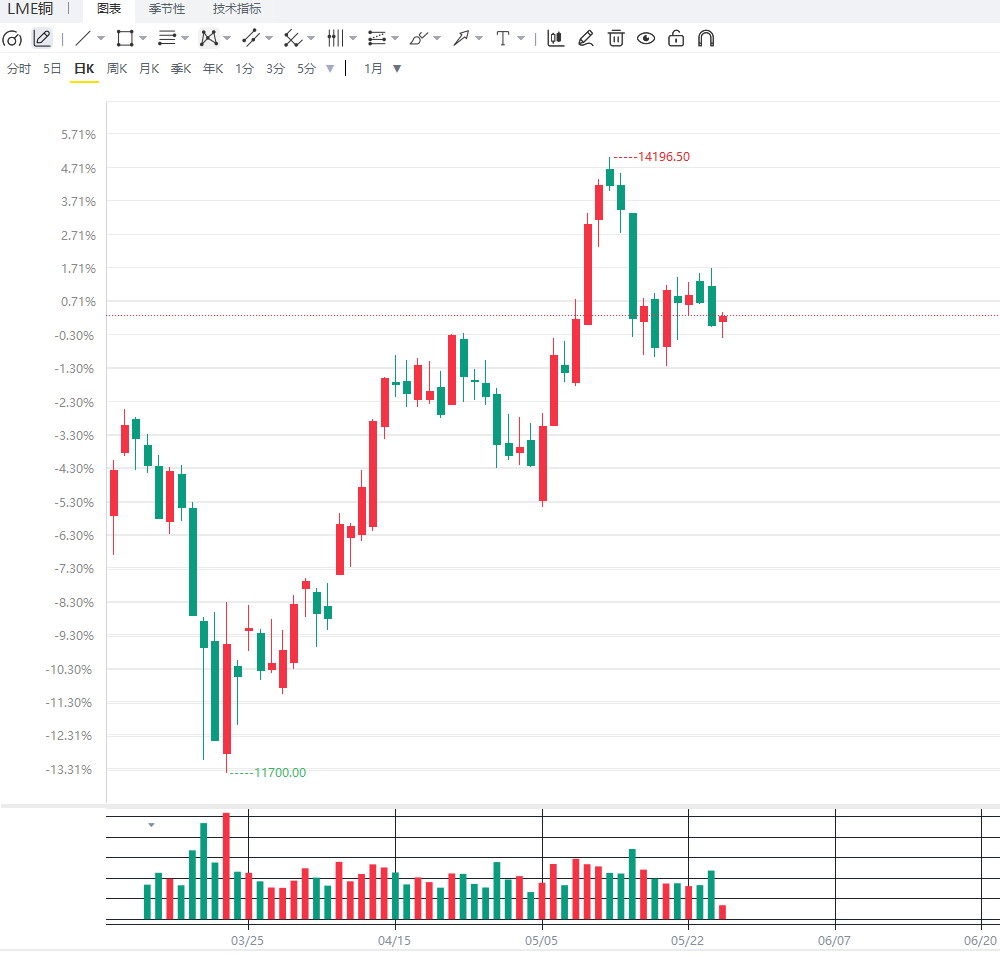
From a daily chart perspective, LME copper prices maintain a strong upward trend. Prices continue to trade above major moving averages, and the MACD indicator remains in a high-level golden cross state, indicating that the medium- to long-term upward trend remains clear. Currently, key resistance levels to watch are the $13,650 and $13,800 area. A break above these levels could lead to further challenges for historical highs. Key support levels are located at $13,280 and the $13,000 area.
Overall, artificial intelligence, power infrastructure upgrades, and the expansion of the new energy industry are becoming the core drivers of global copper demand growth, while limited supply-side expansion continues to strengthen market expectations for a long-term rise in copper prices.
Editor's Summary : The global copper market is currently driven by both expanding demand from artificial intelligence and constrained supply growth. With the continued expansion of global AI industry, power infrastructure, and new energy investment, copper's importance as a key industrial metal is further enhanced. At the same time, the US's early increase in copper imports and the continued low global inventory levels have reinforced market concerns about future supply tightness. Although the escalating situation in the Middle East has temporarily dampened overall risk appetite, copper prices have still significantly outperformed most other base metals. The market will need to focus on changes in global energy investment, potential US tariff policies, the supply situation of major mines, and global economic growth. These factors will collectively determine the long-term trend of copper prices and the direction of market fluctuations.
In a recent report, ANZ research analysts pointed out that the artificial intelligence boom is significantly increasing global demand for power infrastructure construction, and copper, as a key industrial metal, continues to benefit from the new round of energy and technology investment cycle. Analysts stated that the current global construction of AI data centers, grid upgrades, and the expansion of high-voltage transmission systems are all substantially increasing copper demand. Particularly in resource-based economies such as Australia, the continued growth in copper usage in transmission lines, electrical equipment, and energy storage facilities further strengthens market expectations for medium- to long-term copper price increases.
Currently, many major economies worldwide are accelerating the upgrading of their energy infrastructure. With the increasing demand for artificial intelligence computing and the rapid rise in data center power consumption, governments and businesses are expanding their power grid investments to meet the future needs of energy-intensive industries. Market research institutions predict that global power infrastructure investment may continue to grow in the coming years, and copper's irreplaceable role in power transmission, electrical equipment, and new energy systems makes it a significant beneficiary of the global energy transition. Meanwhile, the recent rapid increase in copper imports in the US market has further exacerbated global concerns about tightening supply.
ANZ Bank points out that due to market concerns about potential new tariffs on copper products in the US, US companies are recently increasing copper imports in advance to avoid future increases in import costs. This "rush to import" is accelerating the decline in global spot market inventories. Analysts believe that increased US import demand is further compressing the global supply of copper available for trade. Especially given the limited new capacity additions at global mines, market concerns about a future supply gap continue to intensify.
Data shows that global copper inventories remain relatively low, while supply growth in some major copper-producing regions is slower than market expectations. Meanwhile, the situation in the Middle East continues to exert pressure on the overall base metals market. Although copper prices are supported by demand driven by artificial intelligence and the energy transition, market risk sentiment remains influenced by tensions between the US and Iran.
Peace talks between the US and Iran are progressing slowly, and market concerns about a prolonged conflict in the Middle East persist. Overall risk appetite among international capital is suppressed, leading to divergent price movements in some base metals. Analysts point out that if the situation in the Middle East continues to escalate, international oil prices may rise further, thereby increasing global industrial costs and fueling concerns about a global economic slowdown.
However, considering the current market structure, copper prices continue to outperform most base metals. Given that the global energy transition, AI infrastructure construction, and the expansion of the new energy industry all heavily rely on copper resources, the market maintains strong confidence in future copper demand growth. From a global supply and demand perspective, the copper market has gradually entered a phase where demand growth outpaces supply expansion. Especially against the backdrop of rapid development in the new energy, electric vehicle, and artificial intelligence industries, global copper consumption is expected to continue growing in the coming years.
Furthermore, the long development cycles of some large-scale mining projects mean that global copper supply is unlikely to increase rapidly in the short term. The market is concerned that the copper market may remain tight for the next few years.
From a daily chart perspective, LME copper prices maintain a strong upward trend. Prices continue to trade above major moving averages, and the MACD indicator remains in a high-level golden cross state, indicating that the medium- to long-term upward trend remains clear. Currently, key resistance levels to watch are the $13,650 and $13,800 area. A break above these levels could lead to further challenges for historical highs. Key support levels are located at $13,280 and the $13,000 area.
Overall, artificial intelligence, power infrastructure upgrades, and the expansion of the new energy industry are becoming the core drivers of global copper demand growth, while limited supply-side expansion continues to strengthen market expectations for a long-term rise in copper prices.
Editor's Summary : The global copper market is currently driven by both expanding demand from artificial intelligence and constrained supply growth. With the continued expansion of global AI industry, power infrastructure, and new energy investment, copper's importance as a key industrial metal is further enhanced. At the same time, the US's early increase in copper imports and the continued low global inventory levels have reinforced market concerns about future supply tightness. Although the escalating situation in the Middle East has temporarily dampened overall risk appetite, copper prices have still significantly outperformed most other base metals. The market will need to focus on changes in global energy investment, potential US tariff policies, the supply situation of major mines, and global economic growth. These factors will collectively determine the long-term trend of copper prices and the direction of market fluctuations.
- Risk Warning and Disclaimer
- The market involves risk, and trading may not be suitable for all investors. This article is for reference only and does not constitute personal investment advice, nor does it take into account certain users’ specific investment objectives, financial situation, or other needs. Any investment decisions made based on this information are at your own risk.