The Fed's preferred inflation gauge will be released tonight: Will the PCE rate help the dollar break through strong resistance?
2026-05-28 15:22:10
The US dollar index is currently trading around 99.30, having fluctuated between 98.91 and 99.55 throughout the week, and is at a critical juncture where it needs to choose a direction. The 99.55 level represents the high point since April and is a technical watershed for whether the dollar index can open up further upside potential. Whether the dollar index can break through this technical level will depend on the US April PCE inflation data to be released tonight.
The US April PCE data will be released at 20:30 Beijing time on Thursday. The market expects the core PCE to rise 0.3% month-on-month and 3.3% year-on-year, with the overall PCE expected to rise to 3.8% year-on-year, the highest level since May 2023.
With Federal Reserve officials recently shifting to a hawkish stance, this inflation report will be a key indicator of whether to raise interest rates before the end of the year. Currently, the market is pricing in a roughly 50% probability of at least one rate hike before the end of 2026.
The U.S. Bureau of Economic Analysis will release the April Personal Consumption Expenditures (PCE) price index data at 8:30 p.m. on Thursday. This timing coincides with a critical period of escalating military conflict between the U.S. and Iran and fluctuating oil prices at high levels, making the market far more sensitive to this data than usual.
Furthermore, this data is the last key inflation report before the Federal Reserve's June policy meeting (June 11), and will provide important reference for policymakers. If the PCE data exceeds expectations, it could directly affect the Fed's policy wording at the next meeting, and even increase the urgency of raising interest rates this year.
The PCE price index is closely watched by market participants because it is the Federal Reserve's preferred inflation gauge and can have a significant impact on the policy outlook. Compared to the more familiar CPI, the PCE better reflects actual consumer spending behavior because it adjusts for substitution effects—for example, when beef prices rise, consumers may switch to buying chicken, and the PCE can capture this change.
This is why, when the Federal Reserve adopted the "average inflation targeting" framework in 2020, it explicitly used PCE as the official measure of inflation. Currently, the market generally expects core PCE to rise to 3.3% year-on-year in April, and overall PCE to rise to 3.8% year-on-year. If the actual readings are higher than expected, it will mean that inflation stickiness is more stubborn than previously assessed, and the Fed's "hawkish wait-and-see" stance may further tilt towards a "rate hike bias."
Conversely, if the data falls short of expectations, it may provide a brief respite for the market. However, given the uncertainty surrounding the situation in the Middle East, a single data point is unlikely to completely reverse current policy expectations.
The core PCE price index, excluding volatile food and energy prices, is expected to rise 0.3% month-on-month in April, the same as the increase in March. This month-on-month growth rate indicates that underlying inflationary pressures have not eased significantly as the market had previously hoped.
Historically, a 0.3% month-on-month increase, while lower than the 0.5% or even higher levels frequently seen during the 2022-2023 peak, is still far higher than the long-term average monthly growth rate (approximately 0.17%) required by the Federal Reserve to achieve its 2% inflation target. If this month-on-month growth rate continues to remain in the 0.2%-0.3% range, the Federal Reserve will find it difficult to gain sufficient confidence to consider interest rate cuts and may even be forced to raise rates further. TD Securities' forecast is slightly more optimistic, predicting a month-on-month increase of 0.26%, but even this is still far above the level consistent with the 2% inflation target.
Core PCE inflation is projected to rise slightly to 3.3% in the 12 months ending in April. Meanwhile, headline PCE inflation is expected to reach 3.8% year-over-year, the highest level since May 2023. This suggests that the "last mile" of this round of inflation may be longer than the Federal Reserve and markets anticipated. The 3.3% core PCE reading is the highest since 2024, indicating that the decline in inflation has stalled or even reversed. The jump in headline PCE to 3.8% is mainly driven by energy prices—Brent crude briefly broke through $115 per barrel in April, and although it has recently retreated, it remains above $95.
For the Federal Reserve, this presents a double dilemma: high overall PCE readings can affect public inflation expectations, while the stubborn core PCE limits policy space. As Fed Governor Waller stated, he would not hesitate to support rate hikes if inflation expectations become "unstable." Tonight's data will be a crucial benchmark for determining whether this warning will translate into action.
The market will scrutinize the PCE data closely, as Federal Reserve officials will consider this inflation indicator when deciding on their next policy move. The PCE is the official inflation benchmark cited by the Fed, and if the data shows persistent inflation, the likelihood of removing the "accommodative bias" from the June meeting will increase significantly. Kashkari has already voted against it, and Waller has publicly supported a shift to a hawkish stance.
Given the ongoing uncertainty surrounding the Middle East conflict, investors will assess the details of the PCE inflation report to determine whether the Federal Reserve might choose to raise interest rates before the end of the year. Currently, the market is pricing in a roughly 50% probability of a rate hike before the end of the year. If core PCE exceeds 3.3% as expected, this probability could rise to over 60%. The performance of the core services sector will be crucial—a month-on-month increase exceeding 0.3% would indicate that a "second wave effect" is forming.
According to the CME FedWatch tool, the market is currently pricing in a 50% probability that the Federal Reserve will raise interest rates by at least 25 basis points by the end of 2026. This probability has increased significantly from 30% a month ago.
This probability represents a fundamental reversal from the initial expectation of multiple interest rate cuts this year. With high oil prices and the PCE rate projected to rise to 3.8%, inflation concerns have outweighed recession fears. If tonight's PCE data exceeds expectations, the probability of an interest rate hike could exceed 60%, at which point the US dollar will receive further support.
Minneapolis Federal Reserve President Neal Kashkari pointed out in an interview on Wednesday that data released since the last policy meeting shows a higher risk of inflation.
Kashkari dissented at the April policy meeting, voting against including an accommodative bias in the policy statement. His latest remarks further confirm the growing hawkish sentiment within the Federal Reserve.
Meanwhile, Christopher Waller, a Federal Reserve governor known for his dovish outlook, also changed his stance last week, saying that the dovish bias in the statement should be removed.
Waller added that he would not hesitate to support raising policy rates if inflation expectations become unstable. This statement, coming from a governor previously considered the most dovish, is significant.
TD Securities, in its preview of the PCE inflation report, stated: "We expect the core and overall PCE price indices to slow to 0.26% and 0.43% month-over-month, respectively, in April."
"The tariff transmission was relatively mild in the month, with the slowdown in super core services offsetting the strength in housing. Our forecast corresponds to a year-on-year PCE growth of 3.3% for core and 3.8% for overall PCE. We also expect nominal and real personal spending to slow in the month."
The US April PCE data will be a key benchmark for assessing the Federal Reserve's policy path. The market expects core PCE to rise to 3.3% year-on-year and overall PCE to rise to 3.8% year-on-year, both reaching multi-month highs. Meanwhile, hawkish signals recently released by Fed officials such as Kashkari and Waller echo the market's pricing in a 50% probability of a rate hike before the end of the year. If the PCE data exceeds expectations, it could further strengthen expectations of a Fed rate hike, pushing up the dollar, US Treasury yields, and putting pressure on global risk assets. Investors should closely monitor the market reaction after the data release and subsequent statements from Fed officials.
The US dollar index is currently showing a generally strong but volatile trend on the daily chart, with moderate upward momentum in the short term and a relatively balanced battle between bulls and bears.
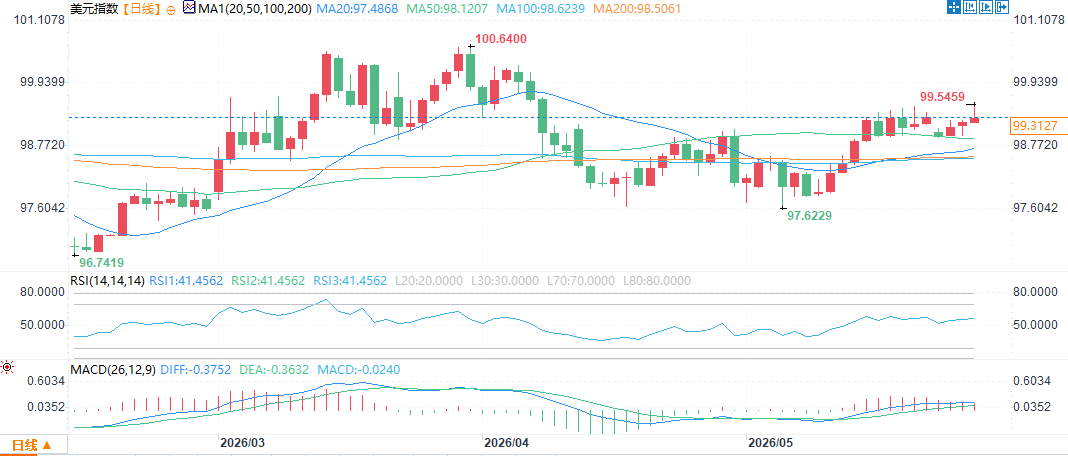
(US Dollar Index Daily Chart, Source: FX678)
In terms of moving averages, the current price is around 99.31, standing above the 50-day, 100-day, and 200-day moving averages. The medium-term moving averages are in a bullish alignment, providing support for the price. The 20-day moving average (97.48), 50-day moving average (98.12), and 100-day moving average (98.62) form the lower support zone, while the key resistance level is the previous high of 99.55. Short-term upward movement faces some resistance.
The RSI is 41.46, near the 50 neutral line, and has not yet entered the overbought or oversold range, indicating that the market momentum is neutral and the consolidation is obvious.
Regarding the MACD indicator, the DIFF line (-0.3752) and DEA line (-0.3632) are close to converging, and the MACD histogram is -0.024, close to the zero axis. The momentum of both bulls and bears is not strong, and a clear trend signal has not yet formed.
The US dollar index is trending bullish in the medium term, but has encountered resistance near its previous high in the short term and is currently consolidating. Key support lies around the 100-day moving average at 98.62; if this support holds, there is still a possibility of challenging the previous high. Resistance is at 99.55; a decisive break above this level would open up further upside potential.
At 15:20 Beijing time on May 28, the US dollar index was at 99.29.
The US April PCE data will be released at 20:30 Beijing time on Thursday. The market expects the core PCE to rise 0.3% month-on-month and 3.3% year-on-year, with the overall PCE expected to rise to 3.8% year-on-year, the highest level since May 2023.
With Federal Reserve officials recently shifting to a hawkish stance, this inflation report will be a key indicator of whether to raise interest rates before the end of the year. Currently, the market is pricing in a roughly 50% probability of at least one rate hike before the end of 2026.
Data release time and importance
The U.S. Bureau of Economic Analysis will release the April Personal Consumption Expenditures (PCE) price index data at 8:30 p.m. on Thursday. This timing coincides with a critical period of escalating military conflict between the U.S. and Iran and fluctuating oil prices at high levels, making the market far more sensitive to this data than usual.
Furthermore, this data is the last key inflation report before the Federal Reserve's June policy meeting (June 11), and will provide important reference for policymakers. If the PCE data exceeds expectations, it could directly affect the Fed's policy wording at the next meeting, and even increase the urgency of raising interest rates this year.
The PCE price index is closely watched by market participants because it is the Federal Reserve's preferred inflation gauge and can have a significant impact on the policy outlook. Compared to the more familiar CPI, the PCE better reflects actual consumer spending behavior because it adjusts for substitution effects—for example, when beef prices rise, consumers may switch to buying chicken, and the PCE can capture this change.
This is why, when the Federal Reserve adopted the "average inflation targeting" framework in 2020, it explicitly used PCE as the official measure of inflation. Currently, the market generally expects core PCE to rise to 3.3% year-on-year in April, and overall PCE to rise to 3.8% year-on-year. If the actual readings are higher than expected, it will mean that inflation stickiness is more stubborn than previously assessed, and the Fed's "hawkish wait-and-see" stance may further tilt towards a "rate hike bias."
Conversely, if the data falls short of expectations, it may provide a brief respite for the market. However, given the uncertainty surrounding the situation in the Middle East, a single data point is unlikely to completely reverse current policy expectations.
Core PCE forecast: 0.3% QoQ, 3.3% YoY
The core PCE price index, excluding volatile food and energy prices, is expected to rise 0.3% month-on-month in April, the same as the increase in March. This month-on-month growth rate indicates that underlying inflationary pressures have not eased significantly as the market had previously hoped.
Historically, a 0.3% month-on-month increase, while lower than the 0.5% or even higher levels frequently seen during the 2022-2023 peak, is still far higher than the long-term average monthly growth rate (approximately 0.17%) required by the Federal Reserve to achieve its 2% inflation target. If this month-on-month growth rate continues to remain in the 0.2%-0.3% range, the Federal Reserve will find it difficult to gain sufficient confidence to consider interest rate cuts and may even be forced to raise rates further. TD Securities' forecast is slightly more optimistic, predicting a month-on-month increase of 0.26%, but even this is still far above the level consistent with the 2% inflation target.
Core PCE inflation is projected to rise slightly to 3.3% in the 12 months ending in April. Meanwhile, headline PCE inflation is expected to reach 3.8% year-over-year, the highest level since May 2023. This suggests that the "last mile" of this round of inflation may be longer than the Federal Reserve and markets anticipated. The 3.3% core PCE reading is the highest since 2024, indicating that the decline in inflation has stalled or even reversed. The jump in headline PCE to 3.8% is mainly driven by energy prices—Brent crude briefly broke through $115 per barrel in April, and although it has recently retreated, it remains above $95.
For the Federal Reserve, this presents a double dilemma: high overall PCE readings can affect public inflation expectations, while the stubborn core PCE limits policy space. As Fed Governor Waller stated, he would not hesitate to support rate hikes if inflation expectations become "unstable." Tonight's data will be a crucial benchmark for determining whether this warning will translate into action.
Market Focus: Rising Interest Rate Hike Expectations
The market will scrutinize the PCE data closely, as Federal Reserve officials will consider this inflation indicator when deciding on their next policy move. The PCE is the official inflation benchmark cited by the Fed, and if the data shows persistent inflation, the likelihood of removing the "accommodative bias" from the June meeting will increase significantly. Kashkari has already voted against it, and Waller has publicly supported a shift to a hawkish stance.
Given the ongoing uncertainty surrounding the Middle East conflict, investors will assess the details of the PCE inflation report to determine whether the Federal Reserve might choose to raise interest rates before the end of the year. Currently, the market is pricing in a roughly 50% probability of a rate hike before the end of the year. If core PCE exceeds 3.3% as expected, this probability could rise to over 60%. The performance of the core services sector will be crucial—a month-on-month increase exceeding 0.3% would indicate that a "second wave effect" is forming.
Market pricing: The probability of an interest rate hike before the end of the year is about 50%.
According to the CME FedWatch tool, the market is currently pricing in a 50% probability that the Federal Reserve will raise interest rates by at least 25 basis points by the end of 2026. This probability has increased significantly from 30% a month ago.
This probability represents a fundamental reversal from the initial expectation of multiple interest rate cuts this year. With high oil prices and the PCE rate projected to rise to 3.8%, inflation concerns have outweighed recession fears. If tonight's PCE data exceeds expectations, the probability of an interest rate hike could exceed 60%, at which point the US dollar will receive further support.
Kashkari: Higher Risk of Inflation
Minneapolis Federal Reserve President Neal Kashkari pointed out in an interview on Wednesday that data released since the last policy meeting shows a higher risk of inflation.
Kashkari dissented at the April policy meeting, voting against including an accommodative bias in the policy statement. His latest remarks further confirm the growing hawkish sentiment within the Federal Reserve.
Waller's Shift: From Dove to Hawk
Meanwhile, Christopher Waller, a Federal Reserve governor known for his dovish outlook, also changed his stance last week, saying that the dovish bias in the statement should be removed.
Waller added that he would not hesitate to support raising policy rates if inflation expectations become unstable. This statement, coming from a governor previously considered the most dovish, is significant.
TD Securities Outlook: Both Core and Overall PCE Prices Will Rise
TD Securities, in its preview of the PCE inflation report, stated: "We expect the core and overall PCE price indices to slow to 0.26% and 0.43% month-over-month, respectively, in April."
"The tariff transmission was relatively mild in the month, with the slowdown in super core services offsetting the strength in housing. Our forecast corresponds to a year-on-year PCE growth of 3.3% for core and 3.8% for overall PCE. We also expect nominal and real personal spending to slow in the month."
The US April PCE data will be a key benchmark for assessing the Federal Reserve's policy path. The market expects core PCE to rise to 3.3% year-on-year and overall PCE to rise to 3.8% year-on-year, both reaching multi-month highs. Meanwhile, hawkish signals recently released by Fed officials such as Kashkari and Waller echo the market's pricing in a 50% probability of a rate hike before the end of the year. If the PCE data exceeds expectations, it could further strengthen expectations of a Fed rate hike, pushing up the dollar, US Treasury yields, and putting pressure on global risk assets. Investors should closely monitor the market reaction after the data release and subsequent statements from Fed officials.
US Dollar Index Daily Technical Analysis
The US dollar index is currently showing a generally strong but volatile trend on the daily chart, with moderate upward momentum in the short term and a relatively balanced battle between bulls and bears.
(US Dollar Index Daily Chart, Source: FX678)
In terms of moving averages, the current price is around 99.31, standing above the 50-day, 100-day, and 200-day moving averages. The medium-term moving averages are in a bullish alignment, providing support for the price. The 20-day moving average (97.48), 50-day moving average (98.12), and 100-day moving average (98.62) form the lower support zone, while the key resistance level is the previous high of 99.55. Short-term upward movement faces some resistance.
The RSI is 41.46, near the 50 neutral line, and has not yet entered the overbought or oversold range, indicating that the market momentum is neutral and the consolidation is obvious.
Regarding the MACD indicator, the DIFF line (-0.3752) and DEA line (-0.3632) are close to converging, and the MACD histogram is -0.024, close to the zero axis. The momentum of both bulls and bears is not strong, and a clear trend signal has not yet formed.
The US dollar index is trending bullish in the medium term, but has encountered resistance near its previous high in the short term and is currently consolidating. Key support lies around the 100-day moving average at 98.62; if this support holds, there is still a possibility of challenging the previous high. Resistance is at 99.55; a decisive break above this level would open up further upside potential.
At 15:20 Beijing time on May 28, the US dollar index was at 99.29.
- Risk Warning and Disclaimer
- The market involves risk, and trading may not be suitable for all investors. This article is for reference only and does not constitute personal investment advice, nor does it take into account certain users’ specific investment objectives, financial situation, or other needs. Any investment decisions made based on this information are at your own risk.