Escalating tensions in the Gulf and soaring oil prices have led to a vicious cycle in which gold prices continue to fall amidst the turmoil.
2026-05-28 17:59:26
On Thursday, May 28th, the main driver for spot gold was not simply safe-haven demand, but rather a rebalancing of geopolitical risks, oil prices, the dollar's pricing power, and interest rate expectations. Spot gold fluctuated around $4390/oz during the European session, dipping to a low of $4366/oz. Meanwhile, the dollar index remained around 99.30, and Brent crude oil rose to around $96/barrel due to escalating tensions in the Gulf, creating an unusual trading scenario for gold where "risks escalated but prices fell."
The key to this round of decline is not the absence of geopolitical risks, but rather a shift in the market's pricing strategy for risk. News reports indicate that the US claimed to have struck military targets near Bandar Abbas, Iran, and intercepted multiple drones; Iran denied the US narrative, stating that the actions caused no substantial damage. Subsequently, Iran responded to the US military targets, and the Gulf situation has again pushed up risk premiums for shipping and energy.
Under normal circumstances, escalating conflict should drive up demand for gold as a safe haven. However, the market reaction this time is closer to a "dollar-first safe haven" scenario. When the dollar strengthens, the cost of buying dollar-denominated gold against non-dollar buyers increases, while funds prioritize reducing their exposure to high volatility. As a non-interest-bearing asset, gold's safe-haven properties are suppressed by opportunity costs in an environment where nominal interest rates don't fall and real interest rates are expected to remain high. This explains why the escalating situation didn't lead to a rise in gold prices, but instead triggered long positions to be reduced.
Rising oil prices should have strengthened gold's narrative as an inflation hedge, but the current market is trading not on "inflation protection," but rather on "inflation extending the high-interest-rate cycle." Following the rapid rise in Brent crude, inflation expectations have resurfaced, and traders' tolerance for the pace of Federal Reserve rate cuts has decreased. The minutes of the Fed's April meeting showed that the target range for the federal funds rate remained at 3.50% to 3.75%, and several officials believed that if inflation persists above 2%, further tightening could be necessary.
Federal Reserve Governor Tim Cook stated on May 27 that maintaining interest rates is the more appropriate path at present, but inflation risks remain tilted to the upside; if the expected decline in inflation does not materialize in time, she is prepared to support a rate hike. She also mentioned that the April personal consumption expenditure price index is projected to be 3.8% year-on-year, and the core index is projected to be 3.3%, both significantly higher than the 2% target.
This puts direct pressure on gold. Gold can hedge against declining currency purchasing power, but it cannot provide coupon income. When rising energy prices are interpreted by the market as "interest rates remaining high for longer," the discount constraint in gold valuation models strengthens, and funds will place greater emphasis on cash yields and short-term interest rates. Consequently, safe-haven buying of gold is easily absorbed by dollar and interest rate trades.
The market structure is also weak. The daily Bollinger Bands show the middle band at approximately $4597/oz, the upper band at approximately $4784/oz, and the lower band at approximately $4411/oz. Spot gold has broken below the lower band and is approaching a low of $4366/oz. This structure indicates that the price has not merely fallen back to the lower edge of the range, but has entered a downward breakout phase following increased volatility.
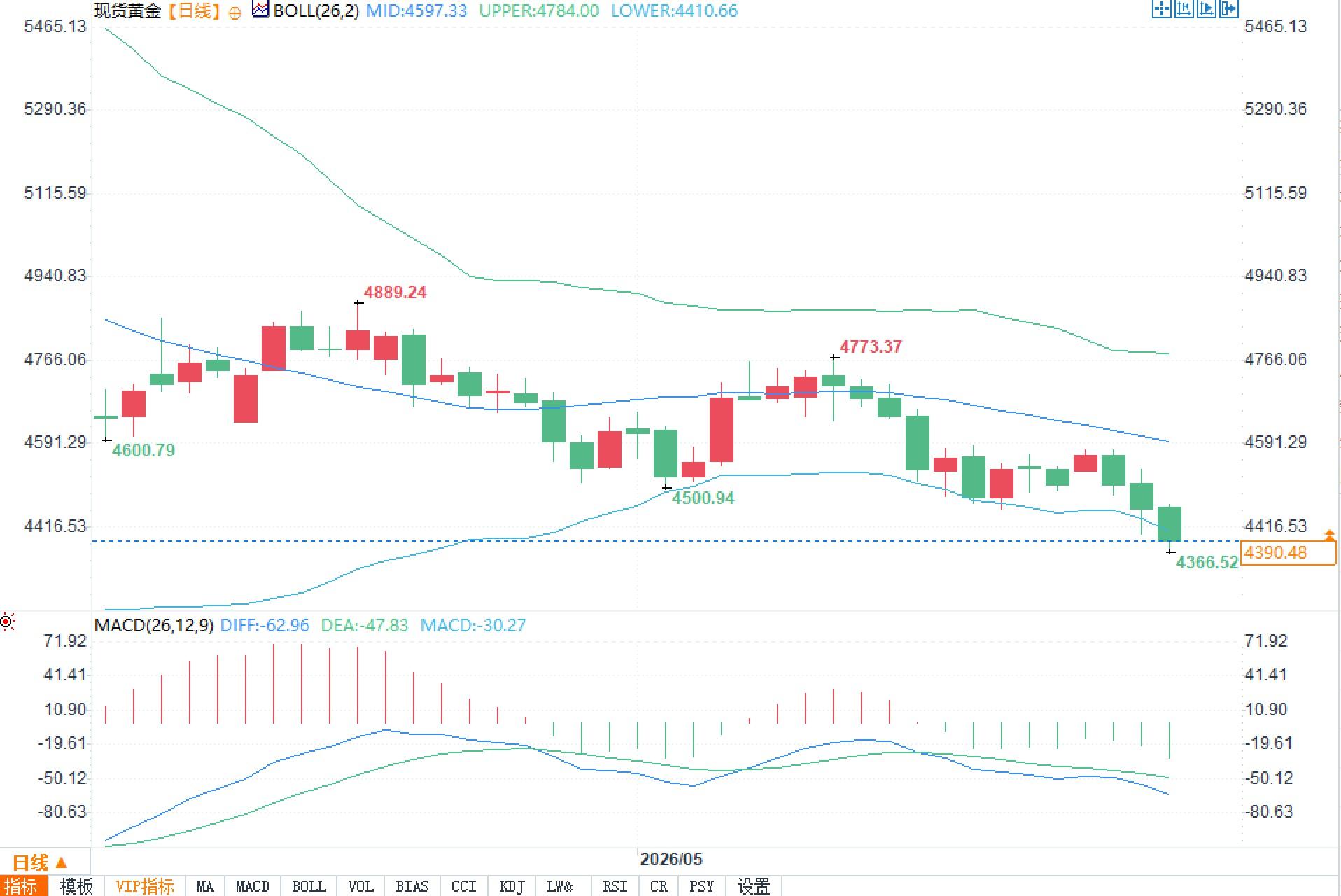
The MACD indicator has also weakened, with the DIFF at approximately -62.96, the DEA at approximately -47.83, and the histogram at approximately -30.27, indicating that the short-to-medium-term momentum has not yet fully recovered. The previous high has shifted from $4889/oz to around $4773/oz, suggesting that the rebound highs are gradually decreasing, indicating a lack of sustained buying interest. If the price fails to regain its position above the lower Bollinger Band, the market is likely to continue pricing around the "weak trend extension"; only if the dollar weakens or interest rate expectations ease will gold potentially reassess its safe-haven premium.
First, will Gulf shipping risks continue to push up crude oil prices? If oil prices remain high, gold may not benefit, as the market will prioritize pricing in inflation and interest rate constraints. Second, can the US dollar index hold near 99? If the dollar continues to receive safe-haven inflows, gold's rebound will be limited. Third, interest rate pricing after the release of the US Personal Consumption Expenditures (PCE) price index. The official data page shows that the previous value for the March PCE price index was 3.5% year-on-year, and the next update date is May 28th during the North American session, which will directly affect expectations before the Fed's June meeting.
Gold is currently not traded solely as a safe-haven asset, but rather as a cross-currency traded across macroeconomic factors. Geopolitical conflicts are increasing tail risks, oil prices are raising inflationary pressures, the US dollar is absorbing safe-haven liquidity, and the Federal Reserve is limiting the possibility of further interest rate cuts. The simultaneous existence of these four factors constitutes the core contradiction behind the decline in gold prices. Therefore, the key is not to determine whether risks exist, but rather whether those risks are ultimately priced into the US dollar, oil, and interest rates, or ultimately reflected in gold itself.
The safe-haven logic has failed, and gold pricing power has shifted to the US dollar and interest rates.
The key to this round of decline is not the absence of geopolitical risks, but rather a shift in the market's pricing strategy for risk. News reports indicate that the US claimed to have struck military targets near Bandar Abbas, Iran, and intercepted multiple drones; Iran denied the US narrative, stating that the actions caused no substantial damage. Subsequently, Iran responded to the US military targets, and the Gulf situation has again pushed up risk premiums for shipping and energy.
Under normal circumstances, escalating conflict should drive up demand for gold as a safe haven. However, the market reaction this time is closer to a "dollar-first safe haven" scenario. When the dollar strengthens, the cost of buying dollar-denominated gold against non-dollar buyers increases, while funds prioritize reducing their exposure to high volatility. As a non-interest-bearing asset, gold's safe-haven properties are suppressed by opportunity costs in an environment where nominal interest rates don't fall and real interest rates are expected to remain high. This explains why the escalating situation didn't lead to a rise in gold prices, but instead triggered long positions to be reduced.
Oil prices fueling inflation concerns and putting pressure on gold prices is not contradictory.
Rising oil prices should have strengthened gold's narrative as an inflation hedge, but the current market is trading not on "inflation protection," but rather on "inflation extending the high-interest-rate cycle." Following the rapid rise in Brent crude, inflation expectations have resurfaced, and traders' tolerance for the pace of Federal Reserve rate cuts has decreased. The minutes of the Fed's April meeting showed that the target range for the federal funds rate remained at 3.50% to 3.75%, and several officials believed that if inflation persists above 2%, further tightening could be necessary.
Federal Reserve Governor Tim Cook stated on May 27 that maintaining interest rates is the more appropriate path at present, but inflation risks remain tilted to the upside; if the expected decline in inflation does not materialize in time, she is prepared to support a rate hike. She also mentioned that the April personal consumption expenditure price index is projected to be 3.8% year-on-year, and the core index is projected to be 3.3%, both significantly higher than the 2% target.
This puts direct pressure on gold. Gold can hedge against declining currency purchasing power, but it cannot provide coupon income. When rising energy prices are interpreted by the market as "interest rates remaining high for longer," the discount constraint in gold valuation models strengthens, and funds will place greater emphasis on cash yields and short-term interest rates. Consequently, safe-haven buying of gold is easily absorbed by dollar and interest rate trades.
Technically, the market has entered a breakdown zone, with a concentrated release of weak signals on the daily chart.
The market structure is also weak. The daily Bollinger Bands show the middle band at approximately $4597/oz, the upper band at approximately $4784/oz, and the lower band at approximately $4411/oz. Spot gold has broken below the lower band and is approaching a low of $4366/oz. This structure indicates that the price has not merely fallen back to the lower edge of the range, but has entered a downward breakout phase following increased volatility.
The MACD indicator has also weakened, with the DIFF at approximately -62.96, the DEA at approximately -47.83, and the histogram at approximately -30.27, indicating that the short-to-medium-term momentum has not yet fully recovered. The previous high has shifted from $4889/oz to around $4773/oz, suggesting that the rebound highs are gradually decreasing, indicating a lack of sustained buying interest. If the price fails to regain its position above the lower Bollinger Band, the market is likely to continue pricing around the "weak trend extension"; only if the dollar weakens or interest rate expectations ease will gold potentially reassess its safe-haven premium.
Key variables that traders need to pay attention to
First, will Gulf shipping risks continue to push up crude oil prices? If oil prices remain high, gold may not benefit, as the market will prioritize pricing in inflation and interest rate constraints. Second, can the US dollar index hold near 99? If the dollar continues to receive safe-haven inflows, gold's rebound will be limited. Third, interest rate pricing after the release of the US Personal Consumption Expenditures (PCE) price index. The official data page shows that the previous value for the March PCE price index was 3.5% year-on-year, and the next update date is May 28th during the North American session, which will directly affect expectations before the Fed's June meeting.
Gold is currently not traded solely as a safe-haven asset, but rather as a cross-currency traded across macroeconomic factors. Geopolitical conflicts are increasing tail risks, oil prices are raising inflationary pressures, the US dollar is absorbing safe-haven liquidity, and the Federal Reserve is limiting the possibility of further interest rate cuts. The simultaneous existence of these four factors constitutes the core contradiction behind the decline in gold prices. Therefore, the key is not to determine whether risks exist, but rather whether those risks are ultimately priced into the US dollar, oil, and interest rates, or ultimately reflected in gold itself.
- Risk Warning and Disclaimer
- The market involves risk, and trading may not be suitable for all investors. This article is for reference only and does not constitute personal investment advice, nor does it take into account certain users’ specific investment objectives, financial situation, or other needs. Any investment decisions made based on this information are at your own risk.