Both bulls and bears of the Japanese yen should take note: the policy signals given by Japanese bond issuance have changed.
2026-05-28 18:43:39
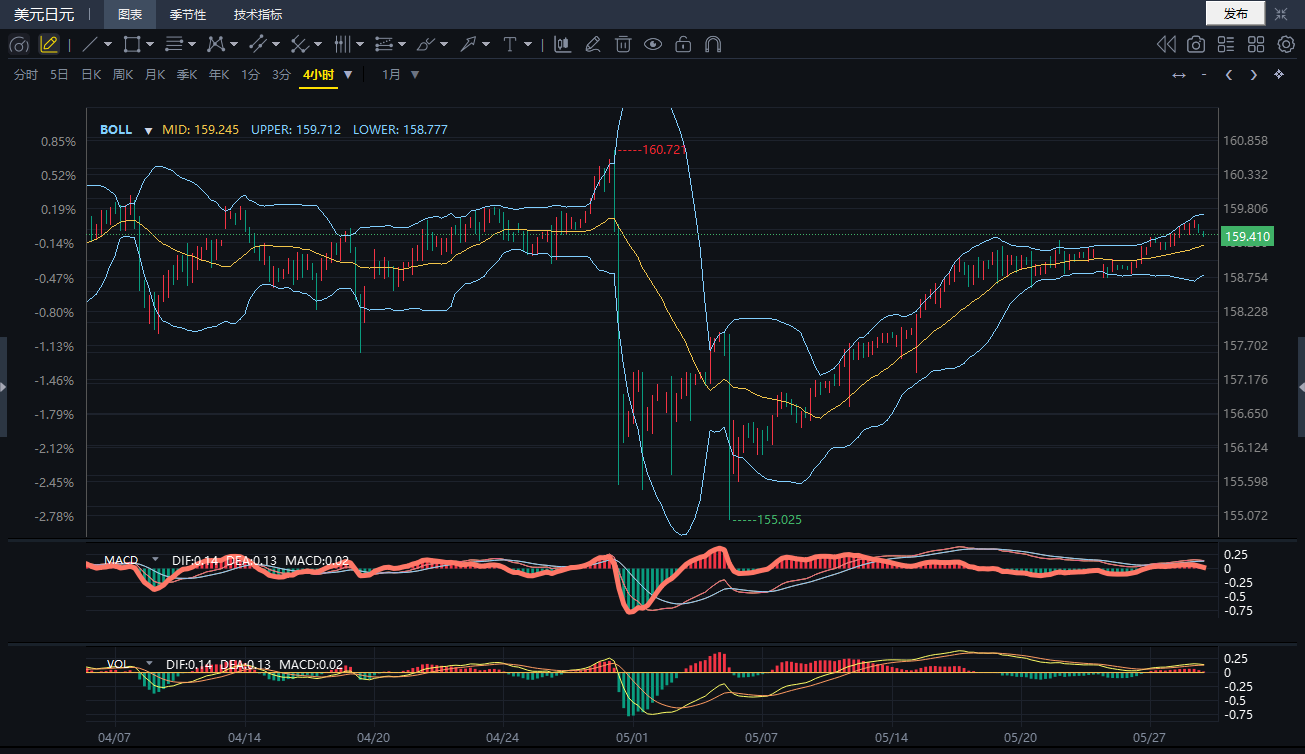
On Thursday (May 28), the yen's exchange rate fluctuations were highly correlated with the Japanese bond market, with the core logic revolving around fluctuating expectations of the Bank of Japan's policy and potential currency intervention. The Japanese bond market exhibited a steepening trend during the day, with short- and medium-term yields falling while ultra-long-term yields rose, reflecting a rapid cooling of market expectations regarding the probability of a Bank of Japan rate hike next month. Coupled with geopolitical tensions, the USD/JPY pair is currently trading at 159.410 on the 4-hour chart, oscillating around the Bollinger Band middle line at 159.245 in the short term, indicating a critical window for the battle between bulls and bears.
Fundamental Logic Chain : Today's price changes in the Japanese government bond market directly reflect a shift in central bank policy expectations. The prevailing market view is that recent escalation in geopolitical tensions may force the Bank of Japan to skip an interest rate hike at its policy meeting next month, resulting in a slower pace of policy tightening than previously anticipated. This expectation is first reflected in the decline of short-term bond yields—the 5-year Japanese government bond yield fell from 1.95% intraday to 1.905% at the close, a decrease of 2.5 basis points, mainly driven by stronger-than-expected 3-5 year bond-buying operations by the Bank of Japan. Meanwhile, news that the Liberal Democratic Party of Japan proposed issuing "bridge bonds" for growth and economic security-related projects initially suppressed Japanese government bond prices in the morning, but the market has not yet formed a consensus on the actual impact of this policy, resulting in a limited overall reaction.
Changes in policy expectations directly impact the exchange rate: A cooling of expectations for a Bank of Japan interest rate hike will reduce the marginal pressure on the widening US-Japan interest rate differential. However, current US Treasury yields remain high, and the yen's exchange rate is approaching its historically sensitive range. Therefore, the expectation of potential currency intervention by the Japanese Ministry of Finance is a key factor limiting the yen's depreciation. Historically, when the USD/JPY exchange rate approaches the 160 mark, the frequency of verbal intervention by Japanese authorities increases significantly, and the probability of actual intervention also rises accordingly.
Technical Support and Resistance Analysis : Referring to the USD/JPY 4-hour chart, the Bollinger Bands are currently flattening and then trending slightly upwards. The first resistance level is the upper Bollinger Band at 159.712; a break above this level would target the previous high of 160.721. On the downside, the first support level is the lower Bollinger Band at 158.777; a break below this level would target the previous low of 155.025. Looking at the MACD indicator, both the DIF and DEA are currently above the zero line, and the red bars are narrowing, indicating a weakening of short-term bullish momentum and a shift in power between buyers and sellers.
Two key signals to watch during the trading session: First, changes in long-term Japanese government bond yields. If the 30-year yield continues to rise and breaks through the 4% mark, it will exacerbate the steepening of the Japanese bond curve and put further pressure on the yen. Second, verbal statements from Japanese authorities. If statements involve exchange rate fluctuations, they will quickly change short-term trading sentiment.
In the short term, the USD/JPY pair is likely to fluctuate between 158.70 and 159.70, with the core driver remaining the interplay between changes in expectations of a Bank of Japan (BOJ) interest rate hike and expectations of intervention. If the BOJ clearly signals a rate hike next month, the yen is expected to appreciate; if the rate hike is further delayed, the exchange rate may retest the resistance level near 160, but potential intervention risks will limit upside potential. In the medium term, attention should be paid to the implementation of Japanese government bond issuance policies. If the issuance of "bridge bonds" exceeds expectations, it will put upward pressure on long-term Japanese government bond yields from the supply side, which will then be transmitted to the exchange rate through the interest rate differential.
1. What is the core impact path of this steepening of the Japanese government bond yield curve on the yen exchange rate?
A: The core impact path is the transmission of policy expectations. The decline in short-term yields reflects a cooling of market expectations for a short-term interest rate hike by the Bank of Japan, which will marginally narrow the expected convergence of the short-term interest rate differential between the US and Japan, putting short-term pressure on the yen. However, if the rise in long-term yields continues, it will push up Japan's long-term borrowing costs, which may attract overseas funds to flow into the Japanese bond market, providing medium-term support for the yen. The market is currently in a phase of negotiation between these two logics.
2. The Bank of Japan's bond-buying operation yielded better-than-expected results, so why did it not lead to a significant appreciation of the yen?
A: This bond-buying operation mainly focused on 3-10 year maturities, directly lowering medium-term yields and reinforcing market expectations that the central bank will not raise interest rates in the short term, thus offsetting the liquidity tightening effect brought about by the bond purchases. Meanwhile, current US Treasury yields remain relatively high, and the US-Japan interest rate differential remains wide, limiting the short-term appreciation potential of the yen.
3. What are the typical triggering conditions for Japan's potential currency intervention?
A: There are typically three triggering conditions: first, the daily exchange rate fluctuation exceeds 1% and shows a one-sided depreciation trend; second, the yen's depreciation is accompanied by a rapid rise in import prices, with inflationary pressures spreading to people's livelihoods; and third, the exchange rate speculation atmosphere is overheated, with short positions in the forward market reaching historical highs. The current exchange rate is approaching the sensitive range of 160, which is the core reason for the rising expectations of intervention.
4. If Japan's "bridge bond" issuance plan is implemented, what medium- to long-term impact will it have on the yen?
A: If the issuance size exceeds expectations, it will first increase the supply of Japanese bonds and push up long-term yields. If the Bank of Japan maintains the same level of bond purchases, the rise in long-term yields will widen the long-term interest rate differential between China and Japan, and between the US and Japan, putting pressure on the yen. However, if the funds raised from the bond issuance effectively boost Japan's economic growth, it will improve Japan's fundamentals and provide medium-term support for the yen. The current impact is not yet clear.
5. How should we interpret the signals currently given by the Bollinger Bands indicator in technical analysis?
A: The current flattening of the Bollinger Band's middle line indicates that the trending market on the 4-hour chart has temporarily ended and entered a consolidation phase. The price is trading between the upper and middle bands, suggesting a short-term bullish bias. However, the narrowing MACD histogram indicates weakening bullish momentum. If the price breaks below the middle band at 159.245, it may test the lower band support in the short term.
Fundamental and technical analysis
Fundamental Logic Chain : Today's price changes in the Japanese government bond market directly reflect a shift in central bank policy expectations. The prevailing market view is that recent escalation in geopolitical tensions may force the Bank of Japan to skip an interest rate hike at its policy meeting next month, resulting in a slower pace of policy tightening than previously anticipated. This expectation is first reflected in the decline of short-term bond yields—the 5-year Japanese government bond yield fell from 1.95% intraday to 1.905% at the close, a decrease of 2.5 basis points, mainly driven by stronger-than-expected 3-5 year bond-buying operations by the Bank of Japan. Meanwhile, news that the Liberal Democratic Party of Japan proposed issuing "bridge bonds" for growth and economic security-related projects initially suppressed Japanese government bond prices in the morning, but the market has not yet formed a consensus on the actual impact of this policy, resulting in a limited overall reaction.
Changes in policy expectations directly impact the exchange rate: A cooling of expectations for a Bank of Japan interest rate hike will reduce the marginal pressure on the widening US-Japan interest rate differential. However, current US Treasury yields remain high, and the yen's exchange rate is approaching its historically sensitive range. Therefore, the expectation of potential currency intervention by the Japanese Ministry of Finance is a key factor limiting the yen's depreciation. Historically, when the USD/JPY exchange rate approaches the 160 mark, the frequency of verbal intervention by Japanese authorities increases significantly, and the probability of actual intervention also rises accordingly.
Technical Support and Resistance Analysis : Referring to the USD/JPY 4-hour chart, the Bollinger Bands are currently flattening and then trending slightly upwards. The first resistance level is the upper Bollinger Band at 159.712; a break above this level would target the previous high of 160.721. On the downside, the first support level is the lower Bollinger Band at 158.777; a break below this level would target the previous low of 155.025. Looking at the MACD indicator, both the DIF and DEA are currently above the zero line, and the red bars are narrowing, indicating a weakening of short-term bullish momentum and a shift in power between buyers and sellers.
Two key signals to watch during the trading session: First, changes in long-term Japanese government bond yields. If the 30-year yield continues to rise and breaks through the 4% mark, it will exacerbate the steepening of the Japanese bond curve and put further pressure on the yen. Second, verbal statements from Japanese authorities. If statements involve exchange rate fluctuations, they will quickly change short-term trading sentiment.
Future Trend Outlook
In the short term, the USD/JPY pair is likely to fluctuate between 158.70 and 159.70, with the core driver remaining the interplay between changes in expectations of a Bank of Japan (BOJ) interest rate hike and expectations of intervention. If the BOJ clearly signals a rate hike next month, the yen is expected to appreciate; if the rate hike is further delayed, the exchange rate may retest the resistance level near 160, but potential intervention risks will limit upside potential. In the medium term, attention should be paid to the implementation of Japanese government bond issuance policies. If the issuance of "bridge bonds" exceeds expectations, it will put upward pressure on long-term Japanese government bond yields from the supply side, which will then be transmitted to the exchange rate through the interest rate differential.
Frequently Asked Questions
1. What is the core impact path of this steepening of the Japanese government bond yield curve on the yen exchange rate?
A: The core impact path is the transmission of policy expectations. The decline in short-term yields reflects a cooling of market expectations for a short-term interest rate hike by the Bank of Japan, which will marginally narrow the expected convergence of the short-term interest rate differential between the US and Japan, putting short-term pressure on the yen. However, if the rise in long-term yields continues, it will push up Japan's long-term borrowing costs, which may attract overseas funds to flow into the Japanese bond market, providing medium-term support for the yen. The market is currently in a phase of negotiation between these two logics.
2. The Bank of Japan's bond-buying operation yielded better-than-expected results, so why did it not lead to a significant appreciation of the yen?
A: This bond-buying operation mainly focused on 3-10 year maturities, directly lowering medium-term yields and reinforcing market expectations that the central bank will not raise interest rates in the short term, thus offsetting the liquidity tightening effect brought about by the bond purchases. Meanwhile, current US Treasury yields remain relatively high, and the US-Japan interest rate differential remains wide, limiting the short-term appreciation potential of the yen.
3. What are the typical triggering conditions for Japan's potential currency intervention?
A: There are typically three triggering conditions: first, the daily exchange rate fluctuation exceeds 1% and shows a one-sided depreciation trend; second, the yen's depreciation is accompanied by a rapid rise in import prices, with inflationary pressures spreading to people's livelihoods; and third, the exchange rate speculation atmosphere is overheated, with short positions in the forward market reaching historical highs. The current exchange rate is approaching the sensitive range of 160, which is the core reason for the rising expectations of intervention.
4. If Japan's "bridge bond" issuance plan is implemented, what medium- to long-term impact will it have on the yen?
A: If the issuance size exceeds expectations, it will first increase the supply of Japanese bonds and push up long-term yields. If the Bank of Japan maintains the same level of bond purchases, the rise in long-term yields will widen the long-term interest rate differential between China and Japan, and between the US and Japan, putting pressure on the yen. However, if the funds raised from the bond issuance effectively boost Japan's economic growth, it will improve Japan's fundamentals and provide medium-term support for the yen. The current impact is not yet clear.
5. How should we interpret the signals currently given by the Bollinger Bands indicator in technical analysis?
A: The current flattening of the Bollinger Band's middle line indicates that the trending market on the 4-hour chart has temporarily ended and entered a consolidation phase. The price is trading between the upper and middle bands, suggesting a short-term bullish bias. However, the narrowing MACD histogram indicates weakening bullish momentum. If the price breaks below the middle band at 159.245, it may test the lower band support in the short term.
- Risk Warning and Disclaimer
- The market involves risk, and trading may not be suitable for all investors. This article is for reference only and does not constitute personal investment advice, nor does it take into account certain users’ specific investment objectives, financial situation, or other needs. Any investment decisions made based on this information are at your own risk.