Euro/Dollar 1.16 Level: A Life-or-Death Stalemate of Energy, Inflation, and Policy – Which Will Break First?
2026-05-28 20:23:21
On Thursday, May 28, the main trading theme for the euro against the dollar shifted from simple interest rate differentials to a rebalancing of energy shocks, inflation expectations, and growth discounts. Current quotes show the euro/dollar pair around 1.1615, near a six-week low. The European Central Bank's April meeting minutes, released on the same day, revealed that maintaining interest rates was not an uncontroversial decision, with some members believing they would not oppose a rate hike if it were on the table.
On April 30, the European Central Bank (ECB) maintained its deposit facility rate, main refinancing rate, and marginal lending rate at 2.00%, 2.15%, and 2.40%, respectively. At the same time, it emphasized that both upside risks to inflation and downside risks to growth had increased, and that the policy path was not predetermined. On the surface, this appeared to be a meeting that postponed action; at a deeper level, the phrase "waiting for the value to decline" in the minutes suggests that the policy focus is shifting from observing the energy shock to preventing a loosening of inflation expectations.
For the euro against the dollar, this hawkish bias does not automatically equate to support for the exchange rate. If expectations of interest rate hikes stem from strong demand, they are generally favorable for the exchange rate; however, if they arise from a negative supply shock driven by energy, they will simultaneously depress real income, corporate profits, and investment appetite. The market is currently trading not on whether the ECB will become more hawkish, but rather on whether hawkishness will further amplify the costs of growth.
Eurozone inflation rose to 3.0% in April, up from 2.6% in March. Breaking it down, energy prices rose 10.8% year-on-year, significantly higher than March's 5.1%, while services inflation was 3.0%, food, alcohol, and tobacco at 2.4%, and non-energy industrial goods at 0.8%. This structure suggests that the primary driver of this round of inflation is still energy, rather than overall overheated demand.
Growth also lacks elasticity. The Eurozone's seasonally adjusted GDP grew by only 0.1% quarter-on-quarter and 0.8% year-on-year in the first quarter, a slowdown from the previous quarter. This combination of rising inflation and declining growth puts the European Central Bank in a classic policy dilemma: if interest rates are too low, inflation expectations may spread; if interest rates are too high, credit and consumption may face greater pressure.
European Central Bank Chief Economist Philip Lane said today that even if the initial energy shock begins to subside, the second-round effects could persist for some time. He also emphasized that central banks must acknowledge the impact of the shock on inflation while avoiding overreacting in policy setting.
The daily chart shows that the euro/dollar pair is currently trading below the Bollinger Band middle line at 1.1682, not far from the lower line at 1.1572, with the upper line at 1.1791. After falling from the high of 1.1848, the price formed a secondary high near 1.1796, and then the center of gravity shifted downwards, with several short-term rebounds failing to effectively recover the middle line.
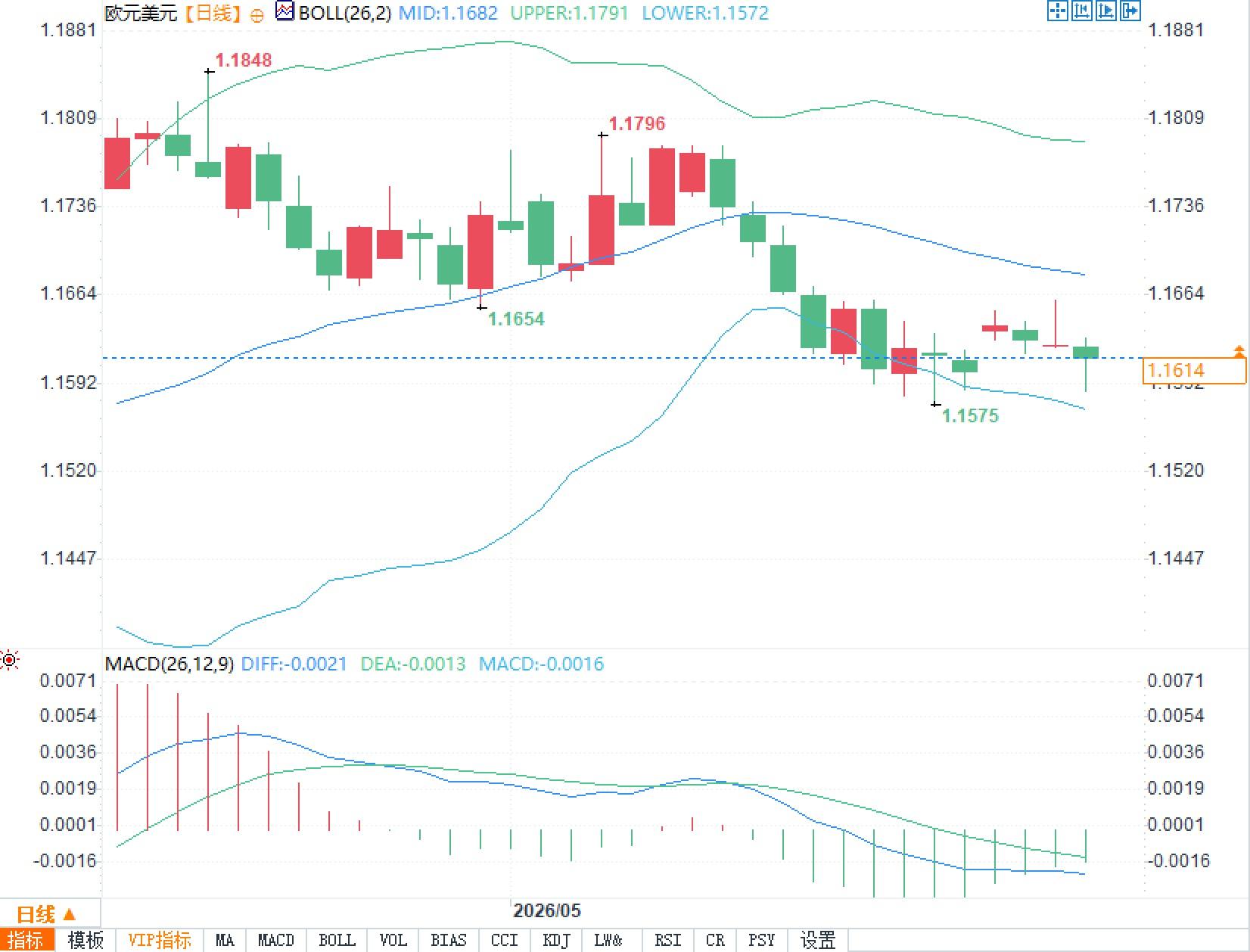
On the MACD level, the DIFF is -0.0021, the DEA is -0.0013, and the histogram is -0.0016, all still below the zero line, indicating that the bearish momentum has not been completely dissipated. The area around 1.1575 is the recent low and also a technical observation zone near the lower Bollinger Band; the 1.1654 to 1.1682 range constitutes a dense zone that prices need to navigate before repairing the weak structure. The core message conveyed by the technical chart is not confirmation of a unilateral trend, but rather the critical state of directional choice during low-level consolidation.
Following its April meeting, the Federal Reserve maintained the target range for the federal funds rate at 3.50%-3.75%, emphasizing that future policy adjustments will be based on data, the outlook, and a balance of risks. Compared to the European Central Bank's 2.00% deposit facility rate, the nominal short-term interest rate differential still gives dollar assets a certain yield advantage, but this advantage is constrained by inflation expectations, fiscal risks, and changes in risk appetite.
Meanwhile, Brent crude oil prices hovered around $96 per barrel on May 28. High energy prices have put pressure on the Eurozone's terms of trade and reinforced market concerns about imported inflation. If energy prices remain high, expectations for a European Central Bank interest rate hike may rise, but the euro may not receive a linear boost, as the growth discount may widen in tandem.
Therefore, the core variables in the current pricing of the euro against the dollar are threefold: first, whether the energy shock can subside; second, whether the European Central Bank prioritizes inflation expectation management over growth concerns; and third, whether the Federal Reserve extends the high-interest-rate environment due to inflation stickiness. Only when a clearer hierarchy emerges between inflation risks and growth pressures will the exchange rate likely break free from its tug-of-war around 1.16.
Question 1: The ECB minutes were hawkish, so why is the euro still weak against the dollar?
A: This round of hawkish signals mainly stems from inflation risks driven by energy, rather than demand expansion. The market is concerned that interest rate hikes will exacerbate growth pressures, therefore the exchange rate may not simply be priced in based on interest rate expectations.
Question 2: Why is the area around 1.1575 important?
A: This area is close to the recent low and the lower Bollinger Band. If the price repeatedly holds above it, it indicates that the downward slope may be slowing down; if it continues to fall below it, the weak structure will be repriced.
Question 3: What is the most crucial data to follow?
A: We should focus on energy prices, the Eurozone's preliminary May inflation figures, the ECB's June communications, and US inflation indicators. The key is not whether individual data points are high or low, but whether the data changes the policy response functions of the two major central banks.
Policy differences become the core of exchange rate pricing
On April 30, the European Central Bank (ECB) maintained its deposit facility rate, main refinancing rate, and marginal lending rate at 2.00%, 2.15%, and 2.40%, respectively. At the same time, it emphasized that both upside risks to inflation and downside risks to growth had increased, and that the policy path was not predetermined. On the surface, this appeared to be a meeting that postponed action; at a deeper level, the phrase "waiting for the value to decline" in the minutes suggests that the policy focus is shifting from observing the energy shock to preventing a loosening of inflation expectations.
For the euro against the dollar, this hawkish bias does not automatically equate to support for the exchange rate. If expectations of interest rate hikes stem from strong demand, they are generally favorable for the exchange rate; however, if they arise from a negative supply shock driven by energy, they will simultaneously depress real income, corporate profits, and investment appetite. The market is currently trading not on whether the ECB will become more hawkish, but rather on whether hawkishness will further amplify the costs of growth.
The double whammy of accelerating inflation and slowing growth
Eurozone inflation rose to 3.0% in April, up from 2.6% in March. Breaking it down, energy prices rose 10.8% year-on-year, significantly higher than March's 5.1%, while services inflation was 3.0%, food, alcohol, and tobacco at 2.4%, and non-energy industrial goods at 0.8%. This structure suggests that the primary driver of this round of inflation is still energy, rather than overall overheated demand.
Growth also lacks elasticity. The Eurozone's seasonally adjusted GDP grew by only 0.1% quarter-on-quarter and 0.8% year-on-year in the first quarter, a slowdown from the previous quarter. This combination of rising inflation and declining growth puts the European Central Bank in a classic policy dilemma: if interest rates are too low, inflation expectations may spread; if interest rates are too high, credit and consumption may face greater pressure.
European Central Bank Chief Economist Philip Lane said today that even if the initial energy shock begins to subside, the second-round effects could persist for some time. He also emphasized that central banks must acknowledge the impact of the shock on inflation while avoiding overreacting in policy setting.
Technical Analysis: The 1.16 level is becoming a consolidation zone.
The daily chart shows that the euro/dollar pair is currently trading below the Bollinger Band middle line at 1.1682, not far from the lower line at 1.1572, with the upper line at 1.1791. After falling from the high of 1.1848, the price formed a secondary high near 1.1796, and then the center of gravity shifted downwards, with several short-term rebounds failing to effectively recover the middle line.
On the MACD level, the DIFF is -0.0021, the DEA is -0.0013, and the histogram is -0.0016, all still below the zero line, indicating that the bearish momentum has not been completely dissipated. The area around 1.1575 is the recent low and also a technical observation zone near the lower Bollinger Band; the 1.1654 to 1.1682 range constitutes a dense zone that prices need to navigate before repairing the weak structure. The core message conveyed by the technical chart is not confirmation of a unilateral trend, but rather the critical state of directional choice during low-level consolidation.
The triple pull of interest rate spreads, energy, and risk appetite
Following its April meeting, the Federal Reserve maintained the target range for the federal funds rate at 3.50%-3.75%, emphasizing that future policy adjustments will be based on data, the outlook, and a balance of risks. Compared to the European Central Bank's 2.00% deposit facility rate, the nominal short-term interest rate differential still gives dollar assets a certain yield advantage, but this advantage is constrained by inflation expectations, fiscal risks, and changes in risk appetite.
Meanwhile, Brent crude oil prices hovered around $96 per barrel on May 28. High energy prices have put pressure on the Eurozone's terms of trade and reinforced market concerns about imported inflation. If energy prices remain high, expectations for a European Central Bank interest rate hike may rise, but the euro may not receive a linear boost, as the growth discount may widen in tandem.
Therefore, the core variables in the current pricing of the euro against the dollar are threefold: first, whether the energy shock can subside; second, whether the European Central Bank prioritizes inflation expectation management over growth concerns; and third, whether the Federal Reserve extends the high-interest-rate environment due to inflation stickiness. Only when a clearer hierarchy emerges between inflation risks and growth pressures will the exchange rate likely break free from its tug-of-war around 1.16.
Frequently Asked Questions
Question 1: The ECB minutes were hawkish, so why is the euro still weak against the dollar?
A: This round of hawkish signals mainly stems from inflation risks driven by energy, rather than demand expansion. The market is concerned that interest rate hikes will exacerbate growth pressures, therefore the exchange rate may not simply be priced in based on interest rate expectations.
Question 2: Why is the area around 1.1575 important?
A: This area is close to the recent low and the lower Bollinger Band. If the price repeatedly holds above it, it indicates that the downward slope may be slowing down; if it continues to fall below it, the weak structure will be repriced.
Question 3: What is the most crucial data to follow?
A: We should focus on energy prices, the Eurozone's preliminary May inflation figures, the ECB's June communications, and US inflation indicators. The key is not whether individual data points are high or low, but whether the data changes the policy response functions of the two major central banks.
- Risk Warning and Disclaimer
- The market involves risk, and trading may not be suitable for all investors. This article is for reference only and does not constitute personal investment advice, nor does it take into account certain users’ specific investment objectives, financial situation, or other needs. Any investment decisions made based on this information are at your own risk.