The Federal Reserve hinted at a one-off inflation shock, and gold is searching for direction amid triple expectations.
2026-05-28 21:48:10
The latest remarks by Federal Reserve Vice Chairman Williams have attracted market attention. He believes that the combination of the US economic vitality and the development of artificial intelligence will continue to boost total factor productivity (TFP), which will have a long-term positive impact on productivity.
He also pointed out that the current overall inflation rate in the United States is about 4%, and the core inflation rate is about 3%.
It also emphasized that the situation in the Middle East is pushing up energy prices, and the resulting inflationary impact is a short-term effect that will likely peak in the coming months.
The US economy is now less sensitive to oil price fluctuations than in the past, and the widespread adoption of AI will not cause long-term structural unemployment.
From a fundamental perspective, the increase in TFP will bring a periodic inflationary pulse: the expansion of the AI industry drives corporate investment and the early release of household consumption, and the short-term demand expansion is faster than the supply of production capacity, forming a one-off inflationary pressure ; in the long term, after the technology is implemented, the improvement in production efficiency will gradually lower prices, and the overall inflation will show a trend of "short-term surge and medium-term decline".
The latest April PCE data further confirms the complex inflation situation. Data shows that core PCE rose 0.2% month-on-month, lower than the market expectation of 0.3%, indicating a slowdown in the short-term upward momentum of inflation; however, core PCE rose to 3.3% year-on-year, a new high since November 2023, indicating that inflation stickiness remains significant.
Driven by energy prices, the overall PCE, which includes food and energy, performed stronger, with the year-on-year forecast revised upward to 3.8% and the month-on-month increase of 0.5%, demonstrating the significant transmission effect of energy inflation caused by geopolitical conflicts.
As geopolitical conflicts escalate, the market pre-priced in energy inflation risks, completely reversing previous expectations of interest rate cuts and making a year-end rate hike the mainstream prediction. Current interest rate futures indicate that the probability of a rate hike this year is increasing month by month, with the probability of a rate hike at the December meeting reaching 55%.
The weaker-than-expected core PCE data this time effectively alleviated market panic over interest rate hikes.
In the stock market, after six consecutive days of gains, S&P 500 futures fell slightly by 0.2% in early trading; the 10-year US Treasury yield rose 3 basis points to 4.51%. Overall asset price volatility reflects the market's conflicted sentiment between high inflation and policy uncertainty.
Williams emphasized that monetary policy should be anchored to data, which has led to a temporary wait-and-see attitude among investors.
With multiple factors at play, gold prices are currently in a period of fluctuation and oscillation. Descriptions of one-off inflation are favorable for gold, but better-than-expected employment data are suppressing gold prices.
The weakening of PCE month-on-month reduced expectations of interest rate hikes, and the slowdown in the rise of US Treasury yields led to a rapid decline in real interest rates in the short term. Coupled with the continued disturbance of Middle East geopolitical risks, this provided safe-haven and valuation support for gold. However, persistently high core inflation and short-term inflationary impulses from TFP significantly suppressed the upside potential of gold prices.
From a technical perspective, spot gold rebounded rapidly after encountering the lower channel line, but due to the overall downward trend, the price of gold was significantly suppressed.
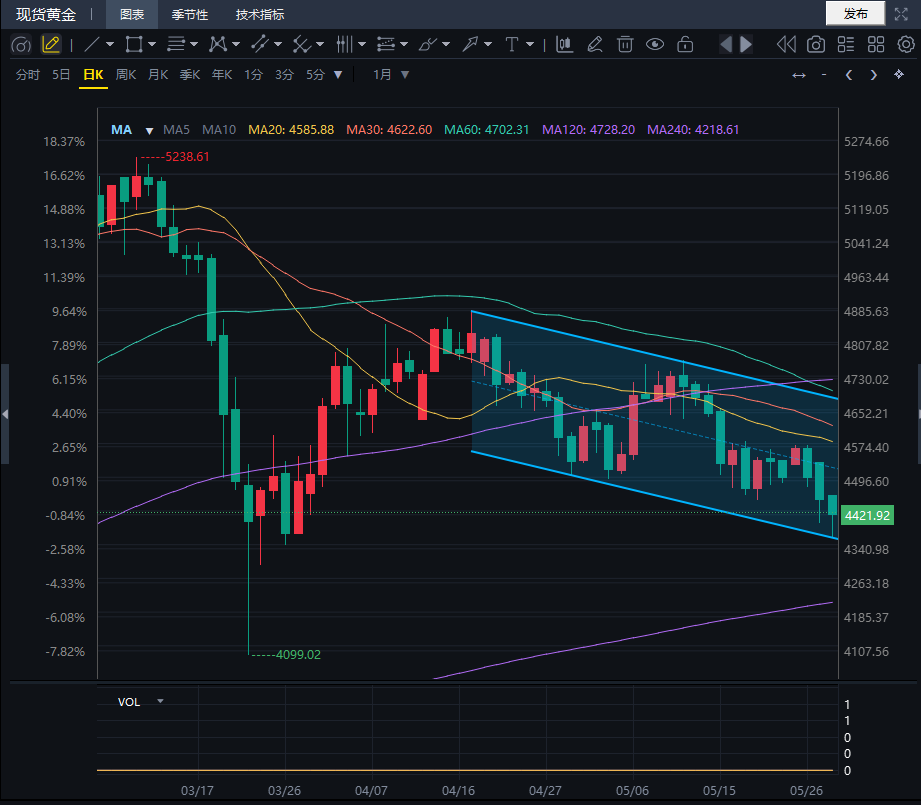
(Spot gold daily chart, source: EasyForex subsidiary)
At 21:45 Beijing time, spot gold was trading at $4,425 per ounce.
He also pointed out that the current overall inflation rate in the United States is about 4%, and the core inflation rate is about 3%.
It also emphasized that the situation in the Middle East is pushing up energy prices, and the resulting inflationary impact is a short-term effect that will likely peak in the coming months.
The US economy is now less sensitive to oil price fluctuations than in the past, and the widespread adoption of AI will not cause long-term structural unemployment.
From a fundamental perspective, the increase in TFP will bring a periodic inflationary pulse: the expansion of the AI industry drives corporate investment and the early release of household consumption, and the short-term demand expansion is faster than the supply of production capacity, forming a one-off inflationary pressure ; in the long term, after the technology is implemented, the improvement in production efficiency will gradually lower prices, and the overall inflation will show a trend of "short-term surge and medium-term decline".
PCE data released: Inflation diverges, pressure eases marginally.
The latest April PCE data further confirms the complex inflation situation. Data shows that core PCE rose 0.2% month-on-month, lower than the market expectation of 0.3%, indicating a slowdown in the short-term upward momentum of inflation; however, core PCE rose to 3.3% year-on-year, a new high since November 2023, indicating that inflation stickiness remains significant.
Driven by energy prices, the overall PCE, which includes food and energy, performed stronger, with the year-on-year forecast revised upward to 3.8% and the month-on-month increase of 0.5%, demonstrating the significant transmission effect of energy inflation caused by geopolitical conflicts.
Interest rate expectations shift: Concerns about rate hikes ease, market sentiment fluctuates.
As geopolitical conflicts escalate, the market pre-priced in energy inflation risks, completely reversing previous expectations of interest rate cuts and making a year-end rate hike the mainstream prediction. Current interest rate futures indicate that the probability of a rate hike this year is increasing month by month, with the probability of a rate hike at the December meeting reaching 55%.
The weaker-than-expected core PCE data this time effectively alleviated market panic over interest rate hikes.
In the stock market, after six consecutive days of gains, S&P 500 futures fell slightly by 0.2% in early trading; the 10-year US Treasury yield rose 3 basis points to 4.51%. Overall asset price volatility reflects the market's conflicted sentiment between high inflation and policy uncertainty.
Williams emphasized that monetary policy should be anchored to data, which has led to a temporary wait-and-see attitude among investors.
A multi-dimensional logical game is unfolding, and the gold price is entering a critical window.
With multiple factors at play, gold prices are currently in a period of fluctuation and oscillation. Descriptions of one-off inflation are favorable for gold, but better-than-expected employment data are suppressing gold prices.
The weakening of PCE month-on-month reduced expectations of interest rate hikes, and the slowdown in the rise of US Treasury yields led to a rapid decline in real interest rates in the short term. Coupled with the continued disturbance of Middle East geopolitical risks, this provided safe-haven and valuation support for gold. However, persistently high core inflation and short-term inflationary impulses from TFP significantly suppressed the upside potential of gold prices.
From a technical perspective, spot gold rebounded rapidly after encountering the lower channel line, but due to the overall downward trend, the price of gold was significantly suppressed.
(Spot gold daily chart, source: EasyForex subsidiary)
At 21:45 Beijing time, spot gold was trading at $4,425 per ounce.
- Risk Warning and Disclaimer
- The market involves risk, and trading may not be suitable for all investors. This article is for reference only and does not constitute personal investment advice, nor does it take into account certain users’ specific investment objectives, financial situation, or other needs. Any investment decisions made based on this information are at your own risk.