One chart: The Baltic Dry Index surges to a two-and-a-half-year peak, with freight rates rising across all ship types, indicating a booming shipping market.
2026-05-28 23:20:12
Latest data shows that the Baltic Dry Index (BDI) reached 3226 points on May 28, 2026, a new high since December 4, 2023, up 3.27% month-on-month, the largest increase since May 13, 2026, and marking the fourth consecutive day of increase (including zero growth). Looking at the short-term charts, the recent 11 BDI data points show: 6 positive increases, 5 negative increases, and 0 zero increases. Specifically, the Panamax Freight Index (BPI) was 2331 points, up 1.70% from the previous value; the Capesize Freight Index (BCI) was 5517 points, up 4.65%; and the Supramax Freight Index (BSI) was 1569 points, up 0.45%. For detailed 720-day and 10-year trend charts of the Baltic Dry Index and its three main sub-indices, please refer to the specially designed charts.
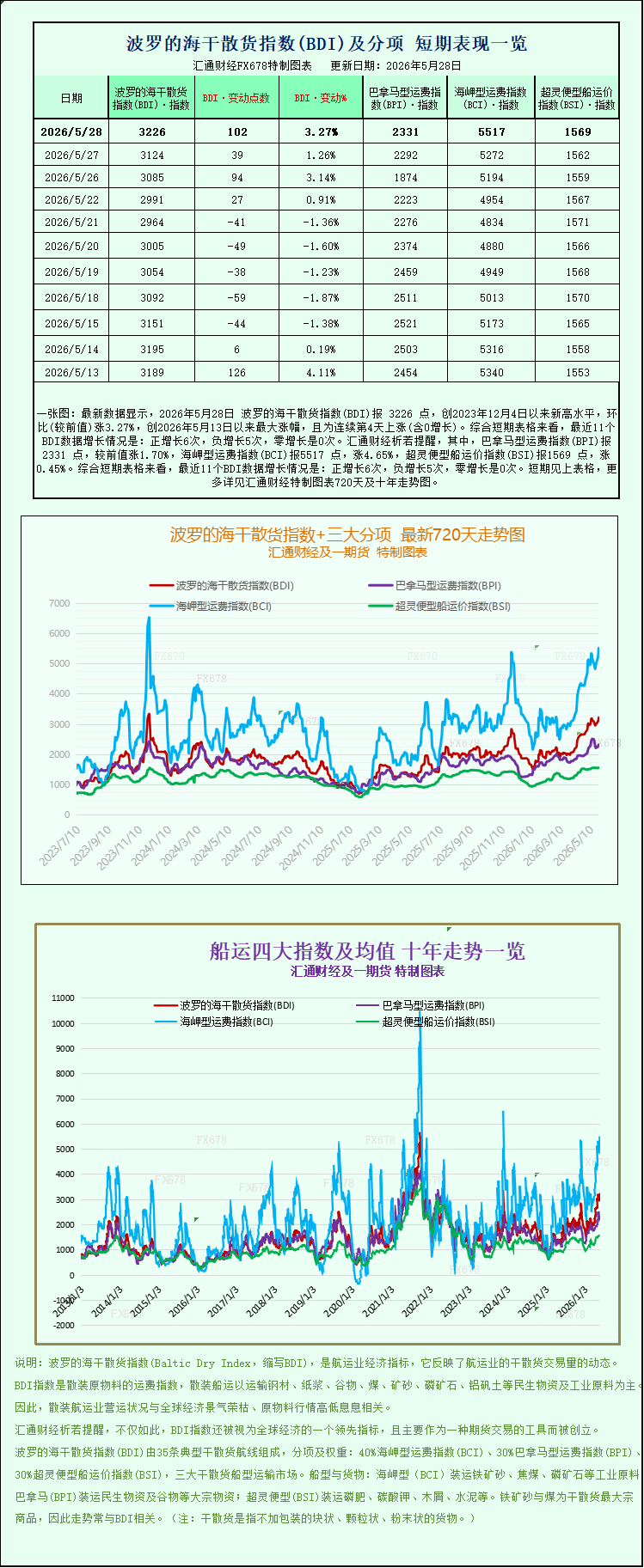
The global dry bulk shipping market is experiencing a comprehensive upward trend. Supported by the strong rise in freight rates across all vessel types, including Capesize, Panamax, and Supramax, the Baltic Dry Index surged on Thursday, hitting a new high in nearly two and a half years. This indicates a recovery in demand in the global dry bulk shipping market and a continued warming of the industry's prosperity.
Data shows that the Baltic Dry Index (BDI), which tracks freight rates for three major dry bulk carrier classes—Capesize, Panamax, and Supramax—surged 102 points, or 3.3%, to close at 3226 points. This is the highest closing level since December 2023 and represents the most significant breakthrough for the industry in the past two and a half years. Market feedback indicates that this index increase was not driven by a single vessel type, but rather by a simultaneous rise in freight rates across all capacity classes, covering various transportation sectors including bulk industrial raw materials and basic food crops.
Large ocean-going vessels were the core driver of this index surge. Among them, the Capesize index, which primarily transports ultra-large tonnage bulk raw materials, saw the most significant increase, surging 245 points in a single day, a rise of 4.7%, closing at 5517 points, also reaching a historical high since December 2023. These types of vessels mainly undertake cross-border transportation of heavy industrial raw materials such as iron ore, thermal coal, and coking coal, and are core carriers in the global industrial supply chain's maritime transport环节.
In terms of profitability, the operating revenue of Capesize vessels has also increased accordingly. According to statistics, the average daily operating revenue of Capesize vessels with a deadweight of 150,000 tons, mainly engaged in long-distance transportation of iron ore and coal, has increased by US$2,224 per day, with the latest average daily revenue climbing to US$46,538. The high operating returns have greatly boosted the enthusiasm of shipowners to order and put them into operation.
The recent surge in freight rates for coal-related shipping routes is inextricably linked to changes in supply and demand in China's domestic coal market. Following a fatal coal mine accident in Shanxi Province, local regulatory authorities swiftly launched a special rectification campaign, conducting comprehensive and intensive safety inspections of numerous coal mines within their jurisdiction. Many non-compliant and pending-verification mines were temporarily shut down. This immediately created market expectations of a short-term shortage of coking coal and thermal coal, causing domestic coking coal prices to rebound from their lows. Upstream and downstream traders accelerated restocking, leading to a surge in cross-border coal purchase orders, directly driving up freight rates on ocean-going coal shipping routes.
The medium-tonnage vessel market also maintained a steady upward trend. The Panamax index, focusing on vessels in the 60,000-70,000 tonne class, rose 39 points, or 1.7%, to close at 2331 points. This vessel type is highly adaptable, primarily transporting bulk coal, wheat, corn, and other energy resources and food crops, covering most major global trade routes. The average daily revenue for this category of vessels increased by $349, with the current daily revenue per vessel stable at $20,978. The peak season for grain exports, coupled with increased energy trade, is the core driver of the rising Panamax freight rates.
The small dry bulk carrier sector saw relatively moderate growth, but still maintained an upward trend. The Supramax vessel index, which covers a wide range of vessels, rose slightly by 7 points, or 0.5%, to 1569 points. These smaller vessels offer greater flexibility and are primarily used for near-shore, short-haul cross-border bulk cargo transportation, filling the last gap in the overall price increase across all vessel types and comprehensively demonstrating the current recovery boom in the global dry bulk shipping market.
The global dry bulk shipping market is experiencing a comprehensive upward trend. Supported by the strong rise in freight rates across all vessel types, including Capesize, Panamax, and Supramax, the Baltic Dry Index surged on Thursday, hitting a new high in nearly two and a half years. This indicates a recovery in demand in the global dry bulk shipping market and a continued warming of the industry's prosperity.
Data shows that the Baltic Dry Index (BDI), which tracks freight rates for three major dry bulk carrier classes—Capesize, Panamax, and Supramax—surged 102 points, or 3.3%, to close at 3226 points. This is the highest closing level since December 2023 and represents the most significant breakthrough for the industry in the past two and a half years. Market feedback indicates that this index increase was not driven by a single vessel type, but rather by a simultaneous rise in freight rates across all capacity classes, covering various transportation sectors including bulk industrial raw materials and basic food crops.
Large ocean-going vessels were the core driver of this index surge. Among them, the Capesize index, which primarily transports ultra-large tonnage bulk raw materials, saw the most significant increase, surging 245 points in a single day, a rise of 4.7%, closing at 5517 points, also reaching a historical high since December 2023. These types of vessels mainly undertake cross-border transportation of heavy industrial raw materials such as iron ore, thermal coal, and coking coal, and are core carriers in the global industrial supply chain's maritime transport环节.
In terms of profitability, the operating revenue of Capesize vessels has also increased accordingly. According to statistics, the average daily operating revenue of Capesize vessels with a deadweight of 150,000 tons, mainly engaged in long-distance transportation of iron ore and coal, has increased by US$2,224 per day, with the latest average daily revenue climbing to US$46,538. The high operating returns have greatly boosted the enthusiasm of shipowners to order and put them into operation.
The recent surge in freight rates for coal-related shipping routes is inextricably linked to changes in supply and demand in China's domestic coal market. Following a fatal coal mine accident in Shanxi Province, local regulatory authorities swiftly launched a special rectification campaign, conducting comprehensive and intensive safety inspections of numerous coal mines within their jurisdiction. Many non-compliant and pending-verification mines were temporarily shut down. This immediately created market expectations of a short-term shortage of coking coal and thermal coal, causing domestic coking coal prices to rebound from their lows. Upstream and downstream traders accelerated restocking, leading to a surge in cross-border coal purchase orders, directly driving up freight rates on ocean-going coal shipping routes.
The medium-tonnage vessel market also maintained a steady upward trend. The Panamax index, focusing on vessels in the 60,000-70,000 tonne class, rose 39 points, or 1.7%, to close at 2331 points. This vessel type is highly adaptable, primarily transporting bulk coal, wheat, corn, and other energy resources and food crops, covering most major global trade routes. The average daily revenue for this category of vessels increased by $349, with the current daily revenue per vessel stable at $20,978. The peak season for grain exports, coupled with increased energy trade, is the core driver of the rising Panamax freight rates.
The small dry bulk carrier sector saw relatively moderate growth, but still maintained an upward trend. The Supramax vessel index, which covers a wide range of vessels, rose slightly by 7 points, or 0.5%, to 1569 points. These smaller vessels offer greater flexibility and are primarily used for near-shore, short-haul cross-border bulk cargo transportation, filling the last gap in the overall price increase across all vessel types and comprehensively demonstrating the current recovery boom in the global dry bulk shipping market.
- Risk Warning and Disclaimer
- The market involves risk, and trading may not be suitable for all investors. This article is for reference only and does not constitute personal investment advice, nor does it take into account certain users’ specific investment objectives, financial situation, or other needs. Any investment decisions made based on this information are at your own risk.