An agreement was so close, yet it couldn't be signed! Gold prices are tied to geopolitical tensions.
2026-05-29 15:47:46
On Friday (May 29), spot gold traded slightly higher during the Asian and European sessions, holding onto Thursday's rebound and currently trading at $4,520.
The geopolitical situation in the Middle East has reached a turning point, with informed US officials revealing that US and Iranian negotiators have reached a provisional consensus on extending the ceasefire and restarting nuclear negotiations, finalizing a 60-day memorandum of understanding.
According to informed U.S. officials, the agreement extends the three-month ceasefire by 60 days, and the core agenda includes negotiations on shipping arrangements in the Strait of Hormuz and Iran's nuclear program.
However, the agreement still requires final approval from US President Trump, and the approval timeline is currently unclear.

The agreement also specified reciprocal considerations: the United States will gradually lift its maritime blockade of Iranian ports and ease energy sanctions, allowing Iran to expand its crude oil exports.
Paradoxically, as news of the agreement was gaining traction, the U.S. Treasury Department intensified sanctions against Iranian military oil sales entities, continuing its strategy of maximum pressure and adding uncertainty to the agreement's implementation.
In addition, the Iranian Revolutionary Guard accused the US military of violating the ceasefire agreement by launching missiles at Bandar Abbas airport and warned that "further violations will face a severe response," emphasizing its control over the Strait of Hormuz.
U.S. Vice President Vance confirmed the existence of the interim agreement on Thursday evening, but admitted that "there is no clear timetable for whether or when the president will sign it," and revealed that the two sides are still negotiating some details of the wording.
Iran has not yet officially confirmed the contents of the agreement, but the agreement was revealed just as the US-Iran ceasefire framework was showing signs of loosening. In the previous 24 hours, Kuwait successfully intercepted a ballistic missile launched by Iran, and the US Central Command confirmed this signal of escalation of the conflict, highlighting the fragility of the geopolitical situation.
As the "lifeline" of global energy transportation, the navigation arrangements in the Strait of Hormuz are a core clause of the agreement.
According to the memorandum, Iran is prohibited from setting up checkpoints and charging fees in the strait, and must clear all mines from the waterway within 30 days to ensure that shipping is "unrestricted".
Positive changes have emerged in navigation through the Strait of Hormuz. On May 28 local time, the Iranian Islamic Revolutionary Guard Corps Navy announced that 26 merchant ships and oil tankers had passed through the Strait of Hormuz safely in the past 24 hours after obtaining permission and coordination.
However, Iran still emphasizes that navigation in the Strait of Hormuz requires permission and coordination, and several ships attempting to illegally enter the Persian Gulf were intercepted or forced to turn back last night.
Citadel Securities is optimistic about the prospects of a US-Iran agreement. Strategist Frank Flight pointed out that two signals indicate a high probability of an agreement: first, Iran’s internet connectivity has recovered to 86% of pre-conflict levels, indicating that it expects the conflict to de-escalate.
Secondly, the increased public appearances of senior Iranian military officials recently reflect a decrease in the risk of escalation.
Flight emphasizes that investors may have underestimated the market rebound potential triggered by the "timely" reopening of the Strait.
The nuclear issue remains the core point of contention in subsequent negotiations. Data from the International Atomic Energy Agency shows that Iran currently possesses 440.9 kilograms of highly enriched uranium at a level of 60%, just one step away from the 90% weapons-grade standard.
The interim agreement aims to first establish a framework for the disposal of highly enriched uranium, with specific details to be refined later. However, the two sides still have differences on the disposal of stockpiles and constraints on enrichment activities.
Iran has not yet committed to relinquishing its uranium stockpile, and analysts believe it may propose that China and Russia act as third-party custodians, but Trump has made it clear that he "does not accept this proposal."
Furthermore, Iran demanded that the agreement include a clause for "Israel to terminate its military operations in Lebanon," while the Israeli airstrikes on Thursday in Beirut's southern suburbs and the port of Sidon, which killed 14 people, further complicated the negotiations and became another uncertainty in the process of advancing the agreement.
The market currently expects an agreement to be reached soon, and gold prices have begun to rebound. However, whether an agreement can ultimately be signed depends on whether it is sufficiently beneficial to the United States. Otherwise, the situation of an agreement being very close to being signed but ultimately failing to be reached will continue.
Technically, although spot gold has rebounded sharply and even risen above the 5-day moving average, it is still in a downtrend. Currently, the gold price is still constrained by the middle line of the descending channel. The gold price is likely to continue to correct in line with the US-Israel agreement that is unlikely to be signed in the near future. However, once the agreement is signed, the market will see a very big reversal. Thursday's sharp rebound in gold prices was a preview of this.
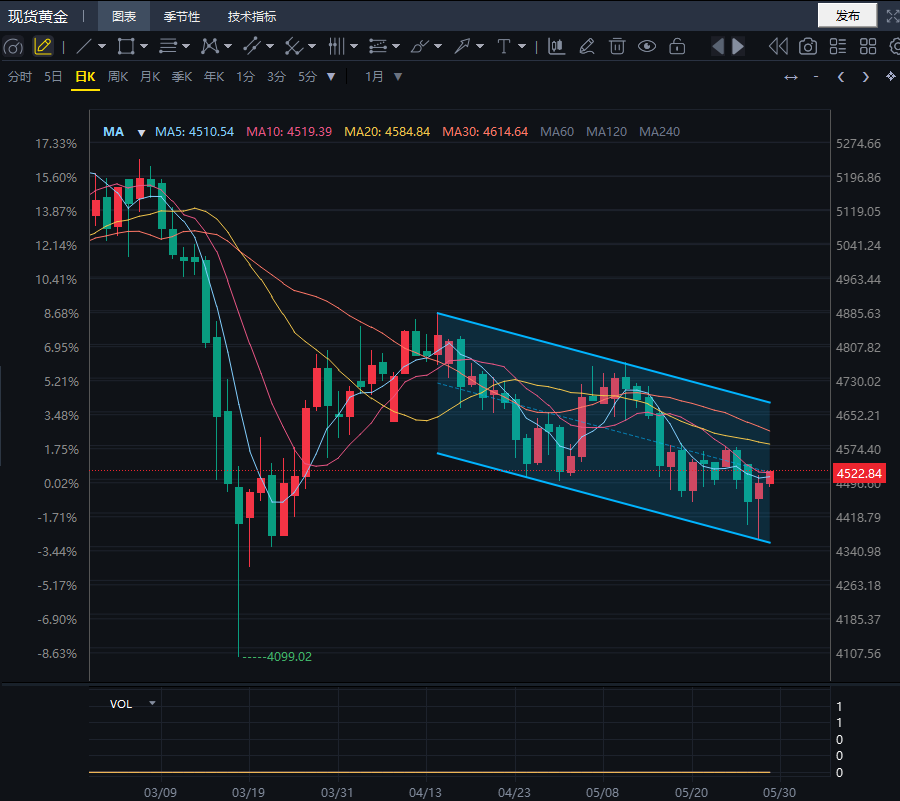
(Spot gold daily chart, source: FX678)
At 15:45 Beijing time, spot gold was trading at $4,525 per ounce.
The geopolitical situation in the Middle East has reached a turning point, with informed US officials revealing that US and Iranian negotiators have reached a provisional consensus on extending the ceasefire and restarting nuclear negotiations, finalizing a 60-day memorandum of understanding.
According to informed U.S. officials, the agreement extends the three-month ceasefire by 60 days, and the core agenda includes negotiations on shipping arrangements in the Strait of Hormuz and Iran's nuclear program.
However, the agreement still requires final approval from US President Trump, and the approval timeline is currently unclear.
The agreement also specified reciprocal considerations: the United States will gradually lift its maritime blockade of Iranian ports and ease energy sanctions, allowing Iran to expand its crude oil exports.
Paradoxically, as news of the agreement was gaining traction, the U.S. Treasury Department intensified sanctions against Iranian military oil sales entities, continuing its strategy of maximum pressure and adding uncertainty to the agreement's implementation.
In addition, the Iranian Revolutionary Guard accused the US military of violating the ceasefire agreement by launching missiles at Bandar Abbas airport and warned that "further violations will face a severe response," emphasizing its control over the Strait of Hormuz.
The game continues, and the ceasefire framework is showing signs of fragility.
U.S. Vice President Vance confirmed the existence of the interim agreement on Thursday evening, but admitted that "there is no clear timetable for whether or when the president will sign it," and revealed that the two sides are still negotiating some details of the wording.
Iran has not yet officially confirmed the contents of the agreement, but the agreement was revealed just as the US-Iran ceasefire framework was showing signs of loosening. In the previous 24 hours, Kuwait successfully intercepted a ballistic missile launched by Iran, and the US Central Command confirmed this signal of escalation of the conflict, highlighting the fragility of the geopolitical situation.
Strait of Hormuz: Core of the Agreement and Current Status of Navigation
As the "lifeline" of global energy transportation, the navigation arrangements in the Strait of Hormuz are a core clause of the agreement.
According to the memorandum, Iran is prohibited from setting up checkpoints and charging fees in the strait, and must clear all mines from the waterway within 30 days to ensure that shipping is "unrestricted".
Positive changes have emerged in navigation through the Strait of Hormuz. On May 28 local time, the Iranian Islamic Revolutionary Guard Corps Navy announced that 26 merchant ships and oil tankers had passed through the Strait of Hormuz safely in the past 24 hours after obtaining permission and coordination.
However, Iran still emphasizes that navigation in the Strait of Hormuz requires permission and coordination, and several ships attempting to illegally enter the Persian Gulf were intercepted or forced to turn back last night.
Institutional Outlook and Core Game: Nuclear Issues Become Key Bottlenecks
Citadel Securities is optimistic about the prospects of a US-Iran agreement. Strategist Frank Flight pointed out that two signals indicate a high probability of an agreement: first, Iran’s internet connectivity has recovered to 86% of pre-conflict levels, indicating that it expects the conflict to de-escalate.
Secondly, the increased public appearances of senior Iranian military officials recently reflect a decrease in the risk of escalation.
Flight emphasizes that investors may have underestimated the market rebound potential triggered by the "timely" reopening of the Strait.
Tackling Nuclear Issues: Disputes over the Disposal of Highly Enriched Uranium and Third-Party Trusteeship
The nuclear issue remains the core point of contention in subsequent negotiations. Data from the International Atomic Energy Agency shows that Iran currently possesses 440.9 kilograms of highly enriched uranium at a level of 60%, just one step away from the 90% weapons-grade standard.
The interim agreement aims to first establish a framework for the disposal of highly enriched uranium, with specific details to be refined later. However, the two sides still have differences on the disposal of stockpiles and constraints on enrichment activities.
Iran has not yet committed to relinquishing its uranium stockpile, and analysts believe it may propose that China and Russia act as third-party custodians, but Trump has made it clear that he "does not accept this proposal."
External factors are interfering: the situation in Lebanon is escalating, complicating negotiations.
Furthermore, Iran demanded that the agreement include a clause for "Israel to terminate its military operations in Lebanon," while the Israeli airstrikes on Thursday in Beirut's southern suburbs and the port of Sidon, which killed 14 people, further complicated the negotiations and became another uncertainty in the process of advancing the agreement.
Summary and Technical Analysis:
The market currently expects an agreement to be reached soon, and gold prices have begun to rebound. However, whether an agreement can ultimately be signed depends on whether it is sufficiently beneficial to the United States. Otherwise, the situation of an agreement being very close to being signed but ultimately failing to be reached will continue.
Technically, although spot gold has rebounded sharply and even risen above the 5-day moving average, it is still in a downtrend. Currently, the gold price is still constrained by the middle line of the descending channel. The gold price is likely to continue to correct in line with the US-Israel agreement that is unlikely to be signed in the near future. However, once the agreement is signed, the market will see a very big reversal. Thursday's sharp rebound in gold prices was a preview of this.
(Spot gold daily chart, source: FX678)
At 15:45 Beijing time, spot gold was trading at $4,525 per ounce.
- Risk Warning and Disclaimer
- The market involves risk, and trading may not be suitable for all investors. This article is for reference only and does not constitute personal investment advice, nor does it take into account certain users’ specific investment objectives, financial situation, or other needs. Any investment decisions made based on this information are at your own risk.