Gold prices rebounded slightly: After the ceasefire draft was reached, will the next wave be a sharp drop or a dramatic reversal?
2026-05-29 21:30:57
On Friday, May 29th, the spot gold market saw a short-term improvement in sentiment. The current price is up 0.63%, trading around $4520 per ounce, while the August contract for US gold futures rose 0.7% to $4562 per ounce. However, this rebound failed to reverse the overall downward trend. Gold prices have fallen by about 2% this month, facing their third consecutive monthly decline. While recovering from the month's low of $4366 per ounce, it remains within a weak and volatile range. The main driving factor is the rumored agreement between the US and Iran to extend the ceasefire and lift shipping restrictions in the Strait of Hormuz, but the agreement has not yet been finalized, and the market continues to oscillate between easing safe-haven demand and the pressure from high interest rate expectations.
The conflict between the US and Iran has lasted for three months since it erupted on February 28, during which time numerous tit-for-tat attacks have strained the global energy supply chain. Latest reports indicate that the two sides reached a draft agreement on Thursday to extend the ceasefire for 60 days and restore normal navigation in the Strait of Hormuz. This strait handles approximately one-fifth of the world's oil and liquefied natural gas transport. The agreement also requires the US to lift its blockade of Iranian ports and ease some sanctions on Iranian oil sales. If ultimately implemented, this would be the biggest step towards peace since the conflict began.
U.S. Vice President Vance stated, "We're not there yet, but we're very close, and we will continue to work on it." However, the U.S. president has not yet approved the agreement, and Iranian state media also reported that the text of the agreement has not yet been finalized or confirmed. Previously, the two sides had repeatedly come close to reaching an agreement, but repeated disagreements highlighted the fragility of the negotiations. Recent repercussions of the conflict, including the downing of an Iranian drone by U.S. Central Command and the strike on the Bandar Abbas ground control station, further underscored the difficulty of implementing the ceasefire agreement.
The resumption of shipping through the Strait of Hormuz is expected to alleviate energy supply bottlenecks, causing oil prices to fall by more than 1%, marking the largest weekly drop since early April. The number of ships passing through the strait daily has decreased by 88% since the initial crackdown on February 28th, and once operations resume, global energy market risk premiums are expected to decline.
U.S. inflation surged to its fastest pace in three years in April, driven by energy prices. High energy costs have solidified market expectations that the Federal Reserve will maintain high interest rates until next year, with some even suggesting a possible rate hike before the end of the year. Gold, as a non-interest-bearing asset, is naturally under pressure in a high-interest-rate environment due to increased holding costs and the enhanced attractiveness of the U.S. dollar.
However, the decline in oil prices is potentially supporting gold through the inflation transmission mechanism. UBS analysis points out that "gold and oil prices maintain a negative correlation, with oil prices influencing inflation and monetary policy. Lower oil prices reduce the probability of interest rate hikes, which is beneficial for gold." If the resumption of navigation in the Strait of Hormuz is implemented, it will directly alleviate energy-driven inflationary pressures, weakening the need for the Federal Reserve to further tighten policy, thus providing gold with a medium-term respite.
However, the current market remains driven by interest rate trends. Rotbart & Co., a precious metals trading firm, summarized in a client report that the global market was in a consolidation phase in May. Geopolitical tensions and inflation concerns continued to influence sentiment, but easing safe-haven demand and a high-interest-rate outlook jointly suppressed precious metals performance. Traders are closely monitoring subsequent statements from the Federal Reserve and whether energy prices can continue to decline to avoid a resurgence of inflation expectations.
From the daily chart, spot gold is currently trading within the lower half of the Bollinger Bands, with the middle band at $4594.51 per ounce, the upper band at $4765.37 per ounce, and the lower band at $4423.65 per ounce. The latest price is fluctuating around $4520 per ounce, below the middle band, indicating a continued weak short-term trend. Recent highs reached $4889.24 and $4773.37, while lows dipped to $4366.52, showing an overall pattern of high-level consolidation followed by a gradual decline.
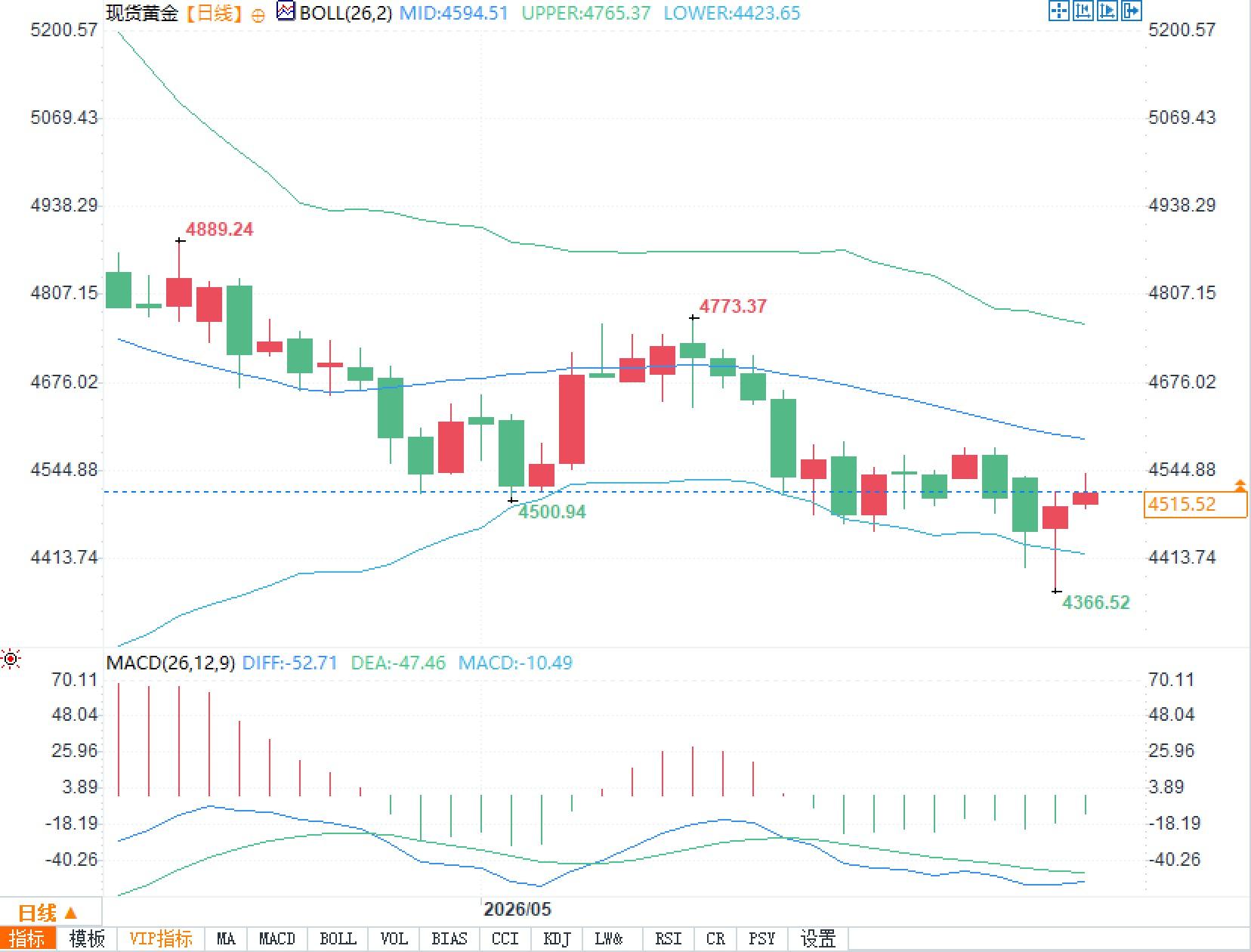
The MACD indicator shows a DIFF value of -52.71, a DEA value of -47.46, and a MACD histogram of -10.49, remaining in negative territory, indicating that while bearish momentum has subsided, it has not yet reversed. The Bollinger Bands are narrowing overall, suggesting that volatility may further compress, and the market is awaiting a fundamental catalyst. While geopolitical events may bring short-term impetus, the technical picture still reflects a temporary waning of risk aversion coupled with pressure on monetary policy.
While the ceasefire agreement framework offers optimistic signals, historical negotiations show that substantial differences remain between the two sides on issues such as Iran's nuclear program, sanctions lifting, and conflicts among regional allies. Any reversal of the agreement could trigger a new round of volatility in the energy market. Traders are watching Pakistan's mediation efforts, developments in Oman, and Israel's ongoing actions in Lebanon, all of which could amplify shifts in global risk appetite.
Overall, spot gold is influenced by the short-term decline in oil prices, while the medium-term outlook depends on the evolution of inflation and interest rate expectations. The drag on non-interest-bearing assets from a high-interest-rate environment remains the main theme, but the buffering effect provided by falling energy prices cannot be ignored. Global markets showed clear signs of consolidation in May, with investors weighing multiple variables. Gold's traditional safe-haven status needs to be dynamically assessed in conjunction with macroeconomic data in the current environment.
Signals of easing geopolitical tensions boosted market sentiment.
The conflict between the US and Iran has lasted for three months since it erupted on February 28, during which time numerous tit-for-tat attacks have strained the global energy supply chain. Latest reports indicate that the two sides reached a draft agreement on Thursday to extend the ceasefire for 60 days and restore normal navigation in the Strait of Hormuz. This strait handles approximately one-fifth of the world's oil and liquefied natural gas transport. The agreement also requires the US to lift its blockade of Iranian ports and ease some sanctions on Iranian oil sales. If ultimately implemented, this would be the biggest step towards peace since the conflict began.
U.S. Vice President Vance stated, "We're not there yet, but we're very close, and we will continue to work on it." However, the U.S. president has not yet approved the agreement, and Iranian state media also reported that the text of the agreement has not yet been finalized or confirmed. Previously, the two sides had repeatedly come close to reaching an agreement, but repeated disagreements highlighted the fragility of the negotiations. Recent repercussions of the conflict, including the downing of an Iranian drone by U.S. Central Command and the strike on the Bandar Abbas ground control station, further underscored the difficulty of implementing the ceasefire agreement.
The resumption of shipping through the Strait of Hormuz is expected to alleviate energy supply bottlenecks, causing oil prices to fall by more than 1%, marking the largest weekly drop since early April. The number of ships passing through the strait daily has decreased by 88% since the initial crackdown on February 28th, and once operations resume, global energy market risk premiums are expected to decline.
The linkage between falling energy prices and inflation expectations
U.S. inflation surged to its fastest pace in three years in April, driven by energy prices. High energy costs have solidified market expectations that the Federal Reserve will maintain high interest rates until next year, with some even suggesting a possible rate hike before the end of the year. Gold, as a non-interest-bearing asset, is naturally under pressure in a high-interest-rate environment due to increased holding costs and the enhanced attractiveness of the U.S. dollar.
However, the decline in oil prices is potentially supporting gold through the inflation transmission mechanism. UBS analysis points out that "gold and oil prices maintain a negative correlation, with oil prices influencing inflation and monetary policy. Lower oil prices reduce the probability of interest rate hikes, which is beneficial for gold." If the resumption of navigation in the Strait of Hormuz is implemented, it will directly alleviate energy-driven inflationary pressures, weakening the need for the Federal Reserve to further tighten policy, thus providing gold with a medium-term respite.
However, the current market remains driven by interest rate trends. Rotbart & Co., a precious metals trading firm, summarized in a client report that the global market was in a consolidation phase in May. Geopolitical tensions and inflation concerns continued to influence sentiment, but easing safe-haven demand and a high-interest-rate outlook jointly suppressed precious metals performance. Traders are closely monitoring subsequent statements from the Federal Reserve and whether energy prices can continue to decline to avoid a resurgence of inflation expectations.
Technical indicators reveal consolidation pressure
From the daily chart, spot gold is currently trading within the lower half of the Bollinger Bands, with the middle band at $4594.51 per ounce, the upper band at $4765.37 per ounce, and the lower band at $4423.65 per ounce. The latest price is fluctuating around $4520 per ounce, below the middle band, indicating a continued weak short-term trend. Recent highs reached $4889.24 and $4773.37, while lows dipped to $4366.52, showing an overall pattern of high-level consolidation followed by a gradual decline.
The MACD indicator shows a DIFF value of -52.71, a DEA value of -47.46, and a MACD histogram of -10.49, remaining in negative territory, indicating that while bearish momentum has subsided, it has not yet reversed. The Bollinger Bands are narrowing overall, suggesting that volatility may further compress, and the market is awaiting a fundamental catalyst. While geopolitical events may bring short-term impetus, the technical picture still reflects a temporary waning of risk aversion coupled with pressure on monetary policy.
Risk Factors and Market Outlook
While the ceasefire agreement framework offers optimistic signals, historical negotiations show that substantial differences remain between the two sides on issues such as Iran's nuclear program, sanctions lifting, and conflicts among regional allies. Any reversal of the agreement could trigger a new round of volatility in the energy market. Traders are watching Pakistan's mediation efforts, developments in Oman, and Israel's ongoing actions in Lebanon, all of which could amplify shifts in global risk appetite.
Overall, spot gold is influenced by the short-term decline in oil prices, while the medium-term outlook depends on the evolution of inflation and interest rate expectations. The drag on non-interest-bearing assets from a high-interest-rate environment remains the main theme, but the buffering effect provided by falling energy prices cannot be ignored. Global markets showed clear signs of consolidation in May, with investors weighing multiple variables. Gold's traditional safe-haven status needs to be dynamically assessed in conjunction with macroeconomic data in the current environment.
- Risk Warning and Disclaimer
- The market involves risk, and trading may not be suitable for all investors. This article is for reference only and does not constitute personal investment advice, nor does it take into account certain users’ specific investment objectives, financial situation, or other needs. Any investment decisions made based on this information are at your own risk.