Random Thoughts on the US-Iran Game: Oil Prices Are Almost at the Adjustment Level
2026-05-29 21:34:33
After hearing rumors that peace talks might be on the horizon, international oil prices surged and then fell on Friday, and today they have fallen by more than 2% again; Brent crude oil has retreated nearly 20% from its 2026 high, and WTI crude oil has also fallen by nearly 17% in a single month.
The fuel market on the consumer side has seen the opposite change, with Costco's latest quarterly gasoline sales hitting a record high, as countless car owners rushed to buy affordable gasoline.
The earlier warning from ExxonMobil executives has further dampened the current weak crude oil market, with the company predicting that global crude oil inventories will fall to extremely low levels within just two or three weeks, at which point the spot Brent crude oil cargo price may even soar to $150 to $160 per barrel.
The situation in the Middle East is always full of division and drama, and recent news has left market participants with mixed feelings.
Just moments before the White House released a major signal that the US and Iran had finalized the general framework of an agreement to end regional conflicts, with only Trump's signature remaining to complete the deal, the entire trading market was immediately immersed in optimism over the easing of geopolitical tensions.
But this sense of peace didn't last long. Iranian state media dropped a bombshell: Tehran launched missiles at multiple unidentified targets, instantly escalating the tense atmosphere back into tension.
Compared to the back-and-forth, ambiguous peace talks between the US and Iran, the US's harsh war rhetoric against Oman, a long-time Gulf ally, truly exposed the arrogance hidden beneath its diplomatic rhetoric and revealed the cruel truth of international politics: small countries have no diplomacy.
Oman, often referred to as the "Switzerland of the Middle East," has long served as a buffer zone between major powers in the Middle East by maintaining its neutrality. In February of this year, it took the initiative to mediate and build a communication bridge for dialogue between the United States and Iran, which was a key tool for the United States to ease tensions with Iran.
However, the US had previously disregarded Oman's neutrality and credibility, recklessly squandering this hard-won trust in mediation. By using Oman's communication channels to release ambiguous signals, the US had continuously provoked Iran's security nerves, indirectly contributing to the attacks against Iranian leaders.
Now, simply because it has been heard that Iran and Oman intend to jointly manage shipping in the Strait of Hormuz, even though this joint management plan does not include any shipping fees and is merely normal maritime cooperation between the two countries based on their natural geographical conditions, the United States has immediately turned its back on them, showing no regard for Oman's past role in mediating.
During a cabinet meeting, Trump made a bold statement that if Oman did not fully comply with the United States' wishes, the US would not hesitate to directly use force against this long-time ally. Finance Minister Bessant followed suit, issuing a strongly worded sanctions statement on social media, threatening to settle accounts with all institutions and individuals cooperating with Iran to build the Straits shipping mechanism, and forcing countries around the world to take sides against Iran's shipping plans.
Melan Hakirian, a researcher at a well-known economic think tank, remarked that this was the first time in the country's diplomatic history that the United States had openly threatened to use force against a member state of the Gulf Cooperation Council.
He stated bluntly that these harsh words were not a well-thought-out and formally implemented national policy of the White House. The source was simply Trump's dissatisfaction with the Omani Foreign Minister's leadership of the US-Iran negotiations. It was purely a matter of personal likes and dislikes that swayed the diplomatic direction of an entire country.
There are currently two interpretations. One is that the US has recently tested Iran's bottom line with military force and expressed dissatisfaction with the agreement. It seems to be controlling the pace of negotiations, but in fact it is a desperate attempt to appear calm. This could lead to resentment towards Oman, because it can no longer tolerate Iran suddenly playing additional cards, such as Oman's support.
Another explanation is that this arbitrary approach, which readily resorts to sanctions and force, stems from America's long-standing winning culture that "America will always win."
In the United States' inherent perception, all countries in the world, even long-time allies, should unconditionally cater to American interests. If there is any action that does not meet its expectations, sanctions and military threats will be immediately imposed, completely ignoring the survival plight of small countries.
Caught between the two superpowers, the United States and Iran, Oman has to maintain its alliance with the United States while also being unable to sever ties with Iran across the sea. The safety of shipping in the Strait of Hormuz is vital to Oman's survival. Its decision to remain neutral, after weighing the pros and cons, is seen by the United States as tantamount to betrayal.
Caught in the crossfire of great power rivalry, Oman's right to maintain neutrality is brutally interfered with by the United States, vividly demonstrating the helplessness and passivity of small-country diplomacy.
The market still believes that oil prices will begin to fall soon, but the reality is that people are rushing to buy oil and oil giants are publicly declaring that their inventories are running low.
However, neither the US nor Iran has shown any signs of making concessions so far, and there may even be a period of harsh rhetoric before an agreement is reached. This could mean that even if oil prices eventually fall, there will be multiple sharp rebounds, as major players need rebounds to sell their shares.
Meanwhile, the United States' arrogant diplomatic style of readily wielding the big stick of force and arbitrarily trampling on the interests of neutral countries will continue to sow the seeds of uncertainty in the crude oil market. Oil prices will continue to fluctuate between the benefits of peace talks and geopolitical risks, and the global energy market may find it difficult to usher in a truly stable moment in the short term.
From a technical perspective, WTI oil prices seem to have bottomed out, but Brent oil prices are still a bit short. Meanwhile, PVC and PTA are showing signs of stabilizing earlier, so there is still a chance for oil prices to rebound.
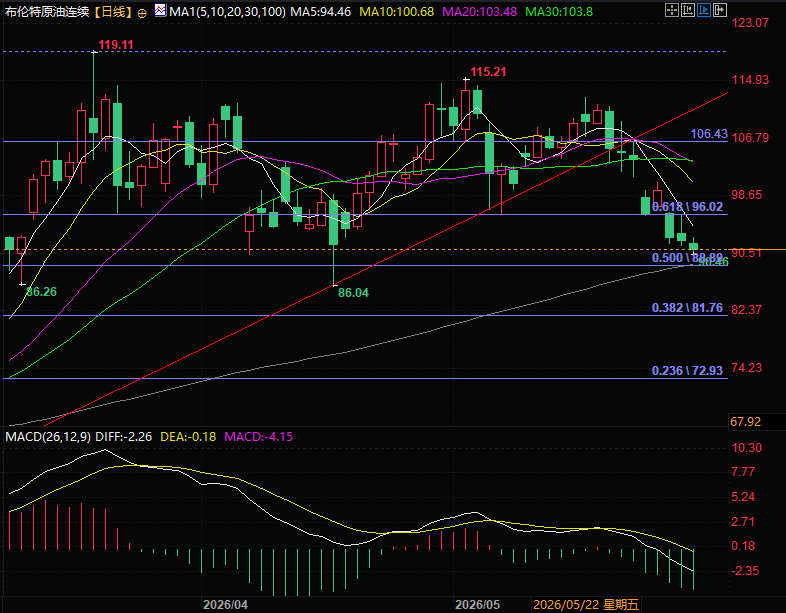
(Brent crude oil futures daily chart, source: FX678)
At 21:31 Beijing time, Brent crude oil futures were trading at $91.06 per barrel.
The fuel market on the consumer side has seen the opposite change, with Costco's latest quarterly gasoline sales hitting a record high, as countless car owners rushed to buy affordable gasoline.
The earlier warning from ExxonMobil executives has further dampened the current weak crude oil market, with the company predicting that global crude oil inventories will fall to extremely low levels within just two or three weeks, at which point the spot Brent crude oil cargo price may even soar to $150 to $160 per barrel.
The situation in the Middle East is always full of division and drama, and recent news has left market participants with mixed feelings.
Just moments before the White House released a major signal that the US and Iran had finalized the general framework of an agreement to end regional conflicts, with only Trump's signature remaining to complete the deal, the entire trading market was immediately immersed in optimism over the easing of geopolitical tensions.
But this sense of peace didn't last long. Iranian state media dropped a bombshell: Tehran launched missiles at multiple unidentified targets, instantly escalating the tense atmosphere back into tension.
Compared to the back-and-forth, ambiguous peace talks between the US and Iran, the US's harsh war rhetoric against Oman, a long-time Gulf ally, truly exposed the arrogance hidden beneath its diplomatic rhetoric and revealed the cruel truth of international politics: small countries have no diplomacy.
Goodwill mediation backfires: Oman's overdrawn neutrality and the US's ruthless betrayal
Oman, often referred to as the "Switzerland of the Middle East," has long served as a buffer zone between major powers in the Middle East by maintaining its neutrality. In February of this year, it took the initiative to mediate and build a communication bridge for dialogue between the United States and Iran, which was a key tool for the United States to ease tensions with Iran.
However, the US had previously disregarded Oman's neutrality and credibility, recklessly squandering this hard-won trust in mediation. By using Oman's communication channels to release ambiguous signals, the US had continuously provoked Iran's security nerves, indirectly contributing to the attacks against Iranian leaders.
Now, simply because it has been heard that Iran and Oman intend to jointly manage shipping in the Strait of Hormuz, even though this joint management plan does not include any shipping fees and is merely normal maritime cooperation between the two countries based on their natural geographical conditions, the United States has immediately turned its back on them, showing no regard for Oman's past role in mediating.
During a cabinet meeting, Trump made a bold statement that if Oman did not fully comply with the United States' wishes, the US would not hesitate to directly use force against this long-time ally. Finance Minister Bessant followed suit, issuing a strongly worded sanctions statement on social media, threatening to settle accounts with all institutions and individuals cooperating with Iran to build the Straits shipping mechanism, and forcing countries around the world to take sides against Iran's shipping plans.
Rooted in the arrogance of hegemony and the belief in "eternal victory," this story reveals the helplessness of small nations struggling to survive in the cracks.
Melan Hakirian, a researcher at a well-known economic think tank, remarked that this was the first time in the country's diplomatic history that the United States had openly threatened to use force against a member state of the Gulf Cooperation Council.
He stated bluntly that these harsh words were not a well-thought-out and formally implemented national policy of the White House. The source was simply Trump's dissatisfaction with the Omani Foreign Minister's leadership of the US-Iran negotiations. It was purely a matter of personal likes and dislikes that swayed the diplomatic direction of an entire country.
Analysis of Trump's diplomatic gaffes
There are currently two interpretations. One is that the US has recently tested Iran's bottom line with military force and expressed dissatisfaction with the agreement. It seems to be controlling the pace of negotiations, but in fact it is a desperate attempt to appear calm. This could lead to resentment towards Oman, because it can no longer tolerate Iran suddenly playing additional cards, such as Oman's support.
Another explanation is that this arbitrary approach, which readily resorts to sanctions and force, stems from America's long-standing winning culture that "America will always win."
In the United States' inherent perception, all countries in the world, even long-time allies, should unconditionally cater to American interests. If there is any action that does not meet its expectations, sanctions and military threats will be immediately imposed, completely ignoring the survival plight of small countries.
Caught between the two superpowers, the United States and Iran, Oman has to maintain its alliance with the United States while also being unable to sever ties with Iran across the sea. The safety of shipping in the Strait of Hormuz is vital to Oman's survival. Its decision to remain neutral, after weighing the pros and cons, is seen by the United States as tantamount to betrayal.
Caught in the crossfire of great power rivalry, Oman's right to maintain neutrality is brutally interfered with by the United States, vividly demonstrating the helplessness and passivity of small-country diplomacy.
Summary and Technical Analysis:
The market still believes that oil prices will begin to fall soon, but the reality is that people are rushing to buy oil and oil giants are publicly declaring that their inventories are running low.
However, neither the US nor Iran has shown any signs of making concessions so far, and there may even be a period of harsh rhetoric before an agreement is reached. This could mean that even if oil prices eventually fall, there will be multiple sharp rebounds, as major players need rebounds to sell their shares.
Meanwhile, the United States' arrogant diplomatic style of readily wielding the big stick of force and arbitrarily trampling on the interests of neutral countries will continue to sow the seeds of uncertainty in the crude oil market. Oil prices will continue to fluctuate between the benefits of peace talks and geopolitical risks, and the global energy market may find it difficult to usher in a truly stable moment in the short term.
From a technical perspective, WTI oil prices seem to have bottomed out, but Brent oil prices are still a bit short. Meanwhile, PVC and PTA are showing signs of stabilizing earlier, so there is still a chance for oil prices to rebound.
(Brent crude oil futures daily chart, source: FX678)
At 21:31 Beijing time, Brent crude oil futures were trading at $91.06 per barrel.
- Risk Warning and Disclaimer
- The market involves risk, and trading may not be suitable for all investors. This article is for reference only and does not constitute personal investment advice, nor does it take into account certain users’ specific investment objectives, financial situation, or other needs. Any investment decisions made based on this information are at your own risk.