Is the oil price around 87 a sign of risk release or the start of a new round of pricing?
2026-05-29 21:59:46
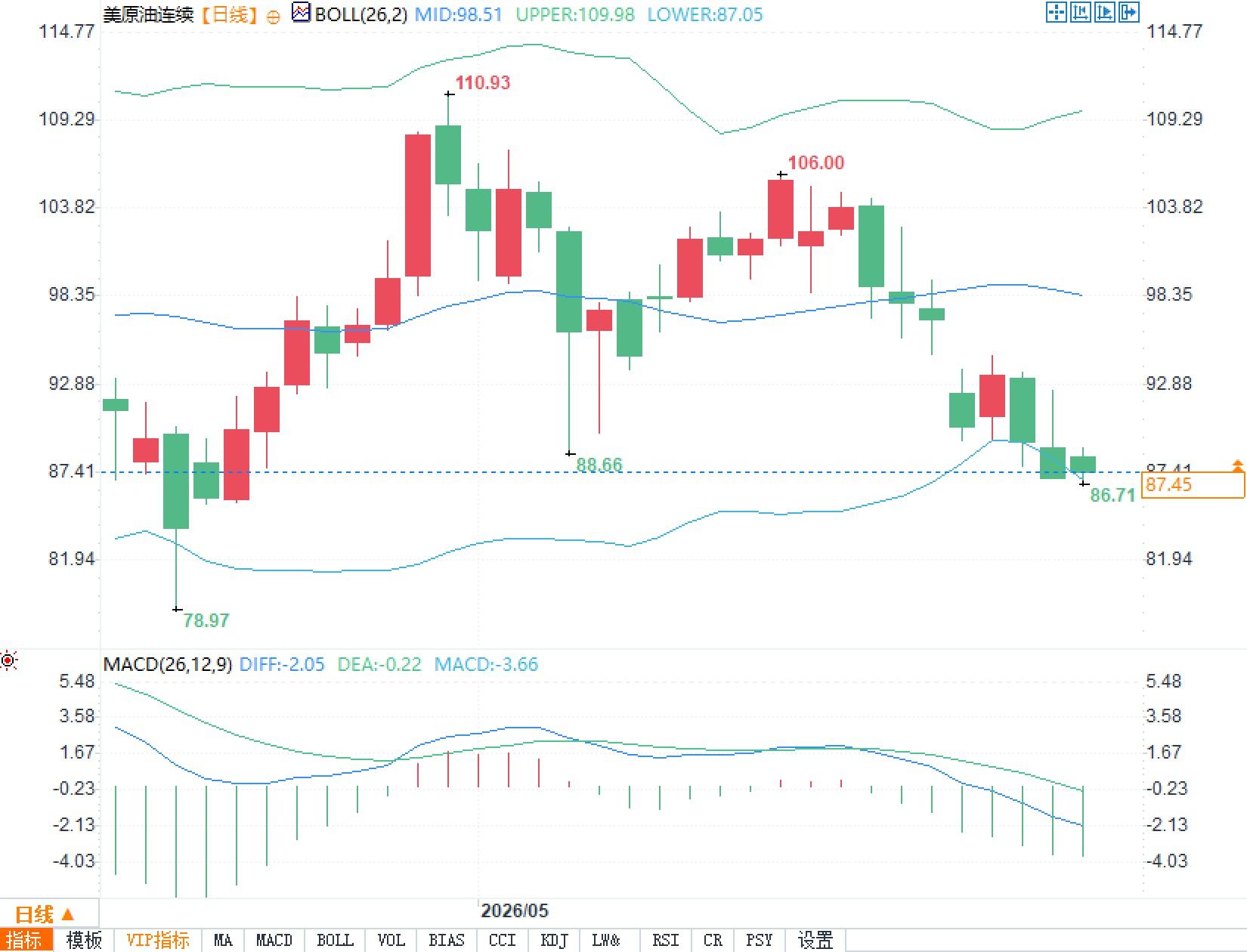
On Friday, May 29th, the crude oil market shifted from a "supply panic premium" to a "repricing of agreement expectations." WTI crude oil for July delivery was last quoted around $87.40 per barrel, down 1.65% on the day; Brent crude was quoted around $91 per barrel, down 1.5% from the previous day. On the daily chart, WTI crude oil prices are approaching the lower Bollinger Band around $87.05, and the MACD remains in negative territory, indicating that risk premium retracement and technical weakness are occurring simultaneously.

The core issue behind this round of oil price declines is not a sudden surge in spot supply, but rather the market's rapid upward revision of the probability of the Strait of Hormuz reopening. The Strait of Hormuz is projected to handle an average of 20.9 million barrels of oil per day in the first half of 2025, roughly equivalent to 20% of global liquid petroleum consumption. Therefore, any change in expectations regarding navigation will directly alter the risk pricing of the crude oil curve.
This is also key to the recent sharp price fluctuations. Previously, the conflict pushed up shipping, insurance, inventory safety margins, and refinery procurement costs, with upstream contracts bearing a larger risk premium; however, with the negotiation window reopening, upstream prices were the first to compress risk premiums. However, the price decline reflects a "reduced probability of the worst-case scenario," and does not necessarily mean that the fundamentals have turned easing.
Iranian Parliament Speaker and negotiator Mohammad Bagher Ghalibaf recently stated that he does not trust guarantees or verbal promises; only actions will be the true measure. Such statements have a direct impact on the oil market: negotiations can reduce tail risks, but they are unlikely to quickly eliminate the safety premium.
From a trading perspective, current market pricing is not simply a bet on the success of the agreement, but rather a redistribution of probabilities between "resumption of navigation" and "recurring conflicts." If the subsequent actions remain merely at the declaration level, shipowners, insurers, and refineries will still demand higher risk compensation, making it difficult for the spot discount to recover quickly. In other words, the written agreement affects futures prices, while actual ship traffic affects the spot market structure, and there is a time lag between the two.
According to the latest weekly report from the U.S. Energy Information Administration, U.S. commercial crude oil inventories fell by 3.3 million barrels to 441.7 million barrels in the week ending May 22, about 2% below the five-year average for the same period; gasoline inventories fell by 2.6 million barrels, also 6% below the five-year average for the same period.
This data indicates that the recent decline in oil prices has not corresponded to inventory accumulation. Refinery operating rates, summer fuel demand, and strategic inventory depletion collectively provide physical support. If the supply chain recovery is slower than financial market expectations, prices will face constraints from inventory replenishment demand and the rigidity of refinery procurement. In particular, after WTI crude oil fell close to the lower Bollinger Band, market divergence will focus on one question: can the risk premium continue to compress, or will it be supported again by low inventory levels?
Federal Reserve Governor Bowman stated that if the energy shock is only temporary, the Fed could choose to observe while maintaining policy credibility; however, if the conflict persists and pushes up energy costs, it could put pressure on inflation later this year. She also noted that progress in reducing inflation has stalled, and current policy is in a "moderately restrictive" state.
This is not a one-way signal for crude oil. If the decline in oil prices stems from expectations of an agreement, inflationary pressures will ease temporarily, and macroeconomic risk appetite will improve. However, if oil prices rise again due to supply constraints, energy costs will re-enter inflationary expectations and limit the scope for monetary policy adjustments. Therefore, crude oil is not just a commodity issue, but also a common variable affecting interest rate paths, corporate costs, and consumer resilience.
Question 1: Does the drop in oil prices mean the end of the supply crisis?
A: No, that doesn't mean so. The current decline is mainly due to rising expectations of an agreement and improved shipping routes, representing a risk premium correction. Inventories remain below seasonal averages, and the recovery of shipping flows, insurance, and refinery purchases will take time; there is no confirmation of easing in the physical market.
Question 2: Why does Iran's hardline rhetoric still affect oil prices?
A: Because crude oil pricing depends not only on the text of the agreement but also on its credibility. A tough stance will increase market concerns about potential reversals of the agreement, keeping shipping and insurance costs at a premium.
Question 3: Why is the Fed's statement related to crude oil?
A: Energy prices will affect the path of inflation. If the oil price shock is short-lived, policymakers may remain on the sidelines; however, if prices continue to rise, inflationary pressures may resurface, thereby impacting interest rate expectations and commodity valuations.
Risk premiums were given back, but this did not indicate an easing of supply and demand.
The core issue behind this round of oil price declines is not a sudden surge in spot supply, but rather the market's rapid upward revision of the probability of the Strait of Hormuz reopening. The Strait of Hormuz is projected to handle an average of 20.9 million barrels of oil per day in the first half of 2025, roughly equivalent to 20% of global liquid petroleum consumption. Therefore, any change in expectations regarding navigation will directly alter the risk pricing of the crude oil curve.
This is also key to the recent sharp price fluctuations. Previously, the conflict pushed up shipping, insurance, inventory safety margins, and refinery procurement costs, with upstream contracts bearing a larger risk premium; however, with the negotiation window reopening, upstream prices were the first to compress risk premiums. However, the price decline reflects a "reduced probability of the worst-case scenario," and does not necessarily mean that the fundamentals have turned easing.
A tough stance or suppression of protocol flexibility
Iranian Parliament Speaker and negotiator Mohammad Bagher Ghalibaf recently stated that he does not trust guarantees or verbal promises; only actions will be the true measure. Such statements have a direct impact on the oil market: negotiations can reduce tail risks, but they are unlikely to quickly eliminate the safety premium.
From a trading perspective, current market pricing is not simply a bet on the success of the agreement, but rather a redistribution of probabilities between "resumption of navigation" and "recurring conflicts." If the subsequent actions remain merely at the declaration level, shipowners, insurers, and refineries will still demand higher risk compensation, making it difficult for the spot discount to recover quickly. In other words, the written agreement affects futures prices, while actual ship traffic affects the spot market structure, and there is a time lag between the two.
Inventory data reveals a hidden tight balance
According to the latest weekly report from the U.S. Energy Information Administration, U.S. commercial crude oil inventories fell by 3.3 million barrels to 441.7 million barrels in the week ending May 22, about 2% below the five-year average for the same period; gasoline inventories fell by 2.6 million barrels, also 6% below the five-year average for the same period.
This data indicates that the recent decline in oil prices has not corresponded to inventory accumulation. Refinery operating rates, summer fuel demand, and strategic inventory depletion collectively provide physical support. If the supply chain recovery is slower than financial market expectations, prices will face constraints from inventory replenishment demand and the rigidity of refinery procurement. In particular, after WTI crude oil fell close to the lower Bollinger Band, market divergence will focus on one question: can the risk premium continue to compress, or will it be supported again by low inventory levels?
The Federal Reserve's perspective amplifies the macroeconomic impact of the energy shock.
Federal Reserve Governor Bowman stated that if the energy shock is only temporary, the Fed could choose to observe while maintaining policy credibility; however, if the conflict persists and pushes up energy costs, it could put pressure on inflation later this year. She also noted that progress in reducing inflation has stalled, and current policy is in a "moderately restrictive" state.
This is not a one-way signal for crude oil. If the decline in oil prices stems from expectations of an agreement, inflationary pressures will ease temporarily, and macroeconomic risk appetite will improve. However, if oil prices rise again due to supply constraints, energy costs will re-enter inflationary expectations and limit the scope for monetary policy adjustments. Therefore, crude oil is not just a commodity issue, but also a common variable affecting interest rate paths, corporate costs, and consumer resilience.
Frequently Asked Questions
Question 1: Does the drop in oil prices mean the end of the supply crisis?
A: No, that doesn't mean so. The current decline is mainly due to rising expectations of an agreement and improved shipping routes, representing a risk premium correction. Inventories remain below seasonal averages, and the recovery of shipping flows, insurance, and refinery purchases will take time; there is no confirmation of easing in the physical market.
Question 2: Why does Iran's hardline rhetoric still affect oil prices?
A: Because crude oil pricing depends not only on the text of the agreement but also on its credibility. A tough stance will increase market concerns about potential reversals of the agreement, keeping shipping and insurance costs at a premium.
Question 3: Why is the Fed's statement related to crude oil?
A: Energy prices will affect the path of inflation. If the oil price shock is short-lived, policymakers may remain on the sidelines; however, if prices continue to rise, inflationary pressures may resurface, thereby impacting interest rate expectations and commodity valuations.
- Risk Warning and Disclaimer
- The market involves risk, and trading may not be suitable for all investors. This article is for reference only and does not constitute personal investment advice, nor does it take into account certain users’ specific investment objectives, financial situation, or other needs. Any investment decisions made based on this information are at your own risk.