Canada's Q1 GDP will be released today: 1.5% growth is expected, but the market has already priced in pessimism. A stronger-than-expected result could trigger a rebound in the Canadian dollar.
2026-05-29 16:52:55
After a sustained rise in May, the USD/CAD pair has shown warning signs of a potential trend reversal on the technical charts. On Friday (May 29th) during the European session, the USD/CAD pair rebounded slightly after yesterday's surge and subsequent pullback, currently trading at 1.3802.
On the fundamental front, optimism surrounding a US-Iran ceasefire weighed on oil prices and the US dollar, while declining US real income and continued depletion of savings raised questions about the resilience of consumption. Canada's Q1 GDP data will be released today, with the market expecting annualized growth of 1.5% (previous value -0.6%), but recent Canadian data has generally been weak.

Reports indicate that the US and Iran may be close to extending their ceasefire agreement, a piece of news that weighed on oil prices and the dollar overnight. Media reports suggest that the two sides have reached a memorandum of understanding to extend the ceasefire for 60 days and open the Strait of Hormuz. Although it still requires Trump's approval, the market has already begun pricing in a "peace dividend." As a result, US crude oil briefly fell below $88 on Thursday.
Weaker-than-expected US data fueled this trend – real disposable income fell in April, and the household savings rate dropped from 3.2% to 2.6%, raising concerns about the resilience of consumer spending. Furthermore, overall PCE inflation at 3.8%, slightly below expectations, weakened inflationary support for the dollar.
Progress on the US-Iran ceasefire has reduced geopolitical risk premiums, putting pressure on oil prices, which are highly correlated with the Canadian dollar—falling oil prices typically mean a weakening Canadian dollar. However, at the same time, the US dollar has also weakened due to reduced safe-haven demand, creating a "hedging effect." This is the fundamental reason for the tug-of-war between bulls and bears around 1.3800 for the USD/CAD pair—the market needs more catalysts to break the deadlock.
The USD/USD pair is currently in a high-level consolidation phase on the daily chart, experiencing short-term downward pressure. The price is fluctuating around the 1.3799 level, with intensified competition between bulls and bears.
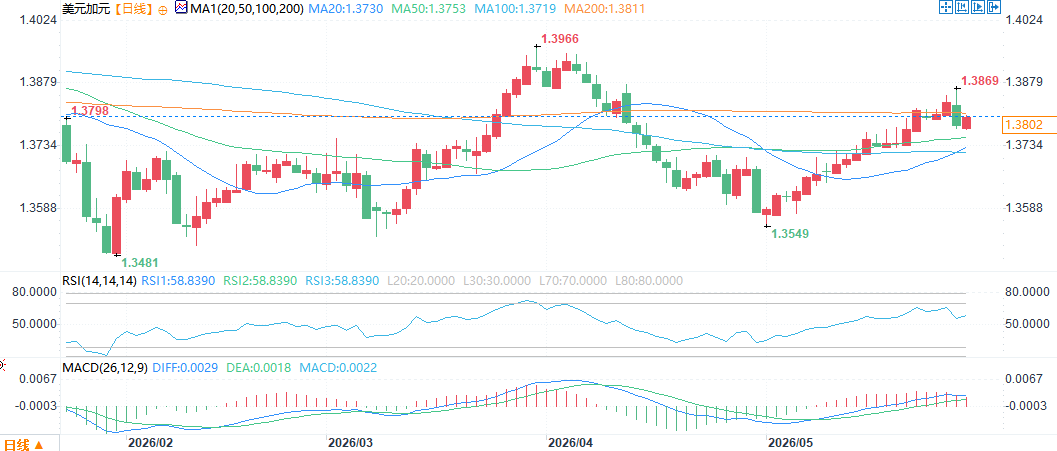
(USD/CAD daily chart, source: EasyForex)
From the perspective of the moving average system, the price is currently trading above the MA20 (1.3730) and MA100 (1.3719), but is being suppressed by the MA50 (1.3753) and MA200 (1.3811). The medium-term moving averages still provide support, but the short-term rebound has encountered resistance. The moving average system has shifted from a bullish alignment to a convergence, indicating a slowdown in upward momentum. After previously rising to a high of 1.3966, the price fell back, reaching a low of 1.3549. Recently, it rebounded to 1.3869 before encountering resistance and pulling back, currently fluctuating around 1.3800.
Regarding key support and resistance levels, short-term support lies at the 1.3799 level, the 20-day moving average (MA20) (1.3730), and the previous low of 1.3549; resistance is at the recent high of 1.3869, with further upside targets at the previous high of 1.3966 and the 200-day moving average (MA200) (1.3811).
In terms of technical indicators, the RSI is currently in the neutral to strong range and has not yet entered the overbought zone, indicating that the bullish momentum still exists but has weakened. The MACD indicator's DIFF line is above the DEA line, and the red bars have shortened slightly, indicating that the upward momentum is slowing down and there is a need for a short-term pullback.
Overall, the USD/CAD pair shows a bullish medium-term trend, but faces short-term pressure at high levels and a potential technical correction, resulting in a generally high-level consolidation pattern. Trading strategy should rely on key support and resistance levels to determine direction. A break above 1.3800 and 1.3869 could potentially challenge the previous high of 1.3966; conversely, a break below 1.3730 and 1.3719 could lead to a further pullback to the 1.3549 low. The current approach is to maintain a slightly bullish bias within the consolidation range, paying close attention to breakouts at key price levels.
Besides the headlines about the Strait of Hormuz, another fundamental risk event traders should pay attention to today is Canada's first-quarter GDP report. The market expects an annualized growth rate of 1.5%, rebounding from the -0.6% contraction in the fourth quarter of last year.
Overall, recent Canadian data has been generally weak, often falling short of expectations. While another instance of Canadian data falling short of expectations would weaken the shorting outlook, another view suggests that, given the market has already priced in a significant amount of pessimism, even results that meet expectations (let alone exceed them) could trigger an asymmetric market reaction—meaning USD/CAD could potentially fall further rather than rebound.
At 16:41 Beijing time on May 29, the USD/CAD exchange rate was 1.3800/01.
On the fundamental front, optimism surrounding a US-Iran ceasefire weighed on oil prices and the US dollar, while declining US real income and continued depletion of savings raised questions about the resilience of consumption. Canada's Q1 GDP data will be released today, with the market expecting annualized growth of 1.5% (previous value -0.6%), but recent Canadian data has generally been weak.
Fundamentals: Ceasefire optimism + weak US data
Reports indicate that the US and Iran may be close to extending their ceasefire agreement, a piece of news that weighed on oil prices and the dollar overnight. Media reports suggest that the two sides have reached a memorandum of understanding to extend the ceasefire for 60 days and open the Strait of Hormuz. Although it still requires Trump's approval, the market has already begun pricing in a "peace dividend." As a result, US crude oil briefly fell below $88 on Thursday.
Weaker-than-expected US data fueled this trend – real disposable income fell in April, and the household savings rate dropped from 3.2% to 2.6%, raising concerns about the resilience of consumer spending. Furthermore, overall PCE inflation at 3.8%, slightly below expectations, weakened inflationary support for the dollar.
Progress on the US-Iran ceasefire has reduced geopolitical risk premiums, putting pressure on oil prices, which are highly correlated with the Canadian dollar—falling oil prices typically mean a weakening Canadian dollar. However, at the same time, the US dollar has also weakened due to reduced safe-haven demand, creating a "hedging effect." This is the fundamental reason for the tug-of-war between bulls and bears around 1.3800 for the USD/CAD pair—the market needs more catalysts to break the deadlock.
USD/USD Daily Technical Analysis
The USD/USD pair is currently in a high-level consolidation phase on the daily chart, experiencing short-term downward pressure. The price is fluctuating around the 1.3799 level, with intensified competition between bulls and bears.
(USD/CAD daily chart, source: EasyForex)
From the perspective of the moving average system, the price is currently trading above the MA20 (1.3730) and MA100 (1.3719), but is being suppressed by the MA50 (1.3753) and MA200 (1.3811). The medium-term moving averages still provide support, but the short-term rebound has encountered resistance. The moving average system has shifted from a bullish alignment to a convergence, indicating a slowdown in upward momentum. After previously rising to a high of 1.3966, the price fell back, reaching a low of 1.3549. Recently, it rebounded to 1.3869 before encountering resistance and pulling back, currently fluctuating around 1.3800.
Regarding key support and resistance levels, short-term support lies at the 1.3799 level, the 20-day moving average (MA20) (1.3730), and the previous low of 1.3549; resistance is at the recent high of 1.3869, with further upside targets at the previous high of 1.3966 and the 200-day moving average (MA200) (1.3811).
In terms of technical indicators, the RSI is currently in the neutral to strong range and has not yet entered the overbought zone, indicating that the bullish momentum still exists but has weakened. The MACD indicator's DIFF line is above the DEA line, and the red bars have shortened slightly, indicating that the upward momentum is slowing down and there is a need for a short-term pullback.
Overall, the USD/CAD pair shows a bullish medium-term trend, but faces short-term pressure at high levels and a potential technical correction, resulting in a generally high-level consolidation pattern. Trading strategy should rely on key support and resistance levels to determine direction. A break above 1.3800 and 1.3869 could potentially challenge the previous high of 1.3966; conversely, a break below 1.3730 and 1.3719 could lead to a further pullback to the 1.3549 low. The current approach is to maintain a slightly bullish bias within the consolidation range, paying close attention to breakouts at key price levels.
Canada's first-quarter GDP data will be released today.
Besides the headlines about the Strait of Hormuz, another fundamental risk event traders should pay attention to today is Canada's first-quarter GDP report. The market expects an annualized growth rate of 1.5%, rebounding from the -0.6% contraction in the fourth quarter of last year.
Overall, recent Canadian data has been generally weak, often falling short of expectations. While another instance of Canadian data falling short of expectations would weaken the shorting outlook, another view suggests that, given the market has already priced in a significant amount of pessimism, even results that meet expectations (let alone exceed them) could trigger an asymmetric market reaction—meaning USD/CAD could potentially fall further rather than rebound.
At 16:41 Beijing time on May 29, the USD/CAD exchange rate was 1.3800/01.
- Risk Warning and Disclaimer
- The market involves risk, and trading may not be suitable for all investors. This article is for reference only and does not constitute personal investment advice, nor does it take into account certain users’ specific investment objectives, financial situation, or other needs. Any investment decisions made based on this information are at your own risk.