A single-week plunge of 11%! The oil market suffered its worst week in seven weeks, as the US-Iran peace talks took a dramatic turn.
2026-05-30 14:54:55
This week's international crude oil market can only be described as "thrilling." From the precipitous drop at the beginning of the week, to the sharp rebound in the middle, and then the back-and-forth trading in the latter half, it ultimately ended with a dismal weekly decline, marking the largest drop in weeks. Brent crude and US crude futures seemed to be on a runaway roller coaster, and the mastermind behind it all had only one name—the US-Iran peace talks. This geopolitical drama, which affects the global energy sector, unfolded a suspenseful series of reversals this week, leaving every trader's heart pounding with the waves of the Strait of Hormuz.

The week began with seemingly hopeful news. On Monday (May 25), optimism suddenly swept through the markets that the US and Iran were close to reaching a peace agreement. Informed officials revealed that Iran's chief negotiator met with the Qatari prime minister in Doha to discuss ending the three-month-long war. The two sides reportedly made progress on a ceasefire memorandum of understanding, which would temporarily halt the fighting and give negotiators 60 days to finalize a agreement.
This news was like a bucket of cold water, instantly extinguishing the raging fire fueled by geopolitical risk premiums. Although both US President Trump and Iran subsequently downplayed expectations of an imminent breakthrough, the market reaction was direct and violent. Due to the Memorial Day holiday, trading was relatively thin, and this lack of liquidity amplified price volatility. Brent crude futures for July delivery plummeted $7.24, nearly 7%, to close at $96.30 a barrel; US crude futures plunged even further, falling $6.30, also nearly 7%, to close at $90.88. Analyst Phil Flynn stated at the time that oil shipments through the Strait of Hormuz seemed likely to resume, although he acknowledged that an agreement was not yet finalized. However, soberly, some cautioned that there were precedents in recent months of agreements nearly reaching a consensus only to ultimately collapse, and this time might be no exception. Regardless, the market had already cast its vote of confidence with real money, and the risk premium was rapidly receding.
However, just one day later, the plot took a dramatic turn. On Tuesday (May 26), the US launched airstrikes against Iran, instantly shattering the peace hopes that had been held the previous day. Iran accused the US of violating the ceasefire agreement and carrying out what it called a "defensive strike." US Secretary of State Rubio vaguely stated that reaching a ceasefire agreement through negotiations might "take a few more days."
As a result, global benchmark Brent crude oil futures for July delivery rebounded sharply on Tuesday, settling up $3.44, or 3.58%, returning to the $99.58 per barrel level. Interestingly, however, US crude oil futures bucked the trend, falling 2.8% to $93.89 per barrel, indicating a divergence in market interpretation of the event. More notably, US gasoline futures plunged 7%, and diesel futures fell 4%, both hitting five-week lows. The underlying logic is that while renewed concerns boosted crude oil futures, the market may also be pricing in how continued or escalating conflict would suppress downstream demand. Since the outbreak of war in late February, Iran has almost completely halted the passage of non-Iranian vessels through the Strait of Hormuz, severely blocking this vital waterway carrying approximately one-fifth of the world's oil and liquefied natural gas. Despite the renewed airstrikes, ship tracking data shows that three LNG carriers have successfully passed through the strait recently, heading to Pakistan, China, and India, which may be a hidden reason for the weak performance of refined oil futures.
Market sentiment became more complex and contradictory on Wednesday (May 27). Investors awaited definitive news regarding the framework of a US-Iran agreement, while various rumors circulated. Ultimately, oil prices plunged again by more than 5%, with Brent crude falling to $94.29 per barrel and US crude to $88.68, completely erasing Tuesday's gains.
The cause of this dramatic volatility was the extreme confusion in the news. On the one hand, US Secretary of State Rubio acknowledged some progress in the negotiations; but on the other hand, President Trump stated that issues still needed to be resolved, and Iranian state media also admitted that unresolved problems existed. Adding to the market's confusion, the US categorically denied Iranian state television reports that a framework agreement had been reached, which had optimistically stated that shipping through the Strait of Hormuz would resume within a month and that the US naval blockade against Iranian ships would be lifted. Analyst Dennis Kisler pointed out that an Iranian military leader stated that the possibility of returning to war was low, leading many traders to believe that a peace agreement was imminent, and the previously priced-in global supply shortage seemed to be easing. Meanwhile, shipping data showed that although overall traffic remained limited, shipping activity in the Strait of Hormuz continued, with a product oil tanker operated by COSCO Shipping transiting this vital waterway. This reality of "dealing while ships pass" greatly reinforced market expectations that the key waterway might gradually reopen.
Thursday's (May 28) trading session perfectly exemplified this week's "news-driven market" characteristic. Oil prices traded in a volatile range before closing mixed, with Brent crude slightly down and U.S. crude slightly up, indicating a stalemate between bulls and bears in the face of conflicting news.
Earlier that day, Iran's Revolutionary Guard announced an attack on a U.S. airbase in response to the U.S. strike on Bandar Abbas. This news initially pushed both Brent and U.S. crude futures up by more than 2%. However, the good news was short-lived. Four sources familiar with the matter told Reuters that the U.S. and Iran had reached an agreement to extend the Middle East ceasefire for 60 days. Although the agreement still needs President Trump's approval, and Iran's Tasnim News Agency emphasized that the text of the memorandum of understanding has not yet been finalized, the market quickly shifted to expectations of peace. In addition, the U.S. Energy Information Administration's crude oil inventory data for last week showed a decrease of 3.3 million barrels, marking the sixth consecutive week of decline, but the decrease was less than the market expectation of 4.1 million barrels, which also put additional downward pressure on oil prices. As consulting firm Ritterbusch and Associates put it, "The oil market is barely rising, driven by positive news from Iran, but any sign of the Strait of Hormuz reopening will cause a sharp drop in oil prices." This statement accurately summarizes the market sentiment that day—any small signal about peace was enough to overshadow actual news of military conflict.
By Friday (May 29), market sentiment had finally tipped in favor of peace. Crude oil futures fell more than 2% that day, bringing this volatile week to a close. Brent crude futures for July delivery settled at $92.05 a barrel, while U.S. crude futures settled at $87.36 a barrel.
Despite remaining differences in the details between the US and Iran—for example, Iran's Fars News Agency stated that the agreement required Iran to open the Strait of Hormuz without restriction, but Iran would reopen it according to its own arrangements and charge transit fees—the market has clearly accepted that a ceasefire is highly probable. John Kilduff, a partner at Again Capital, bluntly stated, "The market believes a ceasefire will be easy; it's a done deal." US President Trump has again called on Iran to immediately reopen the Strait, and the market's focus has completely shifted to "when" rather than "whether."
Ultimately, Brent crude futures plunged approximately 11% this week, marking their biggest weekly drop in seven weeks; U.S. crude futures fell over 9%, their biggest weekly drop in six weeks. Both benchmark oil prices fell to their lowest levels since mid-April. UBS analyst Giovanni Stanovo, summarizing the week's market performance, noted that despite continued restrictions on oil transport through the Strait of Hormuz and a continued decline in global inventories, the market's focus was entirely on the possibility of a U.S.-Iran agreement. The continued decline in oil prices even began to force some market participants to close out their long positions, creating a self-reinforcing downward spiral.
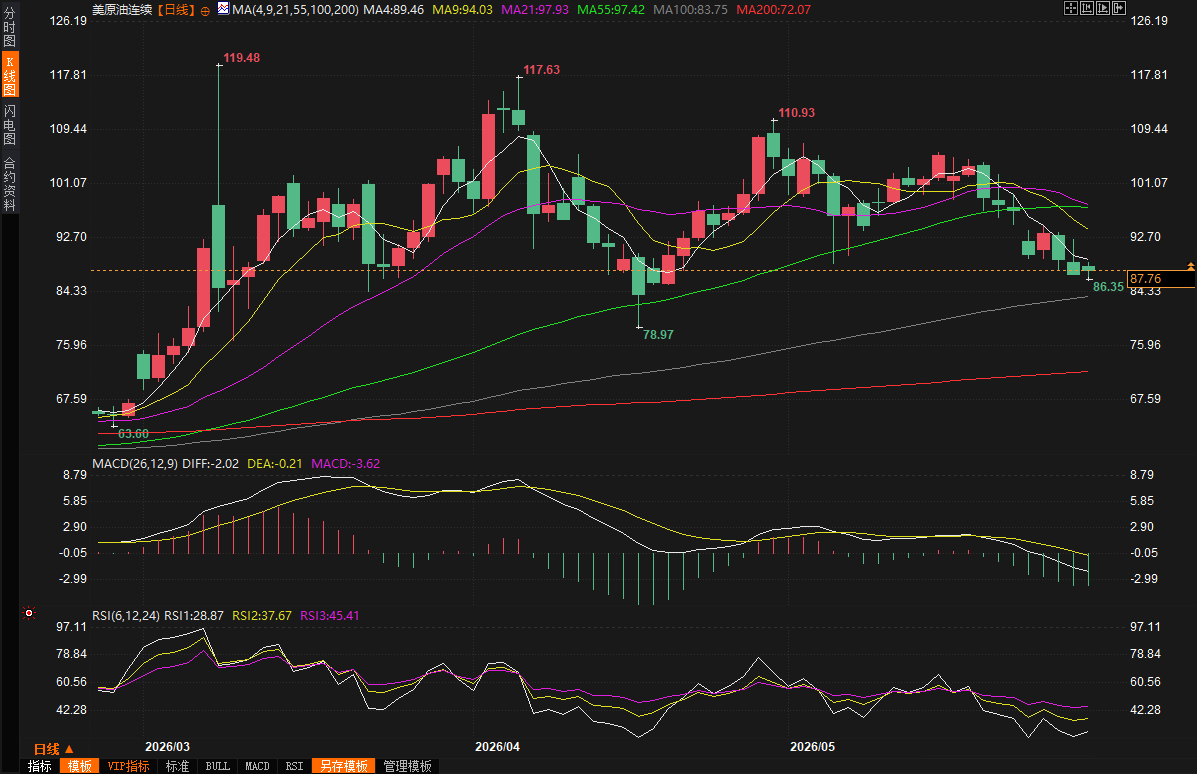
(US crude oil daily chart, source: FX678)
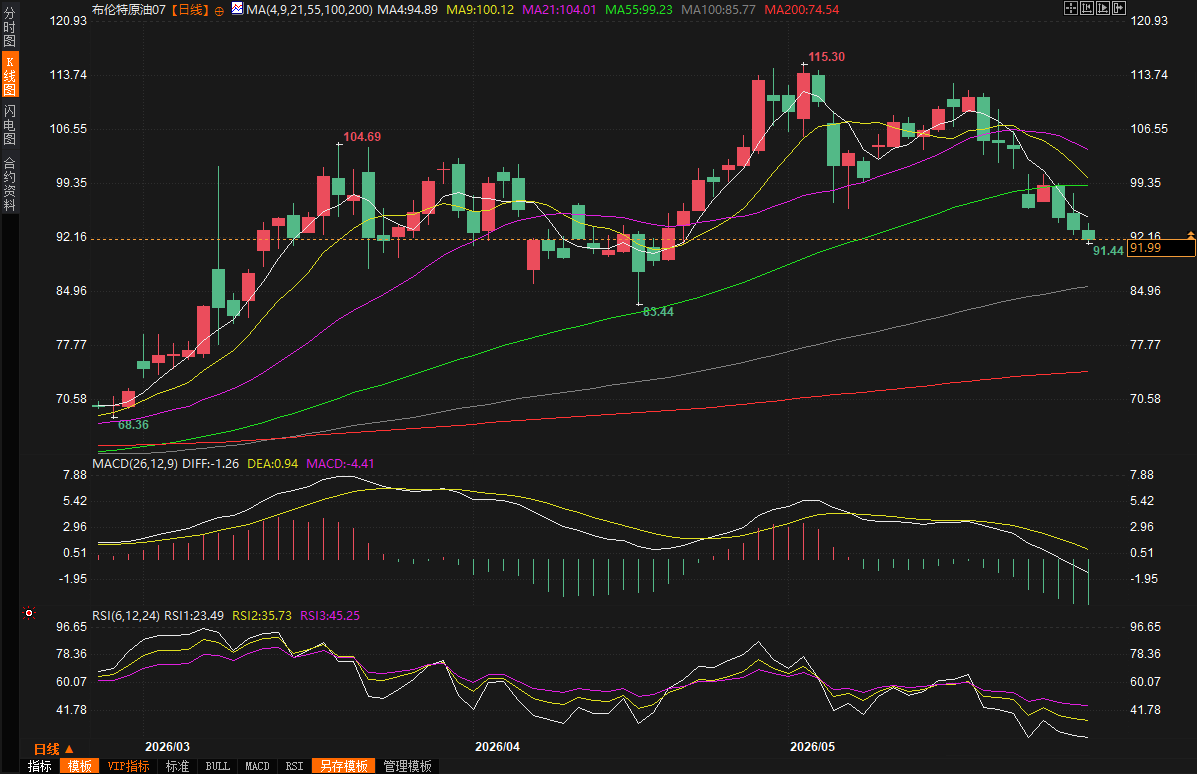
(Brent crude oil July futures daily chart, source: FX678)
Looking back at this week, the crude oil market was completely hijacked by news surrounding the US-Iran negotiations. From the optimistic plunge at the beginning of the week, to the rebound due to conflict in the middle, and then to the repeated weighing of options in the latter half, it ultimately ended with expectations of peace prevailing and a sharp drop in oil prices. This week's performance vividly demonstrated the enormous impact of geopolitical risks on commodity markets, and also reminded all participants that in the current highly uncertain environment, any single piece of news can cause prices to fluctuate wildly within a range of several dollars.
Looking ahead, the core contradictions in the market remain clear. In the short term, as long as any positive signals emerge regarding a ceasefire and the reopening of the Strait of Hormuz, the geopolitical premium in oil prices is likely to continue to be squeezed. Investors need to closely monitor whether the US and Iran can actually sign the 60-day ceasefire memorandum of understanding in the coming days. However, we cannot ignore several important practical issues. Even if a peace agreement is reached, the repair of damaged oil and gas facilities and the full restoration of normal shipping in the Strait of Hormuz will take several months. As analyst June Goh stated, the 10-11 million barrel per day oil supply gap will not disappear immediately, and the global market will continue to deplete inventories. Therefore, whether this round of oil price decline is a trend reversal or an emotional release after an overreaction may only be answered when the agreement is actually signed and the Strait is truly reopened. Before that, any one-sided bets may face the risk of being repeatedly crushed by market sentiment.
The beginning: A glimmer of peace appears, but oil prices suffer a "Black Monday".
The week began with seemingly hopeful news. On Monday (May 25), optimism suddenly swept through the markets that the US and Iran were close to reaching a peace agreement. Informed officials revealed that Iran's chief negotiator met with the Qatari prime minister in Doha to discuss ending the three-month-long war. The two sides reportedly made progress on a ceasefire memorandum of understanding, which would temporarily halt the fighting and give negotiators 60 days to finalize a agreement.
This news was like a bucket of cold water, instantly extinguishing the raging fire fueled by geopolitical risk premiums. Although both US President Trump and Iran subsequently downplayed expectations of an imminent breakthrough, the market reaction was direct and violent. Due to the Memorial Day holiday, trading was relatively thin, and this lack of liquidity amplified price volatility. Brent crude futures for July delivery plummeted $7.24, nearly 7%, to close at $96.30 a barrel; US crude futures plunged even further, falling $6.30, also nearly 7%, to close at $90.88. Analyst Phil Flynn stated at the time that oil shipments through the Strait of Hormuz seemed likely to resume, although he acknowledged that an agreement was not yet finalized. However, soberly, some cautioned that there were precedents in recent months of agreements nearly reaching a consensus only to ultimately collapse, and this time might be no exception. Regardless, the market had already cast its vote of confidence with real money, and the risk premium was rapidly receding.
Reversal: The battle reignites, and the bulls' hopes are instantly shattered.
However, just one day later, the plot took a dramatic turn. On Tuesday (May 26), the US launched airstrikes against Iran, instantly shattering the peace hopes that had been held the previous day. Iran accused the US of violating the ceasefire agreement and carrying out what it called a "defensive strike." US Secretary of State Rubio vaguely stated that reaching a ceasefire agreement through negotiations might "take a few more days."
As a result, global benchmark Brent crude oil futures for July delivery rebounded sharply on Tuesday, settling up $3.44, or 3.58%, returning to the $99.58 per barrel level. Interestingly, however, US crude oil futures bucked the trend, falling 2.8% to $93.89 per barrel, indicating a divergence in market interpretation of the event. More notably, US gasoline futures plunged 7%, and diesel futures fell 4%, both hitting five-week lows. The underlying logic is that while renewed concerns boosted crude oil futures, the market may also be pricing in how continued or escalating conflict would suppress downstream demand. Since the outbreak of war in late February, Iran has almost completely halted the passage of non-Iranian vessels through the Strait of Hormuz, severely blocking this vital waterway carrying approximately one-fifth of the world's oil and liquefied natural gas. Despite the renewed airstrikes, ship tracking data shows that three LNG carriers have successfully passed through the strait recently, heading to Pakistan, China, and India, which may be a hidden reason for the weak performance of refined oil futures.
Suspense: Amidst conflicting news, the market oscillates between hope and fear.
Market sentiment became more complex and contradictory on Wednesday (May 27). Investors awaited definitive news regarding the framework of a US-Iran agreement, while various rumors circulated. Ultimately, oil prices plunged again by more than 5%, with Brent crude falling to $94.29 per barrel and US crude to $88.68, completely erasing Tuesday's gains.
The cause of this dramatic volatility was the extreme confusion in the news. On the one hand, US Secretary of State Rubio acknowledged some progress in the negotiations; but on the other hand, President Trump stated that issues still needed to be resolved, and Iranian state media also admitted that unresolved problems existed. Adding to the market's confusion, the US categorically denied Iranian state television reports that a framework agreement had been reached, which had optimistically stated that shipping through the Strait of Hormuz would resume within a month and that the US naval blockade against Iranian ships would be lifted. Analyst Dennis Kisler pointed out that an Iranian military leader stated that the possibility of returning to war was low, leading many traders to believe that a peace agreement was imminent, and the previously priced-in global supply shortage seemed to be easing. Meanwhile, shipping data showed that although overall traffic remained limited, shipping activity in the Strait of Hormuz continued, with a product oil tanker operated by COSCO Shipping transiting this vital waterway. This reality of "dealing while ships pass" greatly reinforced market expectations that the key waterway might gradually reopen.
Tug-of-War: A Battle Between True and False Information, and a Fierce Game Between Bulls and Bears
Thursday's (May 28) trading session perfectly exemplified this week's "news-driven market" characteristic. Oil prices traded in a volatile range before closing mixed, with Brent crude slightly down and U.S. crude slightly up, indicating a stalemate between bulls and bears in the face of conflicting news.
Earlier that day, Iran's Revolutionary Guard announced an attack on a U.S. airbase in response to the U.S. strike on Bandar Abbas. This news initially pushed both Brent and U.S. crude futures up by more than 2%. However, the good news was short-lived. Four sources familiar with the matter told Reuters that the U.S. and Iran had reached an agreement to extend the Middle East ceasefire for 60 days. Although the agreement still needs President Trump's approval, and Iran's Tasnim News Agency emphasized that the text of the memorandum of understanding has not yet been finalized, the market quickly shifted to expectations of peace. In addition, the U.S. Energy Information Administration's crude oil inventory data for last week showed a decrease of 3.3 million barrels, marking the sixth consecutive week of decline, but the decrease was less than the market expectation of 4.1 million barrels, which also put additional downward pressure on oil prices. As consulting firm Ritterbusch and Associates put it, "The oil market is barely rising, driven by positive news from Iran, but any sign of the Strait of Hormuz reopening will cause a sharp drop in oil prices." This statement accurately summarizes the market sentiment that day—any small signal about peace was enough to overshadow actual news of military conflict.
Finale: Agreement framework becomes clearer, week ends in dismal disappointment.
By Friday (May 29), market sentiment had finally tipped in favor of peace. Crude oil futures fell more than 2% that day, bringing this volatile week to a close. Brent crude futures for July delivery settled at $92.05 a barrel, while U.S. crude futures settled at $87.36 a barrel.
Despite remaining differences in the details between the US and Iran—for example, Iran's Fars News Agency stated that the agreement required Iran to open the Strait of Hormuz without restriction, but Iran would reopen it according to its own arrangements and charge transit fees—the market has clearly accepted that a ceasefire is highly probable. John Kilduff, a partner at Again Capital, bluntly stated, "The market believes a ceasefire will be easy; it's a done deal." US President Trump has again called on Iran to immediately reopen the Strait, and the market's focus has completely shifted to "when" rather than "whether."
Ultimately, Brent crude futures plunged approximately 11% this week, marking their biggest weekly drop in seven weeks; U.S. crude futures fell over 9%, their biggest weekly drop in six weeks. Both benchmark oil prices fell to their lowest levels since mid-April. UBS analyst Giovanni Stanovo, summarizing the week's market performance, noted that despite continued restrictions on oil transport through the Strait of Hormuz and a continued decline in global inventories, the market's focus was entirely on the possibility of a U.S.-Iran agreement. The continued decline in oil prices even began to force some market participants to close out their long positions, creating a self-reinforcing downward spiral.
(US crude oil daily chart, source: FX678)
(Brent crude oil July futures daily chart, source: FX678)
Summary and Outlook: Risk premiums have faded, and the market awaits the real "shoe dropping" (i.e., the outcome of market decisions).
Looking back at this week, the crude oil market was completely hijacked by news surrounding the US-Iran negotiations. From the optimistic plunge at the beginning of the week, to the rebound due to conflict in the middle, and then to the repeated weighing of options in the latter half, it ultimately ended with expectations of peace prevailing and a sharp drop in oil prices. This week's performance vividly demonstrated the enormous impact of geopolitical risks on commodity markets, and also reminded all participants that in the current highly uncertain environment, any single piece of news can cause prices to fluctuate wildly within a range of several dollars.
Looking ahead, the core contradictions in the market remain clear. In the short term, as long as any positive signals emerge regarding a ceasefire and the reopening of the Strait of Hormuz, the geopolitical premium in oil prices is likely to continue to be squeezed. Investors need to closely monitor whether the US and Iran can actually sign the 60-day ceasefire memorandum of understanding in the coming days. However, we cannot ignore several important practical issues. Even if a peace agreement is reached, the repair of damaged oil and gas facilities and the full restoration of normal shipping in the Strait of Hormuz will take several months. As analyst June Goh stated, the 10-11 million barrel per day oil supply gap will not disappear immediately, and the global market will continue to deplete inventories. Therefore, whether this round of oil price decline is a trend reversal or an emotional release after an overreaction may only be answered when the agreement is actually signed and the Strait is truly reopened. Before that, any one-sided bets may face the risk of being repeatedly crushed by market sentiment.
- Risk Warning and Disclaimer
- The market involves risk, and trading may not be suitable for all investors. This article is for reference only and does not constitute personal investment advice, nor does it take into account certain users’ specific investment objectives, financial situation, or other needs. Any investment decisions made based on this information are at your own risk.