Gold Trading Alert: Geopolitical Conflicts Remain, Can Gold Prices Rise Again After a Brief Respite? The June Game of Game Theory Begins
2026-06-01 07:23:44
Spot gold opened slightly lower on Monday, June 1, 2026, falling as much as 0.48% to around $4,518 per ounce, as market sentiment cooled briefly. The previous weekend's lack of a clear breakthrough in US-Iran peace talks, coupled with the continued advance of Israeli troops into southern Lebanon, further exacerbated international concerns about the Middle East situation spiraling out of control. Meanwhile, US crude oil opened nearly 2% higher, surging over 3% to above $90 per barrel at one point. The rebound in energy prices directly boosted inflation expectations and strengthened the pressure on the Federal Reserve to maintain high interest rates or even raise them, becoming the main reason for the short-term pressure on gold prices.
However, focusing solely on Monday's slight pullback is clearly insufficient. Looking at Friday's strong rebound of over 1%, reaching a high of $4595 per ounce, gold continues to demonstrate strong resilience at higher levels. While May saw a monthly decline dragged down by inflation and interest rate hike expectations, June presents a complex yet opportunity-filled trading environment due to geopolitical tensions, a period of concentrated economic data releases, and uncertainty surrounding the Federal Reserve's policy path. Currently, gold prices have recovered their earlier losses, rebounding to around the $4540 level.
Gold's strong rebound last week near key support levels was mainly driven by market optimism regarding an extension of the US-Iran ceasefire agreement. US President Trump repeatedly stated he would make a final decision on a 60-day extension, emphasizing that the agreement must include tough conditions such as opening the Strait of Hormuz and eliminating Iran's nuclear capabilities. Iran, however, released more cautious and even resistant signals, calling Trump's remarks an "attempt to create a false victory" and insisting that the Strait's control should be decided by Iran and Oman, while also demanding the unfreezing of $12 billion in assets.
Despite significant differences remaining between the two sides on core issues—from the dismantling of nuclear facilities to passage fees in the Strait of Hormuz and the unfreezing of funds—negotiation channels have not been closed. Iran's chief negotiator, Ghalibaf, made it clear that an agreement would not be easily reached unless the rights of the Iranian people could be guaranteed; while US Defense Secretary Hergsays stated firmly that the US was prepared to resume military strikes against Iran if an agreement could not be reached.
This tug-of-war between negotiations and fighting is precisely the kind of market conditions gold thrives on. As long as tensions in the Middle East remain unresolved, safe-haven demand will continue to support gold prices. Especially as Israel continues its advance in southern Lebanon, the risk of spillover from the conflict could push up oil prices at any time, indirectly benefiting gold.
In contrast to the geopolitical optimism are macroeconomic pressures. The energy price surge triggered by the conflict with Iran has led to a three-year high in US inflation in April. Market expectations that the Federal Reserve will maintain high interest rates until next fall significantly increase the opportunity cost of holding non-yielding gold.
Although oil prices saw a significant correction last week due to ceasefire expectations (Brent crude fell by about 11% for the week), they rebounded on Monday, indicating that the market remains skeptical about the actual implementation of the agreement. The Strait of Hormuz, a vital global oil shipping route, directly drives up global energy costs due to restricted passage. As long as the Strait issue remains unresolved, inflationary pressures will be difficult to alleviate quickly, and the Federal Reserve's policy path will be unlikely to shift towards easing.
The US dollar index recorded consecutive declines last week, but still remained within the 98-99 range. A weaker dollar provides short-term support for gold prices, but if US economic data continues to show resilience, the dollar may regain buying interest, which will be another major variable for gold.
From a technical perspective, spot gold rebounded sharply last week from a two-month low near $4,365, indicating that bullish momentum is still building. August gold futures also followed the spot rally, closing up 1.3%. A Kitco survey shows that Wall Street analysts have turned significantly bullish on gold's performance in the coming week, with 75% of experts expecting prices to rise, while retail investor sentiment is relatively divided.
Among the 12 Wall Street analysts surveyed, sentiment has shifted strongly to bullish. A significant 9 experts, or 75% of respondents, expect gold prices to rise in the coming week. Only 2 are bearish, and 1 anticipates sideways movement. This is directly related to the technical pattern of gold prices successfully rebounding from the key support level (around $4365). Professional traders generally believe that this rebound confirms the validity of the bottom.
However, the situation is quite different in an online poll of retail investors on Main Street. Of the 39 votes cast, only 17 retail traders, or 44%, expect gold prices to rise. More notably, 10 (26%) are bearish, while a significant 12 (31%) expect gold prices to trade sideways. This hesitation among retail investors reflects their deep concern about the current macroeconomic environment (high interest rates, a strong dollar), and their lack of belief that a technical rebound can reverse the overall downward pressure.
However, gold is currently still in a high-level consolidation pattern. $4,595 has become a significant short-term resistance level, while the area below $4,500 forms initial support.
From Geopolitics to Economics: The Test of a Data-Driven Week
As we enter the first week of June, the market spotlight is slowly shifting from the Strait of Hormuz to domestic US economic data. Investors will be focused entirely on the health of the US economy and labor market this week, as a series of data releases could significantly impact the Federal Reserve's interest rate expectations.
Monday's first release will be the ISM Manufacturing Purchasing Managers' Index, which analysts will closely watch to see if it stabilizes at current levels or slips further into contraction territory. This will provide an initial benchmark for the market's assessment of the resilience of the US economy.
The "Trio" of the job market: ADP, Initial Jobless Claims, and Non-Farm Payrolls
The real climax will come after midweek. On Wednesday, the ADP employment report will be released as a leading indicator for Friday's official non-farm payroll data. Following this, the ISM Services Purchasing Managers' Index will be released; given the dominant role of the service sector in the US economy, this data is no less important than that of manufacturing.
Of course, the most anticipated event this week is the US non-farm payrolls report released on Friday. This report will provide the most comprehensive assessment of hiring, the unemployment rate, and wage growth. It's worth noting that despite market concerns about slowing economic growth, weekly initial jobless claims in the US remain at historically low levels. Many economists have therefore described the labor market as "extremely resilient."
A strong non-farm payroll report would be disastrous for gold. If the data shows a still-hot job market and robust wage growth, the Federal Reserve's resolve to maintain high interest rates for an extended period will be further strengthened, and gold prices could very well test the support level of $4,350 or even lower. Conversely, if the data shows significant weakness, market expectations for an earlier Fed shift will rise, which might open a decent window for a rebound in gold.
In summary, gold faces a short-term dilemma due to both geopolitical optimism and expectations of macroeconomic tightening, but the medium- to long-term outlook remains bullish. As long as the US-Iran negotiations fail to reach a comprehensive and stable agreement in the near term, the fragility of the Middle East situation will continue to provide gold with a safe-haven premium.
This week, the focus will be on two main areas: first, the actual passage through the Strait of Hormuz and the latest statements from both sides; and second, the strength of US employment data. If the non-farm payroll data is strong, expectations for a Fed rate hike will rise, and gold prices may face further downward pressure. Conversely, if the data is weak or geopolitical tensions ease and drag down oil prices, gold is expected to regain its upward momentum and challenge $4,600 or even higher.
For investors, now is not the time to chase highs and sell lows, but rather a time to patiently wait for key events to unfold and for a clear direction to emerge. Gold's safe-haven asset properties will be highlighted again in the complex geopolitical environment of 2026, and its ultimate direction will ultimately be determined by substantial progress in US-Iran negotiations and the actual performance of US economic data.
Overall, although gold saw a slight pullback on Monday, this appears to be more of a consolidation phase than a trend reversal. In June, amidst geopolitical uncertainties and macroeconomic competition, gold is likely to continue its high-level consolidation with a slightly bullish bias; any significant breakout from either side could trigger volatile price movements.
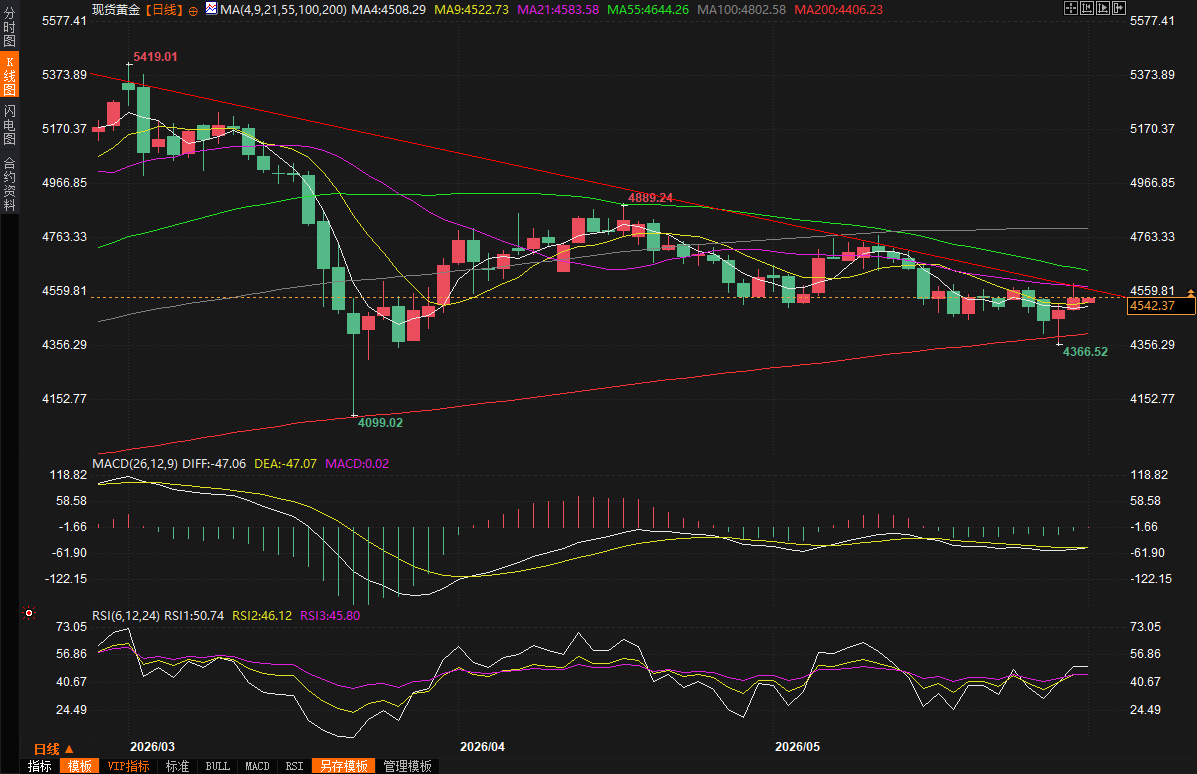
(Spot gold daily chart, source: FX678)
At 07:22 Beijing time, spot gold was trading at $4,542.28 per ounce.
However, focusing solely on Monday's slight pullback is clearly insufficient. Looking at Friday's strong rebound of over 1%, reaching a high of $4595 per ounce, gold continues to demonstrate strong resilience at higher levels. While May saw a monthly decline dragged down by inflation and interest rate hike expectations, June presents a complex yet opportunity-filled trading environment due to geopolitical tensions, a period of concentrated economic data releases, and uncertainty surrounding the Federal Reserve's policy path. Currently, gold prices have recovered their earlier losses, rebounding to around the $4540 level.
I. Geopolitics Remains the Core Driver: The Tug-of-War in US-Iran Ceasefire Negotiations
Gold's strong rebound last week near key support levels was mainly driven by market optimism regarding an extension of the US-Iran ceasefire agreement. US President Trump repeatedly stated he would make a final decision on a 60-day extension, emphasizing that the agreement must include tough conditions such as opening the Strait of Hormuz and eliminating Iran's nuclear capabilities. Iran, however, released more cautious and even resistant signals, calling Trump's remarks an "attempt to create a false victory" and insisting that the Strait's control should be decided by Iran and Oman, while also demanding the unfreezing of $12 billion in assets.
Despite significant differences remaining between the two sides on core issues—from the dismantling of nuclear facilities to passage fees in the Strait of Hormuz and the unfreezing of funds—negotiation channels have not been closed. Iran's chief negotiator, Ghalibaf, made it clear that an agreement would not be easily reached unless the rights of the Iranian people could be guaranteed; while US Defense Secretary Hergsays stated firmly that the US was prepared to resume military strikes against Iran if an agreement could not be reached.
This tug-of-war between negotiations and fighting is precisely the kind of market conditions gold thrives on. As long as tensions in the Middle East remain unresolved, safe-haven demand will continue to support gold prices. Especially as Israel continues its advance in southern Lebanon, the risk of spillover from the conflict could push up oil prices at any time, indirectly benefiting gold.
II. Oil Prices, Inflation, and the Federal Reserve: Multiple Pressures Facing Gold
In contrast to the geopolitical optimism are macroeconomic pressures. The energy price surge triggered by the conflict with Iran has led to a three-year high in US inflation in April. Market expectations that the Federal Reserve will maintain high interest rates until next fall significantly increase the opportunity cost of holding non-yielding gold.
Although oil prices saw a significant correction last week due to ceasefire expectations (Brent crude fell by about 11% for the week), they rebounded on Monday, indicating that the market remains skeptical about the actual implementation of the agreement. The Strait of Hormuz, a vital global oil shipping route, directly drives up global energy costs due to restricted passage. As long as the Strait issue remains unresolved, inflationary pressures will be difficult to alleviate quickly, and the Federal Reserve's policy path will be unlikely to shift towards easing.
The US dollar index recorded consecutive declines last week, but still remained within the 98-99 range. A weaker dollar provides short-term support for gold prices, but if US economic data continues to show resilience, the dollar may regain buying interest, which will be another major variable for gold.
III. Technical Analysis and Market Sentiment: From Support Rebound to High-Level Consolidation
From a technical perspective, spot gold rebounded sharply last week from a two-month low near $4,365, indicating that bullish momentum is still building. August gold futures also followed the spot rally, closing up 1.3%. A Kitco survey shows that Wall Street analysts have turned significantly bullish on gold's performance in the coming week, with 75% of experts expecting prices to rise, while retail investor sentiment is relatively divided.
Among the 12 Wall Street analysts surveyed, sentiment has shifted strongly to bullish. A significant 9 experts, or 75% of respondents, expect gold prices to rise in the coming week. Only 2 are bearish, and 1 anticipates sideways movement. This is directly related to the technical pattern of gold prices successfully rebounding from the key support level (around $4365). Professional traders generally believe that this rebound confirms the validity of the bottom.
However, the situation is quite different in an online poll of retail investors on Main Street. Of the 39 votes cast, only 17 retail traders, or 44%, expect gold prices to rise. More notably, 10 (26%) are bearish, while a significant 12 (31%) expect gold prices to trade sideways. This hesitation among retail investors reflects their deep concern about the current macroeconomic environment (high interest rates, a strong dollar), and their lack of belief that a technical rebound can reverse the overall downward pressure.
However, gold is currently still in a high-level consolidation pattern. $4,595 has become a significant short-term resistance level, while the area below $4,500 forms initial support.
This week's focus shifts – non-farm payroll data may be the next key catalyst.
From Geopolitics to Economics: The Test of a Data-Driven Week
As we enter the first week of June, the market spotlight is slowly shifting from the Strait of Hormuz to domestic US economic data. Investors will be focused entirely on the health of the US economy and labor market this week, as a series of data releases could significantly impact the Federal Reserve's interest rate expectations.
Monday's first release will be the ISM Manufacturing Purchasing Managers' Index, which analysts will closely watch to see if it stabilizes at current levels or slips further into contraction territory. This will provide an initial benchmark for the market's assessment of the resilience of the US economy.
The "Trio" of the job market: ADP, Initial Jobless Claims, and Non-Farm Payrolls
The real climax will come after midweek. On Wednesday, the ADP employment report will be released as a leading indicator for Friday's official non-farm payroll data. Following this, the ISM Services Purchasing Managers' Index will be released; given the dominant role of the service sector in the US economy, this data is no less important than that of manufacturing.
Of course, the most anticipated event this week is the US non-farm payrolls report released on Friday. This report will provide the most comprehensive assessment of hiring, the unemployment rate, and wage growth. It's worth noting that despite market concerns about slowing economic growth, weekly initial jobless claims in the US remain at historically low levels. Many economists have therefore described the labor market as "extremely resilient."
A strong non-farm payroll report would be disastrous for gold. If the data shows a still-hot job market and robust wage growth, the Federal Reserve's resolve to maintain high interest rates for an extended period will be further strengthened, and gold prices could very well test the support level of $4,350 or even lower. Conversely, if the data shows significant weakness, market expectations for an earlier Fed shift will rise, which might open a decent window for a rebound in gold.
IV. June Gold Outlook: Risks and Opportunities Coexist
In summary, gold faces a short-term dilemma due to both geopolitical optimism and expectations of macroeconomic tightening, but the medium- to long-term outlook remains bullish. As long as the US-Iran negotiations fail to reach a comprehensive and stable agreement in the near term, the fragility of the Middle East situation will continue to provide gold with a safe-haven premium.
This week, the focus will be on two main areas: first, the actual passage through the Strait of Hormuz and the latest statements from both sides; and second, the strength of US employment data. If the non-farm payroll data is strong, expectations for a Fed rate hike will rise, and gold prices may face further downward pressure. Conversely, if the data is weak or geopolitical tensions ease and drag down oil prices, gold is expected to regain its upward momentum and challenge $4,600 or even higher.
For investors, now is not the time to chase highs and sell lows, but rather a time to patiently wait for key events to unfold and for a clear direction to emerge. Gold's safe-haven asset properties will be highlighted again in the complex geopolitical environment of 2026, and its ultimate direction will ultimately be determined by substantial progress in US-Iran negotiations and the actual performance of US economic data.
Overall, although gold saw a slight pullback on Monday, this appears to be more of a consolidation phase than a trend reversal. In June, amidst geopolitical uncertainties and macroeconomic competition, gold is likely to continue its high-level consolidation with a slightly bullish bias; any significant breakout from either side could trigger volatile price movements.
(Spot gold daily chart, source: FX678)
At 07:22 Beijing time, spot gold was trading at $4,542.28 per ounce.
- Risk Warning and Disclaimer
- The market involves risk, and trading may not be suitable for all investors. This article is for reference only and does not constitute personal investment advice, nor does it take into account certain users’ specific investment objectives, financial situation, or other needs. Any investment decisions made based on this information are at your own risk.