40-Year Highest Yield + 160 Warning Line: Japan's Dual Dilemma of Fiscal and Monetary Policies
2026-06-01 08:51:47
The USD/JPY pair traded around 159.40 in Asian trading on Monday (June 1), hovering around the 159 level for several consecutive trading days, just a step away from the 160 level that triggered intervention at the end of April. The yen's stalemate is inextricably linked to the volatility in the Japanese government bond market.
The yield on Japan's 10-year government bonds rose to 2.80% on May 20, a new high since 1996. Although it subsequently fell back, it is still holding above 2.65%. The yield on 30-year government bonds also briefly broke through 4%. Behind this trend is the market's dual concerns about fiscal discipline and inflationary pressures.
Japanese Prime Minister Sanae Takaichi is drafting a supplementary budget of approximately 3 trillion yen (about US$19 billion) to address the pressure on households from rising energy prices, and has indicated that it will be financed by issuing deficit-covered bonds, while pledging to keep the total amount of bonds issued unchanged in the 2026 calendar year.
However, some analysts believe that this supplementary budget is more of a "targeted relief" than a large-scale stimulus, and the Japanese economy still benefits from strong growth in semiconductor exports and AI-related demand.

The Japanese government is preparing a supplementary budget of approximately 3 trillion yen (about US$19 billion) to replenish reserves amid high energy costs and to fund subsidies for fuel and utilities.
Japanese Prime Minister Sanae Takaichi is drafting a supplementary budget to help households cope with the pressures of the cost of living, but this has also raised questions in the market about her ability to keep her debt issuance commitments. The budget, roughly 3 trillion yen, is largely in line with market expectations, but its release comes against the backdrop of Japan still grappling with high energy prices, rising subsidy costs, and a weak yen.
Sanae Takaichi stated that the total bond issuance for the 2026 calendar year will remain unchanged from the original budget plan. She attempted to quell concerns in the bond market, saying that additional spending would be financed through the issuance of deficit-covering bonds.
However, Jesper Koll, a specialist at Monex Group, bluntly stated: "The bond market has many characteristics, but it is not stupid. You cannot increase spending without increasing debt."
Louis Chua, Asia equity research analyst at Julius Baer, said: “Recent developments – including continued uncertainty in the Middle East, high commodity prices, and rising fuel subsidy spending – have exacerbated concerns in the bond market about Japan’s fiscal situation this year.”
Koll believes that investors would be more confident if the government publicly announced the issuance of 10 trillion yen in bonds to finance a 10 trillion yen budget, rather than launching a smaller bailout package and promising not to issue any more bonds. "People would believe the former, nobody would believe the latter."
However, not all analysts believe the budget is destructive.
Krishna Bhimavarapu, an economist for Asia Pacific at State Street Global Advisors, said the firm “remains structurally optimistic about the Japanese economy and markets.”
He believes that this supplementary budget does not look like a large-scale stimulus, but rather a targeted relief for households facing energy price pressures due to the conflict with Iran, which is consistent with Sanae Kaoichi's philosophy rather than a large-scale demand stimulus.
Recent data reinforces this view. The economy grew at an annualized rate of 2.1% in the first quarter, with real GDP growing by 0.5% quarter-on-quarter. Exports in April increased by 14.8% year-on-year, driven by strong semiconductor shipments and AI-related demand.
Koll also believes that the stock market still has room to rise due to corporate restructuring, record mergers and acquisitions, activist investors, private equity, and domestic business investment.
But the situation is different for bonds and the yen. The dollar is still trading above 159 against the yen, not far from the 160 level—a level that is generally considered a potential trigger for intervention.
Data released by Japan's Ministry of Finance on Friday showed that between April 28 and May 27, Japan intervened in the foreign exchange market with 11.7 trillion yen (approximately US$73.6 billion) to support the continuously weakening yen. While this amount is substantial, the market generally believes that the intervention can only "buy time" and cannot "change the trend." As former Bank of Japan policy board member Makoto Sakurai stated, "If they don't raise interest rates this time, their policy will lag behind the situation. This meeting is crucial."
Makoto Sakurai's warning is not unfounded. Current market pricing indicates that the probability of the Bank of Japan raising interest rates by 25 basis points at its June 16 meeting has climbed to approximately 78%-80%.
Several institutions pointed out that U.S. Treasury Secretary Bessenter gave the "green light" for further interest rate hikes in Japan during his visit to Tokyo this month, which cleared diplomatic obstacles for the Sanae Takaichi government to accept the rate hike.
Standard Chartered Bank analysts pointed out that the USD/JPY exchange rate has recently remained close to 159, and despite the overall weakness of the US dollar, there has been no significant buying interest in the yen.
HSBC emphasized that the boosting effect of simple intervention on the yen would quickly fade, and unless external conditions such as the Bank of Japan raising interest rates and falling oil prices come together, the USD/JPY exchange rate is unlikely to establish a clear downward trend in the short term.
From a technical perspective, the USD/JPY pair is currently in a high-level consolidation phase within a long-term uptrend, with the overall bullish pattern remaining stable. In the short term, it is testing key resistance levels.
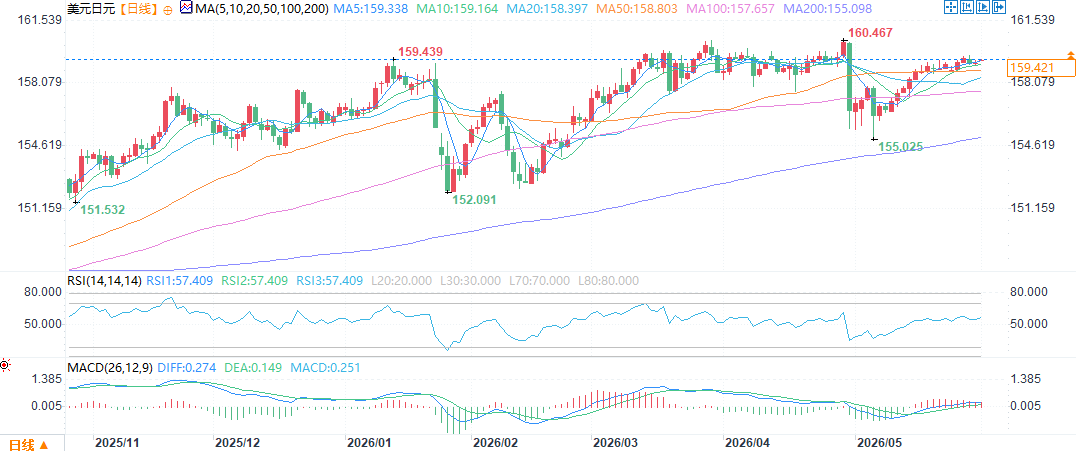
(USD/JPY daily chart, source: FX678)
In terms of moving averages, the price is currently trading above all moving averages (MA5, MA10, MA20, MA50, MA100, MA200), forming a standard bullish alignment. The long-term trend is clearly upward, while short-term moving averages continue to provide support. After a previous surge to 160.47, the price quickly fell back to 155.03, followed by a strong rebound. The current price is trading around 159.42, having returned to the upper edge of the previous consolidation range.
Regarding key support and resistance levels, short-term support lies at the 20-day moving average (MA20) (158.40) and the 50-day moving average (MA50) (158.80), with strong support below at the previous low of 155.03. Resistance is at the recent high of 160.47, and a break above this level could open up new upside potential.
At 8:51 AM Beijing time on June 1, the USD/JPY exchange rate was 159.44/45.
The yield on Japan's 10-year government bonds rose to 2.80% on May 20, a new high since 1996. Although it subsequently fell back, it is still holding above 2.65%. The yield on 30-year government bonds also briefly broke through 4%. Behind this trend is the market's dual concerns about fiscal discipline and inflationary pressures.
Japanese Prime Minister Sanae Takaichi is drafting a supplementary budget of approximately 3 trillion yen (about US$19 billion) to address the pressure on households from rising energy prices, and has indicated that it will be financed by issuing deficit-covered bonds, while pledging to keep the total amount of bonds issued unchanged in the 2026 calendar year.
However, some analysts believe that this supplementary budget is more of a "targeted relief" than a large-scale stimulus, and the Japanese economy still benefits from strong growth in semiconductor exports and AI-related demand.
Supplementary budget released: approximately 3 trillion yen for energy subsidies
The Japanese government is preparing a supplementary budget of approximately 3 trillion yen (about US$19 billion) to replenish reserves amid high energy costs and to fund subsidies for fuel and utilities.
Japanese Prime Minister Sanae Takaichi is drafting a supplementary budget to help households cope with the pressures of the cost of living, but this has also raised questions in the market about her ability to keep her debt issuance commitments. The budget, roughly 3 trillion yen, is largely in line with market expectations, but its release comes against the backdrop of Japan still grappling with high energy prices, rising subsidy costs, and a weak yen.
Bond issuance commitments questioned
Sanae Takaichi stated that the total bond issuance for the 2026 calendar year will remain unchanged from the original budget plan. She attempted to quell concerns in the bond market, saying that additional spending would be financed through the issuance of deficit-covering bonds.
However, Jesper Koll, a specialist at Monex Group, bluntly stated: "The bond market has many characteristics, but it is not stupid. You cannot increase spending without increasing debt."
Fiscal concerns vs. targeted relief
Louis Chua, Asia equity research analyst at Julius Baer, said: “Recent developments – including continued uncertainty in the Middle East, high commodity prices, and rising fuel subsidy spending – have exacerbated concerns in the bond market about Japan’s fiscal situation this year.”
Koll believes that investors would be more confident if the government publicly announced the issuance of 10 trillion yen in bonds to finance a 10 trillion yen budget, rather than launching a smaller bailout package and promising not to issue any more bonds. "People would believe the former, nobody would believe the latter."
Optimistic view: Not a large-scale stimulus, the economy still has support.
However, not all analysts believe the budget is destructive.
Krishna Bhimavarapu, an economist for Asia Pacific at State Street Global Advisors, said the firm “remains structurally optimistic about the Japanese economy and markets.”
He believes that this supplementary budget does not look like a large-scale stimulus, but rather a targeted relief for households facing energy price pressures due to the conflict with Iran, which is consistent with Sanae Kaoichi's philosophy rather than a large-scale demand stimulus.
Economic data: Strong exports supported by AI demand.
Recent data reinforces this view. The economy grew at an annualized rate of 2.1% in the first quarter, with real GDP growing by 0.5% quarter-on-quarter. Exports in April increased by 14.8% year-on-year, driven by strong semiconductor shipments and AI-related demand.
Koll also believes that the stock market still has room to rise due to corporate restructuring, record mergers and acquisitions, activist investors, private equity, and domestic business investment.
Bond Market and Yen Outlook: Upward Yield Trend May Continue
But the situation is different for bonds and the yen. The dollar is still trading above 159 against the yen, not far from the 160 level—a level that is generally considered a potential trigger for intervention.
Data released by Japan's Ministry of Finance on Friday showed that between April 28 and May 27, Japan intervened in the foreign exchange market with 11.7 trillion yen (approximately US$73.6 billion) to support the continuously weakening yen. While this amount is substantial, the market generally believes that the intervention can only "buy time" and cannot "change the trend." As former Bank of Japan policy board member Makoto Sakurai stated, "If they don't raise interest rates this time, their policy will lag behind the situation. This meeting is crucial."
Makoto Sakurai's warning is not unfounded. Current market pricing indicates that the probability of the Bank of Japan raising interest rates by 25 basis points at its June 16 meeting has climbed to approximately 78%-80%.
Several institutions pointed out that U.S. Treasury Secretary Bessenter gave the "green light" for further interest rate hikes in Japan during his visit to Tokyo this month, which cleared diplomatic obstacles for the Sanae Takaichi government to accept the rate hike.
Standard Chartered Bank analysts pointed out that the USD/JPY exchange rate has recently remained close to 159, and despite the overall weakness of the US dollar, there has been no significant buying interest in the yen.
HSBC emphasized that the boosting effect of simple intervention on the yen would quickly fade, and unless external conditions such as the Bank of Japan raising interest rates and falling oil prices come together, the USD/JPY exchange rate is unlikely to establish a clear downward trend in the short term.
From a technical perspective, the USD/JPY pair is currently in a high-level consolidation phase within a long-term uptrend, with the overall bullish pattern remaining stable. In the short term, it is testing key resistance levels.
(USD/JPY daily chart, source: FX678)
In terms of moving averages, the price is currently trading above all moving averages (MA5, MA10, MA20, MA50, MA100, MA200), forming a standard bullish alignment. The long-term trend is clearly upward, while short-term moving averages continue to provide support. After a previous surge to 160.47, the price quickly fell back to 155.03, followed by a strong rebound. The current price is trading around 159.42, having returned to the upper edge of the previous consolidation range.
Regarding key support and resistance levels, short-term support lies at the 20-day moving average (MA20) (158.40) and the 50-day moving average (MA50) (158.80), with strong support below at the previous low of 155.03. Resistance is at the recent high of 160.47, and a break above this level could open up new upside potential.
At 8:51 AM Beijing time on June 1, the USD/JPY exchange rate was 159.44/45.
- Risk Warning and Disclaimer
- The market involves risk, and trading may not be suitable for all investors. This article is for reference only and does not constitute personal investment advice, nor does it take into account certain users’ specific investment objectives, financial situation, or other needs. Any investment decisions made based on this information are at your own risk.