Unexpected stall in Japanese corporate investment coupled with escalating Middle East risks sent the dollar near a four-week high against the yen.
2026-06-01 09:53:21
The US dollar rose against the Japanese yen (USD/JPY) in Asian trading on Monday, regaining the 159 level and approaching 159.50, continuing its recent strong performance. Market concerns about a slowdown in Japanese economic growth, coupled with renewed demand for the safe-haven dollar, pushed the exchange rate close to its near four-week high reached last week.

Data released that day showed that Japanese corporate capital expenditure stagnated in the first quarter, significantly lower than market expectations, and slowed considerably from the approximately 6.5% year-on-year increase expected in the fourth quarter of 2025. As a key indicator of economic vitality, the weakening growth momentum of corporate investment has raised new concerns about the prospects for Japan's economic recovery.
Stagnant capital expenditure growth signifies a decline in corporate expansion willingness and reflects a cautious attitude towards the future economic environment. Against the backdrop of rising global economic uncertainty and increased energy price volatility, Japan, as an economy highly dependent on energy imports, faces further increased pressure.
Meanwhile, the situation in the Middle East remains a significant variable influencing global markets. Israel's expansion of its ground operations in Lebanon has further strained regional security. Negotiations between the United States and Iran regarding their nuclear programs and the Strait of Hormuz have yet to yield a breakthrough, with both sides continuing to exchange proposals through mediation channels in Pakistan and other regions.
The market generally believes that the safety of shipping through the Strait of Hormuz is directly related to the stability of global energy supply. The Strait of Hormuz handles approximately 20% of global seaborne crude oil transport; any disruption to this transport would have a significant impact on the Japanese economy, which is heavily reliant on imported energy. Therefore, escalating geopolitical risks have weakened market confidence in the yen. On the other hand, the US dollar has received multiple positive supports. With ongoing risks in the Middle East, funds are flowing back into safe-haven assets such as the US dollar. The US dollar index has gradually rebounded from near its two-week low, indicating a decline in market risk appetite.
Furthermore, the rebound in international oil prices from last week's lows has reignited market concerns about US inflation. Investors worry that rising energy prices could push up transportation and production costs, thus delaying the decline in US inflation. The market now widely expects the Federal Reserve to maintain its high-interest-rate policy for longer than previously anticipated. If energy prices continue to rise and drive a rebound in inflation, the Fed may even maintain its hawkish stance. This expectation is keeping US Treasury yields high and further enhancing the attractiveness of the US dollar.
Some market analysts have stated, "The current rise in the USD/JPY exchange rate is not solely driven by a stronger dollar; weak Japanese economic data and the impact of energy risks on Japan's economic outlook are also significant factors contributing to the upward movement." However, concerns remain about potential renewed government intervention in the foreign exchange market. As the USD/JPY exchange rate approaches the 160 level again, the policy moves of the Ministry of Finance and the Bank of Japan are attracting close market attention.
Historical experience shows that when the USD/JPY exchange rate rapidly approaches or breaks through key psychological levels, Japanese authorities often strengthen verbal warnings or even take actual intervention measures to slow the yen's depreciation. Therefore, although the USD/JPY exchange rate maintains an overall upward trend, investors remain somewhat cautious about chasing the rally.
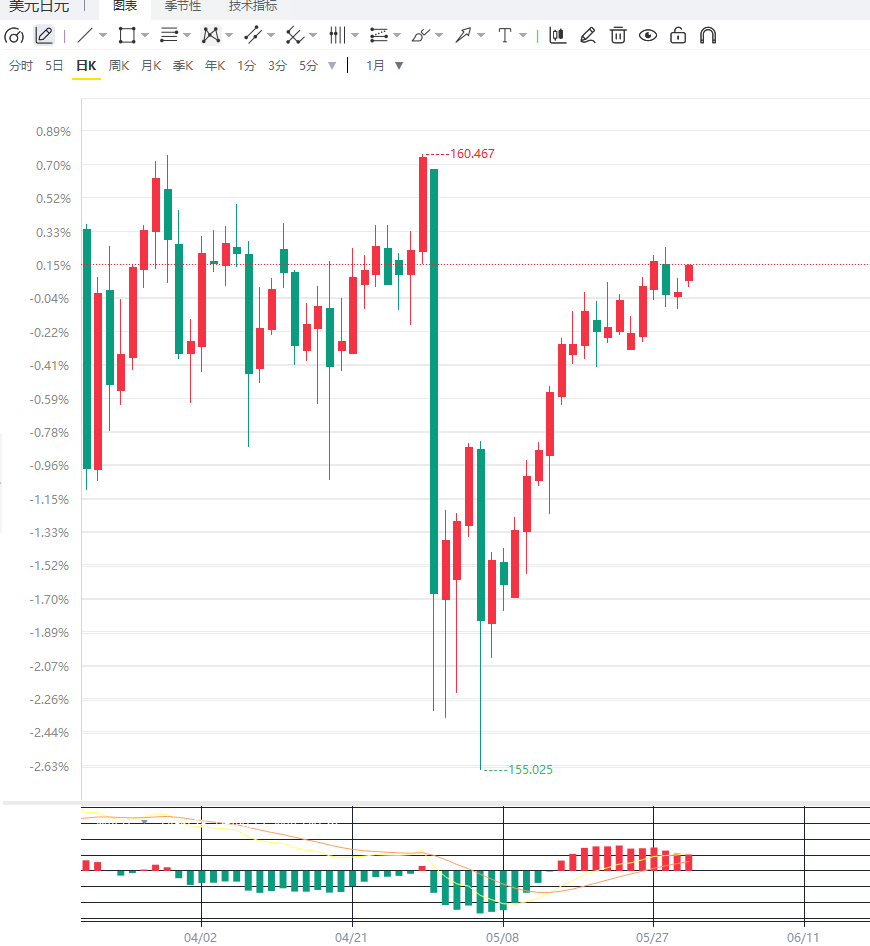
From the daily chart, the USD/JPY pair maintains a clear upward structure. The exchange rate has consistently traded above major moving averages, indicating a continued bullish trend in the medium to long term. The 158.00 area forms a significant support level in the near term, while the 160.00 level represents a key psychological resistance. A decisive break above 160.00 could lead to further testing of the 161.50 and even 163.00 areas; conversely, a drop below 158.00 could trigger a period of correction. The RSI indicator remains above 60, suggesting that bullish momentum still dominates. The MACD indicator continues above the zero line, with the red bars gradually expanding, reflecting increased upward momentum in the market.
From the 4-hour chart, the exchange rate has rebounded steadily after stabilizing around 156.50, with short-term moving averages re-aligning in a bullish pattern. The MACD indicator has formed a golden cross and continues to diverge upwards, indicating that short-term funds remain biased towards buying. The RSI indicator has risen to around 65, but has not yet entered the extreme overbought zone. Short-term support levels are located in the 158.80 and 158.00 area, while the first resistance level is around 159.50. A break above this level could lead to a further challenge of the 160.00 mark. Overall, the short-term trend remains bullish, but caution is advised near the 160 level due to the risk of significant volatility caused by potential intervention from the Japanese government.
Editor's Summary:
This week, market focus will shift to key US economic data. Investors will pay close attention to the ISM Manufacturing PMI, employment data, and the subsequent non-farm payroll report. This data will not only influence market assessments of the US economic outlook but will also directly impact expectations for future Federal Reserve policy. Strong data could continue to support the USD/JPY pair; conversely, signs of slowing economic growth could limit further upside for the dollar.
Data released that day showed that Japanese corporate capital expenditure stagnated in the first quarter, significantly lower than market expectations, and slowed considerably from the approximately 6.5% year-on-year increase expected in the fourth quarter of 2025. As a key indicator of economic vitality, the weakening growth momentum of corporate investment has raised new concerns about the prospects for Japan's economic recovery.
Stagnant capital expenditure growth signifies a decline in corporate expansion willingness and reflects a cautious attitude towards the future economic environment. Against the backdrop of rising global economic uncertainty and increased energy price volatility, Japan, as an economy highly dependent on energy imports, faces further increased pressure.
Meanwhile, the situation in the Middle East remains a significant variable influencing global markets. Israel's expansion of its ground operations in Lebanon has further strained regional security. Negotiations between the United States and Iran regarding their nuclear programs and the Strait of Hormuz have yet to yield a breakthrough, with both sides continuing to exchange proposals through mediation channels in Pakistan and other regions.
The market generally believes that the safety of shipping through the Strait of Hormuz is directly related to the stability of global energy supply. The Strait of Hormuz handles approximately 20% of global seaborne crude oil transport; any disruption to this transport would have a significant impact on the Japanese economy, which is heavily reliant on imported energy. Therefore, escalating geopolitical risks have weakened market confidence in the yen. On the other hand, the US dollar has received multiple positive supports. With ongoing risks in the Middle East, funds are flowing back into safe-haven assets such as the US dollar. The US dollar index has gradually rebounded from near its two-week low, indicating a decline in market risk appetite.
Furthermore, the rebound in international oil prices from last week's lows has reignited market concerns about US inflation. Investors worry that rising energy prices could push up transportation and production costs, thus delaying the decline in US inflation. The market now widely expects the Federal Reserve to maintain its high-interest-rate policy for longer than previously anticipated. If energy prices continue to rise and drive a rebound in inflation, the Fed may even maintain its hawkish stance. This expectation is keeping US Treasury yields high and further enhancing the attractiveness of the US dollar.
Some market analysts have stated, "The current rise in the USD/JPY exchange rate is not solely driven by a stronger dollar; weak Japanese economic data and the impact of energy risks on Japan's economic outlook are also significant factors contributing to the upward movement." However, concerns remain about potential renewed government intervention in the foreign exchange market. As the USD/JPY exchange rate approaches the 160 level again, the policy moves of the Ministry of Finance and the Bank of Japan are attracting close market attention.
Historical experience shows that when the USD/JPY exchange rate rapidly approaches or breaks through key psychological levels, Japanese authorities often strengthen verbal warnings or even take actual intervention measures to slow the yen's depreciation. Therefore, although the USD/JPY exchange rate maintains an overall upward trend, investors remain somewhat cautious about chasing the rally.
From the daily chart, the USD/JPY pair maintains a clear upward structure. The exchange rate has consistently traded above major moving averages, indicating a continued bullish trend in the medium to long term. The 158.00 area forms a significant support level in the near term, while the 160.00 level represents a key psychological resistance. A decisive break above 160.00 could lead to further testing of the 161.50 and even 163.00 areas; conversely, a drop below 158.00 could trigger a period of correction. The RSI indicator remains above 60, suggesting that bullish momentum still dominates. The MACD indicator continues above the zero line, with the red bars gradually expanding, reflecting increased upward momentum in the market.
From the 4-hour chart, the exchange rate has rebounded steadily after stabilizing around 156.50, with short-term moving averages re-aligning in a bullish pattern. The MACD indicator has formed a golden cross and continues to diverge upwards, indicating that short-term funds remain biased towards buying. The RSI indicator has risen to around 65, but has not yet entered the extreme overbought zone. Short-term support levels are located in the 158.80 and 158.00 area, while the first resistance level is around 159.50. A break above this level could lead to a further challenge of the 160.00 mark. Overall, the short-term trend remains bullish, but caution is advised near the 160 level due to the risk of significant volatility caused by potential intervention from the Japanese government.
Editor's Summary:
This week, market focus will shift to key US economic data. Investors will pay close attention to the ISM Manufacturing PMI, employment data, and the subsequent non-farm payroll report. This data will not only influence market assessments of the US economic outlook but will also directly impact expectations for future Federal Reserve policy. Strong data could continue to support the USD/JPY pair; conversely, signs of slowing economic growth could limit further upside for the dollar.
- Risk Warning and Disclaimer
- The market involves risk, and trading may not be suitable for all investors. This article is for reference only and does not constitute personal investment advice, nor does it take into account certain users’ specific investment objectives, financial situation, or other needs. Any investment decisions made based on this information are at your own risk.