The unexpected contraction in the Canadian economy, coupled with increased demand for the safe-haven dollar, sent the USD/CAD pair back above 1.3800.
2026-06-01 14:47:46
The US dollar (USD/CAD) continued its rebound in Asian trading on Monday, recovering the 1.3800 level. Although it is still some distance from the mid-April high of around 1.3870 reached last week, the overall market sentiment remains bullish on the US dollar.
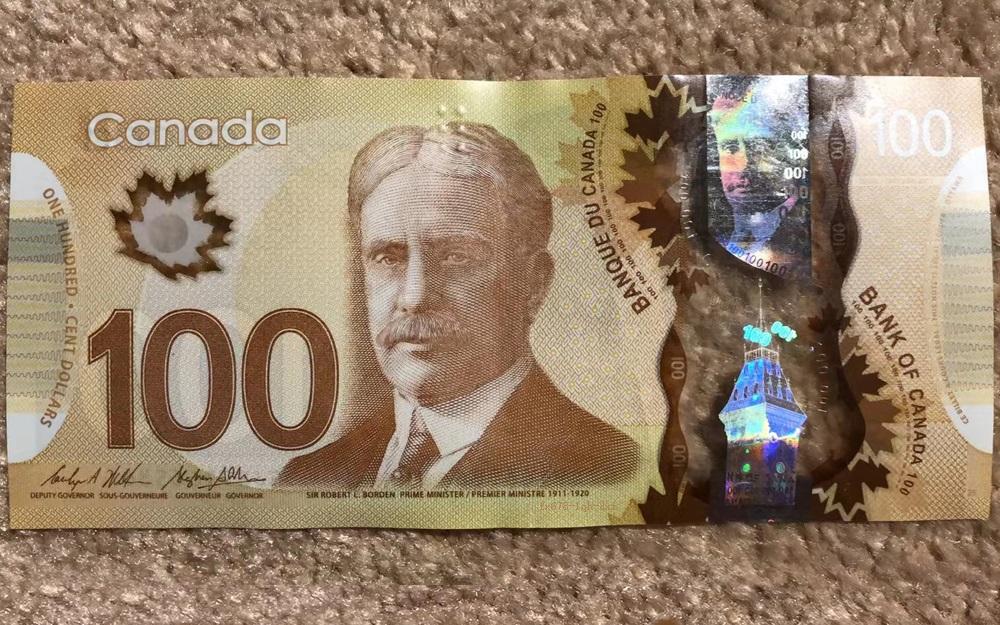
The core factors currently attracting market attention remain the diplomatic negotiations between the United States and Iran, as well as the security situation in the Middle East. Due to the significant differences between the two sides regarding their nuclear programs and the Strait of Hormuz, market expectations for a final agreement have cooled.
Meanwhile, Israel's expanded military operations in Lebanon have further increased uncertainty in the region. Rising risk aversion has boosted the US dollar, becoming a significant driver of its appreciation against the Canadian dollar.
Iran's chief negotiator, Ghalibaf, stated that Iran will not accept any agreement unless its national interests are fully guaranteed. This implies that future negotiations still face significant challenges. Furthermore, the recent hardening of the US stance on some key issues further complicates the process of reaching an agreement. Consequently, the market continues to maintain a certain risk premium, supporting the US dollar's performance.
The current rise in the US dollar is driven not only by safe-haven demand but also by expectations surrounding Federal Reserve policy. With the recent rebound in international oil prices and renewed concerns about energy supply risks, the market is worried that US inflation may face upward pressure again. Based on market pricing, investors now expect a higher probability of another 25 basis point rate hike by the Federal Reserve this year. High interest rate expectations are keeping US Treasury yields high and also enhancing the attractiveness of dollar-denominated assets.
In contrast, the Canadian dollar faces pressure from domestic economic data. The latest data from Canada shows that its GDP contracted by approximately 0.1% annualized in the first quarter of 2026, significantly weaker than market expectations. This unexpected negative growth reflects the gradually emerging dampening effect of the high-interest-rate environment on consumption and investment. The slowdown in economic growth has reduced market expectations for further policy tightening by the Bank of Canada, thus weakening the Canadian dollar's performance.
However, the Canadian dollar did not experience a significant decline, largely due to the rebound in international oil prices. Canada is one of the world's major energy exporters, and rising oil prices typically benefit its trade revenue and fiscal situation. Recently, with renewed tensions in the Middle East, international oil prices have rebounded from near a one-month low. This trend has improved market sentiment towards the Canadian dollar to some extent and limited the potential for further gains in the US dollar against the Canadian dollar.
Market analysts point out that "the current USD/CAD exchange rate reflects a balance between the safe-haven advantage of the US dollar and the support of oil prices for the Canadian dollar. In the short term, the market still needs new catalysts to break this equilibrium." From a market sentiment perspective, investors are currently focusing on the resilience of the US economy, the prospects for Canadian economic growth, and changes in the international energy market. These three factors will jointly determine the future trend of the USD/CAD exchange rate.
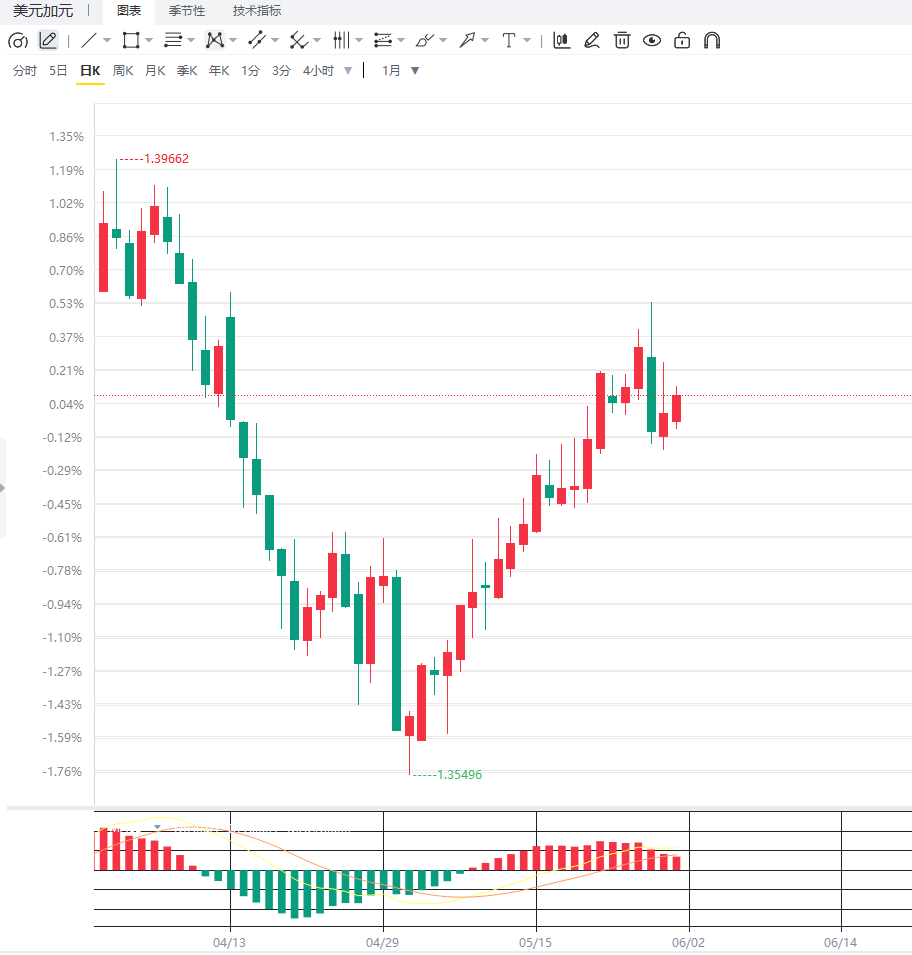
From the daily chart, the USD/CAD pair has formed a clear upward channel since early May, maintaining a complete bullish structure. The exchange rate continues to trade above major moving averages, indicating a medium-term upward bias. The 1.3750 area forms a significant support level, while the vicinity of 1.3870 is a key resistance level in the near term. A break above 1.3870 could lead to further challenges of the 1.3950 and 1.4000 areas; a break below 1.3750 could trigger a period of correction. The RSI indicator is hovering around 60, indicating that the market remains bullish. The MACD indicator maintains a golden cross structure, reflecting that upward momentum has not yet completely subsided.
From the 4-hour chart, the exchange rate has maintained a fluctuating upward trend recently. Short-term moving averages have reformed into a bullish alignment, indicating a recovery in short-term buying power. The MACD indicator is running above the zero line, with the red bars gradually expanding, reflecting improved short-term market momentum. The RSI indicator is hovering around 58, not yet entering overbought territory. Short-term support levels are located in the 1.3780 and 1.3750 area, while resistance levels are around 1.3850 and 1.3870. A break above 1.3870 could potentially extend the upward trend that has formed over the past month.
The market will continue to focus on the progress of US-Iran negotiations, developments in the Middle East, and this week's US ISM Manufacturing PMI and non-farm payroll data. Meanwhile, Canadian economic data and international oil price movements will continue to influence the Canadian dollar's performance. Against the backdrop of a strong US dollar and a slowing Canadian economy, the USD/CAD pair is generally biased towards a volatile upward trend, but a rebound in oil prices may limit the upside potential.
Editor's Summary : The USD/CAD pair is currently driven by multiple fundamental factors. Uncertainty surrounding the US-Iran negotiations and continued tensions in the Middle East have enhanced the US dollar's safe-haven appeal. Meanwhile, rising expectations of a Fed rate hike further strengthen the dollar's advantage. However, Canada's unexpected first-quarter economic contraction has weakened market confidence in the Canadian dollar. From a core market logic perspective, the current strength of the US dollar and the weakness of the Canadian economy constitute the main drivers of the USD/CAD rise. As long as US economic data remains resilient and the market maintains its hawkish expectations for the Fed, the US dollar is likely to continue to receive support. However, the rebound in international oil prices is providing some buffer for the Canadian dollar. As a typical commodity currency, the Canadian dollar often benefits from rising energy prices. Therefore, oil price movements will be one of the important variables affecting the exchange rate in the future. In the coming week, the US non-farm payroll report, the ISM manufacturing PMI, changes in the Middle East situation, and the performance of the oil market will be key factors determining the direction of the USD/CAD pair. Before breaking through 1.3870, the market may maintain a volatile but slightly bullish trend.
The core factors currently attracting market attention remain the diplomatic negotiations between the United States and Iran, as well as the security situation in the Middle East. Due to the significant differences between the two sides regarding their nuclear programs and the Strait of Hormuz, market expectations for a final agreement have cooled.
Meanwhile, Israel's expanded military operations in Lebanon have further increased uncertainty in the region. Rising risk aversion has boosted the US dollar, becoming a significant driver of its appreciation against the Canadian dollar.
Iran's chief negotiator, Ghalibaf, stated that Iran will not accept any agreement unless its national interests are fully guaranteed. This implies that future negotiations still face significant challenges. Furthermore, the recent hardening of the US stance on some key issues further complicates the process of reaching an agreement. Consequently, the market continues to maintain a certain risk premium, supporting the US dollar's performance.
The current rise in the US dollar is driven not only by safe-haven demand but also by expectations surrounding Federal Reserve policy. With the recent rebound in international oil prices and renewed concerns about energy supply risks, the market is worried that US inflation may face upward pressure again. Based on market pricing, investors now expect a higher probability of another 25 basis point rate hike by the Federal Reserve this year. High interest rate expectations are keeping US Treasury yields high and also enhancing the attractiveness of dollar-denominated assets.
In contrast, the Canadian dollar faces pressure from domestic economic data. The latest data from Canada shows that its GDP contracted by approximately 0.1% annualized in the first quarter of 2026, significantly weaker than market expectations. This unexpected negative growth reflects the gradually emerging dampening effect of the high-interest-rate environment on consumption and investment. The slowdown in economic growth has reduced market expectations for further policy tightening by the Bank of Canada, thus weakening the Canadian dollar's performance.
However, the Canadian dollar did not experience a significant decline, largely due to the rebound in international oil prices. Canada is one of the world's major energy exporters, and rising oil prices typically benefit its trade revenue and fiscal situation. Recently, with renewed tensions in the Middle East, international oil prices have rebounded from near a one-month low. This trend has improved market sentiment towards the Canadian dollar to some extent and limited the potential for further gains in the US dollar against the Canadian dollar.
Market analysts point out that "the current USD/CAD exchange rate reflects a balance between the safe-haven advantage of the US dollar and the support of oil prices for the Canadian dollar. In the short term, the market still needs new catalysts to break this equilibrium." From a market sentiment perspective, investors are currently focusing on the resilience of the US economy, the prospects for Canadian economic growth, and changes in the international energy market. These three factors will jointly determine the future trend of the USD/CAD exchange rate.
From the daily chart, the USD/CAD pair has formed a clear upward channel since early May, maintaining a complete bullish structure. The exchange rate continues to trade above major moving averages, indicating a medium-term upward bias. The 1.3750 area forms a significant support level, while the vicinity of 1.3870 is a key resistance level in the near term. A break above 1.3870 could lead to further challenges of the 1.3950 and 1.4000 areas; a break below 1.3750 could trigger a period of correction. The RSI indicator is hovering around 60, indicating that the market remains bullish. The MACD indicator maintains a golden cross structure, reflecting that upward momentum has not yet completely subsided.
From the 4-hour chart, the exchange rate has maintained a fluctuating upward trend recently. Short-term moving averages have reformed into a bullish alignment, indicating a recovery in short-term buying power. The MACD indicator is running above the zero line, with the red bars gradually expanding, reflecting improved short-term market momentum. The RSI indicator is hovering around 58, not yet entering overbought territory. Short-term support levels are located in the 1.3780 and 1.3750 area, while resistance levels are around 1.3850 and 1.3870. A break above 1.3870 could potentially extend the upward trend that has formed over the past month.
The market will continue to focus on the progress of US-Iran negotiations, developments in the Middle East, and this week's US ISM Manufacturing PMI and non-farm payroll data. Meanwhile, Canadian economic data and international oil price movements will continue to influence the Canadian dollar's performance. Against the backdrop of a strong US dollar and a slowing Canadian economy, the USD/CAD pair is generally biased towards a volatile upward trend, but a rebound in oil prices may limit the upside potential.
Editor's Summary : The USD/CAD pair is currently driven by multiple fundamental factors. Uncertainty surrounding the US-Iran negotiations and continued tensions in the Middle East have enhanced the US dollar's safe-haven appeal. Meanwhile, rising expectations of a Fed rate hike further strengthen the dollar's advantage. However, Canada's unexpected first-quarter economic contraction has weakened market confidence in the Canadian dollar. From a core market logic perspective, the current strength of the US dollar and the weakness of the Canadian economy constitute the main drivers of the USD/CAD rise. As long as US economic data remains resilient and the market maintains its hawkish expectations for the Fed, the US dollar is likely to continue to receive support. However, the rebound in international oil prices is providing some buffer for the Canadian dollar. As a typical commodity currency, the Canadian dollar often benefits from rising energy prices. Therefore, oil price movements will be one of the important variables affecting the exchange rate in the future. In the coming week, the US non-farm payroll report, the ISM manufacturing PMI, changes in the Middle East situation, and the performance of the oil market will be key factors determining the direction of the USD/CAD pair. Before breaking through 1.3870, the market may maintain a volatile but slightly bullish trend.
- Risk Warning and Disclaimer
- The market involves risk, and trading may not be suitable for all investors. This article is for reference only and does not constitute personal investment advice, nor does it take into account certain users’ specific investment objectives, financial situation, or other needs. Any investment decisions made based on this information are at your own risk.