German retail sales fell less than expected, supporting the euro and suggesting it will remain range-bound in the short term.
2026-06-01 16:05:40
The euro traded in a range against the US dollar (EUR/USD) in the European session on Monday. After rebounding from around 1.1585 over the past two trading days, the pair has temporarily lost upward momentum and is currently fluctuating around 1.1650, with both bulls and bears remaining cautious. The latest German economic data showed that German retail sales fell 0.3% month-on-month in April, marking the second consecutive month of decline. However, this data was slightly better than the market expectation of a 0.4% decline and was unchanged from the previously revised March figure.

Data released by the Federal Statistical Office of Germany indicates that while German consumer spending remains under some pressure, the decline in consumer activity has not accelerated further. As the Eurozone's largest economy, German consumer performance is generally considered an important indicator of the Eurozone's economic health.
While German retail sales data failed to show growth, the better-than-expected results eased investor concerns about a Eurozone economic slowdown, providing some support for the euro. However, compared to the mild positive news from Europe, the market is more focused on the impact from the situation in the United States and the Middle East. Currently, negotiations between the United States and Iran regarding their nuclear programs and the Strait of Hormuz have not yielded any significant breakthroughs.
Iran's chief negotiator, Ghalibaf, stated that Iran will not accept any agreement until its core national interests are fully guaranteed. Meanwhile, the United States has recently been reported to have further strengthened its negotiating stance, increasing the difficulty of reaching an agreement.
Furthermore, Israel's escalating military operations in Lebanon have kept security risks in the Middle East at a high level. Global investors are therefore continuing to allocate to safe-haven assets, with the US dollar, as the international reserve currency, benefiting significantly. The persistent geopolitical risks have led to a resurgence in demand for the US dollar as a safe haven, becoming one of the main factors suppressing the rise of the euro against the dollar.
Meanwhile, international oil prices rebounded after a sharp correction last week. Renewed concerns about energy supply risks in the Middle East pushed oil prices up from a more than one-month low. Rising energy prices not only affect global economic growth expectations but also exacerbate market concerns about future inflation. Some investors therefore believe that the Federal Reserve may need to maintain a high-interest-rate policy environment for an extended period.
Market expectations regarding the Federal Reserve's future policy path are shifting. With rising energy prices and a resilient US economy, the market has renewed its bets on further tightening. Some market analysts point out that "the dollar is currently supported by both safe-haven demand and interest rate expectations, while the euro relies more on expectations of European Central Bank rate hikes; therefore, the euro's upside potential is limited in the short term."
Some market analysts pointed out: "Currently, the US dollar is supported by both safe-haven demand and interest rate expectations, while the euro relies more on expectations of interest rate hikes by the European Central Bank. Therefore, the euro's rebound potential is limited in the short term."
However, the euro is not entirely without supporting factors. Recent minutes from the European Central Bank's (ECB) meeting revealed that some policymakers had previously supported a more aggressive tightening path. The market now widely expects the ECB to implement an interest rate hike of approximately 25 basis points at its meeting this month. Persistent inflationary pressures and the ECB's hawkish stance provide some floor support for the euro.
The interplay between expectations of a European Central Bank interest rate hike and the safe-haven demand for the US dollar is the core logic behind the current euro/dollar exchange rate movement. From a market perspective, the US ISM Manufacturing PMI data will be a significant short-term catalyst. This data reflects the state of US manufacturing activity and influences market judgments on US economic growth and monetary policy.
Furthermore, the US non-farm payrolls report released this Friday will be a key event influencing the movements of the US dollar and the euro. If the job market continues to be strong, the dollar may gain further upward momentum; conversely, it may drive a temporary rebound in the euro.
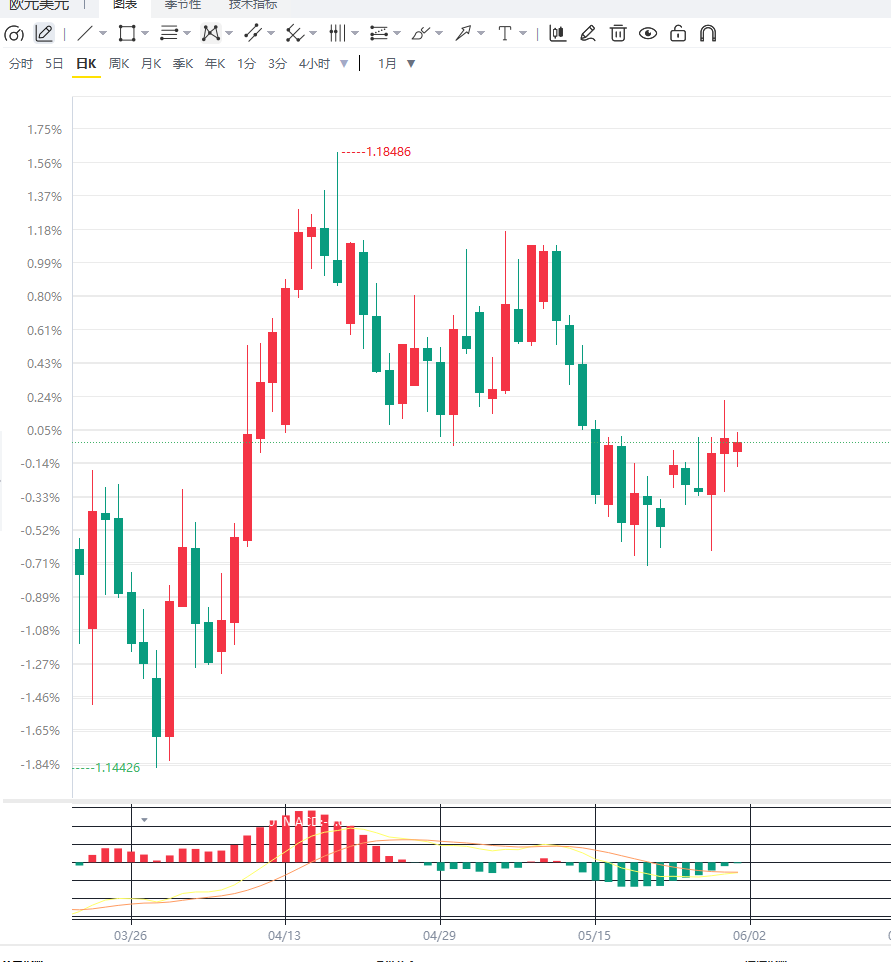
From the daily chart, the EUR/USD pair maintains its overall medium-term uptrend structure, but recent upward momentum has clearly slowed. The pair rebounded technically after finding support around 1.1585 and is currently trading above the major moving averages. The 1.1600 area forms the current key support level, while the 1.1700-1.1750 area forms a significant resistance zone. A break above 1.1750 could lead to a further challenge of the highs near 1.1800; a break below 1.1600 could result in a retest of the 1.1585 support area. The RSI indicator is around 55, indicating a continued mild bullish trend. The MACD indicator's red bars continue to contract, reflecting a weakening of upward momentum.
The market will focus on the US ISM Manufacturing PMI, non-farm payroll data, and the latest developments in US-Iran negotiations. Meanwhile, the European Central Bank's policy meeting this month is expected to continue to influence the euro's performance. Given the coexistence of safe-haven demand for the US dollar and expectations of an ECB rate hike, the euro/dollar exchange rate may continue to fluctuate in the short term, awaiting new fundamental factors to break the balance.
Editor's Summary : The euro/dollar exchange rate is currently influenced by a confluence of factors. While German retail sales data was slightly better than expected, it did not change the overall trend of slowing European economic growth. Meanwhile, the uncertain prospects of US-Iran negotiations and continued tensions in the Middle East are driving a resurgence in demand for the dollar as a safe haven. From a core market logic perspective, the dollar is currently supported by both safe-haven demand and hawkish expectations from the Federal Reserve, while the euro mainly relies on expectations of a European Central Bank (ECB) rate hike to maintain its strength. In the short term, both currencies have supporting fundamentals, so the exchange rate is more likely to maintain a range-bound trading pattern. The market needs to wait for further clarity from US economic data and ECB policy signals before a new trend can emerge. In the coming week, the US ISM Manufacturing PMI, non-farm payroll report, and developments in the Middle East will be the core drivers determining the direction of the euro/dollar exchange rate. If US data continues to be strong, the dollar is expected to maintain its advantage; if the ECB releases a clearer hawkish signal, the euro still has a chance to challenge recent highs.
Data released by the Federal Statistical Office of Germany indicates that while German consumer spending remains under some pressure, the decline in consumer activity has not accelerated further. As the Eurozone's largest economy, German consumer performance is generally considered an important indicator of the Eurozone's economic health.
While German retail sales data failed to show growth, the better-than-expected results eased investor concerns about a Eurozone economic slowdown, providing some support for the euro. However, compared to the mild positive news from Europe, the market is more focused on the impact from the situation in the United States and the Middle East. Currently, negotiations between the United States and Iran regarding their nuclear programs and the Strait of Hormuz have not yielded any significant breakthroughs.
Iran's chief negotiator, Ghalibaf, stated that Iran will not accept any agreement until its core national interests are fully guaranteed. Meanwhile, the United States has recently been reported to have further strengthened its negotiating stance, increasing the difficulty of reaching an agreement.
Furthermore, Israel's escalating military operations in Lebanon have kept security risks in the Middle East at a high level. Global investors are therefore continuing to allocate to safe-haven assets, with the US dollar, as the international reserve currency, benefiting significantly. The persistent geopolitical risks have led to a resurgence in demand for the US dollar as a safe haven, becoming one of the main factors suppressing the rise of the euro against the dollar.
Meanwhile, international oil prices rebounded after a sharp correction last week. Renewed concerns about energy supply risks in the Middle East pushed oil prices up from a more than one-month low. Rising energy prices not only affect global economic growth expectations but also exacerbate market concerns about future inflation. Some investors therefore believe that the Federal Reserve may need to maintain a high-interest-rate policy environment for an extended period.
Market expectations regarding the Federal Reserve's future policy path are shifting. With rising energy prices and a resilient US economy, the market has renewed its bets on further tightening. Some market analysts point out that "the dollar is currently supported by both safe-haven demand and interest rate expectations, while the euro relies more on expectations of European Central Bank rate hikes; therefore, the euro's upside potential is limited in the short term."
Some market analysts pointed out: "Currently, the US dollar is supported by both safe-haven demand and interest rate expectations, while the euro relies more on expectations of interest rate hikes by the European Central Bank. Therefore, the euro's rebound potential is limited in the short term."
However, the euro is not entirely without supporting factors. Recent minutes from the European Central Bank's (ECB) meeting revealed that some policymakers had previously supported a more aggressive tightening path. The market now widely expects the ECB to implement an interest rate hike of approximately 25 basis points at its meeting this month. Persistent inflationary pressures and the ECB's hawkish stance provide some floor support for the euro.
The interplay between expectations of a European Central Bank interest rate hike and the safe-haven demand for the US dollar is the core logic behind the current euro/dollar exchange rate movement. From a market perspective, the US ISM Manufacturing PMI data will be a significant short-term catalyst. This data reflects the state of US manufacturing activity and influences market judgments on US economic growth and monetary policy.
Furthermore, the US non-farm payrolls report released this Friday will be a key event influencing the movements of the US dollar and the euro. If the job market continues to be strong, the dollar may gain further upward momentum; conversely, it may drive a temporary rebound in the euro.
From the daily chart, the EUR/USD pair maintains its overall medium-term uptrend structure, but recent upward momentum has clearly slowed. The pair rebounded technically after finding support around 1.1585 and is currently trading above the major moving averages. The 1.1600 area forms the current key support level, while the 1.1700-1.1750 area forms a significant resistance zone. A break above 1.1750 could lead to a further challenge of the highs near 1.1800; a break below 1.1600 could result in a retest of the 1.1585 support area. The RSI indicator is around 55, indicating a continued mild bullish trend. The MACD indicator's red bars continue to contract, reflecting a weakening of upward momentum.
The market will focus on the US ISM Manufacturing PMI, non-farm payroll data, and the latest developments in US-Iran negotiations. Meanwhile, the European Central Bank's policy meeting this month is expected to continue to influence the euro's performance. Given the coexistence of safe-haven demand for the US dollar and expectations of an ECB rate hike, the euro/dollar exchange rate may continue to fluctuate in the short term, awaiting new fundamental factors to break the balance.
Editor's Summary : The euro/dollar exchange rate is currently influenced by a confluence of factors. While German retail sales data was slightly better than expected, it did not change the overall trend of slowing European economic growth. Meanwhile, the uncertain prospects of US-Iran negotiations and continued tensions in the Middle East are driving a resurgence in demand for the dollar as a safe haven. From a core market logic perspective, the dollar is currently supported by both safe-haven demand and hawkish expectations from the Federal Reserve, while the euro mainly relies on expectations of a European Central Bank (ECB) rate hike to maintain its strength. In the short term, both currencies have supporting fundamentals, so the exchange rate is more likely to maintain a range-bound trading pattern. The market needs to wait for further clarity from US economic data and ECB policy signals before a new trend can emerge. In the coming week, the US ISM Manufacturing PMI, non-farm payroll report, and developments in the Middle East will be the core drivers determining the direction of the euro/dollar exchange rate. If US data continues to be strong, the dollar is expected to maintain its advantage; if the ECB releases a clearer hawkish signal, the euro still has a chance to challenge recent highs.
- Risk Warning and Disclaimer
- The market involves risk, and trading may not be suitable for all investors. This article is for reference only and does not constitute personal investment advice, nor does it take into account certain users’ specific investment objectives, financial situation, or other needs. Any investment decisions made based on this information are at your own risk.