Behind the tug-of-war over gold at $4,500, the real pressure lies not in safe-haven demand.
2026-06-01 15:57:56
On Monday, June 1st, spot gold traded around $4,500 per ounce in early European trading, down approximately 0.80% on the day. Meanwhile, the US dollar index remained near 99, Brent crude rose to around $94 per barrel, and US crude was around $90.5 per barrel, with the rebound in energy prices continuing to amplify inflation sensitivity.
The ongoing negotiations between the US and Iran regarding a ceasefire extension have not yet been resolved, maintaining a safe-haven premium in the market. However, the market has not seen a one-sided rush to buy gold. This is because the unresolved negotiations are simultaneously increasing demand for the US dollar as a defensive asset. A stronger dollar raises the cost of holding gold for non-dollar investors, offsetting some of the safe-haven buying.
This is also the core contradiction behind the recent repeated fluctuations in gold prices around $4,500. If geopolitical uncertainty only manifests as emotional fluctuations and does not translate into sustained financial market pressure, gold will find it difficult to open up upward space solely based on the safe-haven narrative. Traders are not really focused on the negotiations themselves, but rather on whether the negotiations will change oil prices, inflation expectations, dollar liquidity, and the Fed's path. Currently, these factors do not support gold quickly breaking out of its consolidation pattern.
The rebound in crude oil prices is a key variable contributing to the current pressure on gold. Brent crude rose to approximately $94 per barrel on June 1st, a daily increase of nearly 3%; US crude also rose to approximately $90.50 per barrel, a daily increase of over 3%. However, the recovery in energy prices does not necessarily benefit gold in a straightforward way; the key lies in its transmission to inflation and interest rate expectations.
When rising oil prices are interpreted by the market as inflationary disturbances, gold's inflation-hedging properties are repriced; conversely, if the market simultaneously believes the Federal Reserve needs to maintain higher interest rates, the opportunity cost of gold as a non-interest-bearing asset will rise accordingly. Current price performance shows the latter has a stronger impact. In other words, gold is not ignoring geopolitical risks, but rather its safe-haven premium is compressed in the face of higher interest rate expectations.
The Federal Reserve maintained its target range for the federal funds rate at 3.50%-3.75% at its April meeting, emphasizing that it will continue to assess new data, changes in the outlook, and the balance of risks, while committing to pushing inflation back to its 2% target. Recent Fed officials have also noted that lower interest rates stimulate demand and could push up inflation, while higher interest rates typically dampen economic activity and suppress inflation.
This means that short-term gold price movements are not solely driven by geopolitical news, but also by whether data is sufficient to alter the interest rate path. The US May jobs report will be released on June 5th, and the market will use job growth, the unemployment rate, and wage growth to determine whether the Federal Reserve still has grounds to maintain a restrictive policy. If employment and inflation data do not show significant weakness, gold's upside potential will likely remain suppressed by real interest rates and the US dollar.
From the daily chart, spot gold is trading below the middle Bollinger Band. The middle Bollinger Band is around $4587.70, the upper band is around $4753.98, and the lower band is around $4421.42. The current price is clearly in the lower half of the channel. After failing to sustain the recent high of $4773.37, gold prices have gradually retreated, with the previous low of $4366.52 remaining a key level for the market.
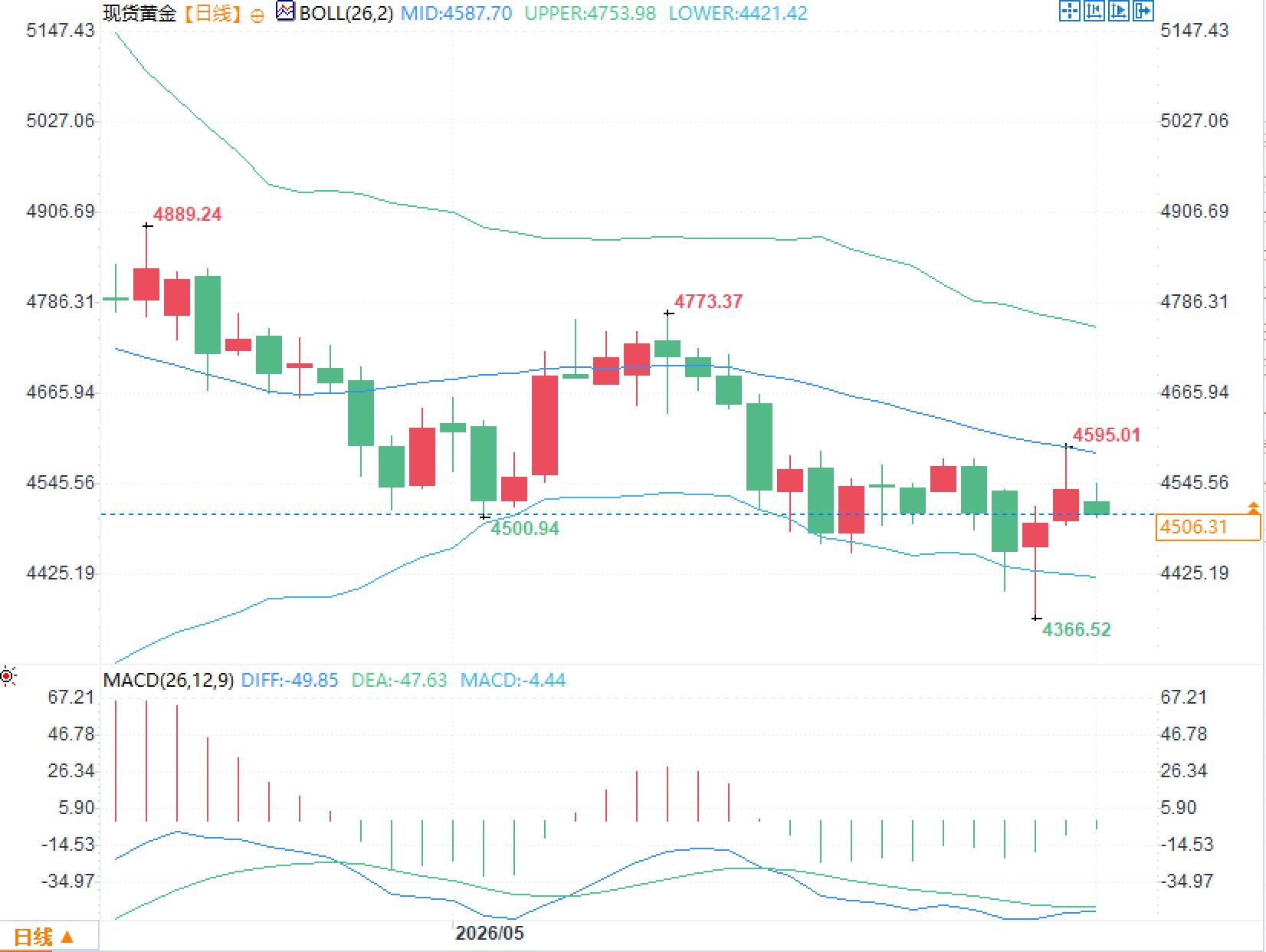
In terms of MACD, the DIF is around -49.85, the DEA is around -47.63, and the histogram is around -4.44, indicating that momentum has not yet fully recovered. More importantly, the price fluctuation range has narrowed, with prices repeatedly testing around $4500 but failing to break away effectively. This technical structure does not imply a predetermined direction, but rather suggests that after volatility compression, sensitivity to employment data, oil prices, and negotiation news may increase.
Question 1: Why is spot gold struggling to strengthen significantly despite the risk aversion environment?
A: While safe-haven demand does exist, the US dollar is also supported by defensive needs. A stronger dollar coupled with high interest rate expectations increases the cost of holding gold, preventing safe-haven buying from translating into a sustained upward trend.
Question 2: Is rising oil prices a positive or negative factor for gold?
A: It depends on the market's pricing focus. If oil prices drive up inflation concerns, gold has an inflation-hedging logic; if oil prices make it more difficult for the Federal Reserve to cut interest rates, then non-interest-bearing gold will be constrained by interest rates, and the market currently leans more towards the latter.
Question 3: Why is the area around $4,500 important?
A: This area is close to the recent center of oscillation and is also a position where prices have repeatedly struggled on the chart. If the price continues to stay below the Bollinger Band's middle line, it indicates that the rebound will still be under pressure; only if subsequent data changes expectations for the US dollar and interest rates will the range of fluctuations likely reopen.
The sideways movement in gold prices reflects the offsetting effect of safe-haven buying and support from the US dollar.
The ongoing negotiations between the US and Iran regarding a ceasefire extension have not yet been resolved, maintaining a safe-haven premium in the market. However, the market has not seen a one-sided rush to buy gold. This is because the unresolved negotiations are simultaneously increasing demand for the US dollar as a defensive asset. A stronger dollar raises the cost of holding gold for non-dollar investors, offsetting some of the safe-haven buying.
This is also the core contradiction behind the recent repeated fluctuations in gold prices around $4,500. If geopolitical uncertainty only manifests as emotional fluctuations and does not translate into sustained financial market pressure, gold will find it difficult to open up upward space solely based on the safe-haven narrative. Traders are not really focused on the negotiations themselves, but rather on whether the negotiations will change oil prices, inflation expectations, dollar liquidity, and the Fed's path. Currently, these factors do not support gold quickly breaking out of its consolidation pattern.
The rebound in oil prices has shifted the macro pricing focus of gold.
The rebound in crude oil prices is a key variable contributing to the current pressure on gold. Brent crude rose to approximately $94 per barrel on June 1st, a daily increase of nearly 3%; US crude also rose to approximately $90.50 per barrel, a daily increase of over 3%. However, the recovery in energy prices does not necessarily benefit gold in a straightforward way; the key lies in its transmission to inflation and interest rate expectations.
When rising oil prices are interpreted by the market as inflationary disturbances, gold's inflation-hedging properties are repriced; conversely, if the market simultaneously believes the Federal Reserve needs to maintain higher interest rates, the opportunity cost of gold as a non-interest-bearing asset will rise accordingly. Current price performance shows the latter has a stronger impact. In other words, gold is not ignoring geopolitical risks, but rather its safe-haven premium is compressed in the face of higher interest rate expectations.
The Federal Reserve's path remains a hard constraint on gold price pricing.
The Federal Reserve maintained its target range for the federal funds rate at 3.50%-3.75% at its April meeting, emphasizing that it will continue to assess new data, changes in the outlook, and the balance of risks, while committing to pushing inflation back to its 2% target. Recent Fed officials have also noted that lower interest rates stimulate demand and could push up inflation, while higher interest rates typically dampen economic activity and suppress inflation.
This means that short-term gold price movements are not solely driven by geopolitical news, but also by whether data is sufficient to alter the interest rate path. The US May jobs report will be released on June 5th, and the market will use job growth, the unemployment rate, and wage growth to determine whether the Federal Reserve still has grounds to maintain a restrictive policy. If employment and inflation data do not show significant weakness, gold's upside potential will likely remain suppressed by real interest rates and the US dollar.
Technical analysis indicates that the $4,500 area remains a key dividing line between bullish and bearish sentiment.
From the daily chart, spot gold is trading below the middle Bollinger Band. The middle Bollinger Band is around $4587.70, the upper band is around $4753.98, and the lower band is around $4421.42. The current price is clearly in the lower half of the channel. After failing to sustain the recent high of $4773.37, gold prices have gradually retreated, with the previous low of $4366.52 remaining a key level for the market.
In terms of MACD, the DIF is around -49.85, the DEA is around -47.63, and the histogram is around -4.44, indicating that momentum has not yet fully recovered. More importantly, the price fluctuation range has narrowed, with prices repeatedly testing around $4500 but failing to break away effectively. This technical structure does not imply a predetermined direction, but rather suggests that after volatility compression, sensitivity to employment data, oil prices, and negotiation news may increase.
Frequently Asked Questions
Question 1: Why is spot gold struggling to strengthen significantly despite the risk aversion environment?
A: While safe-haven demand does exist, the US dollar is also supported by defensive needs. A stronger dollar coupled with high interest rate expectations increases the cost of holding gold, preventing safe-haven buying from translating into a sustained upward trend.
Question 2: Is rising oil prices a positive or negative factor for gold?
A: It depends on the market's pricing focus. If oil prices drive up inflation concerns, gold has an inflation-hedging logic; if oil prices make it more difficult for the Federal Reserve to cut interest rates, then non-interest-bearing gold will be constrained by interest rates, and the market currently leans more towards the latter.
Question 3: Why is the area around $4,500 important?
A: This area is close to the recent center of oscillation and is also a position where prices have repeatedly struggled on the chart. If the price continues to stay below the Bollinger Band's middle line, it indicates that the rebound will still be under pressure; only if subsequent data changes expectations for the US dollar and interest rates will the range of fluctuations likely reopen.
- Risk Warning and Disclaimer
- The market involves risk, and trading may not be suitable for all investors. This article is for reference only and does not constitute personal investment advice, nor does it take into account certain users’ specific investment objectives, financial situation, or other needs. Any investment decisions made based on this information are at your own risk.