US military base attacked along with expensive drones! Gold faces test at $4500 level.
2026-06-01 16:31:34
On Monday (June 1), spot gold rose slightly in the morning but then retreated sharply, currently trading around the 4500 level. There was still no good news from the Middle East over the weekend, and news of a missile threat against Kuwait also emerged during the session.
The recent escalation of geopolitical tensions in the Middle East, with the military standoff and negotiation process between the United States and Iran running in parallel, has added further uncertainty to the already tense regional security landscape.
Over the weekend, Iran shot down a U.S. MQ-1 Predator drone near the Strait of Hormuz . In retaliation, the U.S. launched airstrikes over the weekend against radar stations and drone command and control centers near Gruuk and Qeshm Island in Iran . The U.S. Central Command emphasized that the strike was "precise and controlled" and aimed at eliminating threats to navigation security in the Persian Gulf, with no U.S. personnel casualties.
The Iranian Revolutionary Guard immediately launched a retaliatory strike. Although the target was not specified, Kuwaiti authorities confirmed that they activated their air defense system early Monday morning, intercepting multiple incoming missiles and a swarm of drones. As the location of the U.S. Army's forward command hub in the Middle East, Kuwait has become an indirect victim of the U.S.-Iran conflict, highlighting the passive position of neighboring countries in the game.
The Iranian Revolutionary Guard stated that the target of the retaliatory strike was an overseas airbase on Sirik Island in southern Iran, which was previously used by the US military in its airstrikes. Some of the retaliatory missiles were intercepted by the local air defense system while passing over Kuwait, and the debris from the explosions fell onto the base's tarmac, damaging a US MQ-9 Reaper drone worth over $30 million.

The US-Iran negotiations have entered a deep phase where "a consensus has been reached in principle, but technical details remain unresolved." The two sides still have differences on core issues such as the control of highly enriched uranium and the unfreezing of $12 billion in frozen assets. Trump has released optimistic signals but has not finalized a ceasefire and a plan for navigation in the Taiwan Strait.
When Trump pushed for a ceasefire, he unexpectedly attached conditions, demanding that Arab countries, Pakistan, and Turkey establish diplomatic relations with Israel in accordance with the Abraham Accords. This further exacerbated the already strained security situation and rifts in US-Arab relations among the Gulf states.
Arab leaders distrust the US and Israel, fearing that establishing diplomatic relations would anger Iran. The public finds it even harder to accept a deeper relationship with Israel due to Israel's military action in Gaza, with many viewing Israel as a "rogue" country.
Iran, in turn, adopted a "facts first" strategy, with its Revolutionary Guard announcing "smart control" of the Strait of Hormuz, emphasizing its sovereignty and listing the US military presence as a major cause of regional insecurity, thus forcing the US to make concessions.
This "fighting while negotiating" stance reflects the complex mentality of both the US and Iran, who are both avoiding a full-scale war and unwilling to compromise. The US needs a diplomatic victory to consolidate its election prospects, while Iran urgently needs to unfreeze its assets to alleviate economic pressure. Neither side is willing to concede on core interests.
The navigation status of the Strait of Hormuz has become a focus of the global energy market.
On May 31 local time, Iran announced that 28 merchant ships had been allowed to pass through the Strait of Hormuz within 24 hours, and that of the 109 large oil tankers stranded in the Persian Gulf after the outbreak of the conflict, 29 had sailed out in a low-speed, covert manner. It is said that the large oil tankers that sailed out of the Strait this time accounted for about a quarter of the total number in the Strait.
It is worth noting that some oil tankers have turned off their Automatic Identification Systems (AIS) to conceal their whereabouts, and the actual number of tankers navigating the area may be higher than the statistics suggest.
However, this "ice-breaking" progress has failed to fundamentally alleviate global energy pressures: as a vital transportation route for one-fifth of the world's crude oil and liquefied natural gas, the strait's navigation efficiency remains far below pre-conflict levels. Coupled with a record-breaking decline in global oil inventories (a daily reduction of 8.7 million barrels in May), the International Energy Agency warned that inventories can only last for a few weeks, and even if shipping fully recovers, market supply shortages will continue until 2027.
Neighboring countries have adopted differing stances on the situation. Kuwait, as a forward base for US troops, directly faces the risk of being caught in the crossfire of a military conflict and can only passively strengthen its air defenses.
Oman has adopted a strategy of "forced neutrality," neither recognizing Iran's exclusive jurisdiction over the Strait of Hormuz nor participating in US sanctions against Iran. It only cooperates with Iran to ensure the safety of the shipping lanes, avoiding jeopardizing its own energy facilities and economic cooperation by taking sides.
This cautious attitude reflects the dilemma faced by Middle Eastern countries in the US-Iran rivalry—they rely on regional stability to ensure energy exports, yet they struggle to escape the influence of major powers, resulting in a profound disruption of the regional geopolitical balance.
Furthermore, the conflict has disrupted the production capacity of fertilizers in the Gulf region, which accounts for 30% of the global fertilizer trade, further triggering a chain reaction of concerns about global food supply shortages.
Both the US and Iran continue to test each other and exercise restraint, but the bombing of the US military base in Kuwait, along with the Reaper drone, is a clear signal of escalating geopolitical risks and a crucial juncture for negotiations. The US's subsequent response to the Iranian attack will be vital for assessing the overall situation. While the US is currently using some military assets, it is also actively persuading Middle Eastern countries to establish diplomatic relations with Israel, and US Secretary of State Rubio has demanded that Hezbollah first cease fire, ultimately aiming to achieve a ceasefire between Israel and the US.
If the stalemate continues, the market may revert to pricing oil prices based on the logic of maintaining high prices in the long term, thereby suppressing gold prices.
However, since both the US and Iran have hard constraints that require ending the war—the US midterm elections and Iran's oil exports—this is more like another "boy who cried wolf" story, where the market, after accounting for the one-off shock, will return to the game of negotiating a peaceful resolution.
Technically, gold prices briefly broke through the middle line of the descending channel, but fell back to the 5-day moving average and the middle line the next day. If gold prices can hold the middle line of the continuously declining channel, they are expected to stabilize and the downward trend will turn into range-bound trading.
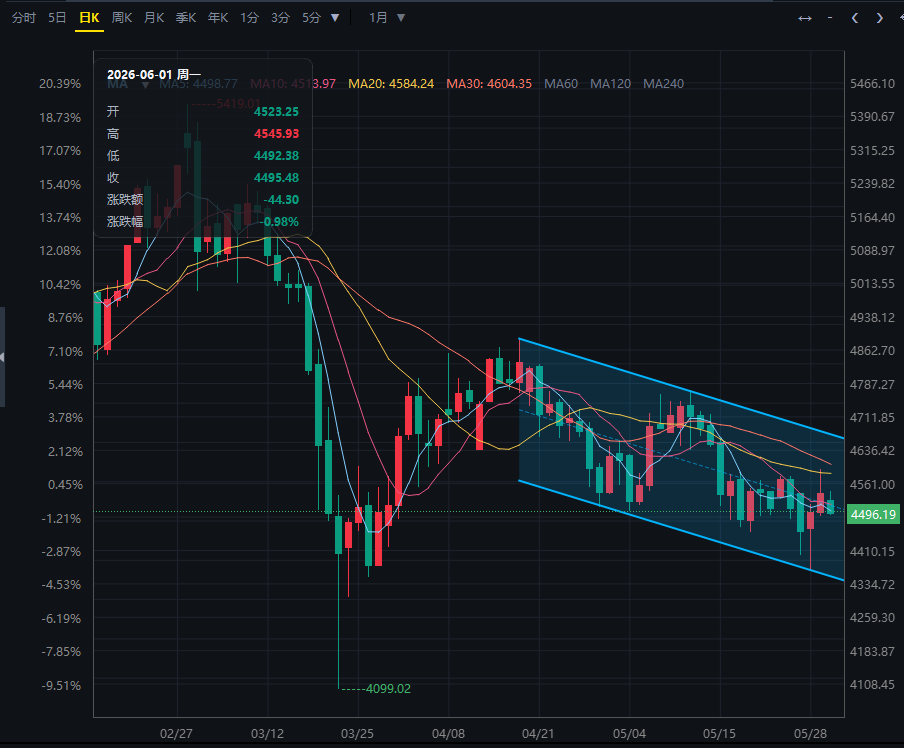
(Spot gold daily chart, source: EasyForex subsidiary)
At 16:20 Beijing time, spot gold was trading at $4494.75 per ounce.
The recent escalation of geopolitical tensions in the Middle East, with the military standoff and negotiation process between the United States and Iran running in parallel, has added further uncertainty to the already tense regional security landscape.
Over the weekend, Iran shot down a U.S. MQ-1 Predator drone near the Strait of Hormuz . In retaliation, the U.S. launched airstrikes over the weekend against radar stations and drone command and control centers near Gruuk and Qeshm Island in Iran . The U.S. Central Command emphasized that the strike was "precise and controlled" and aimed at eliminating threats to navigation security in the Persian Gulf, with no U.S. personnel casualties.
The Iranian Revolutionary Guard immediately launched a retaliatory strike. Although the target was not specified, Kuwaiti authorities confirmed that they activated their air defense system early Monday morning, intercepting multiple incoming missiles and a swarm of drones. As the location of the U.S. Army's forward command hub in the Middle East, Kuwait has become an indirect victim of the U.S.-Iran conflict, highlighting the passive position of neighboring countries in the game.
The Iranian Revolutionary Guard stated that the target of the retaliatory strike was an overseas airbase on Sirik Island in southern Iran, which was previously used by the US military in its airstrikes. Some of the retaliatory missiles were intercepted by the local air defense system while passing over Kuwait, and the debris from the explosions fell onto the base's tarmac, damaging a US MQ-9 Reaper drone worth over $30 million.
Negotiations on nuclear issues and other details remain deadlocked, with the US attaching conditions to establishing diplomatic relations with Israel.
The US-Iran negotiations have entered a deep phase where "a consensus has been reached in principle, but technical details remain unresolved." The two sides still have differences on core issues such as the control of highly enriched uranium and the unfreezing of $12 billion in frozen assets. Trump has released optimistic signals but has not finalized a ceasefire and a plan for navigation in the Taiwan Strait.
When Trump pushed for a ceasefire, he unexpectedly attached conditions, demanding that Arab countries, Pakistan, and Turkey establish diplomatic relations with Israel in accordance with the Abraham Accords. This further exacerbated the already strained security situation and rifts in US-Arab relations among the Gulf states.
Arab leaders distrust the US and Israel, fearing that establishing diplomatic relations would anger Iran. The public finds it even harder to accept a deeper relationship with Israel due to Israel's military action in Gaza, with many viewing Israel as a "rogue" country.
Iran, in turn, adopted a "facts first" strategy, with its Revolutionary Guard announcing "smart control" of the Strait of Hormuz, emphasizing its sovereignty and listing the US military presence as a major cause of regional insecurity, thus forcing the US to make concessions.
This "fighting while negotiating" stance reflects the complex mentality of both the US and Iran, who are both avoiding a full-scale war and unwilling to compromise. The US needs a diplomatic victory to consolidate its election prospects, while Iran urgently needs to unfreeze its assets to alleviate economic pressure. Neither side is willing to concede on core interests.
Cross-Strait Navigation Breaks the Ice: Short-Term Relief Fails to Address Long-Term Supply Gap
The navigation status of the Strait of Hormuz has become a focus of the global energy market.
On May 31 local time, Iran announced that 28 merchant ships had been allowed to pass through the Strait of Hormuz within 24 hours, and that of the 109 large oil tankers stranded in the Persian Gulf after the outbreak of the conflict, 29 had sailed out in a low-speed, covert manner. It is said that the large oil tankers that sailed out of the Strait this time accounted for about a quarter of the total number in the Strait.
It is worth noting that some oil tankers have turned off their Automatic Identification Systems (AIS) to conceal their whereabouts, and the actual number of tankers navigating the area may be higher than the statistics suggest.
However, this "ice-breaking" progress has failed to fundamentally alleviate global energy pressures: as a vital transportation route for one-fifth of the world's crude oil and liquefied natural gas, the strait's navigation efficiency remains far below pre-conflict levels. Coupled with a record-breaking decline in global oil inventories (a daily reduction of 8.7 million barrels in May), the International Energy Agency warned that inventories can only last for a few weeks, and even if shipping fully recovers, market supply shortages will continue until 2027.
Divergent Stances Among Neighboring Countries: A Dilemma in the Game and Hidden Concerns in the Supply Chain
Neighboring countries have adopted differing stances on the situation. Kuwait, as a forward base for US troops, directly faces the risk of being caught in the crossfire of a military conflict and can only passively strengthen its air defenses.
Oman has adopted a strategy of "forced neutrality," neither recognizing Iran's exclusive jurisdiction over the Strait of Hormuz nor participating in US sanctions against Iran. It only cooperates with Iran to ensure the safety of the shipping lanes, avoiding jeopardizing its own energy facilities and economic cooperation by taking sides.
This cautious attitude reflects the dilemma faced by Middle Eastern countries in the US-Iran rivalry—they rely on regional stability to ensure energy exports, yet they struggle to escape the influence of major powers, resulting in a profound disruption of the regional geopolitical balance.
Furthermore, the conflict has disrupted the production capacity of fertilizers in the Gulf region, which accounts for 30% of the global fertilizer trade, further triggering a chain reaction of concerns about global food supply shortages.
Summary and Technical Analysis:
Both the US and Iran continue to test each other and exercise restraint, but the bombing of the US military base in Kuwait, along with the Reaper drone, is a clear signal of escalating geopolitical risks and a crucial juncture for negotiations. The US's subsequent response to the Iranian attack will be vital for assessing the overall situation. While the US is currently using some military assets, it is also actively persuading Middle Eastern countries to establish diplomatic relations with Israel, and US Secretary of State Rubio has demanded that Hezbollah first cease fire, ultimately aiming to achieve a ceasefire between Israel and the US.
If the stalemate continues, the market may revert to pricing oil prices based on the logic of maintaining high prices in the long term, thereby suppressing gold prices.
However, since both the US and Iran have hard constraints that require ending the war—the US midterm elections and Iran's oil exports—this is more like another "boy who cried wolf" story, where the market, after accounting for the one-off shock, will return to the game of negotiating a peaceful resolution.
Technically, gold prices briefly broke through the middle line of the descending channel, but fell back to the 5-day moving average and the middle line the next day. If gold prices can hold the middle line of the continuously declining channel, they are expected to stabilize and the downward trend will turn into range-bound trading.
(Spot gold daily chart, source: EasyForex subsidiary)
At 16:20 Beijing time, spot gold was trading at $4494.75 per ounce.
- Risk Warning and Disclaimer
- The market involves risk, and trading may not be suitable for all investors. This article is for reference only and does not constitute personal investment advice, nor does it take into account certain users’ specific investment objectives, financial situation, or other needs. Any investment decisions made based on this information are at your own risk.