British pound bulls seize the opportunity: With the US dollar holding steady ahead of the non-farm payroll week, the pound is poised for its third consecutive gain.
2026-06-01 16:52:29
On Monday (June 1), during the European session, the pound traded around 1.3470 against the dollar, recording a slight increase and on track for a third consecutive trading day of gains. The pound generally rose against other major currencies.
Despite Bank of England Governor Bailey's statement that the central bank does not need to rush to raise interest rates and his warning that the Middle East conflict poses a risk to the economic outlook, the pound has shown some resilience.
At a conference in Reykjavik, Bailey said that the economic weakness and uncertainty surrounding the impact of the war with Iran mean that tolerating inflation temporarily above target is an appropriate policy trade-off.
However, he clarified that this tolerance would begin to wane if "signs of a second wave of effects begin to emerge." Meanwhile, the dollar held steady around 99.00 ahead of this week's non-farm payroll data release, with investors focusing on the US ISM Manufacturing PMI data to be released later on Monday.
Bailey stated that if "signs of a second round of effects begin to emerge," tolerance for inflation above target will begin to diminish.
This statement leaves room for potential future interest rate hikes, meaning the Bank of England will take action if rising energy prices begin to spread more broadly to wages and core prices.
The so-called "second-round effect" refers to the spread of rising energy costs through transportation, raw materials, and other channels to a wider range of economic sectors, triggering a "wage-price spiral." Once formed, inflation becomes self-reinforcing and persistent. Bailey's subtext is: seeing these signs, the Bank of England will no longer tolerate it.
The scenario of an energy supply shock is particularly detrimental to economies like the UK, which heavily rely on oil imports to meet its energy needs. Approximately half of the UK's oil and gas consumption is imported. Rising oil prices directly increase import bills, worsen the trade balance, and squeeze household and business spending.
Unlike the United States, which boasts a massive energy industry, Britain cannot profit from high oil prices; only consumers suffer. This puts the Bank of England in a more severe "stagflation" trade-off than the Federal Reserve. Bailey's "tolerant" stance is essentially buying time for this difficult trade-off—waiting for the energy shock to subside while closely monitoring the second-round effects.
Meanwhile, the dollar held steady amid a week packed with US data (especially the May non-farm payrolls report due on Friday).
This week, from the ISM Manufacturing PMI to the ADP employment report, and then Friday's non-farm payrolls, data will focus on reflecting the true resilience of the US economy amid energy shocks. The US dollar is holding steady near the 99 level, reflecting market caution ahead of the release of these crucial data points. Currently, the US dollar index is trading around 99.00.
Investors will be closely watching official U.S. employment data for new clues about the Federal Reserve's monetary policy outlook. Strong employment figures will increase expectations of a Fed rate hike, which would be positive for the dollar; conversely, weak employment data would be negative for the dollar. Currently, the market expects May's non-farm payrolls to increase by approximately 90,000 jobs, with an unemployment rate of 4.3%. Any data exceeding expectations could trigger significant volatility in the dollar.
On Monday, investors will also be watching the US May ISM Manufacturing PMI data, due at 22:00 Beijing time. The market expectation is 49.5. The "Prices Paid" sub-index in the report is particularly noteworthy—this indicator is a leading indicator of inflation.
If the price paid index continues to rise, it will reinforce the Federal Reserve's hawkish stance and provide support for the dollar.
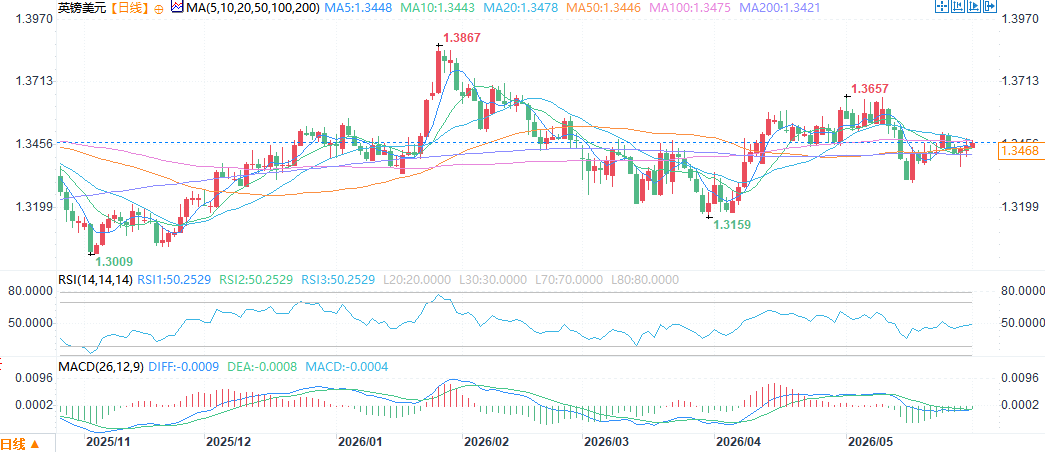
(GBP/USD daily chart, source: FX678)
The GBP/USD pair is currently in a wide-range, directionless consolidation phase on the daily chart. The price has fallen from its previous high of 1.3867, bottomed at 1.3159, rebounded to 1.3657, and recently fallen again, currently trading around 1.3468. It is within a densely packed area where multiple moving averages intersect, indicating a stalemate between bulls and bears, with no clear unilateral trend yet.
On the moving average system, the price oscillates repeatedly around the MA5/10/20/50/100, and has not yet formed a bullish or bearish alignment; the RSI indicator is near 50, in the neutral range, with no overbought or oversold signals; the MACD's DIFF and DEA lines are converging near the zero axis, and the momentum bars are extremely short, indicating that the bullish and bearish momentum is almost balanced.
Overall, the pound/dollar pair is expected to continue its range-bound trading in the short term, with resistance at 1.3657 and support around 1.3300. A breakout of this key range is needed to confirm the next direction.
At 16:43 Beijing time on June 1, the British pound was trading at 1.3471/72 against the US dollar.
Despite Bank of England Governor Bailey's statement that the central bank does not need to rush to raise interest rates and his warning that the Middle East conflict poses a risk to the economic outlook, the pound has shown some resilience.
At a conference in Reykjavik, Bailey said that the economic weakness and uncertainty surrounding the impact of the war with Iran mean that tolerating inflation temporarily above target is an appropriate policy trade-off.
However, he clarified that this tolerance would begin to wane if "signs of a second wave of effects begin to emerge." Meanwhile, the dollar held steady around 99.00 ahead of this week's non-farm payroll data release, with investors focusing on the US ISM Manufacturing PMI data to be released later on Monday.
Pele stated: Tolerating inflation has prerequisites; the second-round effect is key.
Bailey stated that if "signs of a second round of effects begin to emerge," tolerance for inflation above target will begin to diminish.
This statement leaves room for potential future interest rate hikes, meaning the Bank of England will take action if rising energy prices begin to spread more broadly to wages and core prices.
The so-called "second-round effect" refers to the spread of rising energy costs through transportation, raw materials, and other channels to a wider range of economic sectors, triggering a "wage-price spiral." Once formed, inflation becomes self-reinforcing and persistent. Bailey's subtext is: seeing these signs, the Bank of England will no longer tolerate it.
The scenario of an energy supply shock is particularly detrimental to economies like the UK, which heavily rely on oil imports to meet its energy needs. Approximately half of the UK's oil and gas consumption is imported. Rising oil prices directly increase import bills, worsen the trade balance, and squeeze household and business spending.
Unlike the United States, which boasts a massive energy industry, Britain cannot profit from high oil prices; only consumers suffer. This puts the Bank of England in a more severe "stagflation" trade-off than the Federal Reserve. Bailey's "tolerant" stance is essentially buying time for this difficult trade-off—waiting for the energy shock to subside while closely monitoring the second-round effects.
Dollar holds steady: Non-farm payroll week begins
Meanwhile, the dollar held steady amid a week packed with US data (especially the May non-farm payrolls report due on Friday).
This week, from the ISM Manufacturing PMI to the ADP employment report, and then Friday's non-farm payrolls, data will focus on reflecting the true resilience of the US economy amid energy shocks. The US dollar is holding steady near the 99 level, reflecting market caution ahead of the release of these crucial data points. Currently, the US dollar index is trading around 99.00.
Investors will be closely watching official U.S. employment data for new clues about the Federal Reserve's monetary policy outlook. Strong employment figures will increase expectations of a Fed rate hike, which would be positive for the dollar; conversely, weak employment data would be negative for the dollar. Currently, the market expects May's non-farm payrolls to increase by approximately 90,000 jobs, with an unemployment rate of 4.3%. Any data exceeding expectations could trigger significant volatility in the dollar.
On Monday, investors will also be watching the US May ISM Manufacturing PMI data, due at 22:00 Beijing time. The market expectation is 49.5. The "Prices Paid" sub-index in the report is particularly noteworthy—this indicator is a leading indicator of inflation.
If the price paid index continues to rise, it will reinforce the Federal Reserve's hawkish stance and provide support for the dollar.
GBP/USD Technical Analysis
(GBP/USD daily chart, source: FX678)
The GBP/USD pair is currently in a wide-range, directionless consolidation phase on the daily chart. The price has fallen from its previous high of 1.3867, bottomed at 1.3159, rebounded to 1.3657, and recently fallen again, currently trading around 1.3468. It is within a densely packed area where multiple moving averages intersect, indicating a stalemate between bulls and bears, with no clear unilateral trend yet.
On the moving average system, the price oscillates repeatedly around the MA5/10/20/50/100, and has not yet formed a bullish or bearish alignment; the RSI indicator is near 50, in the neutral range, with no overbought or oversold signals; the MACD's DIFF and DEA lines are converging near the zero axis, and the momentum bars are extremely short, indicating that the bullish and bearish momentum is almost balanced.
Overall, the pound/dollar pair is expected to continue its range-bound trading in the short term, with resistance at 1.3657 and support around 1.3300. A breakout of this key range is needed to confirm the next direction.
At 16:43 Beijing time on June 1, the British pound was trading at 1.3471/72 against the US dollar.
- Risk Warning and Disclaimer
- The market involves risk, and trading may not be suitable for all investors. This article is for reference only and does not constitute personal investment advice, nor does it take into account certain users’ specific investment objectives, financial situation, or other needs. Any investment decisions made based on this information are at your own risk.