With US-Iran negotiations stalled, the strength of the oil price rebound remains questionable.
2026-06-01 18:02:22
Over the weekend, renewed clashes between the US and Iran near the Strait of Hormuz shattered nearly two months of relative calm. This military friction, occurring along the world's most important oil route, has once again plunged the crude oil market into a deep abyss of uncertainty. Brent crude rebounded more than 3.7% in a single day, touching the $94 mark—but is this increase a trend reversal or merely a short-covering maneuver?

The overall ceasefire remains unchanged, but the rifts are widening.
Since the ceasefire agreement took effect in early April, US-Iran negotiations have presented themselves as "close to a deal," yet have consistently failed to materialize. Trump has insisted on social media that Iran "very much wants to talk" and assured that the final outcome would benefit the US and its allies. However, reports indicate that Trump himself has made several demands for modifications to the latest terms drafted by his team and Iranian officials, with the issue of nuclear material disposal being one of the core points of contention. The two sides remain locked in a tug-of-war over details such as the management of Iran's enriched uranium stockpile and the implementation of a verification mechanism, making a consensus unlikely in the short term.
Meanwhile, Iran has made a ceasefire in Lebanon a precondition for any agreement, while Israel's ground offensive continues. Israeli Prime Minister Netanyahu's announcement this weekend of the capture of the strategically important Beaufort Castle indicates that the situation is far from stable. Amidst this multi-party power struggle, the complexity of the negotiations has far exceeded market expectations.
Wolf, a senior fellow at the Bruegel Institute, bluntly stated that market participants were "overly optimistic" about a diplomatic breakthrough. He pointed out that after more than 90 days of ceasefire, the fundamentals of the negotiations have not changed substantially: Iran retains nuclear enrichment materials, has the capability to maintain a blockade of the Strait of Hormuz, and the cost of a military retaliation against the US remains. The fundamentals have not changed at all. Iran still possesses the capability to cause significant damage, still controls the Strait of Hormuz, and still possesses nuclear enrichment materials. Several overseas energy analysis institutions echoed this view, believing that the current geopolitical risks have only been temporarily eased and have not eliminated the underlying threats.
The rebound candlestick had a small body, indicating slightly insufficient buying power.
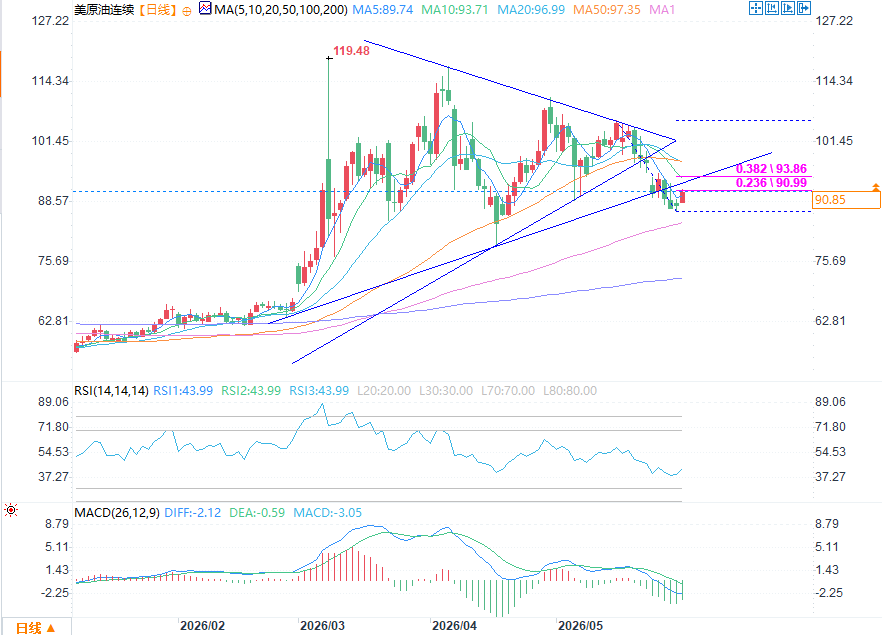
(WTI crude oil daily chart source: FX678)
From a technical perspective, crude oil prices are currently still trading below two upward trend lines. The recent rebound is characterized by small-bodied bullish candlesticks, which is not a signal of a strong upward move, but rather more like short covering and profit-taking after the previous sharp decline. The lack of short-term buying power is clearly reflected in the price structure.
Based on the Fibonacci retracement system analysis, this rebound precisely touched the 23.6% Fibonacci retracement level of the previous downward wave. After reaching this range, the upward momentum has become insufficient. Another set of Fibonacci resistance levels above also forms a superimposed resistance, further limiting the rebound's potential and preventing the bulls from launching a sustained upward attack.
Looking at the key support levels on the chart, if the market ends this rebound and returns to a downward channel, the first thing to watch is the previous low of 85.45, which is the first key support level. Once this level is effectively broken, the downside potential will open up further, with the next important target at 76.73.
The strategic value of Hormuz: Why the market cannot easily price it.
The Strait of Hormuz typically handles about 20% of global crude oil trade. If the situation escalates to a full blockade, the impact on the global energy market would be systemic, not localized. This weekend, Kuwait reported that its air defense system had intercepted missile and drone attacks originating from Iran, which the Kuwaiti Foreign Ministry characterized as a "dangerous escalation."
Kuwait's involvement is significant—as a relatively moderate political power in the Gulf region, the forced activation of its air defense system signifies that the spillover effects of the conflict have begun to reach indirect combatants. The shipping news outlet Lloyd's of Shipping also issued a warning, noting minor detours and delays in shipping services around the strait, and rising logistics costs. This signal should have made the market more cautious, rather than causing complacency due to Trump's optimistic statements.
Risk Warning
If negotiations remain deadlocked, there is a technical possibility of downward movement. The $80 and even $70 range are not unattainable targets; however, close attention should be paid to the two key support levels of $85.45 and $76.73, and caution should be exercised regarding the risk of accelerated downward movement after a breakout. At the current stage, the logic for a one-sided long position lacks sufficient support.
Trump's dilemma: negotiations need quiet, markets need certainty.
Trump's complaint that "the clamor of critics" both inside and outside his party disrupted his negotiating pace indicates that the negotiations are not progressing smoothly. A truly close agreement usually doesn't require leaders to expend effort appeasing external public opinion.
For the crude oil market, Trump's rhetoric is itself a source of volatility. His optimistic remarks may trigger short-term profit-taking, but structural buying requires more solid evidence: concrete progress on the nuclear issue, a commitment from Iran to freeze uranium enrichment, or a clear signal of de-escalation in the Lebanon-Israel conflict. Until these conditions are met, rallies should be seen as opportunities to buy on dips rather than the start of a trend reversal. Bloomberg Energy Commentary also points out that the market has long been desensitized to verbal positive news; only a concrete agreement can completely reverse the short-term weakness in oil prices.
Conclusion: Waiting for the true turning point amidst repeated cycles.
No negotiation will be smooth sailing; this is a reality the market must accept. The current volatile market—with sharp drops followed by strong rebounds the next day—is a true reflection of this uncertainty. The overarching context of a ceasefire remains unchanged, providing support for the market; however, the absence of an agreement means that a significant breakout from the top is equally difficult.
Until a structural solution emerges, a sensible strategy for crude oil might be to reduce the impulse to chase rising prices, increase skepticism about the sustainability of the rebound, and wait for policy signals that can truly reshape supply expectations.
The overall ceasefire remains unchanged, but the rifts are widening.
Since the ceasefire agreement took effect in early April, US-Iran negotiations have presented themselves as "close to a deal," yet have consistently failed to materialize. Trump has insisted on social media that Iran "very much wants to talk" and assured that the final outcome would benefit the US and its allies. However, reports indicate that Trump himself has made several demands for modifications to the latest terms drafted by his team and Iranian officials, with the issue of nuclear material disposal being one of the core points of contention. The two sides remain locked in a tug-of-war over details such as the management of Iran's enriched uranium stockpile and the implementation of a verification mechanism, making a consensus unlikely in the short term.
Meanwhile, Iran has made a ceasefire in Lebanon a precondition for any agreement, while Israel's ground offensive continues. Israeli Prime Minister Netanyahu's announcement this weekend of the capture of the strategically important Beaufort Castle indicates that the situation is far from stable. Amidst this multi-party power struggle, the complexity of the negotiations has far exceeded market expectations.
Wolf, a senior fellow at the Bruegel Institute, bluntly stated that market participants were "overly optimistic" about a diplomatic breakthrough. He pointed out that after more than 90 days of ceasefire, the fundamentals of the negotiations have not changed substantially: Iran retains nuclear enrichment materials, has the capability to maintain a blockade of the Strait of Hormuz, and the cost of a military retaliation against the US remains. The fundamentals have not changed at all. Iran still possesses the capability to cause significant damage, still controls the Strait of Hormuz, and still possesses nuclear enrichment materials. Several overseas energy analysis institutions echoed this view, believing that the current geopolitical risks have only been temporarily eased and have not eliminated the underlying threats.
The rebound candlestick had a small body, indicating slightly insufficient buying power.
(WTI crude oil daily chart source: FX678)
From a technical perspective, crude oil prices are currently still trading below two upward trend lines. The recent rebound is characterized by small-bodied bullish candlesticks, which is not a signal of a strong upward move, but rather more like short covering and profit-taking after the previous sharp decline. The lack of short-term buying power is clearly reflected in the price structure.
Based on the Fibonacci retracement system analysis, this rebound precisely touched the 23.6% Fibonacci retracement level of the previous downward wave. After reaching this range, the upward momentum has become insufficient. Another set of Fibonacci resistance levels above also forms a superimposed resistance, further limiting the rebound's potential and preventing the bulls from launching a sustained upward attack.
Looking at the key support levels on the chart, if the market ends this rebound and returns to a downward channel, the first thing to watch is the previous low of 85.45, which is the first key support level. Once this level is effectively broken, the downside potential will open up further, with the next important target at 76.73.
The strategic value of Hormuz: Why the market cannot easily price it.
The Strait of Hormuz typically handles about 20% of global crude oil trade. If the situation escalates to a full blockade, the impact on the global energy market would be systemic, not localized. This weekend, Kuwait reported that its air defense system had intercepted missile and drone attacks originating from Iran, which the Kuwaiti Foreign Ministry characterized as a "dangerous escalation."
Kuwait's involvement is significant—as a relatively moderate political power in the Gulf region, the forced activation of its air defense system signifies that the spillover effects of the conflict have begun to reach indirect combatants. The shipping news outlet Lloyd's of Shipping also issued a warning, noting minor detours and delays in shipping services around the strait, and rising logistics costs. This signal should have made the market more cautious, rather than causing complacency due to Trump's optimistic statements.
Risk Warning
If negotiations remain deadlocked, there is a technical possibility of downward movement. The $80 and even $70 range are not unattainable targets; however, close attention should be paid to the two key support levels of $85.45 and $76.73, and caution should be exercised regarding the risk of accelerated downward movement after a breakout. At the current stage, the logic for a one-sided long position lacks sufficient support.
Trump's dilemma: negotiations need quiet, markets need certainty.
Trump's complaint that "the clamor of critics" both inside and outside his party disrupted his negotiating pace indicates that the negotiations are not progressing smoothly. A truly close agreement usually doesn't require leaders to expend effort appeasing external public opinion.
For the crude oil market, Trump's rhetoric is itself a source of volatility. His optimistic remarks may trigger short-term profit-taking, but structural buying requires more solid evidence: concrete progress on the nuclear issue, a commitment from Iran to freeze uranium enrichment, or a clear signal of de-escalation in the Lebanon-Israel conflict. Until these conditions are met, rallies should be seen as opportunities to buy on dips rather than the start of a trend reversal. Bloomberg Energy Commentary also points out that the market has long been desensitized to verbal positive news; only a concrete agreement can completely reverse the short-term weakness in oil prices.
Conclusion: Waiting for the true turning point amidst repeated cycles.
No negotiation will be smooth sailing; this is a reality the market must accept. The current volatile market—with sharp drops followed by strong rebounds the next day—is a true reflection of this uncertainty. The overarching context of a ceasefire remains unchanged, providing support for the market; however, the absence of an agreement means that a significant breakout from the top is equally difficult.
Until a structural solution emerges, a sensible strategy for crude oil might be to reduce the impulse to chase rising prices, increase skepticism about the sustainability of the rebound, and wait for policy signals that can truly reshape supply expectations.
- Risk Warning and Disclaimer
- The market involves risk, and trading may not be suitable for all investors. This article is for reference only and does not constitute personal investment advice, nor does it take into account certain users’ specific investment objectives, financial situation, or other needs. Any investment decisions made based on this information are at your own risk.