Iran warns "every choice has a price," will crude oil return to $100?
2026-06-01 17:56:04
On Monday, June 1st, the crude oil market refocused its pricing attention on risks in the Gulf region and the pace of maritime transport recovery. Brent crude traded around $94 per barrel during the European session, up about 3% on the day, but still down 17.63% over the past month. This indicates that the current rebound is not a one-sided correction, but rather a repricing from "the expectation of an agreement compressing the risk premium" to "uncertainty regarding the implementation of the ceasefire." The chart shows that Brent crude is currently trading slightly above the lower Bollinger Band at $91.25 per barrel, but significantly below the middle band at $103.93 per barrel. The MACD remains in negative territory, indicating a coexistence of short-term recovery and medium-term weakness.

The core issue in the latest news is not whether the US and Iran are still negotiating, but whether the preconditions of the agreement can truly be maintained. Iranian official Ghalibaf recently stated that the maritime blockade and the escalation of the situation in Lebanon are evidence that the ceasefire has not been observed, emphasizing that every choice has a cost. For the crude oil market, such statements will directly translate into three types of costs: shipping insurance costs, detour and port demurrage costs, and the risk premium for near-month contracts.
The market had previously bet that the 60-day implementation window would reduce supply disruptions, but the current problem is that the agreement terms not only need to be reached, but also need to remain in effect. As long as any of the following aspects—shipping routes, security arrangements in Lebanon, preconditions regarding the nuclear issue, and the pace of sanctions easing—remain inconsistent, Brent prices will struggle to return to a state solely driven by inventory and demand models.
From a daily chart perspective, the area around $94/barrel appears more like a consolidation zone after risk premium recovery than a strong confirmation zone. After rebounding from around $89.93/barrel, the price remains below the Bollinger Middle Band, indicating that the downtrend has not fully reversed; however, buying interest near the Lower Band suggests that the price below $91/barrel is beginning to reflect fundamental constraints such as shipping disruptions and declining inventories.
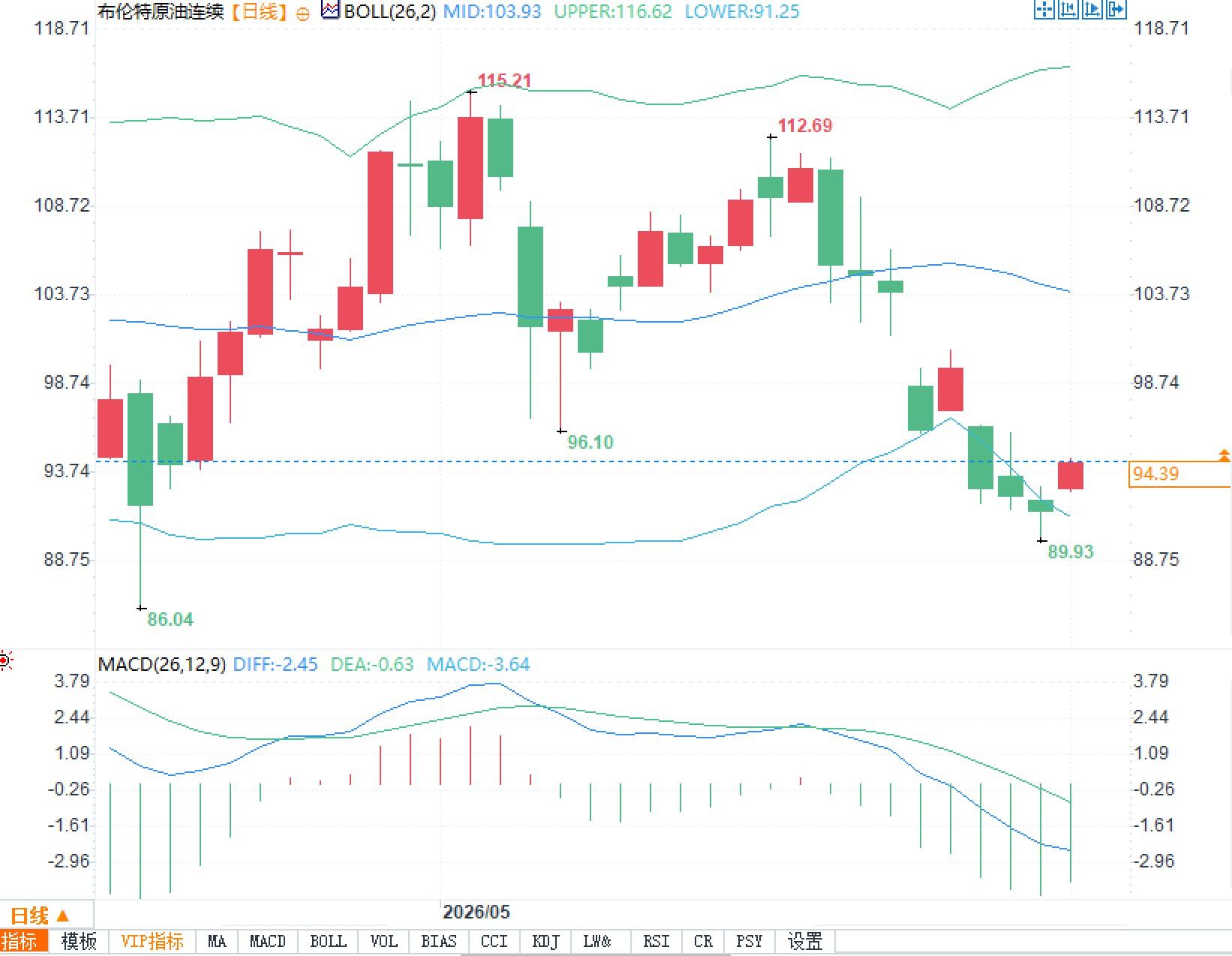
The MACD shows a DIFF of -2.45, a DEA of -0.63, and a histogram of -3.64, indicating that momentum has not yet turned positive. Traders are not focused on single-day gains, but rather on whether the price can shift from a weak correction near the lower Bollinger Band to a repricing towards the middle band of $103.93 per barrel. If news continues to pull in different directions, Brent's volatility may trade out before the direction itself.
The latest weekly report from the U.S. Energy Information Administration shows that for the week ending May 22, U.S. refinery crude oil processing volume was 17 million barrels per day, an increase of 652,000 barrels per day from the previous week, with refinery utilization rising to 94.5%. This indicates that high oil prices have not immediately dampened refinery processing willingness; on the contrary, refined product margins and summer demand expectations have driven refinery operations to maintain high capacity.
The signals from the inventory side are more noteworthy. Commercial crude oil inventories fell by 3.3 million barrels to 441.7 million barrels, about 2% lower than the five-year average for the same period; gasoline inventories fell by 2.6 million barrels, 6% lower than the five-year average for the same period; and distillate fuel inventories fell by 2.1 million barrels, about 11% lower than the five-year average for the same period. This data suggests that crude oil prices are constrained by demand concerns on the upside, but supported by low refined product inventories and high refinery operating rates on the downside. Therefore, the market is prone to a structure where sharp drops are difficult to sustain and rebounds lack trend confirmation.
The International Energy Agency's May report projects that global oil demand will decrease by 420,000 barrels per day to 104 million barrels per day in 2026, with a more significant decline in the second quarter. Meanwhile, global supply fell by another 1.8 million barrels per day to 95.1 million barrels per day in April. If shipping routes gradually resume from June, global supply may still decrease by an average of 3.9 million barrels per day in 2026.
The OPEC monthly report lowered its forecast for global demand growth in 2026 to 1.17 million barrels per day, down from the previous 1.38 million barrels per day, and also revised its average demand forecast for the second quarter down to 104.57 million barrels per day. While the two reports differ in their assessment of demand direction, they share the common view that high oil prices have begun to weaken demand elasticity.
Therefore, the core issue for Brent crude oil right now is not whether demand is strong or weak, but whether the recovery of logistics is outpacing inventory depletion. If the ceasefire agreement continues to lack credibility in its implementation, prices will continue to include a shipping risk premium; only if transportation gradually recovers and the rate of inventory decline slows can the risk premium around $94/barrel be further compressed.
Question 1: Why have oil prices started to rebound even though the ceasefire negotiations have not broken down?
A: Crude oil pricing is based on the probability of implementation, not verbal progress. As long as shipping routes, the Lebanon issue, and the nuclear issue are on the same negotiation list, failure to maintain any one of them for 60 days will increase insurance, freight rates, and near-month premiums.
Question 2: Does the price of around $94 per barrel indicate that supply risks have been fully priced in?
A: Not necessarily. The price is still below the Bollinger Middle Band, indicating insufficient trend recovery; however, the continuous decline in inventory and tight supply of refined oil products mean that the support below comes from fundamentals rather than simply sentiment.
Question 3: Why didn't the downward revision of demand suppress oil prices?
A: Demand expectations have indeed cooled, but in the short term, there is a shortage of readily deliverable seaborne crude oil and refined products. As long as logistics recovery lags behind inventory depletion, prices are likely to remain highly volatile.
Ceasefire Implementation Risk Repricing
The core issue in the latest news is not whether the US and Iran are still negotiating, but whether the preconditions of the agreement can truly be maintained. Iranian official Ghalibaf recently stated that the maritime blockade and the escalation of the situation in Lebanon are evidence that the ceasefire has not been observed, emphasizing that every choice has a cost. For the crude oil market, such statements will directly translate into three types of costs: shipping insurance costs, detour and port demurrage costs, and the risk premium for near-month contracts.
The market had previously bet that the 60-day implementation window would reduce supply disruptions, but the current problem is that the agreement terms not only need to be reached, but also need to remain in effect. As long as any of the following aspects—shipping routes, security arrangements in Lebanon, preconditions regarding the nuclear issue, and the pace of sanctions easing—remain inconsistent, Brent prices will struggle to return to a state solely driven by inventory and demand models.
Market structure: $94/barrel is not a strong confirmation
From a daily chart perspective, the area around $94/barrel appears more like a consolidation zone after risk premium recovery than a strong confirmation zone. After rebounding from around $89.93/barrel, the price remains below the Bollinger Middle Band, indicating that the downtrend has not fully reversed; however, buying interest near the Lower Band suggests that the price below $91/barrel is beginning to reflect fundamental constraints such as shipping disruptions and declining inventories.
The MACD shows a DIFF of -2.45, a DEA of -0.63, and a histogram of -3.64, indicating that momentum has not yet turned positive. Traders are not focused on single-day gains, but rather on whether the price can shift from a weak correction near the lower Bollinger Band to a repricing towards the middle band of $103.93 per barrel. If news continues to pull in different directions, Brent's volatility may trade out before the direction itself.
Inventories and Refineries: Refined Products Are Tighter Than Crude Oil
The latest weekly report from the U.S. Energy Information Administration shows that for the week ending May 22, U.S. refinery crude oil processing volume was 17 million barrels per day, an increase of 652,000 barrels per day from the previous week, with refinery utilization rising to 94.5%. This indicates that high oil prices have not immediately dampened refinery processing willingness; on the contrary, refined product margins and summer demand expectations have driven refinery operations to maintain high capacity.
The signals from the inventory side are more noteworthy. Commercial crude oil inventories fell by 3.3 million barrels to 441.7 million barrels, about 2% lower than the five-year average for the same period; gasoline inventories fell by 2.6 million barrels, 6% lower than the five-year average for the same period; and distillate fuel inventories fell by 2.1 million barrels, about 11% lower than the five-year average for the same period. This data suggests that crude oil prices are constrained by demand concerns on the upside, but supported by low refined product inventories and high refinery operating rates on the downside. Therefore, the market is prone to a structure where sharp drops are difficult to sustain and rebounds lack trend confirmation.
Supply and demand expectations: Cooling demand cannot fully cover logistical constraints
The International Energy Agency's May report projects that global oil demand will decrease by 420,000 barrels per day to 104 million barrels per day in 2026, with a more significant decline in the second quarter. Meanwhile, global supply fell by another 1.8 million barrels per day to 95.1 million barrels per day in April. If shipping routes gradually resume from June, global supply may still decrease by an average of 3.9 million barrels per day in 2026.
The OPEC monthly report lowered its forecast for global demand growth in 2026 to 1.17 million barrels per day, down from the previous 1.38 million barrels per day, and also revised its average demand forecast for the second quarter down to 104.57 million barrels per day. While the two reports differ in their assessment of demand direction, they share the common view that high oil prices have begun to weaken demand elasticity.
Therefore, the core issue for Brent crude oil right now is not whether demand is strong or weak, but whether the recovery of logistics is outpacing inventory depletion. If the ceasefire agreement continues to lack credibility in its implementation, prices will continue to include a shipping risk premium; only if transportation gradually recovers and the rate of inventory decline slows can the risk premium around $94/barrel be further compressed.
Frequently Asked Questions
Question 1: Why have oil prices started to rebound even though the ceasefire negotiations have not broken down?
A: Crude oil pricing is based on the probability of implementation, not verbal progress. As long as shipping routes, the Lebanon issue, and the nuclear issue are on the same negotiation list, failure to maintain any one of them for 60 days will increase insurance, freight rates, and near-month premiums.
Question 2: Does the price of around $94 per barrel indicate that supply risks have been fully priced in?
A: Not necessarily. The price is still below the Bollinger Middle Band, indicating insufficient trend recovery; however, the continuous decline in inventory and tight supply of refined oil products mean that the support below comes from fundamentals rather than simply sentiment.
Question 3: Why didn't the downward revision of demand suppress oil prices?
A: Demand expectations have indeed cooled, but in the short term, there is a shortage of readily deliverable seaborne crude oil and refined products. As long as logistics recovery lags behind inventory depletion, prices are likely to remain highly volatile.
- Risk Warning and Disclaimer
- The market involves risk, and trading may not be suitable for all investors. This article is for reference only and does not constitute personal investment advice, nor does it take into account certain users’ specific investment objectives, financial situation, or other needs. Any investment decisions made based on this information are at your own risk.