The US dollar is poised to rise against the Canadian dollar for its second consecutive day, with expectations of a Bank of Canada rate hike now at zero.
2026-06-01 16:36:38
The US dollar is on track for a second consecutive day of gains against the Canadian dollar during Asian trading hours on Monday (June 1), currently trading around 1.3810. The dollar is supported by safe-haven demand due to uncertainty surrounding a US-Iran peace agreement.
Meanwhile, the Canadian economic outlook has turned significantly dovish—the economy unexpectedly contracted in the first quarter (declining year-on-year for the second consecutive quarter), and core inflation slowed to its lowest level in five years, completely dispelling market expectations for a near-term interest rate hike by the Bank of Canada. Market pricing indicates a 40.2% probability of a 25 basis point rate hike by the Federal Reserve before the end of the year. The US manufacturing PMI report will be released later on Monday.
The geopolitical landscape remains highly volatile, and diplomatic channels between Washington and Tehran continue to operate actively. Iranian Foreign Minister Araqchi confirmed that negotiations and information exchanges with the United States are currently underway. However, he maintained a cautious stance, emphasizing that the trajectory of the negotiations cannot be properly assessed until a clear and formal outcome is reached.
Adding momentum to these diplomatic efforts is President Trump's demand for specific modifications to the proposed US-Iran agreement. This agreement, which aims to permanently halt the hostilities that erupted earlier this year, is currently facing adjustments surrounding key security and non-proliferation issues. Specifically, the modification requests focus on the strategic passage dynamics in the Strait of Hormuz and the management and disposal of Iran's highly enriched uranium stockpile.
Meanwhile, global financial markets are navigating changes in central bank policy expectations. In the United States, macroeconomic sentiment has adjusted to price in a tighter monetary environment over a longer period.
According to the CME FedWatch tool, traders are currently pricing in a 40.2% probability of the Federal Reserve raising interest rates by 25 basis points before the end of the year, reflecting the market's continued caution regarding inflation and economic resilience.
In contrast, the Canadian economic outlook has shifted significantly to a dovish stance, leading to a substantial weakening of the Canadian dollar. This contrasts sharply with the relative resilience of the US economy—Canada has experienced two consecutive quarters of year-on-year declines, technically entering a "growth recession." Market expectations for a June rate hike by the Bank of Canada have plummeted from 30% a month ago to near zero.
The latest economic data shows that the Canadian economy unexpectedly contracted year-on-year in the first quarter of 2026. Real GDP fell by 0.2% year-on-year in the first quarter, far below the expected growth of 0.5%, marking the second consecutive quarter of negative growth. Manufacturing, construction, and retail trade were the main drags.
This data, representing the second consecutive quarter of year-on-year decline, highlights a significant loss of domestic growth momentum, which in turn pushed the US dollar higher against the Canadian dollar. The USD/CAD pair jumped nearly 50 points to above 1.3820 shortly after the data release. The market widely expects the Bank of Canada to keep interest rates unchanged at its June 10 meeting.
The sharp cooling of Canadian consumer prices further confirms the economic slowdown. The April CPI fell to 2.5% year-on-year, below the expected 2.6%; the central bank's preferred core inflation gauge slowed to 2.4% and 2.3%, both five-year lows. Services inflation also cooled, contrasting sharply with the US core PCE remaining high at 3.3%.
This cooling trend strongly validates the central bank's view that energy-driven inflation may only be temporary. With oil prices falling from $115 to around $90, the energy-driven inflationary pull is waning.
Therefore, these data completely dispelled any market expectations for a near-term interest rate hike. The probability of a Bank of Canada rate hike in June has fallen from 30% to near zero, and some traders have even begun betting on a rate cut by the end of the year. The market widely expects the central bank to keep interest rates unchanged at its June 10 meeting.
The USD/CAD pair is currently in a slightly bullish consolidation phase on the daily chart. After rebounding from a low of 1.3481, the price encountered resistance at 1.3966 and fell back. Recently, it has risen again and is currently trading around 1.3819, within a range where moving averages are intertwined. Bullish momentum remains but faces some resistance.
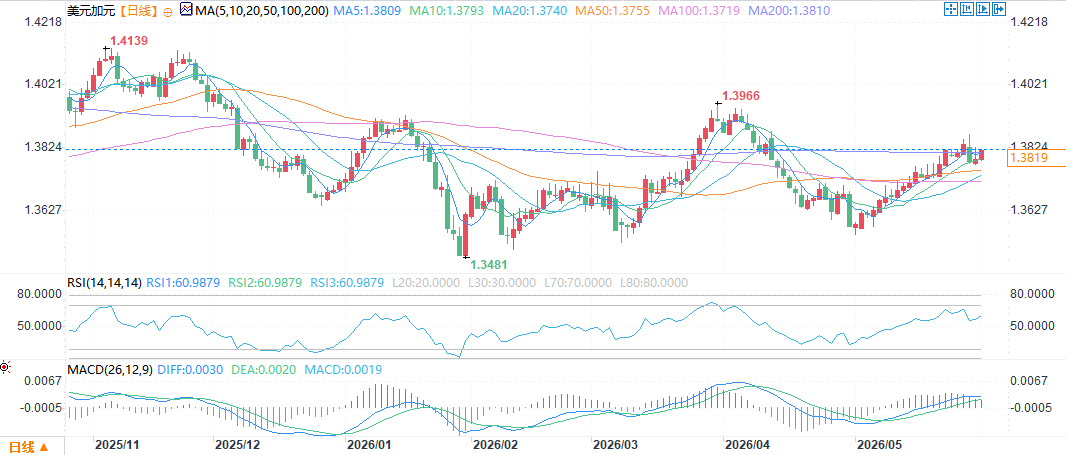
(USD/CAD daily chart, source: EasyForex)
From the perspective of the moving average system, the price has risen above multiple moving averages such as MA5, MA10, MA20, MA50, and MA100, forming a preliminary bullish pattern. The short-term moving averages are providing support for the price, but it has not yet broken through the resistance of the previous high of 1.3966. The battle between bulls and bears is relatively deadlocked in the 1.38-1.39 range.
In terms of indicators, the RSI is currently at 60.99, which is in the neutral to strong range and close to the overbought zone, indicating that the short-term bullish momentum is strong but there is a risk of pullback; the MACD's DIFF line and DEA line are running above the zero axis, and the histogram is positive, indicating that the bullish momentum is still being released, but the slope has slowed down and the upward momentum is weakening at the margin.
Overall, the USD/CAD pair is trending slightly higher in the short term, with key resistance levels at the previous high of 1.3966 and the psychological level of 1.40, while support lies in the 1.3700-1.3650 range. A break above 1.3966 could open up further upside potential; conversely, it is likely to maintain a high-level consolidation pattern.
At 15:53 Beijing time on June 1, the US dollar was trading at 1.3812/13 against the Canadian dollar.
Meanwhile, the Canadian economic outlook has turned significantly dovish—the economy unexpectedly contracted in the first quarter (declining year-on-year for the second consecutive quarter), and core inflation slowed to its lowest level in five years, completely dispelling market expectations for a near-term interest rate hike by the Bank of Canada. Market pricing indicates a 40.2% probability of a 25 basis point rate hike by the Federal Reserve before the end of the year. The US manufacturing PMI report will be released later on Monday.
Geopolitics: US-Iran diplomatic channels are active, but the outlook remains uncertain.
The geopolitical landscape remains highly volatile, and diplomatic channels between Washington and Tehran continue to operate actively. Iranian Foreign Minister Araqchi confirmed that negotiations and information exchanges with the United States are currently underway. However, he maintained a cautious stance, emphasizing that the trajectory of the negotiations cannot be properly assessed until a clear and formal outcome is reached.
Adding momentum to these diplomatic efforts is President Trump's demand for specific modifications to the proposed US-Iran agreement. This agreement, which aims to permanently halt the hostilities that erupted earlier this year, is currently facing adjustments surrounding key security and non-proliferation issues. Specifically, the modification requests focus on the strategic passage dynamics in the Strait of Hormuz and the management and disposal of Iran's highly enriched uranium stockpile.
The possibility of a Fed rate hike before the end of the year remains.
Meanwhile, global financial markets are navigating changes in central bank policy expectations. In the United States, macroeconomic sentiment has adjusted to price in a tighter monetary environment over a longer period.
According to the CME FedWatch tool, traders are currently pricing in a 40.2% probability of the Federal Reserve raising interest rates by 25 basis points before the end of the year, reflecting the market's continued caution regarding inflation and economic resilience.
Canadian Economy: Significant Dovish Shift Leads to Weakening of the Canadian Dollar
In contrast, the Canadian economic outlook has shifted significantly to a dovish stance, leading to a substantial weakening of the Canadian dollar. This contrasts sharply with the relative resilience of the US economy—Canada has experienced two consecutive quarters of year-on-year declines, technically entering a "growth recession." Market expectations for a June rate hike by the Bank of Canada have plummeted from 30% a month ago to near zero.
The latest economic data shows that the Canadian economy unexpectedly contracted year-on-year in the first quarter of 2026. Real GDP fell by 0.2% year-on-year in the first quarter, far below the expected growth of 0.5%, marking the second consecutive quarter of negative growth. Manufacturing, construction, and retail trade were the main drags.
This data, representing the second consecutive quarter of year-on-year decline, highlights a significant loss of domestic growth momentum, which in turn pushed the US dollar higher against the Canadian dollar. The USD/CAD pair jumped nearly 50 points to above 1.3820 shortly after the data release. The market widely expects the Bank of Canada to keep interest rates unchanged at its June 10 meeting.
Inflation slows: Core inflation falls to five-year low
The sharp cooling of Canadian consumer prices further confirms the economic slowdown. The April CPI fell to 2.5% year-on-year, below the expected 2.6%; the central bank's preferred core inflation gauge slowed to 2.4% and 2.3%, both five-year lows. Services inflation also cooled, contrasting sharply with the US core PCE remaining high at 3.3%.
This cooling trend strongly validates the central bank's view that energy-driven inflation may only be temporary. With oil prices falling from $115 to around $90, the energy-driven inflationary pull is waning.
Therefore, these data completely dispelled any market expectations for a near-term interest rate hike. The probability of a Bank of Canada rate hike in June has fallen from 30% to near zero, and some traders have even begun betting on a rate cut by the end of the year. The market widely expects the central bank to keep interest rates unchanged at its June 10 meeting.
USD/CAD Technical Analysis
The USD/CAD pair is currently in a slightly bullish consolidation phase on the daily chart. After rebounding from a low of 1.3481, the price encountered resistance at 1.3966 and fell back. Recently, it has risen again and is currently trading around 1.3819, within a range where moving averages are intertwined. Bullish momentum remains but faces some resistance.
(USD/CAD daily chart, source: EasyForex)
From the perspective of the moving average system, the price has risen above multiple moving averages such as MA5, MA10, MA20, MA50, and MA100, forming a preliminary bullish pattern. The short-term moving averages are providing support for the price, but it has not yet broken through the resistance of the previous high of 1.3966. The battle between bulls and bears is relatively deadlocked in the 1.38-1.39 range.
In terms of indicators, the RSI is currently at 60.99, which is in the neutral to strong range and close to the overbought zone, indicating that the short-term bullish momentum is strong but there is a risk of pullback; the MACD's DIFF line and DEA line are running above the zero axis, and the histogram is positive, indicating that the bullish momentum is still being released, but the slope has slowed down and the upward momentum is weakening at the margin.
Overall, the USD/CAD pair is trending slightly higher in the short term, with key resistance levels at the previous high of 1.3966 and the psychological level of 1.40, while support lies in the 1.3700-1.3650 range. A break above 1.3966 could open up further upside potential; conversely, it is likely to maintain a high-level consolidation pattern.
At 15:53 Beijing time on June 1, the US dollar was trading at 1.3812/13 against the Canadian dollar.
- Risk Warning and Disclaimer
- The market involves risk, and trading may not be suitable for all investors. This article is for reference only and does not constitute personal investment advice, nor does it take into account certain users’ specific investment objectives, financial situation, or other needs. Any investment decisions made based on this information are at your own risk.