Is the Fed's rate cut dream shattered? Rabobank predicts only one rate cut in 2026, with the second not expected until 2027.
2026-06-01 16:38:00
On Monday (June 1st) during the European session, the 10-year US Treasury yield remained stable at around 4.46%, while the 2-year US Treasury yield stayed around 4.03%. In the foreign exchange market, the US dollar index fluctuated narrowly around the 99 level.
With US Treasury yields remaining high and the dollar fluctuating within a narrow range, what will be the Federal Reserve's next policy move? Rabobank has provided its latest assessment.
Philip Marey, senior U.S. strategist at Rabobank, updated his outlook on the Federal Reserve's policy, noting that the FOMC had clearly shifted away from its dovish stance ahead of Warsh's first meeting as chairman.
Marey stated that developments in the Middle East could keep energy prices high for an extended period. Therefore, Rabobank now expects the Federal Reserve's first rate cut to be delayed until October 2026, with the second cut in January 2027, a postponement from previous forecasts of September and December 2026.
Philip Marey, senior U.S. strategist at Rabobank, updated his outlook on the Federal Reserve's policy, noting that the FOMC had clearly shifted away from its dovish stance ahead of Warsh's first meeting as chairman. This shift was the culmination of a series of hawkish signals over the past few weeks.
Previously, the Federal Reserve retained the wording "accommodative bias" after its April meeting, hinting that the next step was more likely to be an interest rate cut. However, with the Middle East conflict pushing up oil prices and April's PCE inflation rising to a three-year high of 3.8%, several Fed officials publicly expressed concerns about inflation. Kashkari had already voted against including "accommodative bias" in April, and Waller, previously the most dovish, also publicly stated that the wording should be removed, while Cook clearly stated that he was "ready to raise interest rates." Before Warsh chairs the meeting for the first time as chairman on June 16-17, these hawkish voices are coalescing into a new consensus.
“In recent weeks, the FOMC appears to have moved further toward abandoning its dovish stance, with several committee members stating their positions ahead of the new chairman Walsh’s first meeting,” Marey noted. This preemptive stance helps the market transition smoothly. However, this hawkish shift is steeper than the market expected—just two months ago, the market was pricing in as many as four rate cuts in 2026, while now even one rate cut is uncertain.
Rabobank has therefore postponed its first rate cut forecast from September to October, and the second from December to January 2027, with the risk of further delays still looming.
Marey stated that developments in the Middle East indicate that energy prices will remain high for an extended period. Despite recent progress in the US-Iran ceasefire negotiations, fundamental differences remain between the two sides on core issues such as their nuclear programs, enriched uranium stockpiles, and control of the Straits of Hormuz. On June 1st, the Iranian Revolutionary Guard confirmed a US attack on its communications towers and immediately retaliated, while the Israeli military launched its deepest invasion of Lebanon in 25 years. These developments demonstrate that tensions in the Middle East are far from over, and any optimistic expectations of an imminent peace process could be overturned by new conflicts.
“We are adjusting our view on the Federal Reserve now, given our higher and more persistent outlook on inflation and the FOMC’s defensive stance on the new chairman,” Marey explained. Brent crude has risen about 25% since the end of February, and as long as the Strait of Hormuz cannot fully restore normal navigation, oil prices are unlikely to fall below $80. Meanwhile, several FOMC members have clearly stated that further rate hikes are not ruled out. Based on these two considerations, Rabobank has postponed its expectation of the first rate cut from September to October, and the second from December to January 2027.
"We no longer predict rate cuts in September and December 2026, but instead expect the first rate cut in October 2026 and the second in January 2027."
Although this adjustment only postpones the interest rate cut schedule by about a month, the policy signal is significant: there may only be one interest rate cut in the whole of 2026, with the second one postponed to January 2027, which is in stark contrast to the market's expectation of "three to four interest rate cuts" at the beginning of the year.
This adjustment, about a month later than previously predicted, reflects Rabobank's reassessment of inflation stickiness and the Federal Reserve's policy path. Two main drivers are at play: first, continued tensions in the Middle East make it difficult for energy prices to return to pre-conflict levels; second, hawkish voices within the FOMC are growing, with several members supporting the removal of the "accommodative bias." Rabobank believes that even if inflation declines, the Fed will "wait for confirmation" before acting, and the timetable for rate cuts in October and January still faces the risk of further delay.
Is the US dollar index ready for this "higher and longer" interest rate path?
From a technical perspective, the US dollar index is currently in a consolidation phase with a slightly bullish bias on the daily chart. After rebounding from a low of 95.57, the price found secondary support at 97.62 and continued to rise, currently trading around 98.98. It has broken above multiple short- and medium-term moving averages, and the moving average system is showing a preliminary bullish alignment. The RSI indicator is in the neutral to slightly bullish range at 51.98, and the MACD indicator's DIFF and DEA lines are running above the zero axis with positive histogram bars, indicating that bullish momentum is still being released. Overall, the short-term trend is slightly bullish with fluctuations. The key resistance levels are the psychological level of 100 and the previous high of 100.64, while the support level is around 98.00. It is necessary to observe whether it can break through the 100 level to open up upward space; otherwise, it is likely to maintain a high-level consolidation trend.
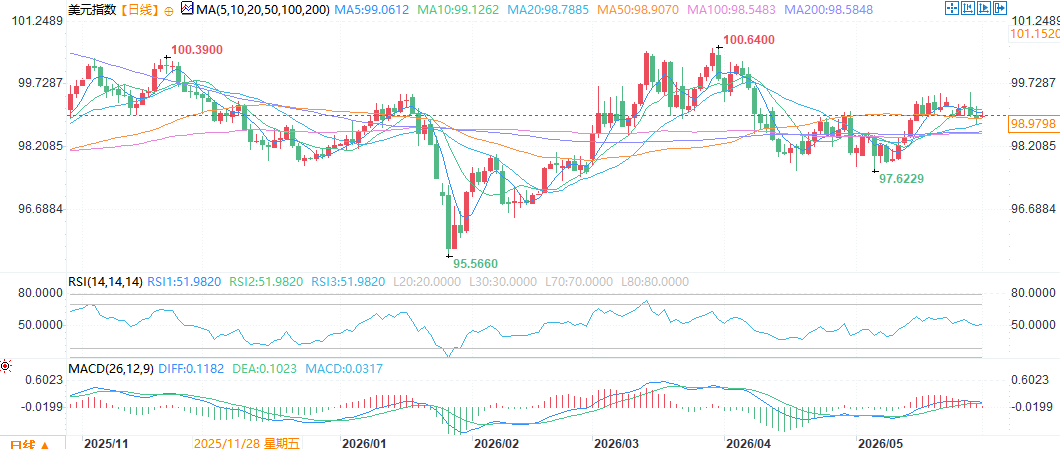
(US Dollar Index Daily Chart, Source: FX678)
At 16:15 Beijing time on June 1, the US dollar index was at 98.97.
With US Treasury yields remaining high and the dollar fluctuating within a narrow range, what will be the Federal Reserve's next policy move? Rabobank has provided its latest assessment.
Philip Marey, senior U.S. strategist at Rabobank, updated his outlook on the Federal Reserve's policy, noting that the FOMC had clearly shifted away from its dovish stance ahead of Warsh's first meeting as chairman.
Marey stated that developments in the Middle East could keep energy prices high for an extended period. Therefore, Rabobank now expects the Federal Reserve's first rate cut to be delayed until October 2026, with the second cut in January 2027, a postponement from previous forecasts of September and December 2026.
FOMC Shifts: Abandoning Dovish Tendency
Philip Marey, senior U.S. strategist at Rabobank, updated his outlook on the Federal Reserve's policy, noting that the FOMC had clearly shifted away from its dovish stance ahead of Warsh's first meeting as chairman. This shift was the culmination of a series of hawkish signals over the past few weeks.
Previously, the Federal Reserve retained the wording "accommodative bias" after its April meeting, hinting that the next step was more likely to be an interest rate cut. However, with the Middle East conflict pushing up oil prices and April's PCE inflation rising to a three-year high of 3.8%, several Fed officials publicly expressed concerns about inflation. Kashkari had already voted against including "accommodative bias" in April, and Waller, previously the most dovish, also publicly stated that the wording should be removed, while Cook clearly stated that he was "ready to raise interest rates." Before Warsh chairs the meeting for the first time as chairman on June 16-17, these hawkish voices are coalescing into a new consensus.
“In recent weeks, the FOMC appears to have moved further toward abandoning its dovish stance, with several committee members stating their positions ahead of the new chairman Walsh’s first meeting,” Marey noted. This preemptive stance helps the market transition smoothly. However, this hawkish shift is steeper than the market expected—just two months ago, the market was pricing in as many as four rate cuts in 2026, while now even one rate cut is uncertain.
Rabobank has therefore postponed its first rate cut forecast from September to October, and the second from December to January 2027, with the risk of further delays still looming.
Middle East Situation: Energy Prices Expected to Remain High
Marey stated that developments in the Middle East indicate that energy prices will remain high for an extended period. Despite recent progress in the US-Iran ceasefire negotiations, fundamental differences remain between the two sides on core issues such as their nuclear programs, enriched uranium stockpiles, and control of the Straits of Hormuz. On June 1st, the Iranian Revolutionary Guard confirmed a US attack on its communications towers and immediately retaliated, while the Israeli military launched its deepest invasion of Lebanon in 25 years. These developments demonstrate that tensions in the Middle East are far from over, and any optimistic expectations of an imminent peace process could be overturned by new conflicts.
“We are adjusting our view on the Federal Reserve now, given our higher and more persistent outlook on inflation and the FOMC’s defensive stance on the new chairman,” Marey explained. Brent crude has risen about 25% since the end of February, and as long as the Strait of Hormuz cannot fully restore normal navigation, oil prices are unlikely to fall below $80. Meanwhile, several FOMC members have clearly stated that further rate hikes are not ruled out. Based on these two considerations, Rabobank has postponed its expectation of the first rate cut from September to October, and the second from December to January 2027.
Interest rate cut expectations delayed: first expected in October 2026.
"We no longer predict rate cuts in September and December 2026, but instead expect the first rate cut in October 2026 and the second in January 2027."
Although this adjustment only postpones the interest rate cut schedule by about a month, the policy signal is significant: there may only be one interest rate cut in the whole of 2026, with the second one postponed to January 2027, which is in stark contrast to the market's expectation of "three to four interest rate cuts" at the beginning of the year.
This adjustment, about a month later than previously predicted, reflects Rabobank's reassessment of inflation stickiness and the Federal Reserve's policy path. Two main drivers are at play: first, continued tensions in the Middle East make it difficult for energy prices to return to pre-conflict levels; second, hawkish voices within the FOMC are growing, with several members supporting the removal of the "accommodative bias." Rabobank believes that even if inflation declines, the Fed will "wait for confirmation" before acting, and the timetable for rate cuts in October and January still faces the risk of further delay.
Is the US dollar index ready for this "higher and longer" interest rate path?
From a technical perspective, the US dollar index is currently in a consolidation phase with a slightly bullish bias on the daily chart. After rebounding from a low of 95.57, the price found secondary support at 97.62 and continued to rise, currently trading around 98.98. It has broken above multiple short- and medium-term moving averages, and the moving average system is showing a preliminary bullish alignment. The RSI indicator is in the neutral to slightly bullish range at 51.98, and the MACD indicator's DIFF and DEA lines are running above the zero axis with positive histogram bars, indicating that bullish momentum is still being released. Overall, the short-term trend is slightly bullish with fluctuations. The key resistance levels are the psychological level of 100 and the previous high of 100.64, while the support level is around 98.00. It is necessary to observe whether it can break through the 100 level to open up upward space; otherwise, it is likely to maintain a high-level consolidation trend.
(US Dollar Index Daily Chart, Source: FX678)
At 16:15 Beijing time on June 1, the US dollar index was at 98.97.
- Risk Warning and Disclaimer
- The market involves risk, and trading may not be suitable for all investors. This article is for reference only and does not constitute personal investment advice, nor does it take into account certain users’ specific investment objectives, financial situation, or other needs. Any investment decisions made based on this information are at your own risk.