Gold and silver prices fell as Iran withdrew from US-Iran talks due to Israel's strikes against Hezbollah in Lebanon.
2026-06-02 00:48:15
On Monday (June 1st) during the US trading session, the global precious metals market weakened overall, with both gold and silver closing lower. The market's safe-haven logic failed, and both assets were suppressed by a confluence of negative factors. Spot gold traded between $4455 and $4506 per ounce, a daily decline of approximately 0.72%-2.1%, breaking below the key psychological level of $4500. New York gold futures were quoted at $4495.30 per ounce, a daily decline of 2.1%. Spot silver followed gold's downward trend, trading at $74.62 per ounce, a daily decline of 0.95%, demonstrating a significant overall weakness.
Looking at the overall trend this year, gold prices have been declining continuously since reaching a historical high of around $5,600 at the end of January, with a cumulative drop of nearly 20%. Since the Middle East conflict and the escalation of geopolitical tensions in the Strait of Hormuz, gold has fallen by more than 15%. Silver has moved lower in tandem with gold, also ending its previous consolidation phase, and its upward potential for the year has been largely wiped out.
Fundamental analysis
The geopolitical situation in the Strait of Hormuz remains the core variable driving the precious metals market this week, and a significant factor indirectly suppressing gold and silver prices. Last weekend, tensions between the US and Iran escalated into direct military conflict, with the US Central Command deploying military forces to strike radar facilities and drone bases within Iran. The Iranian Revolutionary Guard retaliated by launching a military counterattack against a US-owned airbase, further heightening regional tensions.
On the diplomatic front, the US and Iran remain irreconcilably divided on three core issues: Iran's nuclear program, the lifting of international sanctions, and control over the Strait of Hormuz, making a breakthrough in negotiations unlikely in the short term. Coupled with Israel's intensified military strikes against Hezbollah in Lebanon, and Iran's formal severing of communication channels with the US, tensions have further escalated. Due to the conflict, the Strait of Hormuz's navigation capacity has plummeted. Before the conflict, nearly 130 oil tankers passed through the strait daily; currently, only four pass through daily, posing a severe challenge to the global energy supply chain. Jonas Goltman, chief market economist at Capital Economics, stated that the market currently only anticipates the possibility of the strait reopening to navigation in the future, but a short-term stalemate is unlikely to be broken.
The safe-haven funds triggered by geopolitical conflicts did not flow into the precious metals market, but instead concentrated in dollar assets, pushing the dollar index to continue to strengthen and exerting direct pressure on both gold and silver. Meanwhile, the yield on 10-year US Treasury bonds remained stable at a high level of around 4.5%. Since gold and silver are both non-yielding assets, the high-interest-rate environment significantly increased the opportunity cost for investors, exacerbating the market's willingness to sell.
Regarding monetary policy expectations, CME FedWatch data shows that the market anticipates a 40% probability of a 25 basis point rate hike at the Fed's December meeting. Coupled with several US economic data points exceeding expectations, market expectations for short-term rate cuts have cooled significantly. Saxo Bank analyst Ole Hansen interprets this as follows: this round of inflation is driven by an energy supply gap, and this unique environment will simultaneously push up the dollar exchange rate and US Treasury yields, rather than benefiting precious metals under the traditional model, thus fundamentally suppressing gold and silver prices.
Geopolitical conflicts directly drove up oil prices, with WTI crude rising over 5% intraday to $90.29 per barrel, and Brent crude approaching $93.64. The surge in energy prices further exacerbated global inflation concerns, and the market generally anticipates that major central banks worldwide will maintain tight monetary policies for an extended period. This tightening liquidity environment is bearish for the precious metals sector as a whole. The traditional logic that rising oil prices benefit inflation-hedging assets has completely failed under the dual hedging effect of a strengthening dollar and high interest rates, putting downward pressure on both gold and silver prices.
Macroeconomic data
Strong US manufacturing data further limited upside potential for precious metals. Data showed that the S&P Global US Manufacturing PMI rose to 55.1 in May from 54.5 in April, while the ISM Manufacturing PMI climbed to 54.0, the highest level since May 2022. This strong manufacturing data confirms the resilience of the US economy, indirectly supporting the Federal Reserve's tightening policy and negatively impacting gold and silver prices.
Although silver possesses the dual attributes of both precious and industrial metals, it did not exhibit independent price movements driven by industrial demand this time. On one hand, the incremental industrial demand brought about by positive developments in the manufacturing sector was limited and insufficient to offset the multiple negative factors of a stronger dollar, high interest rates, and the diversion of safe-haven funds. On the other hand, the overall sentiment in the precious metals sector weakened, and the sector-wide linkage effect dragged silver down in tandem, ultimately resulting in a market pattern where both gold and silver declined.
This week, the market will focus on several key macroeconomic data releases: Wednesday will see the release of ADP employment data, factory orders, durable goods orders, the ISM services index, and the Federal Reserve's Beige Book; Friday will see the release of the US non-farm payrolls report. These data will directly revise market expectations for the Fed's subsequent monetary policy and dominate the short-term trend of precious metals.
Technical Analysis
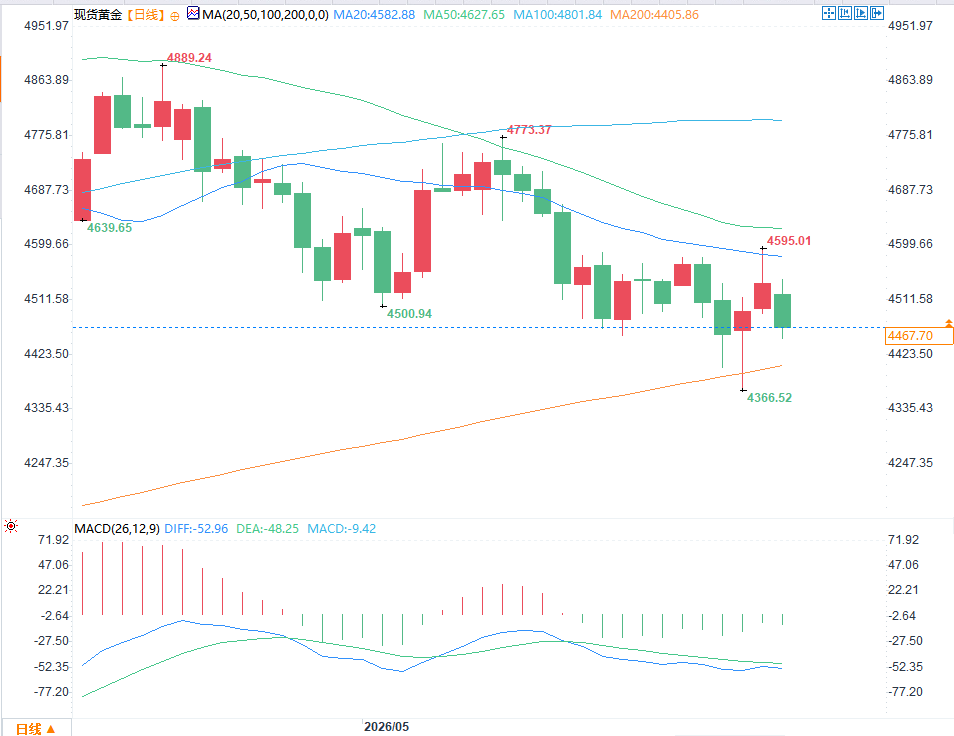
(Spot gold daily chart source: FX678)
On the daily chart for spot gold, gold maintains a clear downward trend. The current price has broken below the $4600 horizontal resistance zone and has been trading below the 100-day simple moving average (approximately $4801) for an extended period, solidifying the bearish pattern. The 200-day simple moving average is located at $4411, temporarily providing bottom support for gold prices. Technically, the RSI is around 43 and the ADX is around 24, indicating that overall bullish momentum is waning and downward pressure continues to mount.
Resistance and support levels: The short-term resistance levels are $4,514, $4,550, $4,576, and $4,600; the short-term support levels are $4,500, $4,488.90, and $4,460. The core structural support level in the medium to long term is at $4,100. If the closing price falls below this level, gold will enter a deep downward trend, and the bearish signal will be significantly strengthened.
On the daily chart, spot silver has weakened, breaking its previous narrow trading range and entering a downward trend. The support from its industrial components is insufficient to counteract the negative factors affecting the sector, and short-term bears are gradually gaining dominance.
Resistance and support levels: Short-term resistance is concentrated at $75.10 and $76.00; the first support level is $74.26, and the core support level is $73.25. If the key support level is broken, the price may test the $72.00 level.
Summarize
In the short term, the precious metals sector is under pressure due to a combination of negative factors: a strong US dollar, inflationary anxieties triggered by soaring oil prices, and stalled US-Iran geopolitical negotiations. Gold and silver are currently showing no divergence and both face downside risks. The high-interest-rate environment, coupled with safe-haven flows favoring the US dollar, has rendered both of the core attributes of precious metals—inflation hedge and safe-haven asset—ineffective, resulting in weak market sentiment.
The three key variables to watch for in the medium-term trend are: First, whether the US-Iran military conflict will de-escalate, whether diplomatic negotiations between the two sides can achieve substantial breakthroughs, and whether the Strait of Hormuz can resume normal navigation; second, whether oil prices will peak and fall, easing global imported inflation pressures; and third, whether weakening US employment and inflation data will force the Federal Reserve to adjust its tightening monetary policy. Only when these conditions show positive signals will gold and silver have the possibility of stopping their decline and rebounding.
The US non-farm payrolls report to be released this Friday is of paramount importance. The data will directly reshape market expectations for Fed rate hikes/cuts and become a key turning point for whether gold and silver prices can stop falling and stabilize in the short term. Investors are advised to focus on avoiding downside risks and to hold positions cautiously.
Looking at the overall trend this year, gold prices have been declining continuously since reaching a historical high of around $5,600 at the end of January, with a cumulative drop of nearly 20%. Since the Middle East conflict and the escalation of geopolitical tensions in the Strait of Hormuz, gold has fallen by more than 15%. Silver has moved lower in tandem with gold, also ending its previous consolidation phase, and its upward potential for the year has been largely wiped out.
Fundamental analysis
The geopolitical situation in the Strait of Hormuz remains the core variable driving the precious metals market this week, and a significant factor indirectly suppressing gold and silver prices. Last weekend, tensions between the US and Iran escalated into direct military conflict, with the US Central Command deploying military forces to strike radar facilities and drone bases within Iran. The Iranian Revolutionary Guard retaliated by launching a military counterattack against a US-owned airbase, further heightening regional tensions.
On the diplomatic front, the US and Iran remain irreconcilably divided on three core issues: Iran's nuclear program, the lifting of international sanctions, and control over the Strait of Hormuz, making a breakthrough in negotiations unlikely in the short term. Coupled with Israel's intensified military strikes against Hezbollah in Lebanon, and Iran's formal severing of communication channels with the US, tensions have further escalated. Due to the conflict, the Strait of Hormuz's navigation capacity has plummeted. Before the conflict, nearly 130 oil tankers passed through the strait daily; currently, only four pass through daily, posing a severe challenge to the global energy supply chain. Jonas Goltman, chief market economist at Capital Economics, stated that the market currently only anticipates the possibility of the strait reopening to navigation in the future, but a short-term stalemate is unlikely to be broken.
The safe-haven funds triggered by geopolitical conflicts did not flow into the precious metals market, but instead concentrated in dollar assets, pushing the dollar index to continue to strengthen and exerting direct pressure on both gold and silver. Meanwhile, the yield on 10-year US Treasury bonds remained stable at a high level of around 4.5%. Since gold and silver are both non-yielding assets, the high-interest-rate environment significantly increased the opportunity cost for investors, exacerbating the market's willingness to sell.
Regarding monetary policy expectations, CME FedWatch data shows that the market anticipates a 40% probability of a 25 basis point rate hike at the Fed's December meeting. Coupled with several US economic data points exceeding expectations, market expectations for short-term rate cuts have cooled significantly. Saxo Bank analyst Ole Hansen interprets this as follows: this round of inflation is driven by an energy supply gap, and this unique environment will simultaneously push up the dollar exchange rate and US Treasury yields, rather than benefiting precious metals under the traditional model, thus fundamentally suppressing gold and silver prices.
Geopolitical conflicts directly drove up oil prices, with WTI crude rising over 5% intraday to $90.29 per barrel, and Brent crude approaching $93.64. The surge in energy prices further exacerbated global inflation concerns, and the market generally anticipates that major central banks worldwide will maintain tight monetary policies for an extended period. This tightening liquidity environment is bearish for the precious metals sector as a whole. The traditional logic that rising oil prices benefit inflation-hedging assets has completely failed under the dual hedging effect of a strengthening dollar and high interest rates, putting downward pressure on both gold and silver prices.
Macroeconomic data
Strong US manufacturing data further limited upside potential for precious metals. Data showed that the S&P Global US Manufacturing PMI rose to 55.1 in May from 54.5 in April, while the ISM Manufacturing PMI climbed to 54.0, the highest level since May 2022. This strong manufacturing data confirms the resilience of the US economy, indirectly supporting the Federal Reserve's tightening policy and negatively impacting gold and silver prices.
Although silver possesses the dual attributes of both precious and industrial metals, it did not exhibit independent price movements driven by industrial demand this time. On one hand, the incremental industrial demand brought about by positive developments in the manufacturing sector was limited and insufficient to offset the multiple negative factors of a stronger dollar, high interest rates, and the diversion of safe-haven funds. On the other hand, the overall sentiment in the precious metals sector weakened, and the sector-wide linkage effect dragged silver down in tandem, ultimately resulting in a market pattern where both gold and silver declined.
This week, the market will focus on several key macroeconomic data releases: Wednesday will see the release of ADP employment data, factory orders, durable goods orders, the ISM services index, and the Federal Reserve's Beige Book; Friday will see the release of the US non-farm payrolls report. These data will directly revise market expectations for the Fed's subsequent monetary policy and dominate the short-term trend of precious metals.
Technical Analysis
(Spot gold daily chart source: FX678)
On the daily chart for spot gold, gold maintains a clear downward trend. The current price has broken below the $4600 horizontal resistance zone and has been trading below the 100-day simple moving average (approximately $4801) for an extended period, solidifying the bearish pattern. The 200-day simple moving average is located at $4411, temporarily providing bottom support for gold prices. Technically, the RSI is around 43 and the ADX is around 24, indicating that overall bullish momentum is waning and downward pressure continues to mount.
Resistance and support levels: The short-term resistance levels are $4,514, $4,550, $4,576, and $4,600; the short-term support levels are $4,500, $4,488.90, and $4,460. The core structural support level in the medium to long term is at $4,100. If the closing price falls below this level, gold will enter a deep downward trend, and the bearish signal will be significantly strengthened.
On the daily chart, spot silver has weakened, breaking its previous narrow trading range and entering a downward trend. The support from its industrial components is insufficient to counteract the negative factors affecting the sector, and short-term bears are gradually gaining dominance.
Resistance and support levels: Short-term resistance is concentrated at $75.10 and $76.00; the first support level is $74.26, and the core support level is $73.25. If the key support level is broken, the price may test the $72.00 level.
Summarize
In the short term, the precious metals sector is under pressure due to a combination of negative factors: a strong US dollar, inflationary anxieties triggered by soaring oil prices, and stalled US-Iran geopolitical negotiations. Gold and silver are currently showing no divergence and both face downside risks. The high-interest-rate environment, coupled with safe-haven flows favoring the US dollar, has rendered both of the core attributes of precious metals—inflation hedge and safe-haven asset—ineffective, resulting in weak market sentiment.
The three key variables to watch for in the medium-term trend are: First, whether the US-Iran military conflict will de-escalate, whether diplomatic negotiations between the two sides can achieve substantial breakthroughs, and whether the Strait of Hormuz can resume normal navigation; second, whether oil prices will peak and fall, easing global imported inflation pressures; and third, whether weakening US employment and inflation data will force the Federal Reserve to adjust its tightening monetary policy. Only when these conditions show positive signals will gold and silver have the possibility of stopping their decline and rebounding.
The US non-farm payrolls report to be released this Friday is of paramount importance. The data will directly reshape market expectations for Fed rate hikes/cuts and become a key turning point for whether gold and silver prices can stop falling and stabilize in the short term. Investors are advised to focus on avoiding downside risks and to hold positions cautiously.
- Risk Warning and Disclaimer
- The market involves risk, and trading may not be suitable for all investors. This article is for reference only and does not constitute personal investment advice, nor does it take into account certain users’ specific investment objectives, financial situation, or other needs. Any investment decisions made based on this information are at your own risk.