A chart shows that the Baltic Dry Index has declined slightly, leading to a decrease in freight rates for Capesize vessels.
2026-06-01 23:50:06
Latest data shows that the Baltic Dry Index (BDI) closed at 3222 points on June 1, 2026, a three-day low, down 0.06% from the previous day, marking the largest drop since May 21, 2026, and the second consecutive day of decline (including zero growth). Looking at the short-term charts, the recent 11 BDI data points show: 4 positive increases, 7 negative increases, and 0 zero increases. Specifically, the Panamax Freight Index (BPI) closed at 2344 points, up 0.04% from the previous day; the Capesize Freight Index (BCI) closed at 5496 points, down 0.13%; and the Supramax Freight Index (BSI) closed at 1570 points, up 0.06%. For detailed 720-day and 10-year trend charts of the Baltic Dry Index and its three main sub-indices, please refer to the specially designed charts.
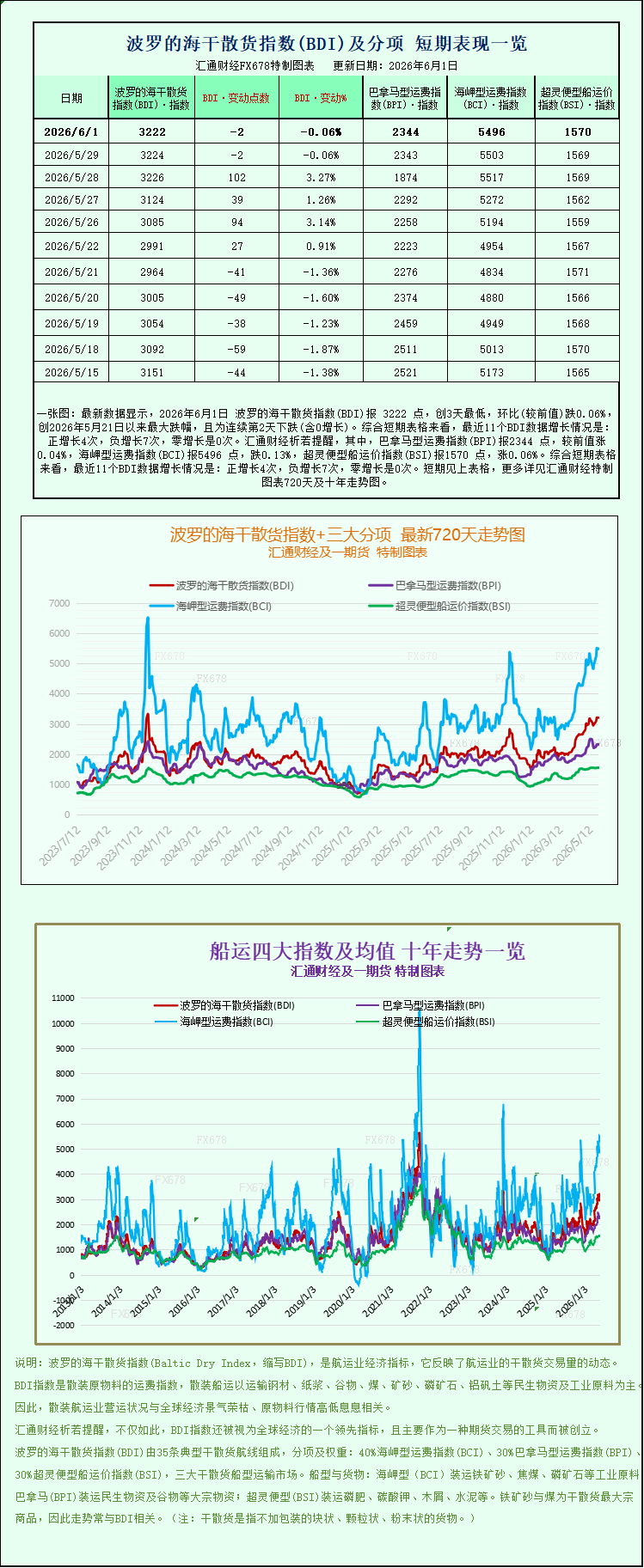
The global dry bulk shipping market is showing a mixed trend. The Baltic Exchange’s core dry bulk freight index fell slightly on Monday. The decline was mainly due to lower freight rates for Capesize vessels, which offset the gains in freight rates for Panamax and Supramax vessels. Overall, the market is experiencing uneven performance.
The Baltic Dry Index (BDI) tracks global shipping rates for the three main dry bulk carrier types: Capesize, Panamax, and Supramax, and is a core indicator of the international commodity shipping market. Data shows that the index fell slightly by 2 basis points, or 0.1%, to close at 3222 points, with relatively small fluctuations and a generally stable trading pace.
Capesize vessels, the mainstay of large-scale mineral and energy transportation, were the primary factor influencing the recent market downturn. In terms of detailed data, the Capesize vessel index (.BACI) also declined, falling 7 points intraday, a drop of 0.1%, closing at 5496 points. This vessel type is primarily used for long-distance transoceanic transportation of bulk raw materials, with a standard deadweight tonnage of up to 150,000 tons. It mainly transports basic industrial raw materials such as iron ore, thermal coal, and coking coal, serving the global steel, thermal power, and other core industrial supply chains. On that day, the average daily operating revenue for this type of vessel on global routes decreased by $65 to $46,346, with a temporary weakening in demand for large bulk carriers dragging down overall freight rates.
It's worth noting that while Capesize shipping rates declined in the shipping market, the domestic coal spot market bucked the trend, creating a stark contrast. On June 1st, domestic coking coal prices surged, reaching a new high in nearly 19 months. The core driver of this price increase stemmed from tightening supply in major domestic coal-producing regions: Shanxi Province, rich in coal resources, recently held a provincial-level special meeting on mine safety production, comprehensively strengthening the inspection and control of coal mine production within its jurisdiction. Market investors and downstream buyers, concerned about a widening domestic coking coal supply gap, saw a surge in stockpiling demand, directly driving up coal prices rapidly.
The market for small and medium-sized dry bulk carriers bucked the trend, providing some support for the index. The Panamax index (.BPNI) rose slightly by 1 point, closing at 2344 points. Panamax vessels, with a deadweight range of 60,000 to 70,000 tons, are suitable for transporting medium-sized bulk commodities, covering most global coastal and ocean routes, primarily carrying coal, grain, and grain products. On that day, the average daily revenue for this vessel type increased by $9 to $21,095, supported by demand for grain transport and small-to-medium-volume coal trade, which contributed to the moderate rise in freight rates.
In addition, the smaller Supramax vessels also maintained a slight upward trend. The corresponding shipping index rose 1 point to close at 1570. These smaller bulk carriers are more flexible and suitable for short-haul routes and the transport of small batches of diverse goods. Demand remains stable in niche transport sectors such as agricultural products and non-metallic ores, supplementing the upward momentum of the shipping market. Overall, the current dry bulk shipping market is clearly differentiated, with freight rates for large raw material transport vessels under pressure, while small and medium-sized cargo ships maintain a steady trend based on essential demand.
The global dry bulk shipping market is showing a mixed trend. The Baltic Exchange’s core dry bulk freight index fell slightly on Monday. The decline was mainly due to lower freight rates for Capesize vessels, which offset the gains in freight rates for Panamax and Supramax vessels. Overall, the market is experiencing uneven performance.
The Baltic Dry Index (BDI) tracks global shipping rates for the three main dry bulk carrier types: Capesize, Panamax, and Supramax, and is a core indicator of the international commodity shipping market. Data shows that the index fell slightly by 2 basis points, or 0.1%, to close at 3222 points, with relatively small fluctuations and a generally stable trading pace.
Capesize vessels, the mainstay of large-scale mineral and energy transportation, were the primary factor influencing the recent market downturn. In terms of detailed data, the Capesize vessel index (.BACI) also declined, falling 7 points intraday, a drop of 0.1%, closing at 5496 points. This vessel type is primarily used for long-distance transoceanic transportation of bulk raw materials, with a standard deadweight tonnage of up to 150,000 tons. It mainly transports basic industrial raw materials such as iron ore, thermal coal, and coking coal, serving the global steel, thermal power, and other core industrial supply chains. On that day, the average daily operating revenue for this type of vessel on global routes decreased by $65 to $46,346, with a temporary weakening in demand for large bulk carriers dragging down overall freight rates.
It's worth noting that while Capesize shipping rates declined in the shipping market, the domestic coal spot market bucked the trend, creating a stark contrast. On June 1st, domestic coking coal prices surged, reaching a new high in nearly 19 months. The core driver of this price increase stemmed from tightening supply in major domestic coal-producing regions: Shanxi Province, rich in coal resources, recently held a provincial-level special meeting on mine safety production, comprehensively strengthening the inspection and control of coal mine production within its jurisdiction. Market investors and downstream buyers, concerned about a widening domestic coking coal supply gap, saw a surge in stockpiling demand, directly driving up coal prices rapidly.
The market for small and medium-sized dry bulk carriers bucked the trend, providing some support for the index. The Panamax index (.BPNI) rose slightly by 1 point, closing at 2344 points. Panamax vessels, with a deadweight range of 60,000 to 70,000 tons, are suitable for transporting medium-sized bulk commodities, covering most global coastal and ocean routes, primarily carrying coal, grain, and grain products. On that day, the average daily revenue for this vessel type increased by $9 to $21,095, supported by demand for grain transport and small-to-medium-volume coal trade, which contributed to the moderate rise in freight rates.
In addition, the smaller Supramax vessels also maintained a slight upward trend. The corresponding shipping index rose 1 point to close at 1570. These smaller bulk carriers are more flexible and suitable for short-haul routes and the transport of small batches of diverse goods. Demand remains stable in niche transport sectors such as agricultural products and non-metallic ores, supplementing the upward momentum of the shipping market. Overall, the current dry bulk shipping market is clearly differentiated, with freight rates for large raw material transport vessels under pressure, while small and medium-sized cargo ships maintain a steady trend based on essential demand.
- Risk Warning and Disclaimer
- The market involves risk, and trading may not be suitable for all investors. This article is for reference only and does not constitute personal investment advice, nor does it take into account certain users’ specific investment objectives, financial situation, or other needs. Any investment decisions made based on this information are at your own risk.