June 2nd Financial Breakfast: Trump "unapproved" the memorandum of understanding; Iranian Revolutionary Guard threatened to control the Bab el-Mandeb Strait; gold prices may test the $4500 mark; oil prices surged over 4%.
2026-06-02 07:39:27
On Tuesday (June 2nd, Beijing time) in early Asian trading, spot gold was trading around $4485 per ounce, and may test the $4500 per ounce level during the day. The probability of a Fed rate hike this year has declined somewhat due to renewed uncertainties in the US-Iran situation. Although US President Trump stated that a memorandum of understanding is expected to be reached within the next week, he also indicated that he has not yet approved the memorandum, and several details still need to be finalized. The Iranian Islamic Revolutionary Guard Corps claimed to have struck US and Israeli ships and hinted that navigation in the Bab el-Mandeb Strait would be restricted. Benefiting from the escalating geopolitical tensions, oil prices rose, with US crude oil returning above the $90 per barrel mark and currently trading around $92.30 per barrel.

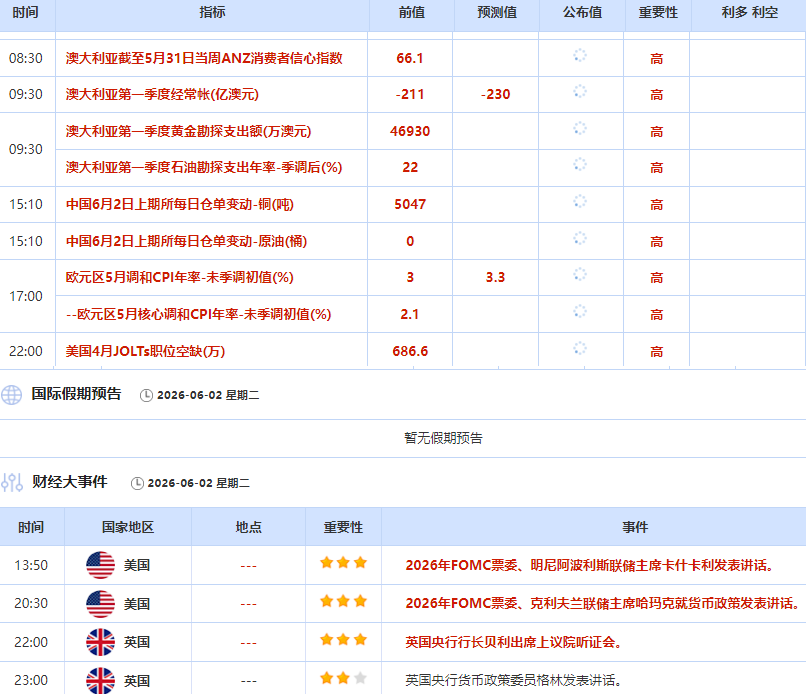
U.S. stocks closed higher across the board on Monday, with the Dow Jones Industrial Average up 0.09%, the S&P 500 up 0.27%, and the Nasdaq Composite up 0.41%.
In terms of individual stocks, MGM rose 16.02%, Arm Holdings rose 15.71%, CDW Corporation rose 12.48%, Datadog rose 12.20%, ZS rose 11.44%, and Gartner rose 10.81%.
Among the "Seven Sisters" (referring to seven major PC manufacturers), Nvidia rose 6.25%, with a turnover of $46.276 billion, mainly due to the company's announcement that it will enter the personal computer market with a new chip, aiming to challenge Intel's dominance in the field and drive the modernization of devices in the AI era.
At Computex, Nvidia CEO Jensen Huang said that starting this fall, the new RTX Spark super chip will be used for the first time in laptops and desktops from major PC manufacturers such as Dell and Lenovo. This marks Nvidia's return to the PC processor market after more than a decade (after previously failing in this field).
Microsoft rose 2.31%, Google fell 1.06%, Apple fell 1.87%, Amazon fell 3.48%, Tesla fell 4.57%, and Meta Platforms fell 5.07%.
Spot gold fell more than 1% on Monday, trading below $4,500 an ounce, amid continued uncertainty surrounding the US-Iran situation. Although US President Trump stated that negotiations between the US and Iran were "looking good, very good," and that while there had been some "minor hiccups," they had been quickly resolved, the two sides are expected to reach a memorandum of understanding within the next week. However, he also noted that he has not yet approved the memorandum, and several details still need to be finalized.
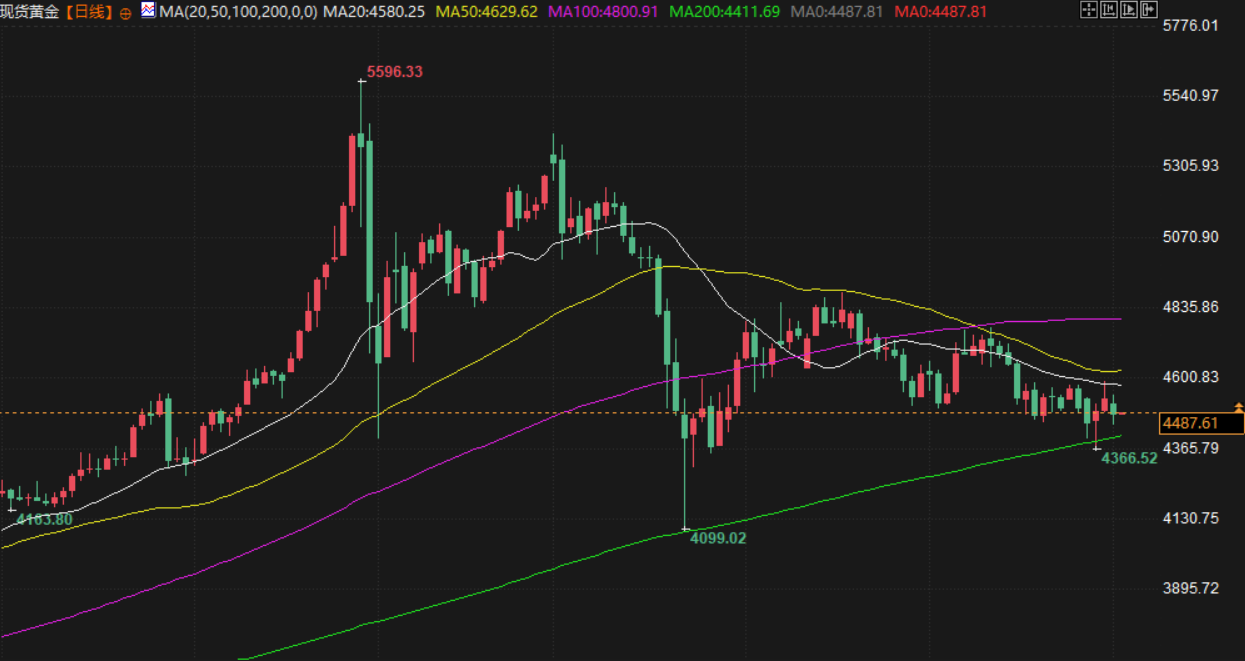
According to CME's "FedWatch": The probability of the Federal Reserve raising interest rates this year is approximately 51.8%. The probability of the Fed keeping rates unchanged by June is 98.4%, with a 1.6% probability of a cumulative 25 basis point rate cut. The probability of the Fed keeping rates unchanged by July is 90.2%, with an 8.4% probability of a cumulative 25 basis point rate hike and a 1.4% probability of a cumulative 25 basis point rate cut. The probability of the Fed keeping rates unchanged by December is 47.5%, with a 51.8% probability of at least a 25 basis point rate hike and a 0.7% probability of a cumulative 25 basis point rate cut.
Oil prices rose on Monday, posting their biggest one-day gain in nearly a month. U.S. crude oil rose more than 5%, approaching $98 a barrel at its highest point, while Brent crude oil rose more than 4%. The U.S.-Iran deal has essentially collapsed amid last week's optimistic expectations, and market optimism is at risk of fading.
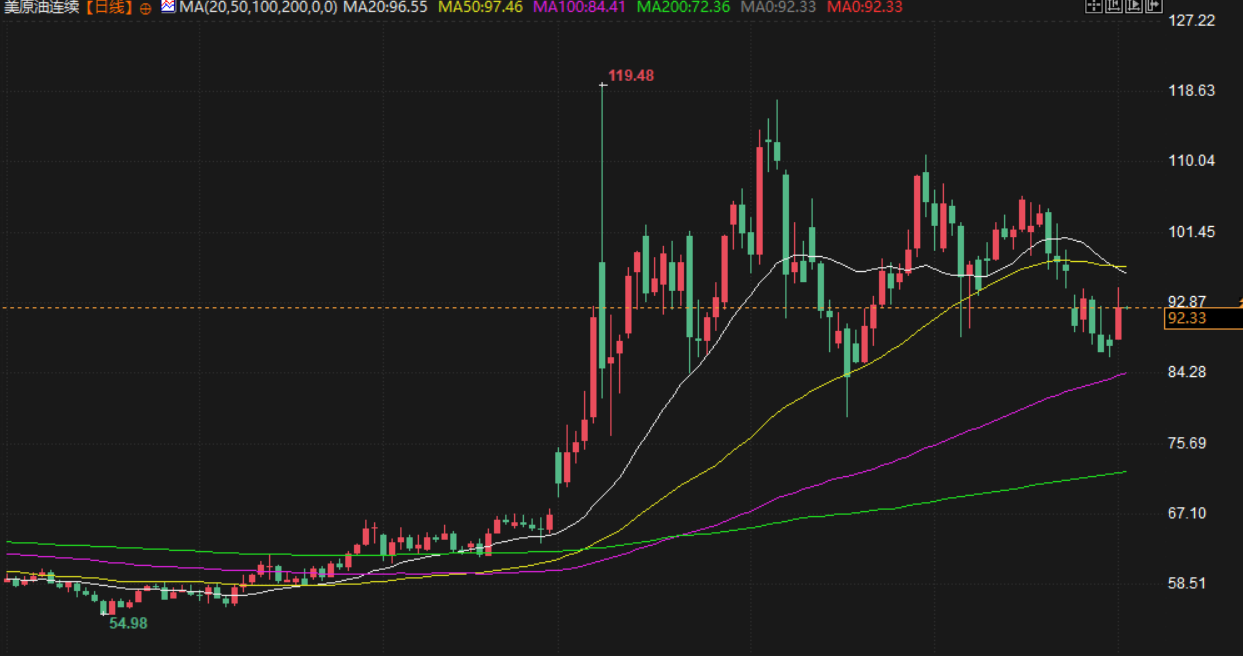
After oil prices saw their biggest single-day gain in nearly a month, market activity gradually stabilized. Uncertainty surrounding the prospects for US-Iran peace talks has further increased the risk of a prolonged disruption to energy supplies in the Persian Gulf. Trump stated that a memorandum of understanding between the US and Iran regarding the reopening of the Strait of Hormuz is expected to be formally reached within the next week. However, he also pointed out that the US still needs to "handle several details" before a final agreement is reached.
Rebecca Babin, a senior energy trader at CIBC, pointed out that if further signs emerge that both sides are no longer actively pursuing negotiations, the "safety cushion" that the market relies on in pricing—the expectation of the best-case scenario—will also disappear. She added that the market has already experienced too much back and forth during this conflict, and nothing is currently certain or settled.
Iran's Foreign Ministry issued a statement on July 1, condemning the United States and Israel for continuing to violate the ceasefire agreement. The statement emphasized that any breach of the ceasefire on any front would be a violation of the overall ceasefire arrangement, and stated that Iran would "use all its capabilities to defend its interests" if necessary.
Furthermore, the Iranian Islamic Revolutionary Guard Corps (IRGC) announced that following the aggressive attack by US forces on Iranian vessels in the Gulf of Oman, the IRGC Navy retaliated by striking the US-Israeli vessel "Sariska" with a cruise missile. The IRGC Navy emphasized that any act of aggression by US forces in the region will be met with a resolute response.
Data from the U.S. Department of Energy shows that strategic petroleum reserves fell by 8 million barrels of crude oil last week. This follows declines of 9.1 million barrels and a record 9.9 million barrels in the previous two weeks. As of now, strategic petroleum reserves have fallen to 357.1 million barrels, the lowest level since January 2024.
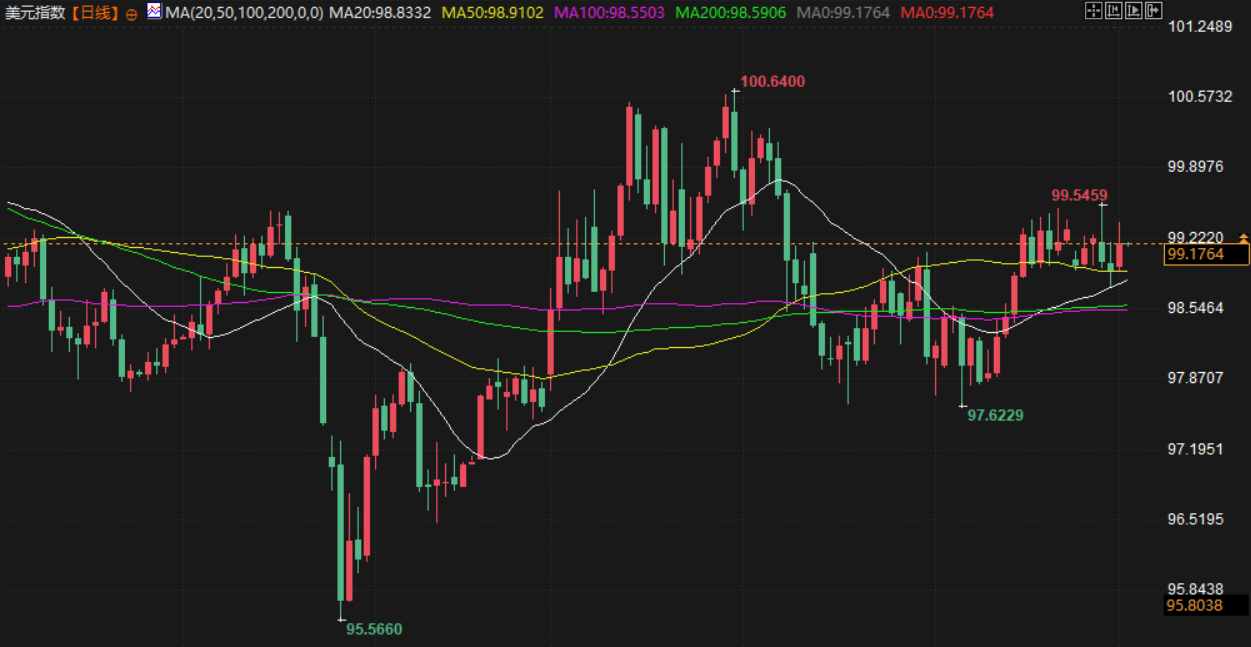
The dollar index rose on Monday, boosted by the manufacturing PMI showing expansion for the fifth consecutive month. The U.S. ISM Manufacturing PMI for May was 54, up 1.3 points from April, the highest level since May 2022, driven by increases in new orders and production. The manufacturing PMI has shown expansion for five consecutive months, indicating renewed vitality in the manufacturing sector against the backdrop of significant increases in investment in artificial intelligence, more favorable tax policies, and reduced trade policy uncertainty.
New orders are growing at their fastest pace in four months, while factory production is also on the rise.
The dollar rose as high as 159.76 against the yen on Monday, nearing the intervention level of 160 yen. Former Bank of Japan policy board member Makoto Sakurai warned on Monday that Japan faces the risk of repeating policy mistakes that led to decades of economic stagnation; the energy shock triggered by the conflict with Iran is creating inflationary pressures, and if not addressed promptly, could force the central bank to raise interest rates sharply in the future.
Policymakers, led by Bank of Japan Governor Kazuo Ueda, are seeking solutions by drawing on historical experience, specifically mentioning the oil crises of 1973 and 1979-1980. However, Makoto Sakurai points out that Ueda failed to mention Japan's asset bubble problem—partly stemming from the massive money printing implemented in 1986 to combat the yen's appreciation. Even as asset prices soared, the central bank maintained an accommodative policy until 1989, when it finally shifted course. Subsequent aggressive interest rate hikes led to the bubble's burst and are considered a major cause of three decades of economic stagnation. Sakurai argues that if the central bank keeps interest rates low for too long, it risks repeating the same mistake, being forced to raise rates sharply when inflation intensifies.
Meanwhile, Japanese Prime Minister Sanae Takaichi is drafting a supplementary budget of approximately 3 trillion yen (US$19 billion) to help households cope with rising energy prices and a weak yen, reversing her previous stance that no additional spending was needed. However, she stated that total bond issuance for calendar year 2026 will remain consistent with the original budget plan. The supplementary spending will be financed through deficit-covering bonds, a move experts point out is a "danger signal," as Japan has never historically formulated policies based on calendar years. Some analysts believe the budget is more of a "targeted buffer" against energy price pressures than a large-scale demand stimulus, consistent with Takaichi's approach.
Recent Japanese economic data has been relatively positive (Q1 GDP grew at an annualized rate of 2.1%, and April exports grew by 14.8%), but the yen is still hovering around 160 against the dollar, and the bond market is increasingly reflecting inflation, interest rate hike expectations, and increased bond supply.
US Strategic Petroleum Reserves Fall to Lowest Level in Over Two Years <br />According to US sources, the Trump administration continues to release large quantities of US strategic petroleum reserves to alleviate the energy supply crisis caused by the US-Iran conflict and the closure of the Strait of Hormuz. Data released by the US Department of Energy on the same day showed that strategic petroleum reserves decreased by 8 million barrels of crude oil last week. This follows decreases of 9.1 million barrels in the previous two weeks and a record 9.9 million barrels in the following weeks. As of now, strategic petroleum reserves have fallen to 357.1 million barrels, the lowest level since January 2024.
Iran's Islamic Revolutionary Guard Corps claims to have struck US and Israeli ships.
On the evening of June 1st local time, the Iranian Islamic Revolutionary Guard Corps (IRGC) announced that following the aggressive attack by US forces on Iranian vessels in the Gulf of Oman, the IRGC Navy retaliated by striking the US-Israeli vessel "Sariska" with a cruise missile. The IRGC Navy emphasized that any act of aggression by US forces in the region would be met with a resolute response. The statement did not specify the timing of the operation. Meanwhile, the UK's Office for Maritime Trade Operations reported on June 1st that a cargo ship sailing in the Persian Gulf near southern Iraq was struck by an unidentified projectile and experienced a violent explosion. (CCTV News)
The Iranian Revolutionary Guard hinted that navigation through the Bab el-Mandeb Strait would be subject to restrictions.
Qani, commander of the Quds Force of Iran's Islamic Revolutionary Guard Corps, said on the 1st that Israel's military operations in Lebanon and Gaza, supported by the United States, would allow the "resistance front" to expand its support for these two fronts and "activate" other fronts, and that navigation in the Bab el-Mandeb Strait would be "consistent" with that in the Strait of Hormuz. (Xinhua)
Trump: Hezbollah and Israel agree not to attack each other.
US President Trump posted on the social media platform "Truth Social" that he had a productive call with Israeli Prime Minister Netanyahu, stating that the US would not send troops to Beirut and that all troops en route to Beirut had been withdrawn. He also stated that he had successfully spoken with Hezbollah through a high-level envoy, reaching a comprehensive ceasefire agreement: Israel would not attack Hezbollah, and Hezbollah would cease attacks on Israel.
Trump said he had not yet received any news from Iran about suspending negotiations.
On June 1st local time, it was learned that US President Trump stated that he had not received any notification from Iran regarding a suspension of negotiations on the Iran issue. On the same day, sources in Iran reported that, given Israel's ongoing military operations in Lebanon and considering that a ceasefire in Lebanon is a prerequisite for a ceasefire between Iran and the US, the Iranian negotiating team has suspended dialogue and text exchanges with the US through intermediaries. The reports stated that Iranian officials and negotiators indicated that Israel must immediately cease its aggressive and brutal military operations in the Gaza Strip and Lebanon, and must completely withdraw its troops from Lebanon. Iranian officials stated that Iran will not hold any negotiations until these demands are met. (CCTV News)
Iran is reportedly set to halt information sharing with the United States in protest against Israel's offensive in Lebanon.
Iran has announced it will halt negotiations with the United States in protest against Israel's escalating ground offensive in Lebanon, escalating tensions as Washington and Tehran seek a temporary peace agreement. A statement cited by the semi-official Tasnim news agency reported that negotiators will suspend "negotiations and document exchanges conducted through mediators." The report caused oil prices to surge and stocks to fall, with Brent crude briefly rising to around $97 a barrel. Last week, Brent crude fell more than 11% as traders were optimistic about the prospects of a deal. Washington and Tehran have been indirectly exchanging information on a draft agreement that would extend the ceasefire by about two months, while Iran would reopen the Strait of Hormuz and the United States would lift its blockade of Iranian ports. However, Iranian officials say Israel's weekend ground offensive in Lebanon, the most extensive in about 25 years, violated the ceasefire agreement. Tehran has maintained that any agreement must apply to all exchanges of fire in the region, including in Lebanon. Hezbollah, backed by Iran, and Israel are waging a parallel war in Lebanon. Mohammad Bagher Ghalibaf, the speaker of the Iranian parliament and chief negotiator, previously posted on social media that Israel's escalation of operations in Lebanon and its maritime blockade of Iranian ports "clearly demonstrate that the United States is not adhering to the ceasefire agreement."
The probability of the Federal Reserve raising interest rates this year is approximately 51.8%.
According to CME's "FedWatch": The probability of the Federal Reserve keeping interest rates unchanged by June is 98.4%, and the probability of a cumulative rate cut of 25 basis points is 1.6%. The probability of the Federal Reserve keeping interest rates unchanged by July is 90.2%, the probability of a cumulative rate hike of 25 basis points is 8.4%, and the probability of a cumulative rate cut of 25 basis points is 1.4%. The probability of the Federal Reserve keeping interest rates unchanged by December is 47.5%, the probability of a rate hike of at least 25 basis points is 51.8%, and the probability of a cumulative rate cut of 25 basis points is 0.7%.
US media reports that Trump called the Israeli prime minister crazy.
According to a report by Axios on the afternoon of June 1st local time, US President Trump expressed "strong dissatisfaction" with Israel's escalation of the situation in Lebanon during a phone call with Israeli Prime Minister Netanyahu. The report stated that in this "strongly worded" call, Trump accused Netanyahu of "overstepping his bounds" on the Lebanese issue. According to a US official, Trump warned Netanyahu that bombing Beirut would "further exacerbate Israel's isolation in the international community." Two sources familiar with the matter revealed that Trump called Netanyahu "crazy" during the call and accused him of being "ungrateful." A U.S. official relayed Trump's words, saying, "If it weren't for me, you'd be in jail by now. I've been helping you. Now everyone hates you, hates Israel." Another source said Trump was "very angry" at the time, even yelling at Netanyahu, "What the hell are you doing?" The report states that Trump did not oppose Israel's "self-defense action" against Hezbollah's attacks in Lebanon, but he believed Netanyahu's recent military escalation in Lebanon was an "overreaction"—in addition to threatening airstrikes on Beirut, the Israeli military has recently expanded its ground operations in southern Lebanon. The report states that this call was one of the most tense calls between Trump and Netanyahu since Trump returned to the White House. A major reason for Trump's anger is that Israel's escalation of the situation in Lebanon could lead to the breakdown of ongoing negotiations between the U.S. and Iran. Iran had previously threatened to withdraw from negotiations with the U.S. if Israel continued its military actions in Lebanon. (CCTV News)
Jensen Huang claims the omnipotent computer has arrived; Nvidia enters the trillion-dollar market.
Nvidia, the American technology company, announced today (July 1st) the launch of a new super chip for Windows PCs. Nvidia CEO Jensen Huang stated that the new product will change the way PCs work, adding, "Microsoft and Nvidia have carefully optimized it, so computers equipped with it can practically 'do everything.'" Analysts believe that Nvidia's official entry into the PC chip market with this new processor aims to break the monopoly of Intel, Apple, and Qualcomm in this field and drive PC devices to meet the demands of the artificial intelligence era. A related source stated, "If you look at this market, including mobile devices, laptops, and desktops, the current potential market size already exceeds $1 trillion annually." (CCTV Finance)
Unitree Experience Center's first store in Asia has opened! Unitree quadruped robots start at 9997 yuan.
On May 31, Unitree Robotics, a well-known domestic robotics company, opened its first offline experience center in Asia, combining immersive smart technology with shopping. The store, with an indoor area of approximately 100 square meters, primarily sells robots, robotic dogs, panda "skins," and fitness bars. Consumers can experience the latest robot models. According to reports, the quadruped robot starts at 9,997 yuan, the humanoid robot R1 starts at 29,999 yuan, and the G1 starts at 85,000 yuan. (CCTV Finance)
Key Focus Today
stock market
U.S. stocks closed higher across the board on Monday, with the Dow Jones Industrial Average up 0.09%, the S&P 500 up 0.27%, and the Nasdaq Composite up 0.41%.
In terms of individual stocks, MGM rose 16.02%, Arm Holdings rose 15.71%, CDW Corporation rose 12.48%, Datadog rose 12.20%, ZS rose 11.44%, and Gartner rose 10.81%.
Among the "Seven Sisters" (referring to seven major PC manufacturers), Nvidia rose 6.25%, with a turnover of $46.276 billion, mainly due to the company's announcement that it will enter the personal computer market with a new chip, aiming to challenge Intel's dominance in the field and drive the modernization of devices in the AI era.
At Computex, Nvidia CEO Jensen Huang said that starting this fall, the new RTX Spark super chip will be used for the first time in laptops and desktops from major PC manufacturers such as Dell and Lenovo. This marks Nvidia's return to the PC processor market after more than a decade (after previously failing in this field).
Microsoft rose 2.31%, Google fell 1.06%, Apple fell 1.87%, Amazon fell 3.48%, Tesla fell 4.57%, and Meta Platforms fell 5.07%.
Gold Market
Spot gold fell more than 1% on Monday, trading below $4,500 an ounce, amid continued uncertainty surrounding the US-Iran situation. Although US President Trump stated that negotiations between the US and Iran were "looking good, very good," and that while there had been some "minor hiccups," they had been quickly resolved, the two sides are expected to reach a memorandum of understanding within the next week. However, he also noted that he has not yet approved the memorandum, and several details still need to be finalized.
According to CME's "FedWatch": The probability of the Federal Reserve raising interest rates this year is approximately 51.8%. The probability of the Fed keeping rates unchanged by June is 98.4%, with a 1.6% probability of a cumulative 25 basis point rate cut. The probability of the Fed keeping rates unchanged by July is 90.2%, with an 8.4% probability of a cumulative 25 basis point rate hike and a 1.4% probability of a cumulative 25 basis point rate cut. The probability of the Fed keeping rates unchanged by December is 47.5%, with a 51.8% probability of at least a 25 basis point rate hike and a 0.7% probability of a cumulative 25 basis point rate cut.
oil market
Oil prices rose on Monday, posting their biggest one-day gain in nearly a month. U.S. crude oil rose more than 5%, approaching $98 a barrel at its highest point, while Brent crude oil rose more than 4%. The U.S.-Iran deal has essentially collapsed amid last week's optimistic expectations, and market optimism is at risk of fading.
After oil prices saw their biggest single-day gain in nearly a month, market activity gradually stabilized. Uncertainty surrounding the prospects for US-Iran peace talks has further increased the risk of a prolonged disruption to energy supplies in the Persian Gulf. Trump stated that a memorandum of understanding between the US and Iran regarding the reopening of the Strait of Hormuz is expected to be formally reached within the next week. However, he also pointed out that the US still needs to "handle several details" before a final agreement is reached.
Rebecca Babin, a senior energy trader at CIBC, pointed out that if further signs emerge that both sides are no longer actively pursuing negotiations, the "safety cushion" that the market relies on in pricing—the expectation of the best-case scenario—will also disappear. She added that the market has already experienced too much back and forth during this conflict, and nothing is currently certain or settled.
Iran's Foreign Ministry issued a statement on July 1, condemning the United States and Israel for continuing to violate the ceasefire agreement. The statement emphasized that any breach of the ceasefire on any front would be a violation of the overall ceasefire arrangement, and stated that Iran would "use all its capabilities to defend its interests" if necessary.
Furthermore, the Iranian Islamic Revolutionary Guard Corps (IRGC) announced that following the aggressive attack by US forces on Iranian vessels in the Gulf of Oman, the IRGC Navy retaliated by striking the US-Israeli vessel "Sariska" with a cruise missile. The IRGC Navy emphasized that any act of aggression by US forces in the region will be met with a resolute response.
Data from the U.S. Department of Energy shows that strategic petroleum reserves fell by 8 million barrels of crude oil last week. This follows declines of 9.1 million barrels and a record 9.9 million barrels in the previous two weeks. As of now, strategic petroleum reserves have fallen to 357.1 million barrels, the lowest level since January 2024.
Foreign exchange market
The dollar index rose on Monday, boosted by the manufacturing PMI showing expansion for the fifth consecutive month. The U.S. ISM Manufacturing PMI for May was 54, up 1.3 points from April, the highest level since May 2022, driven by increases in new orders and production. The manufacturing PMI has shown expansion for five consecutive months, indicating renewed vitality in the manufacturing sector against the backdrop of significant increases in investment in artificial intelligence, more favorable tax policies, and reduced trade policy uncertainty.
New orders are growing at their fastest pace in four months, while factory production is also on the rise.
The dollar rose as high as 159.76 against the yen on Monday, nearing the intervention level of 160 yen. Former Bank of Japan policy board member Makoto Sakurai warned on Monday that Japan faces the risk of repeating policy mistakes that led to decades of economic stagnation; the energy shock triggered by the conflict with Iran is creating inflationary pressures, and if not addressed promptly, could force the central bank to raise interest rates sharply in the future.
Policymakers, led by Bank of Japan Governor Kazuo Ueda, are seeking solutions by drawing on historical experience, specifically mentioning the oil crises of 1973 and 1979-1980. However, Makoto Sakurai points out that Ueda failed to mention Japan's asset bubble problem—partly stemming from the massive money printing implemented in 1986 to combat the yen's appreciation. Even as asset prices soared, the central bank maintained an accommodative policy until 1989, when it finally shifted course. Subsequent aggressive interest rate hikes led to the bubble's burst and are considered a major cause of three decades of economic stagnation. Sakurai argues that if the central bank keeps interest rates low for too long, it risks repeating the same mistake, being forced to raise rates sharply when inflation intensifies.
Meanwhile, Japanese Prime Minister Sanae Takaichi is drafting a supplementary budget of approximately 3 trillion yen (US$19 billion) to help households cope with rising energy prices and a weak yen, reversing her previous stance that no additional spending was needed. However, she stated that total bond issuance for calendar year 2026 will remain consistent with the original budget plan. The supplementary spending will be financed through deficit-covering bonds, a move experts point out is a "danger signal," as Japan has never historically formulated policies based on calendar years. Some analysts believe the budget is more of a "targeted buffer" against energy price pressures than a large-scale demand stimulus, consistent with Takaichi's approach.
Recent Japanese economic data has been relatively positive (Q1 GDP grew at an annualized rate of 2.1%, and April exports grew by 14.8%), but the yen is still hovering around 160 against the dollar, and the bond market is increasingly reflecting inflation, interest rate hike expectations, and increased bond supply.
International News
US Strategic Petroleum Reserves Fall to Lowest Level in Over Two Years <br />According to US sources, the Trump administration continues to release large quantities of US strategic petroleum reserves to alleviate the energy supply crisis caused by the US-Iran conflict and the closure of the Strait of Hormuz. Data released by the US Department of Energy on the same day showed that strategic petroleum reserves decreased by 8 million barrels of crude oil last week. This follows decreases of 9.1 million barrels in the previous two weeks and a record 9.9 million barrels in the following weeks. As of now, strategic petroleum reserves have fallen to 357.1 million barrels, the lowest level since January 2024.
Iran's Islamic Revolutionary Guard Corps claims to have struck US and Israeli ships.
On the evening of June 1st local time, the Iranian Islamic Revolutionary Guard Corps (IRGC) announced that following the aggressive attack by US forces on Iranian vessels in the Gulf of Oman, the IRGC Navy retaliated by striking the US-Israeli vessel "Sariska" with a cruise missile. The IRGC Navy emphasized that any act of aggression by US forces in the region would be met with a resolute response. The statement did not specify the timing of the operation. Meanwhile, the UK's Office for Maritime Trade Operations reported on June 1st that a cargo ship sailing in the Persian Gulf near southern Iraq was struck by an unidentified projectile and experienced a violent explosion. (CCTV News)
The Iranian Revolutionary Guard hinted that navigation through the Bab el-Mandeb Strait would be subject to restrictions.
Qani, commander of the Quds Force of Iran's Islamic Revolutionary Guard Corps, said on the 1st that Israel's military operations in Lebanon and Gaza, supported by the United States, would allow the "resistance front" to expand its support for these two fronts and "activate" other fronts, and that navigation in the Bab el-Mandeb Strait would be "consistent" with that in the Strait of Hormuz. (Xinhua)
Trump: Hezbollah and Israel agree not to attack each other.
US President Trump posted on the social media platform "Truth Social" that he had a productive call with Israeli Prime Minister Netanyahu, stating that the US would not send troops to Beirut and that all troops en route to Beirut had been withdrawn. He also stated that he had successfully spoken with Hezbollah through a high-level envoy, reaching a comprehensive ceasefire agreement: Israel would not attack Hezbollah, and Hezbollah would cease attacks on Israel.
Trump said he had not yet received any news from Iran about suspending negotiations.
On June 1st local time, it was learned that US President Trump stated that he had not received any notification from Iran regarding a suspension of negotiations on the Iran issue. On the same day, sources in Iran reported that, given Israel's ongoing military operations in Lebanon and considering that a ceasefire in Lebanon is a prerequisite for a ceasefire between Iran and the US, the Iranian negotiating team has suspended dialogue and text exchanges with the US through intermediaries. The reports stated that Iranian officials and negotiators indicated that Israel must immediately cease its aggressive and brutal military operations in the Gaza Strip and Lebanon, and must completely withdraw its troops from Lebanon. Iranian officials stated that Iran will not hold any negotiations until these demands are met. (CCTV News)
Iran is reportedly set to halt information sharing with the United States in protest against Israel's offensive in Lebanon.
Iran has announced it will halt negotiations with the United States in protest against Israel's escalating ground offensive in Lebanon, escalating tensions as Washington and Tehran seek a temporary peace agreement. A statement cited by the semi-official Tasnim news agency reported that negotiators will suspend "negotiations and document exchanges conducted through mediators." The report caused oil prices to surge and stocks to fall, with Brent crude briefly rising to around $97 a barrel. Last week, Brent crude fell more than 11% as traders were optimistic about the prospects of a deal. Washington and Tehran have been indirectly exchanging information on a draft agreement that would extend the ceasefire by about two months, while Iran would reopen the Strait of Hormuz and the United States would lift its blockade of Iranian ports. However, Iranian officials say Israel's weekend ground offensive in Lebanon, the most extensive in about 25 years, violated the ceasefire agreement. Tehran has maintained that any agreement must apply to all exchanges of fire in the region, including in Lebanon. Hezbollah, backed by Iran, and Israel are waging a parallel war in Lebanon. Mohammad Bagher Ghalibaf, the speaker of the Iranian parliament and chief negotiator, previously posted on social media that Israel's escalation of operations in Lebanon and its maritime blockade of Iranian ports "clearly demonstrate that the United States is not adhering to the ceasefire agreement."
The probability of the Federal Reserve raising interest rates this year is approximately 51.8%.
According to CME's "FedWatch": The probability of the Federal Reserve keeping interest rates unchanged by June is 98.4%, and the probability of a cumulative rate cut of 25 basis points is 1.6%. The probability of the Federal Reserve keeping interest rates unchanged by July is 90.2%, the probability of a cumulative rate hike of 25 basis points is 8.4%, and the probability of a cumulative rate cut of 25 basis points is 1.4%. The probability of the Federal Reserve keeping interest rates unchanged by December is 47.5%, the probability of a rate hike of at least 25 basis points is 51.8%, and the probability of a cumulative rate cut of 25 basis points is 0.7%.
US media reports that Trump called the Israeli prime minister crazy.
According to a report by Axios on the afternoon of June 1st local time, US President Trump expressed "strong dissatisfaction" with Israel's escalation of the situation in Lebanon during a phone call with Israeli Prime Minister Netanyahu. The report stated that in this "strongly worded" call, Trump accused Netanyahu of "overstepping his bounds" on the Lebanese issue. According to a US official, Trump warned Netanyahu that bombing Beirut would "further exacerbate Israel's isolation in the international community." Two sources familiar with the matter revealed that Trump called Netanyahu "crazy" during the call and accused him of being "ungrateful." A U.S. official relayed Trump's words, saying, "If it weren't for me, you'd be in jail by now. I've been helping you. Now everyone hates you, hates Israel." Another source said Trump was "very angry" at the time, even yelling at Netanyahu, "What the hell are you doing?" The report states that Trump did not oppose Israel's "self-defense action" against Hezbollah's attacks in Lebanon, but he believed Netanyahu's recent military escalation in Lebanon was an "overreaction"—in addition to threatening airstrikes on Beirut, the Israeli military has recently expanded its ground operations in southern Lebanon. The report states that this call was one of the most tense calls between Trump and Netanyahu since Trump returned to the White House. A major reason for Trump's anger is that Israel's escalation of the situation in Lebanon could lead to the breakdown of ongoing negotiations between the U.S. and Iran. Iran had previously threatened to withdraw from negotiations with the U.S. if Israel continued its military actions in Lebanon. (CCTV News)
Jensen Huang claims the omnipotent computer has arrived; Nvidia enters the trillion-dollar market.
Nvidia, the American technology company, announced today (July 1st) the launch of a new super chip for Windows PCs. Nvidia CEO Jensen Huang stated that the new product will change the way PCs work, adding, "Microsoft and Nvidia have carefully optimized it, so computers equipped with it can practically 'do everything.'" Analysts believe that Nvidia's official entry into the PC chip market with this new processor aims to break the monopoly of Intel, Apple, and Qualcomm in this field and drive PC devices to meet the demands of the artificial intelligence era. A related source stated, "If you look at this market, including mobile devices, laptops, and desktops, the current potential market size already exceeds $1 trillion annually." (CCTV Finance)
Domestic News
Unitree Experience Center's first store in Asia has opened! Unitree quadruped robots start at 9997 yuan.
On May 31, Unitree Robotics, a well-known domestic robotics company, opened its first offline experience center in Asia, combining immersive smart technology with shopping. The store, with an indoor area of approximately 100 square meters, primarily sells robots, robotic dogs, panda "skins," and fitness bars. Consumers can experience the latest robot models. According to reports, the quadruped robot starts at 9,997 yuan, the humanoid robot R1 starts at 29,999 yuan, and the G1 starts at 85,000 yuan. (CCTV Finance)
- Risk Warning and Disclaimer
- The market involves risk, and trading may not be suitable for all investors. This article is for reference only and does not constitute personal investment advice, nor does it take into account certain users’ specific investment objectives, financial situation, or other needs. Any investment decisions made based on this information are at your own risk.