With changes in the cross-strait shipping landscape and declining global inventories, industry giants are warning of a potential price inflection point for crude oil within weeks.
2026-06-02 10:46:19
With the conflict in Iran remaining deadlocked, it has become the prevailing market consensus that the Strait of Hormuz is unlikely to regain its pre-war shipping capacity. Officials and shipping industry insiders from many countries predict that new country-specific regulations will be implemented for passage through the strait.
Currently, oil prices have slightly declined due to positive rumors surrounding price negotiations. However, executives from leading oil companies such as ExxonMobil and Chevron have issued warnings that global crude oil buffer inventories are rapidly depleting, and the pressure of supply-demand imbalance will materialize in the coming weeks. This suggests that Brent crude oil has the potential to surge significantly in the future. Geopolitical reshaping of shipping rules and persistently low inventories are the two core factors influencing international oil prices in the medium to long term.
Several senior industry experts and U.S. officials have warned that once Iran firmly establishes control over the Strait of Hormuz, the shipping capacity of the waterway may never return to what it was before the conflict erupted on February 28. Amos Hochstein, senior advisor on national security and energy in the Biden administration, stated that regardless of the final agreement reached between the U.S. and Iran, Iran will effectively control the strait for some time to come, a reality acknowledged by all parties in the Middle East.
Current US-Iran negotiations are only focused on extending the ceasefire, failing to completely resolve the dispute, and bilateral differences remain. The market generally expects Iran to maintain substantial control over the shipping lanes for an extended period.
According to Helima Croft, an analyst at RBC Capital Markets, as long as Iran maintains its operational influence in the Straits of Hormuz, crude oil transshipment will shrink significantly. Although the US is secretly coordinating the passage of ships through the Straits in batches, the scale of navigation is limited, and oil transport disruptions may become a long-term norm.
Richard Meade, editor-in-chief of Lloyd's Directory, stated that the Straits' shipping capacity has only recovered to 60-70% of pre-war levels, with differentiated passage policies emerging . Ships from major Asian countries enjoy preferential treatment, while ships from Western countries must pay tolls. This new model of dividing navigation rights based on geopolitical positions will not directly trigger an economic recession, but it breaks the principles of free navigation and sows the seeds of long-term energy risks.
Against the backdrop of a deteriorating shipping landscape, international oil giants have issued a series of inventory warnings.
Neil Chapman, senior vice president of ExxonMobil, said at an industry conference in New York that global crude oil inventories are about to hit historic lows and may reach a critical threshold within two or three weeks, at which point oil prices will rise rapidly.
Chevron CEO Mike Wirth also warned that global buffer inventories continue to be depleted, significantly reducing the market's ability to bridge the supply-demand gap. Data shows that the U.S. Strategic Petroleum Reserve has shrunk from 415.4 million barrels before the conflict to 365.1 million barrels. He predicts that supply and demand pressures will be transmitted to the spot market in the coming weeks, with upward pressure on oil prices concentrated in June and July.
Oil prices have fallen recently due to speculation that the US and Iran may reach a ceasefire, dropping to a more than one-month low last Friday. Although Brent crude rose 4.06% on Monday (June 1) to close at $95.31, it was still far below the previous price of over $100 and significantly different from the institutional forecast of $120 to $150 after the continued geopolitical turmoil.
Short-term price movements have been detached from supply and demand fundamentals due to news-driven fluctuations, but as inventories are rapidly depleted, market pricing logic will eventually return to reality. If the situation in the Persian Gulf does not substantially ease, oil prices, which have been suppressed for some time, will likely experience a significant correction.
Overall, the new navigation pattern in the Strait of Hormuz and the rapid decline in global inventories are doubly positive factors, and the decline in oil prices brought about by short-term public opinion is only a temporary phenomenon.
Amid geopolitical stalemates and depleted buffer inventories, crude oil prices may reach a turning point in the coming weeks, with upside risks in the energy market continuing to accumulate.
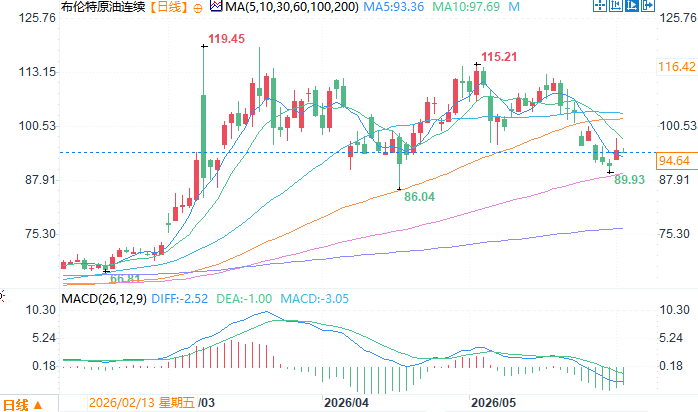
Brent crude oil daily chart source: EasyForex
At 10:46 AM Beijing time on June 2nd, Brent crude oil futures were trading at $94.64 per barrel.
Currently, oil prices have slightly declined due to positive rumors surrounding price negotiations. However, executives from leading oil companies such as ExxonMobil and Chevron have issued warnings that global crude oil buffer inventories are rapidly depleting, and the pressure of supply-demand imbalance will materialize in the coming weeks. This suggests that Brent crude oil has the potential to surge significantly in the future. Geopolitical reshaping of shipping rules and persistently low inventories are the two core factors influencing international oil prices in the medium to long term.
Geopolitical shifts are reshaping shipping routes, making it difficult for strait transport capacity to return to pre-war levels.
Several senior industry experts and U.S. officials have warned that once Iran firmly establishes control over the Strait of Hormuz, the shipping capacity of the waterway may never return to what it was before the conflict erupted on February 28. Amos Hochstein, senior advisor on national security and energy in the Biden administration, stated that regardless of the final agreement reached between the U.S. and Iran, Iran will effectively control the strait for some time to come, a reality acknowledged by all parties in the Middle East.
Current US-Iran negotiations are only focused on extending the ceasefire, failing to completely resolve the dispute, and bilateral differences remain. The market generally expects Iran to maintain substantial control over the shipping lanes for an extended period.
According to Helima Croft, an analyst at RBC Capital Markets, as long as Iran maintains its operational influence in the Straits of Hormuz, crude oil transshipment will shrink significantly. Although the US is secretly coordinating the passage of ships through the Straits in batches, the scale of navigation is limited, and oil transport disruptions may become a long-term norm.
Richard Meade, editor-in-chief of Lloyd's Directory, stated that the Straits' shipping capacity has only recovered to 60-70% of pre-war levels, with differentiated passage policies emerging . Ships from major Asian countries enjoy preferential treatment, while ships from Western countries must pay tolls. This new model of dividing navigation rights based on geopolitical positions will not directly trigger an economic recession, but it breaks the principles of free navigation and sows the seeds of long-term energy risks.
Major players issue inventory warnings, and the window for spot price increases is drawing near.
Against the backdrop of a deteriorating shipping landscape, international oil giants have issued a series of inventory warnings.
Neil Chapman, senior vice president of ExxonMobil, said at an industry conference in New York that global crude oil inventories are about to hit historic lows and may reach a critical threshold within two or three weeks, at which point oil prices will rise rapidly.
Chevron CEO Mike Wirth also warned that global buffer inventories continue to be depleted, significantly reducing the market's ability to bridge the supply-demand gap. Data shows that the U.S. Strategic Petroleum Reserve has shrunk from 415.4 million barrels before the conflict to 365.1 million barrels. He predicts that supply and demand pressures will be transmitted to the spot market in the coming weeks, with upward pressure on oil prices concentrated in June and July.
Oil prices weakened against the trend in the short term, but fundamentals will ultimately dominate the market.
Oil prices have fallen recently due to speculation that the US and Iran may reach a ceasefire, dropping to a more than one-month low last Friday. Although Brent crude rose 4.06% on Monday (June 1) to close at $95.31, it was still far below the previous price of over $100 and significantly different from the institutional forecast of $120 to $150 after the continued geopolitical turmoil.
Short-term price movements have been detached from supply and demand fundamentals due to news-driven fluctuations, but as inventories are rapidly depleted, market pricing logic will eventually return to reality. If the situation in the Persian Gulf does not substantially ease, oil prices, which have been suppressed for some time, will likely experience a significant correction.
Summarize
Overall, the new navigation pattern in the Strait of Hormuz and the rapid decline in global inventories are doubly positive factors, and the decline in oil prices brought about by short-term public opinion is only a temporary phenomenon.
Amid geopolitical stalemates and depleted buffer inventories, crude oil prices may reach a turning point in the coming weeks, with upside risks in the energy market continuing to accumulate.
Brent crude oil daily chart source: EasyForex
At 10:46 AM Beijing time on June 2nd, Brent crude oil futures were trading at $94.64 per barrel.
- Risk Warning and Disclaimer
- The market involves risk, and trading may not be suitable for all investors. This article is for reference only and does not constitute personal investment advice, nor does it take into account certain users’ specific investment objectives, financial situation, or other needs. Any investment decisions made based on this information are at your own risk.