Global rush to buy US crude oil! May exports hit a record 5.6 million barrels per day, Japan's imports surged 32%, who will fill the Middle East gap?
2026-06-02 09:14:46
On Tuesday (June 2) during Asian trading hours, US crude oil futures opened higher but then fluctuated lower, currently trading around $91.80 per barrel. Previously, on Friday, optimism surrounding a US-Iran ceasefire briefly pushed it below $87, before rebounding above $90 due to news of attacks on Kuwait and Iran's blockade of the Strait of Hormuz.
Echoing the volatile oil price trend, U.S. crude oil exports are filling the supply gap in the Middle East at a record pace.
Ship tracking data released Monday showed that U.S. crude oil exports climbed to a record 5.6 million barrels per day in May, driven by a surge in demand for U.S. crude from refineries in Asia and Europe fueled by the Middle East crisis. The war between the U.S. and Israel and Iran has triggered the largest supply disruption in the history of the global energy market, with about one-fifth of the world's oil and gas supply passing through the Strait of Hormuz, a crucial waterway that was effectively closed when the war broke out at the end of February.
According to data and analytics firm Kpler, U.S. crude oil exports in May surpassed the April record of 5.2 million barrels per day, when the U.S. benchmark WTI crude was trading at a significant discount to the global benchmark Brent. U.S. physical crude oil grades are typically priced based on the WTI spread, and this significant discount to Brent makes it more economical for foreign buyers to purchase U.S. crude and ship it globally.

In March, the discount of WTI to Brent futures reached as high as $20.69 per barrel, the largest in 13 years, as supply disruptions in the Middle East caused Brent to outperform WTI. In April (when most of the transactions for May exports were executed), the discount averaged about $8.86, compared to a pre-war average discount of $4.85.
Matt Smith, head of commodities research at Kpler, said: "Given the supply losses in the Middle East, it's not surprising to see large purchases from Asia."
Exports to both Asia and Europe hit record highs in May. Asia absorbed 2.45 million barrels per day of exports, remaining the largest buyer for the second consecutive month, followed by Europe with 2.4 million barrels per day.
Japan, which typically imports most of its crude oil from the Middle East, accounted for the largest share of U.S. crude oil imports from Asia in May, reaching 808,000 barrels per day, a record 32% jump from the previous month.
U.S. crude oil shipments to the Mediterranean and Black Seas also hit a record high in May, with Bulgaria, Croatia, Turkey, and Greece becoming rare transatlantic buyers. Italy's record imports of 335,000 barrels per day fueled European demand growth.
"We believe Asian purchases are primarily driven by need, while European purchases are mainly due to favorable shipping economies and lower transatlantic freight rates," said Rohit Rathod, senior oil market analyst at Vortexa. At least 283,000 barrels per day (approximately 5%) of U.S. exports in May came from crude oil held in the U.S. Strategic Petroleum Reserve.
This oil is part of the 172 million barrels currently being released from the U.S. emergency oil reserves to combat soaring crude oil prices and is destined for buyers in Europe and Asia.
After a surge in exports in May, exports are expected to decline in June as hopes for a ceasefire ease supply concerns and narrow the WTI-Brent discount.
Although the WTI-Brent discount remained significant in early May, it narrowed in the second half of the month, trading at a discount of approximately $6 on Monday. Consulting firm Energy Aspects estimates average exports of approximately 4.9 million barrels per day in June and approximately 4.6 million barrels per day in July.
"We expect June exports to fall by more than 1 million barrels per day compared to May," said Georgios Sakellariou, a chartering analyst at Signal Maritime, adding that the company shipped at least 10 fewer Very Large Crude Carriers (VLCCs) in June than in May.
Sources and analysts say that low domestic WTI crude oil inventories in the United States will incentivize more crude oil to flow into domestic storage, thereby reducing exports.
US crude oil futures are currently in a correction phase after an upward move on the daily chart. Prices have fallen from a high of $119.48 and recently broken below several short-term moving averages. They are currently trading around $91.90, and are under significant pressure overall.
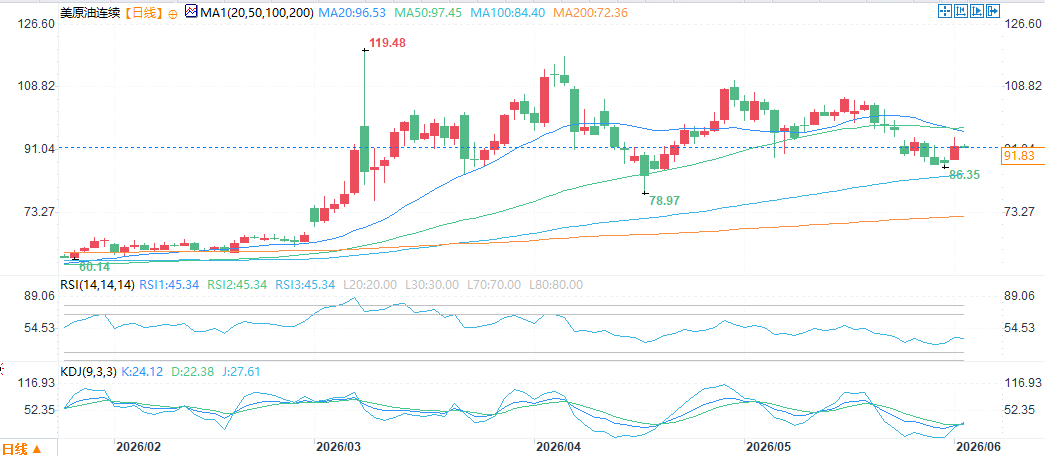
(US crude oil futures daily chart, source: FX678)
On the moving average system, the price has broken below the MA20 (96.53) and MA50 (97.45) moving averages, and is currently finding support above the MA100 (84.40). The 20-day moving average has crossed below the 50-day moving average, forming a death cross, indicating strong resistance above. In terms of indicators, the RSI is currently at 45.34, in a neutral to weak range, and the downward momentum is still releasing.
Overall, US crude oil faces significant short-term downward pressure, with key support levels at the low of $86.35 and the 100-day moving average (MA100) at $84.40, while resistance lies at the 20-day moving average (MA20) at $96.53. If it fails to quickly recover above the short-term moving averages, the downward trend is likely to continue.
At 09:13 Beijing time on June 2, US crude oil futures were trading at $91.78 per barrel.
Echoing the volatile oil price trend, U.S. crude oil exports are filling the supply gap in the Middle East at a record pace.
Ship tracking data released Monday showed that U.S. crude oil exports climbed to a record 5.6 million barrels per day in May, driven by a surge in demand for U.S. crude from refineries in Asia and Europe fueled by the Middle East crisis. The war between the U.S. and Israel and Iran has triggered the largest supply disruption in the history of the global energy market, with about one-fifth of the world's oil and gas supply passing through the Strait of Hormuz, a crucial waterway that was effectively closed when the war broke out at the end of February.
According to data and analytics firm Kpler, U.S. crude oil exports in May surpassed the April record of 5.2 million barrels per day, when the U.S. benchmark WTI crude was trading at a significant discount to the global benchmark Brent. U.S. physical crude oil grades are typically priced based on the WTI spread, and this significant discount to Brent makes it more economical for foreign buyers to purchase U.S. crude and ship it globally.
WTI discount widens: Reaching $20.69 per barrel in March.
In March, the discount of WTI to Brent futures reached as high as $20.69 per barrel, the largest in 13 years, as supply disruptions in the Middle East caused Brent to outperform WTI. In April (when most of the transactions for May exports were executed), the discount averaged about $8.86, compared to a pre-war average discount of $4.85.
Matt Smith, head of commodities research at Kpler, said: "Given the supply losses in the Middle East, it's not surprising to see large purchases from Asia."
Demand in Asia and Europe: Japan and Italy lead the way.
Exports to both Asia and Europe hit record highs in May. Asia absorbed 2.45 million barrels per day of exports, remaining the largest buyer for the second consecutive month, followed by Europe with 2.4 million barrels per day.
Japan, which typically imports most of its crude oil from the Middle East, accounted for the largest share of U.S. crude oil imports from Asia in May, reaching 808,000 barrels per day, a record 32% jump from the previous month.
U.S. crude oil shipments to the Mediterranean and Black Seas also hit a record high in May, with Bulgaria, Croatia, Turkey, and Greece becoming rare transatlantic buyers. Italy's record imports of 335,000 barrels per day fueled European demand growth.
Strategic petroleum reserves released: approximately 5% of exports.
"We believe Asian purchases are primarily driven by need, while European purchases are mainly due to favorable shipping economies and lower transatlantic freight rates," said Rohit Rathod, senior oil market analyst at Vortexa. At least 283,000 barrels per day (approximately 5%) of U.S. exports in May came from crude oil held in the U.S. Strategic Petroleum Reserve.
This oil is part of the 172 million barrels currently being released from the U.S. emergency oil reserves to combat soaring crude oil prices and is destined for buyers in Europe and Asia.
June Outlook: Exports are expected to decline
After a surge in exports in May, exports are expected to decline in June as hopes for a ceasefire ease supply concerns and narrow the WTI-Brent discount.
Although the WTI-Brent discount remained significant in early May, it narrowed in the second half of the month, trading at a discount of approximately $6 on Monday. Consulting firm Energy Aspects estimates average exports of approximately 4.9 million barrels per day in June and approximately 4.6 million barrels per day in July.
"We expect June exports to fall by more than 1 million barrels per day compared to May," said Georgios Sakellariou, a chartering analyst at Signal Maritime, adding that the company shipped at least 10 fewer Very Large Crude Carriers (VLCCs) in June than in May.
Sources and analysts say that low domestic WTI crude oil inventories in the United States will incentivize more crude oil to flow into domestic storage, thereby reducing exports.
US crude oil futures are currently in a correction phase after an upward move on the daily chart. Prices have fallen from a high of $119.48 and recently broken below several short-term moving averages. They are currently trading around $91.90, and are under significant pressure overall.
(US crude oil futures daily chart, source: FX678)
On the moving average system, the price has broken below the MA20 (96.53) and MA50 (97.45) moving averages, and is currently finding support above the MA100 (84.40). The 20-day moving average has crossed below the 50-day moving average, forming a death cross, indicating strong resistance above. In terms of indicators, the RSI is currently at 45.34, in a neutral to weak range, and the downward momentum is still releasing.
Overall, US crude oil faces significant short-term downward pressure, with key support levels at the low of $86.35 and the 100-day moving average (MA100) at $84.40, while resistance lies at the 20-day moving average (MA20) at $96.53. If it fails to quickly recover above the short-term moving averages, the downward trend is likely to continue.
At 09:13 Beijing time on June 2, US crude oil futures were trading at $91.78 per barrel.
- Risk Warning and Disclaimer
- The market involves risk, and trading may not be suitable for all investors. This article is for reference only and does not constitute personal investment advice, nor does it take into account certain users’ specific investment objectives, financial situation, or other needs. Any investment decisions made based on this information are at your own risk.