Rising inflation expectations in the Eurozone have strengthened bets on interest rate hikes, causing the euro to remain range-bound against the pound.
2026-06-02 15:27:09
The euro traded sideways against the pound sterling (EUR/GBP) in early European trading on Tuesday, hovering around 0.8645. Investors remained cautious as the market awaited the latest eurozone inflation data, resulting in relatively stable trading sentiment.

This week, Eurozone consumer price data has become one of the most important focuses for European financial markets. The market expects the Eurozone's May unified consumer price index (HICP) to rise to 3.2% year-on-year from 3.0% previously. If the actual data exceeds market expectations, it could further strengthen market bets on the European Central Bank (ECB) continuing to tighten monetary policy. Currently, the market estimates a nearly 92% probability of a 25 basis point rate hike at the ECB's June meeting, with the deposit rate potentially rising to 2.25%.
Meanwhile, investors are also paying close attention to whether the European Central Bank (ECB) will take further tightening measures in the second half of this year. Currently, the market estimates a probability of another rate hike in September at around 50%. With rising energy prices and increased risks of imported inflation from the Middle East situation, concerns about the inflation outlook within the ECB have intensified.
The international energy market has recently been affected by the situation in the Middle East. Supply risks in the Strait of Hormuz have kept crude oil prices high, while high energy costs in Europe, as a net energy importer, could further push up price pressures. This presents the European Central Bank with new challenges in controlling inflation.
Market analysts believe that if core inflation in the Eurozone continues to exceed expectations, the European Central Bank may be forced to maintain a hawkish stance for an extended period. In contrast, the Bank of England's current policy stance is significantly more cautious. Bank of England Governor Bailey recently stated that given the uncertainty in the Middle East and weak UK economic growth, the Bank of England is in no hurry to raise interest rates further.
The UK economy has been relatively weak recently. High interest rates continue to suppress consumption and business investment, while the housing market still faces adjustment pressures. Although UK inflation remains above the central bank's target, policymakers are more concerned about the risk of slower economic growth. The market currently expects the Bank of England to raise interest rates by approximately 32 basis points this year, meaning a 25 basis point hike has already been largely priced in, while the probability of a second hike is only about 30%.
This divergence in monetary policy expectations has been a key factor supporting the euro against the pound recently. If the European Central Bank continues its hawkish stance while the Bank of England maintains a cautious position, the euro's interest rate advantage over the pound is expected to widen further. In addition, investors are also watching this week's US employment data and changes in global risk sentiment. Although the euro/pound exchange rate is a European currency cross, global capital flows and changes in risk aversion can still indirectly affect the exchange rate by influencing the European economic outlook.
From the daily chart, the MACD indicator maintains a golden cross structure, with the red momentum bars continuing to expand, indicating that the medium-term bullish trend still holds the upper hand. The RSI indicator is around 58, reflecting that the market is in a relatively strong state but has not yet entered the overbought zone. Currently, the key resistance levels to watch are 0.8680, 0.8720, and 0.8780; the support levels are around 0.8610, 0.8570, and 0.8520. The overall trend remains in a range-bound pattern.
Observing the 4-hour chart, the exchange rate has been consolidating around 0.8640 recently, with short-term moving averages maintaining a bullish alignment. The MACD indicator is running above the zero line, but the momentum bars are slightly contracting, indicating that the market is awaiting a new directional choice. The RSI indicator remains around 55, indicating a relatively balanced short-term trend. If the price breaks through the 0.8680 resistance area, it may further test the 0.8720 level; if it falls below the 0.8610 support, it may pull back to test the 0.8570 area. Overall, the short-term trend still leans towards a moderate upward movement.
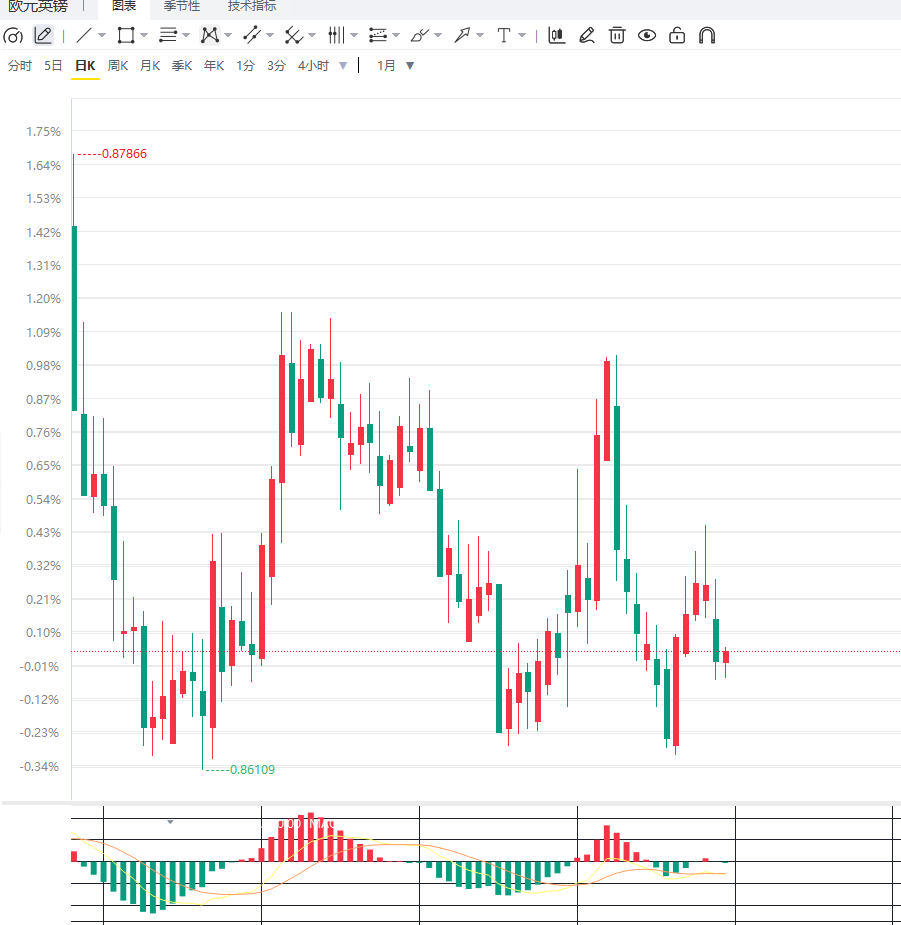
Editor's Summary : The current euro/pound exchange rate movement is primarily driven by the policy expectation divergence between the European Central Bank (ECB) and the Bank of England (BOE). Increased expectations of rising inflation in the Eurozone have strengthened market bets on further ECB rate hikes, while weak UK economic growth limits the BOE's room for further policy tightening. From a fundamental perspective, the euro still holds a certain advantage over the pound. In the short term, the Eurozone HICP data will be a crucial catalyst for market direction. If inflation is higher than expected, the euro/pound exchange rate could further challenge the 0.87 level; conversely, if the data is lower than expected, it may trigger some profit-taking.
This week, Eurozone consumer price data has become one of the most important focuses for European financial markets. The market expects the Eurozone's May unified consumer price index (HICP) to rise to 3.2% year-on-year from 3.0% previously. If the actual data exceeds market expectations, it could further strengthen market bets on the European Central Bank (ECB) continuing to tighten monetary policy. Currently, the market estimates a nearly 92% probability of a 25 basis point rate hike at the ECB's June meeting, with the deposit rate potentially rising to 2.25%.
Meanwhile, investors are also paying close attention to whether the European Central Bank (ECB) will take further tightening measures in the second half of this year. Currently, the market estimates a probability of another rate hike in September at around 50%. With rising energy prices and increased risks of imported inflation from the Middle East situation, concerns about the inflation outlook within the ECB have intensified.
The international energy market has recently been affected by the situation in the Middle East. Supply risks in the Strait of Hormuz have kept crude oil prices high, while high energy costs in Europe, as a net energy importer, could further push up price pressures. This presents the European Central Bank with new challenges in controlling inflation.
Market analysts believe that if core inflation in the Eurozone continues to exceed expectations, the European Central Bank may be forced to maintain a hawkish stance for an extended period. In contrast, the Bank of England's current policy stance is significantly more cautious. Bank of England Governor Bailey recently stated that given the uncertainty in the Middle East and weak UK economic growth, the Bank of England is in no hurry to raise interest rates further.
The UK economy has been relatively weak recently. High interest rates continue to suppress consumption and business investment, while the housing market still faces adjustment pressures. Although UK inflation remains above the central bank's target, policymakers are more concerned about the risk of slower economic growth. The market currently expects the Bank of England to raise interest rates by approximately 32 basis points this year, meaning a 25 basis point hike has already been largely priced in, while the probability of a second hike is only about 30%.
This divergence in monetary policy expectations has been a key factor supporting the euro against the pound recently. If the European Central Bank continues its hawkish stance while the Bank of England maintains a cautious position, the euro's interest rate advantage over the pound is expected to widen further. In addition, investors are also watching this week's US employment data and changes in global risk sentiment. Although the euro/pound exchange rate is a European currency cross, global capital flows and changes in risk aversion can still indirectly affect the exchange rate by influencing the European economic outlook.
From the daily chart, the MACD indicator maintains a golden cross structure, with the red momentum bars continuing to expand, indicating that the medium-term bullish trend still holds the upper hand. The RSI indicator is around 58, reflecting that the market is in a relatively strong state but has not yet entered the overbought zone. Currently, the key resistance levels to watch are 0.8680, 0.8720, and 0.8780; the support levels are around 0.8610, 0.8570, and 0.8520. The overall trend remains in a range-bound pattern.
Observing the 4-hour chart, the exchange rate has been consolidating around 0.8640 recently, with short-term moving averages maintaining a bullish alignment. The MACD indicator is running above the zero line, but the momentum bars are slightly contracting, indicating that the market is awaiting a new directional choice. The RSI indicator remains around 55, indicating a relatively balanced short-term trend. If the price breaks through the 0.8680 resistance area, it may further test the 0.8720 level; if it falls below the 0.8610 support, it may pull back to test the 0.8570 area. Overall, the short-term trend still leans towards a moderate upward movement.
Editor's Summary : The current euro/pound exchange rate movement is primarily driven by the policy expectation divergence between the European Central Bank (ECB) and the Bank of England (BOE). Increased expectations of rising inflation in the Eurozone have strengthened market bets on further ECB rate hikes, while weak UK economic growth limits the BOE's room for further policy tightening. From a fundamental perspective, the euro still holds a certain advantage over the pound. In the short term, the Eurozone HICP data will be a crucial catalyst for market direction. If inflation is higher than expected, the euro/pound exchange rate could further challenge the 0.87 level; conversely, if the data is lower than expected, it may trigger some profit-taking.
- Risk Warning and Disclaimer
- The market involves risk, and trading may not be suitable for all investors. This article is for reference only and does not constitute personal investment advice, nor does it take into account certain users’ specific investment objectives, financial situation, or other needs. Any investment decisions made based on this information are at your own risk.