With inflation exceeding 3% and an interest rate hike imminent, the Korean won is falling even more sharply.
2026-06-02 16:36:45
On Tuesday (June 2) during Asian trading hours, the US dollar rose slightly against the South Korean won to around 1518, potentially marking its third consecutive day of gains.
Meanwhile, inflationary pressures in South Korea are accelerating. Against the backdrop of robust economic growth and persistently rising inflation, the Bank of Korea is poised to begin a new round of tightening.
South Korea's CPI rose 3.1% year-on-year in May (compared to 2.6% in April, with market expectations of 2.9% and ING's expectation of 3.0%).
The main driver was fuel prices: gasoline and diesel prices rose 23.1% and 33.3% year-on-year, respectively. Despite the government maintaining the gasoline price cap and extending fuel tax exemptions, inflationary pressures have spread to other sectors. Airfares (30.1%) and IT equipment (14.3%) saw significant price increases. Prices for other major items, such as clothing, household goods, and housing, also rose compared to the previous month. Core CPI rose to 2.5% year-on-year (compared to 2.2% in April, in line with market expectations).
In the coming months, inflation is expected to approach 3.5%, driven by high energy prices and the intensifying effects of a second round of inflation.
Earlier this week, Bank of Korea Governor Lee Chang-yong once again signaled a hawkish stance.
He made it clear that the current macroeconomic environment—including persistent inflationary pressures and robust export performance—still supports further tightening of monetary policy.
This statement is consistent with his previous emphasis on "preventing inflation expectations from becoming unanchored" and has strengthened market expectations for a July rate hike.
It is worth noting that Lee Chang-yong also mentioned that even if interest rates are raised, the domestic economy is still expected to benefit from the wealth effect and indirect fiscal support, thereby mitigating the impact of tightening on private consumption.
Current market pricing implies a cumulative interest rate hike of 100 basis points over the next 12 months, while economists predict between two and four hikes. A cumulative rate hike of 75 basis points is expected by the first half of 2027.
The final interest rate level depends on the strength of the transmission of information technology (IT) and export growth to the domestic economy. Once the policy rate reaches 3%, the Bank of Korea may cautiously proceed with further tightening given policymakers' concerns about exacerbating the imbalances in the "K-shaped recovery."
Governor Lee Chang-yong believes the domestic economy will benefit from positive spillovers such as improved wealth effects and indirect fiscal support. Furthermore, the Bank of Korea's latest outlook projects solid growth and sticky inflation in 2027, providing a basis for raising the terminal interest rate to 3.25%.
In summary, South Korea's unexpectedly high inflation, strong exports, and the central bank's hawkish stance all point to July as the starting point for interest rate hikes. The future pace of rate hikes and the final interest rate will depend on the transmission of domestic demand and the structure of the recovery.
The USD/KRW pair is currently trading around 1518, having stabilized above all four moving averages (MA20, MA50, MA100, and MA200), which are rising in an orderly fashion from bottom to top, indicating a solid medium- to long-term bullish trend. After reaching a high of 1536 in the previous session, the price retraced, finding support at the key low of 1438 in May before rebounding quickly. Supported by long-term moving averages, it has continued to recover lost ground and is currently approaching its previous high, with 1536 acting as strong short-term resistance. Key medium-term support levels are 1438, 1425, and 1423.
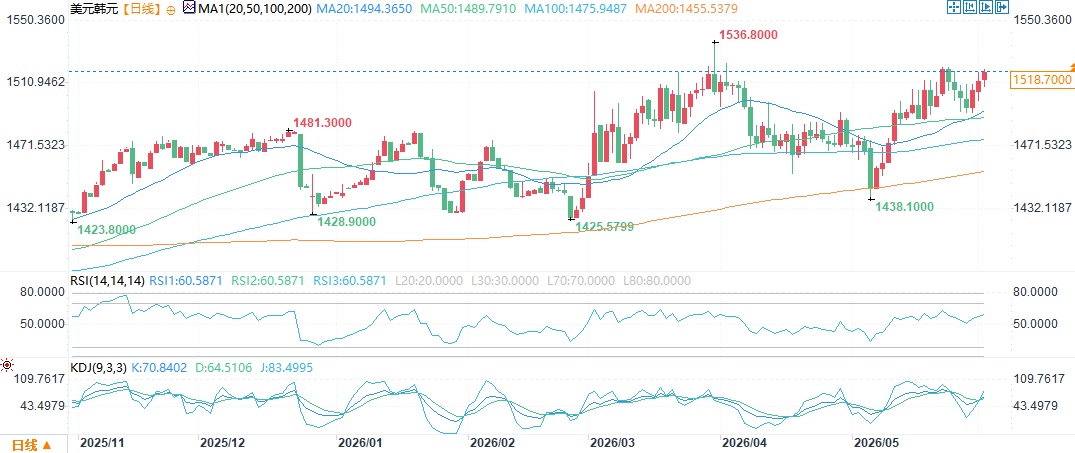
(USD/KRW daily chart, source: FX678)
In terms of indicators, the RSI value is 60.59, which is firmly above the 50 level, the dividing line between bullish and bearish trends, indicating that the bulls have the upper hand, but there is still room for the price to fall below the 70 overbought level.
Amid rising expectations of a Fed rate hike and diverging monetary policies between the US and South Korea, the overall bullish logic for the exchange rate remains unchanged. Short-term resistance is seen at the previous high of 1536; a pullback would target the 1495-1500 moving average support. A decisive break above 1536 would open up new upside potential, and a bullish bias is maintained as long as the price doesn't fall below the medium-term moving average.
At 16:25 Beijing time on June 2, the US dollar was trading at 1517.80/81 against the South Korean won.
Meanwhile, inflationary pressures in South Korea are accelerating. Against the backdrop of robust economic growth and persistently rising inflation, the Bank of Korea is poised to begin a new round of tightening.
Consumer inflation accelerated in May, exceeding market expectations.
South Korea's CPI rose 3.1% year-on-year in May (compared to 2.6% in April, with market expectations of 2.9% and ING's expectation of 3.0%).
The main driver was fuel prices: gasoline and diesel prices rose 23.1% and 33.3% year-on-year, respectively. Despite the government maintaining the gasoline price cap and extending fuel tax exemptions, inflationary pressures have spread to other sectors. Airfares (30.1%) and IT equipment (14.3%) saw significant price increases. Prices for other major items, such as clothing, household goods, and housing, also rose compared to the previous month. Core CPI rose to 2.5% year-on-year (compared to 2.2% in April, in line with market expectations).
In the coming months, inflation is expected to approach 3.5%, driven by high energy prices and the intensifying effects of a second round of inflation.
The Bank of Korea could start raising interest rates as early as July.
Earlier this week, Bank of Korea Governor Lee Chang-yong once again signaled a hawkish stance.
He made it clear that the current macroeconomic environment—including persistent inflationary pressures and robust export performance—still supports further tightening of monetary policy.
This statement is consistent with his previous emphasis on "preventing inflation expectations from becoming unanchored" and has strengthened market expectations for a July rate hike.
It is worth noting that Lee Chang-yong also mentioned that even if interest rates are raised, the domestic economy is still expected to benefit from the wealth effect and indirect fiscal support, thereby mitigating the impact of tightening on private consumption.
The market is focused on the pace and magnitude of interest rate hikes.
Current market pricing implies a cumulative interest rate hike of 100 basis points over the next 12 months, while economists predict between two and four hikes. A cumulative rate hike of 75 basis points is expected by the first half of 2027.
The final interest rate level depends on the strength of the transmission of information technology (IT) and export growth to the domestic economy. Once the policy rate reaches 3%, the Bank of Korea may cautiously proceed with further tightening given policymakers' concerns about exacerbating the imbalances in the "K-shaped recovery."
Governor Lee Chang-yong believes the domestic economy will benefit from positive spillovers such as improved wealth effects and indirect fiscal support. Furthermore, the Bank of Korea's latest outlook projects solid growth and sticky inflation in 2027, providing a basis for raising the terminal interest rate to 3.25%.
In summary, South Korea's unexpectedly high inflation, strong exports, and the central bank's hawkish stance all point to July as the starting point for interest rate hikes. The future pace of rate hikes and the final interest rate will depend on the transmission of domestic demand and the structure of the recovery.
USD/KRW Daily Technical Analysis
The USD/KRW pair is currently trading around 1518, having stabilized above all four moving averages (MA20, MA50, MA100, and MA200), which are rising in an orderly fashion from bottom to top, indicating a solid medium- to long-term bullish trend. After reaching a high of 1536 in the previous session, the price retraced, finding support at the key low of 1438 in May before rebounding quickly. Supported by long-term moving averages, it has continued to recover lost ground and is currently approaching its previous high, with 1536 acting as strong short-term resistance. Key medium-term support levels are 1438, 1425, and 1423.
(USD/KRW daily chart, source: FX678)
In terms of indicators, the RSI value is 60.59, which is firmly above the 50 level, the dividing line between bullish and bearish trends, indicating that the bulls have the upper hand, but there is still room for the price to fall below the 70 overbought level.
Amid rising expectations of a Fed rate hike and diverging monetary policies between the US and South Korea, the overall bullish logic for the exchange rate remains unchanged. Short-term resistance is seen at the previous high of 1536; a pullback would target the 1495-1500 moving average support. A decisive break above 1536 would open up new upside potential, and a bullish bias is maintained as long as the price doesn't fall below the medium-term moving average.
At 16:25 Beijing time on June 2, the US dollar was trading at 1517.80/81 against the South Korean won.
- Risk Warning and Disclaimer
- The market involves risk, and trading may not be suitable for all investors. This article is for reference only and does not constitute personal investment advice, nor does it take into account certain users’ specific investment objectives, financial situation, or other needs. Any investment decisions made based on this information are at your own risk.