US crude oil futures: Iran negotiations stalled vs. Trump's peace signals; API inventory may be key to short-term breakthrough.
2026-06-02 16:34:02
On Tuesday (June 2) during Asian trading hours, US crude oil futures prices traded around $91.10, down more than 1%.
Despite reports that Iran has halted negotiations with the United States, the market remains cautious about any factors that could ease tensions in the Middle East. Meanwhile, the upcoming API crude oil inventory data is also attracting attention.
According to Iran's official Tasnim News Agency on Monday, Tehran's negotiating team has decided to stop exchanging information with the United States through intermediaries due to recent attacks in Lebanon.
Iran believes that maintaining indirect communication with the United States is no longer feasible given the continued deterioration of the regional security situation. This move marks the first substantial interruption of diplomatic contacts between the two countries since the temporary ceasefire agreement reached in early April.
In response, US President Trump quickly stated that the US would maintain its blockade of Iranian ports and would not make any concessions due to Iran's unilateral suspension of contact. Trump declared, "If they don't want to talk, that's fine with me," implying that the US was not in a hurry to return to the negotiating table.
Trump also emphasized that the U.S. policy of economic pressure on Iran will not change, including continued restrictions on oil exports and financial access.
Analysts point out that significant differences remain between the US and Iran on core issues such as the situation in Lebanon and navigation safety in the Strait of Hormuz, making a resumption of negotiations unlikely in the short term. As a result, market concerns about disruptions to Middle Eastern supply chains have intensified, providing some short-term support for oil prices after the news was released. If the diplomatic deadlock continues, the risk premium for crude oil may widen further.

Amid escalating tensions between the US and Iran, US President Trump and Israeli Prime Minister Netanyahu have released signals that appear to be in different directions but are actually interconnected.
In his latest statement, Trump demonstrated a degree of willingness to negotiate. He stated that he believes an agreement can be reached "within the next week," one that would include reopening the Strait of Hormuz and extending the existing ceasefire with Iran. This statement subtly contrasts with the previous hardline stance of maintaining the blockade of Iranian ports, suggesting that the US still retains room for a diplomatic solution beyond military confrontation and economic sanctions.
Trump also emphasized that if Iran is unwilling to continue dialogue, "that's fine"—a statement that both maintains the bottom line for pressure and leaves room for further maneuvering.
In contrast to Trump's relative restraint, Israeli Prime Minister Netanyahu continued to adopt a tough stance. He made it clear that the Israeli military would continue its military operations against Hezbollah in southern Lebanon, emphasizing that this was a necessary measure to ensure the security of Israel's northern border.
While negotiations between the United States and Iran may ease tensions in the Gulf region to some extent, the conflict between Israel and Hezbollah in Lebanon has not cooled down in tandem, meaning that a comprehensive security and stability in the Middle East is unlikely to emerge in the short term.
From a market perspective, Trump's "expectations of peace talks" tend to suppress oil prices, while Netanyahu's "continued attacks" could exacerbate geopolitical risk premiums. The coexistence of these two factors creates greater uncertainty for oil traders when judging short-term direction.
Currently, US crude oil futures prices are consolidating around $91, and the market is being repeatedly pulled in opposite directions by two opposing forces.
On the one hand, geopolitical uncertainty continues to provide upward support for oil prices. Iran's suspension of indirect negotiations with the United States marks a renewed tightening of US-Iran relations, which had briefly eased since early April.
What worries the market even more is that the Strait of Hormuz—a vital waterway for approximately 20% of global crude oil shipments—is facing the risk of being effectively blocked by Iran. Although the US has not confirmed any related military deployments, if navigation through the strait is disrupted, the global oil supply chain will suffer an immediate shock, and risk premiums similar to those during the 2019 tanker attacks could reappear.
Furthermore, Israel's military operations in southern Lebanon continue, and the extent to which Hezbollah, as Iran's core proxy force, is involved in the conflict remains unclear. Any sign of escalation could push oil prices up again.
On the other hand, market hopes for the resumption of peace talks between the US and Iran have not completely dissipated, which poses a potential downward pressure on oil prices.
While making a tough stance, Trump also released a vague signal that "an agreement may be reached within the next week."
Some traders believe this is both a tactic by the US to exert pressure and an indication that both sides still maintain communication channels. If a breakthrough can be achieved diplomatically on the issue of navigation in the Strait of Hormuz, or if the temporary ceasefire agreement is extended, the risk premium for crude oil will quickly fall, and oil prices may give back their recent gains.
In the short term, the direction of oil prices depends on whether "conflict escalation" or "diplomatic breakthrough" occurs first. Until the situation becomes clearer, oil prices are likely to remain highly volatile.
The American Petroleum Institute (API) will release its latest weekly crude oil inventory report later on Tuesday. As an important leading indicator for the weekly EIA official inventory data, the API report often triggers short-term fluctuations in the crude oil market, especially at this sensitive time when geopolitical risks and supply and demand fundamentals are intertwined.
If inventory declines exceed expectations, it typically sends two signals: first, US refinery utilization rates remain high, with strong demand for gasoline and distillate fuels; second, crude oil exports remain robust, with global buyers maintaining their willingness to purchase US light, sweet crude oil. Both scenarios point to either "strengthened demand" or "tightening supply," potentially driving oil prices up rapidly. Especially at the current price level around $91, if the report shows an inventory reduction of more than 2 million barrels, the market might interpret this as evidence of an early summer travel peak, triggering short covering and long position increases, further pushing oil prices upward.
Conversely, if inventory increases more than expected, it suggests a loosening of the supply and demand balance. Possible reasons include: refineries undergoing seasonal maintenance leading to a decrease in crude oil processing, a temporary increase in imports, or end-user consumption being suppressed due to high oil prices.
Either scenario would exacerbate market concerns about either "weak demand" or "oversupply." Given that the US-Iran situation has not deteriorated further, such data could prompt traders to reduce some of their geopolitical risk premiums, causing WTI oil prices to give back recent gains.
US crude oil futures are currently trading at $91.10. Prices have fallen below the 20-day and 50-day moving averages, with short-term moving averages turning from support to resistance. However, prices have firmly held above the 100-day and 200-day moving averages, indicating that the overall upward trend remains intact.
After falling from the high of 119.48, the market has entered a period of high-level fluctuation and decline. The previous levels of 107.9 and 99 form layers of resistance above, while the key medium- and long-term support is at the 85 level below. The previous low of 54.98 is a strong support level for the far-month period.
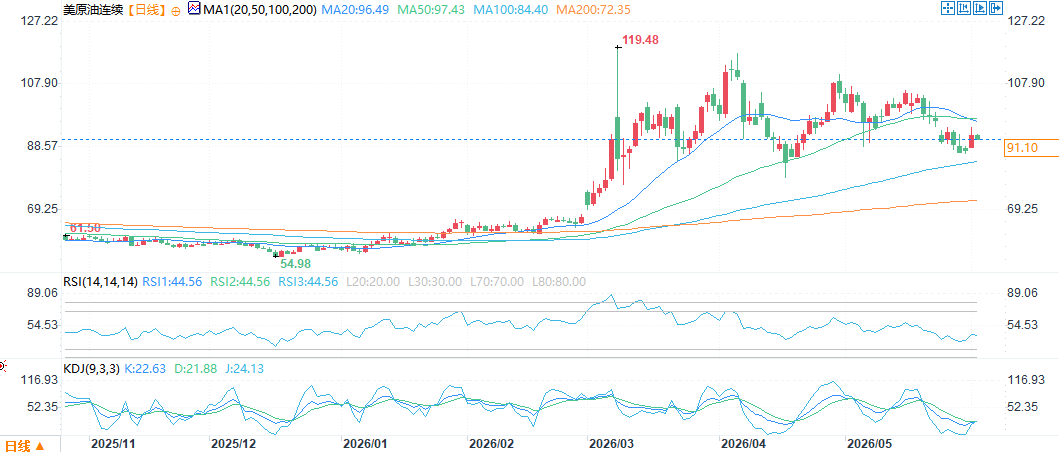
(US crude oil futures daily chart, source: FX678)
In terms of indicators, the RSI value is 44.56, running below the 50 midline, indicating that the short-term bears have the upper hand but have not yet entered the oversold zone below 30.
Crude oil is consolidating at high levels amid a battle between supply and demand. The first resistance level for a short-term rebound is the 95-96 moving average. After the rebound encounters resistance, it is likely to continue its weak consolidation. As long as it does not break below the key support level of 85, the medium-term upward trend remains intact, and the downside potential is limited.
Overall, US crude oil futures are currently consolidating around $91, with market focus concentrated on developments in the US-Iran situation and API inventory data. Geopolitical risks and expectations of peace talks are alternately pulling oil prices, and the short-term direction remains unclear. Traders need to closely monitor the latest news from the Middle East and how changes in crude oil inventories guide supply and demand expectations.
At 15:34 Beijing time on June 2, US crude oil futures were trading at $91.46 per barrel.
Despite reports that Iran has halted negotiations with the United States, the market remains cautious about any factors that could ease tensions in the Middle East. Meanwhile, the upcoming API crude oil inventory data is also attracting attention.
Geopolitical developments: Iran halts negotiations, Trump maintains blockade.
According to Iran's official Tasnim News Agency on Monday, Tehran's negotiating team has decided to stop exchanging information with the United States through intermediaries due to recent attacks in Lebanon.
Iran believes that maintaining indirect communication with the United States is no longer feasible given the continued deterioration of the regional security situation. This move marks the first substantial interruption of diplomatic contacts between the two countries since the temporary ceasefire agreement reached in early April.
In response, US President Trump quickly stated that the US would maintain its blockade of Iranian ports and would not make any concessions due to Iran's unilateral suspension of contact. Trump declared, "If they don't want to talk, that's fine with me," implying that the US was not in a hurry to return to the negotiating table.
Trump also emphasized that the U.S. policy of economic pressure on Iran will not change, including continued restrictions on oil exports and financial access.
Analysts point out that significant differences remain between the US and Iran on core issues such as the situation in Lebanon and navigation safety in the Strait of Hormuz, making a resumption of negotiations unlikely in the short term. As a result, market concerns about disruptions to Middle Eastern supply chains have intensified, providing some short-term support for oil prices after the news was released. If the diplomatic deadlock continues, the risk premium for crude oil may widen further.
Trump and Netanyahu's positions
Amid escalating tensions between the US and Iran, US President Trump and Israeli Prime Minister Netanyahu have released signals that appear to be in different directions but are actually interconnected.
In his latest statement, Trump demonstrated a degree of willingness to negotiate. He stated that he believes an agreement can be reached "within the next week," one that would include reopening the Strait of Hormuz and extending the existing ceasefire with Iran. This statement subtly contrasts with the previous hardline stance of maintaining the blockade of Iranian ports, suggesting that the US still retains room for a diplomatic solution beyond military confrontation and economic sanctions.
Trump also emphasized that if Iran is unwilling to continue dialogue, "that's fine"—a statement that both maintains the bottom line for pressure and leaves room for further maneuvering.
In contrast to Trump's relative restraint, Israeli Prime Minister Netanyahu continued to adopt a tough stance. He made it clear that the Israeli military would continue its military operations against Hezbollah in southern Lebanon, emphasizing that this was a necessary measure to ensure the security of Israel's northern border.
While negotiations between the United States and Iran may ease tensions in the Gulf region to some extent, the conflict between Israel and Hezbollah in Lebanon has not cooled down in tandem, meaning that a comprehensive security and stability in the Middle East is unlikely to emerge in the short term.
From a market perspective, Trump's "expectations of peace talks" tend to suppress oil prices, while Netanyahu's "continued attacks" could exacerbate geopolitical risk premiums. The coexistence of these two factors creates greater uncertainty for oil traders when judging short-term direction.
Factors influencing oil prices: Uncertainty pulling in both directions
Currently, US crude oil futures prices are consolidating around $91, and the market is being repeatedly pulled in opposite directions by two opposing forces.
On the one hand, geopolitical uncertainty continues to provide upward support for oil prices. Iran's suspension of indirect negotiations with the United States marks a renewed tightening of US-Iran relations, which had briefly eased since early April.
What worries the market even more is that the Strait of Hormuz—a vital waterway for approximately 20% of global crude oil shipments—is facing the risk of being effectively blocked by Iran. Although the US has not confirmed any related military deployments, if navigation through the strait is disrupted, the global oil supply chain will suffer an immediate shock, and risk premiums similar to those during the 2019 tanker attacks could reappear.
Furthermore, Israel's military operations in southern Lebanon continue, and the extent to which Hezbollah, as Iran's core proxy force, is involved in the conflict remains unclear. Any sign of escalation could push oil prices up again.
On the other hand, market hopes for the resumption of peace talks between the US and Iran have not completely dissipated, which poses a potential downward pressure on oil prices.
While making a tough stance, Trump also released a vague signal that "an agreement may be reached within the next week."
Some traders believe this is both a tactic by the US to exert pressure and an indication that both sides still maintain communication channels. If a breakthrough can be achieved diplomatically on the issue of navigation in the Strait of Hormuz, or if the temporary ceasefire agreement is extended, the risk premium for crude oil will quickly fall, and oil prices may give back their recent gains.
In the short term, the direction of oil prices depends on whether "conflict escalation" or "diplomatic breakthrough" occurs first. Until the situation becomes clearer, oil prices are likely to remain highly volatile.
API Inventory Data Forecast
The American Petroleum Institute (API) will release its latest weekly crude oil inventory report later on Tuesday. As an important leading indicator for the weekly EIA official inventory data, the API report often triggers short-term fluctuations in the crude oil market, especially at this sensitive time when geopolitical risks and supply and demand fundamentals are intertwined.
If inventory declines exceed expectations, it typically sends two signals: first, US refinery utilization rates remain high, with strong demand for gasoline and distillate fuels; second, crude oil exports remain robust, with global buyers maintaining their willingness to purchase US light, sweet crude oil. Both scenarios point to either "strengthened demand" or "tightening supply," potentially driving oil prices up rapidly. Especially at the current price level around $91, if the report shows an inventory reduction of more than 2 million barrels, the market might interpret this as evidence of an early summer travel peak, triggering short covering and long position increases, further pushing oil prices upward.
Conversely, if inventory increases more than expected, it suggests a loosening of the supply and demand balance. Possible reasons include: refineries undergoing seasonal maintenance leading to a decrease in crude oil processing, a temporary increase in imports, or end-user consumption being suppressed due to high oil prices.
Either scenario would exacerbate market concerns about either "weak demand" or "oversupply." Given that the US-Iran situation has not deteriorated further, such data could prompt traders to reduce some of their geopolitical risk premiums, causing WTI oil prices to give back recent gains.
US crude oil futures daily technical analysis
US crude oil futures are currently trading at $91.10. Prices have fallen below the 20-day and 50-day moving averages, with short-term moving averages turning from support to resistance. However, prices have firmly held above the 100-day and 200-day moving averages, indicating that the overall upward trend remains intact.
After falling from the high of 119.48, the market has entered a period of high-level fluctuation and decline. The previous levels of 107.9 and 99 form layers of resistance above, while the key medium- and long-term support is at the 85 level below. The previous low of 54.98 is a strong support level for the far-month period.
(US crude oil futures daily chart, source: FX678)
In terms of indicators, the RSI value is 44.56, running below the 50 midline, indicating that the short-term bears have the upper hand but have not yet entered the oversold zone below 30.
Crude oil is consolidating at high levels amid a battle between supply and demand. The first resistance level for a short-term rebound is the 95-96 moving average. After the rebound encounters resistance, it is likely to continue its weak consolidation. As long as it does not break below the key support level of 85, the medium-term upward trend remains intact, and the downside potential is limited.
Overall, US crude oil futures are currently consolidating around $91, with market focus concentrated on developments in the US-Iran situation and API inventory data. Geopolitical risks and expectations of peace talks are alternately pulling oil prices, and the short-term direction remains unclear. Traders need to closely monitor the latest news from the Middle East and how changes in crude oil inventories guide supply and demand expectations.
At 15:34 Beijing time on June 2, US crude oil futures were trading at $91.46 per barrel.
- Risk Warning and Disclaimer
- The market involves risk, and trading may not be suitable for all investors. This article is for reference only and does not constitute personal investment advice, nor does it take into account certain users’ specific investment objectives, financial situation, or other needs. Any investment decisions made based on this information are at your own risk.