The rupee is under pressure! Oil price rebound, foreign capital outflows, and upcoming US data make the Reserve Bank of India the last line of defense on Friday.
2026-06-02 16:35:54
On Tuesday (June 2), the US dollar traded around 95.20 against the Indian rupee, up slightly by 0.2%. The escalating conflict between Israel and Lebanon, which stalled US-Iran negotiations, and rising oil prices have created uncertainty for the Indian rupee, which relies heavily on crude oil imports.
Due to new uncertainties surrounding the prospects of a US-Iran agreement, WTI crude oil prices remain above $90.
For India, every significant rise in oil prices means increased pressure from imported oil. India is the world's third-largest crude oil importer, relying on overseas supplies for about 85% of its oil demand, and crude oil imports have consistently accounted for more than 20% of its total imports.
In theory, when oil prices rise, India needs to use more US dollars to purchase the same amount of crude oil, leading to a widening trade deficit, pressure on the current account, and consequently, downward pressure on the rupee. Currently, WTI oil prices are above $90; if this level is maintained, India's import expenditures in June will increase significantly, and the rupee may face even greater pressure.
According to Iran's Tasnim News Agency on Monday, Tehran's negotiating team has stopped exchanging information with the United States through intermediaries in protest against the attacks on Lebanon. Iranian Parliament Speaker Ghalibaf posted on social media that the US naval blockade and war crimes in Lebanon are clear evidence of its violation of the ceasefire agreement.
Meanwhile, Iranian Foreign Minister Araqchi warned that both Iran and the United States would face serious consequences if military action were to take place on multiple fronts, including Lebanon.
On the other hand, in a media interview, US President Trump attempted to reassure the market, expressing confidence that an agreement to extend the ceasefire and reopen the Strait of Hormuz with Iran would be reached within the next week, and claiming that he had quickly resolved a diplomatic "minor glitch" that had previously threatened the progress of the negotiations.
Trump later posted on social media that the attacks between Israel and Lebanon had ceased.
The Reserve Bank of India's monetary policy statement this Friday will be a key catalyst for the rupee's movement. The market almost unanimously expects the central bank to keep the repo rate unchanged at 5.25%, marking the seventh consecutive day without change.
With international oil prices high, India, as the world's third-largest crude oil importer, is facing accumulating imported inflationary pressures. Therefore, even if interest rates remain unchanged, the central bank is likely to maintain or even strengthen its hawkish policy stance to anchor inflation expectations.
Investors will also be watching Governor Sanjay Malhotra's comments on the economic outlook against the backdrop of the Middle East crisis. A hawkish tone would suggest a possible future interest rate hike; conversely, a hawkish tone could indicate further downward pressure on the currency.
On the first trading day of June, foreign institutional investors continued their net selling in the Indian stock market, reducing their holdings by 391.18 billion rupees in a single day, indicating that overseas funds' risk appetite for the Indian market is still cooling. In fact, this is not an isolated incident—overseas investors have been reducing their holdings in the Indian stock market for quite some time, reflecting a systemic reduction behavior under multiple pressures.
Meanwhile, the energy supply disruptions caused by tensions in the Middle East are further exacerbating market concerns about the profit prospects of Indian companies. India is the world's third-largest importer of crude oil, relying on overseas supplies for approximately 85% of its oil demand. International oil prices have remained high amidst ongoing US-Iran negotiations, directly pushing up operating costs for energy-intensive industries such as aviation, chemicals, logistics, and manufacturing. Several securities firms have lowered their profit forecasts for these sectors, believing that if oil prices remain above $90 for an extended period, Indian companies' profit margins will face significant pressure.
In summary, the continued outflow of foreign capital and high energy costs are creating dual pressures. On the one hand, the withdrawal of overseas investors weakens the financial support for the stock market; on the other hand, downward revisions to earnings expectations may trigger further valuation reassessments. Against this backdrop, the correlation between the Indian rupee exchange rate and short-term stock market movements may strengthen, and the market's sensitivity to the Reserve Bank of India's policy responses will also increase.
On Tuesday, investors will focus on the U.S. April JOLTS job openings data, due at 22:00 Beijing time. As a key indicator for the Federal Reserve to assess the tightness of the labor market, this data will provide important clues about employment demand, thereby influencing market expectations regarding the path of monetary policy.
Market consensus is that U.S. employers will report approximately 6.82 million job openings in April, roughly unchanged from March's 6.866 million. If the actual figure matches expectations or fluctuates slightly, it could suggest that labor demand remains moderately cooling, potentially supporting the Federal Reserve's consideration of when to cut interest rates this year.
However, if job openings unexpectedly rise sharply, it indicates that the labor market remains tight, which could strengthen the Federal Reserve's case for delaying policy easing, thereby boosting the dollar.
The USD/RUB pair is hovering around 95.20, having slightly retreated below the 20-day moving average (MA20), but firmly holding above the 50-day, 100-day, and 200-day moving averages (MA50, MA100, and MA200). All four moving averages remain upwardly diverging, indicating a healthy medium- to long-term uptrend. After reaching a high of 96.96, the price has pulled back slightly and entered a consolidation phase, supported by the medium-term moving averages. 96.96 is a strong short-term resistance level, while 94.4 and 92.34 provide key support levels.
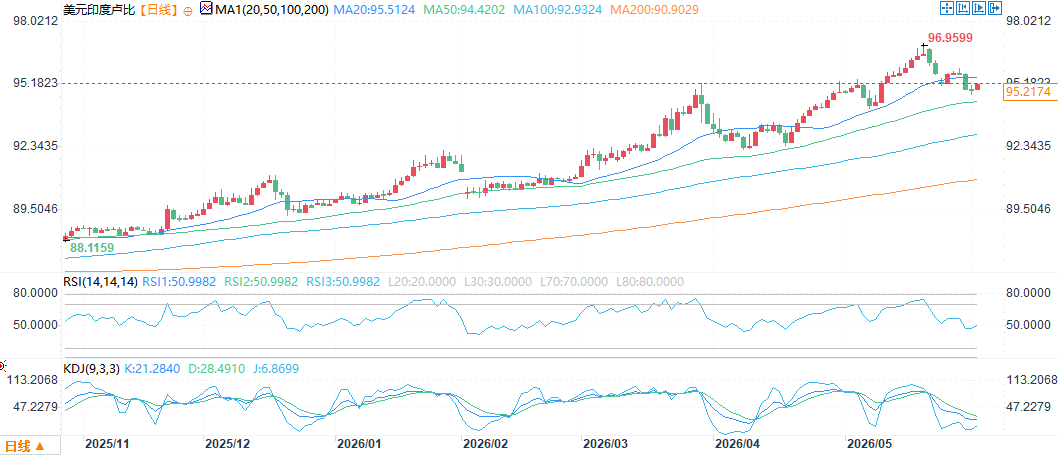
(USD/RUB daily chart, source: EasyForex)
In terms of indicators, the RSI value is 50.99, hovering near the 50 dividing line between bullish and bearish forces, indicating a basic balance between bullish and bearish forces.
Amidst rising expectations of a Fed rate hike and diverging monetary policies between the US and India, the overall bullish trend in the exchange rate remains unchanged. After a short-term pullback and consolidation, a rebound is expected, with the primary target for the rebound being the 95.5-96 level. As long as the price does not break below the 50-day moving average (MA50), the medium-term upward trend will continue, and the downside potential is limited.
At 16:13 Beijing time on June 2, the US dollar was trading at 95.21/22 against the rupee.
Oil price rebound drags down rupee
Due to new uncertainties surrounding the prospects of a US-Iran agreement, WTI crude oil prices remain above $90.
For India, every significant rise in oil prices means increased pressure from imported oil. India is the world's third-largest crude oil importer, relying on overseas supplies for about 85% of its oil demand, and crude oil imports have consistently accounted for more than 20% of its total imports.
In theory, when oil prices rise, India needs to use more US dollars to purchase the same amount of crude oil, leading to a widening trade deficit, pressure on the current account, and consequently, downward pressure on the rupee. Currently, WTI oil prices are above $90; if this level is maintained, India's import expenditures in June will increase significantly, and the rupee may face even greater pressure.
US-Iran negotiations stalled
According to Iran's Tasnim News Agency on Monday, Tehran's negotiating team has stopped exchanging information with the United States through intermediaries in protest against the attacks on Lebanon. Iranian Parliament Speaker Ghalibaf posted on social media that the US naval blockade and war crimes in Lebanon are clear evidence of its violation of the ceasefire agreement.
Meanwhile, Iranian Foreign Minister Araqchi warned that both Iran and the United States would face serious consequences if military action were to take place on multiple fronts, including Lebanon.
On the other hand, in a media interview, US President Trump attempted to reassure the market, expressing confidence that an agreement to extend the ceasefire and reopen the Strait of Hormuz with Iran would be reached within the next week, and claiming that he had quickly resolved a diplomatic "minor glitch" that had previously threatened the progress of the negotiations.
Trump later posted on social media that the attacks between Israel and Lebanon had ceased.
Awaiting the Reserve Bank of India's policy decision
The Reserve Bank of India's monetary policy statement this Friday will be a key catalyst for the rupee's movement. The market almost unanimously expects the central bank to keep the repo rate unchanged at 5.25%, marking the seventh consecutive day without change.
With international oil prices high, India, as the world's third-largest crude oil importer, is facing accumulating imported inflationary pressures. Therefore, even if interest rates remain unchanged, the central bank is likely to maintain or even strengthen its hawkish policy stance to anchor inflation expectations.
Investors will also be watching Governor Sanjay Malhotra's comments on the economic outlook against the backdrop of the Middle East crisis. A hawkish tone would suggest a possible future interest rate hike; conversely, a hawkish tone could indicate further downward pressure on the currency.
Foreign investors continued to be net sellers.
On the first trading day of June, foreign institutional investors continued their net selling in the Indian stock market, reducing their holdings by 391.18 billion rupees in a single day, indicating that overseas funds' risk appetite for the Indian market is still cooling. In fact, this is not an isolated incident—overseas investors have been reducing their holdings in the Indian stock market for quite some time, reflecting a systemic reduction behavior under multiple pressures.
Meanwhile, the energy supply disruptions caused by tensions in the Middle East are further exacerbating market concerns about the profit prospects of Indian companies. India is the world's third-largest importer of crude oil, relying on overseas supplies for approximately 85% of its oil demand. International oil prices have remained high amidst ongoing US-Iran negotiations, directly pushing up operating costs for energy-intensive industries such as aviation, chemicals, logistics, and manufacturing. Several securities firms have lowered their profit forecasts for these sectors, believing that if oil prices remain above $90 for an extended period, Indian companies' profit margins will face significant pressure.
In summary, the continued outflow of foreign capital and high energy costs are creating dual pressures. On the one hand, the withdrawal of overseas investors weakens the financial support for the stock market; on the other hand, downward revisions to earnings expectations may trigger further valuation reassessments. Against this backdrop, the correlation between the Indian rupee exchange rate and short-term stock market movements may strengthen, and the market's sensitivity to the Reserve Bank of India's policy responses will also increase.
Pay attention to JOLTS job vacancy data in the United States
On Tuesday, investors will focus on the U.S. April JOLTS job openings data, due at 22:00 Beijing time. As a key indicator for the Federal Reserve to assess the tightness of the labor market, this data will provide important clues about employment demand, thereby influencing market expectations regarding the path of monetary policy.
Market consensus is that U.S. employers will report approximately 6.82 million job openings in April, roughly unchanged from March's 6.866 million. If the actual figure matches expectations or fluctuates slightly, it could suggest that labor demand remains moderately cooling, potentially supporting the Federal Reserve's consideration of when to cut interest rates this year.
However, if job openings unexpectedly rise sharply, it indicates that the labor market remains tight, which could strengthen the Federal Reserve's case for delaying policy easing, thereby boosting the dollar.
Technical Analysis
The USD/RUB pair is hovering around 95.20, having slightly retreated below the 20-day moving average (MA20), but firmly holding above the 50-day, 100-day, and 200-day moving averages (MA50, MA100, and MA200). All four moving averages remain upwardly diverging, indicating a healthy medium- to long-term uptrend. After reaching a high of 96.96, the price has pulled back slightly and entered a consolidation phase, supported by the medium-term moving averages. 96.96 is a strong short-term resistance level, while 94.4 and 92.34 provide key support levels.
(USD/RUB daily chart, source: EasyForex)
In terms of indicators, the RSI value is 50.99, hovering near the 50 dividing line between bullish and bearish forces, indicating a basic balance between bullish and bearish forces.
Amidst rising expectations of a Fed rate hike and diverging monetary policies between the US and India, the overall bullish trend in the exchange rate remains unchanged. After a short-term pullback and consolidation, a rebound is expected, with the primary target for the rebound being the 95.5-96 level. As long as the price does not break below the 50-day moving average (MA50), the medium-term upward trend will continue, and the downside potential is limited.
At 16:13 Beijing time on June 2, the US dollar was trading at 95.21/22 against the rupee.
- Risk Warning and Disclaimer
- The market involves risk, and trading may not be suitable for all investors. This article is for reference only and does not constitute personal investment advice, nor does it take into account certain users’ specific investment objectives, financial situation, or other needs. Any investment decisions made based on this information are at your own risk.