Oil prices fall, Trump angrily calls Israel "crazy"! US and Iran may reach an agreement within a week.
2026-06-02 15:28:19
International oil prices opened slightly lower on Tuesday (June 2nd). Prices had surged by over 6% overnight, but subsequently experienced a significant pullback. Currently, WTI crude oil is trading around $91.54, down 0.6%.
On June 1, local time, US President Trump conveyed optimistic progress in the US-Iran negotiations during a telephone interview, saying that the communication between the two sides "looked good, very good," and that although there had been "minor hiccups" in the process, they had been quickly and properly resolved.
Trump went further ahead, predicting that the US and Iran will reach a memorandum of understanding within the next week, with key points including extending the current ceasefire and pushing for the reopening of the Strait of Hormuz.
However, he also made it clear that he has not yet formally approved the memorandum, and there are still a few details that need to be finalized, with negotiations entering the final sprint stage.
International Atomic Energy Agency Director General Grossi stated that transferring Iran's highly enriched uranium stockpile abroad is a "difficult but not impossible" task, and that transporting Iran's uranium stockpile abroad is an extremely sensitive and technically complex process.
Several options are currently being discussed, including transferring Iranian uranium abroad or diluting it to a lower enrichment level.
Although the IAEA is not directly involved, the association says its assistance in the process will make it feasible and efficient.
Trump has adopted a dual strategy of "pro-peace and restraint" in dealing with the current situation.
On the one hand, through multiple channels, including Lebanese President Joseph Aoun and the US ambassador to Lebanon, he engaged in multiple rounds of communication and coordination with Hezbollah, ultimately pushing for a ceasefire agreement between Israel and Lebanon. Hezbollah formally pledged to cease attacks against Israel, while Israel abandoned its plan to deploy ground troops to Beirut, and previously deployed forces received orders to withdraw. This resulted in a reciprocal agreement of "no unprovoked attacks." This achievement was subsequently confirmed by a statement from the Lebanese presidential office.
On the other hand, Trump expressed strong dissatisfaction with Israel's military escalation.
According to foreign media reports, he used "strong language" in his call with Netanyahu, accusing the latter of "overdoing things" on the Lebanon issue, not only threatening airstrikes on Beirut but also expanding ground operations in southern Lebanon.
Trump even bluntly called Netanyahu "crazy" and "ungrateful," warning him that "if it weren't for me, you would be in jail by now," and angrily questioned, "What are you doing?" This was the most tense call between Trump and Netanyahu since Trump returned to the White House.
Despite Trump's attempts to mediate and his criticism, Israeli Prime Minister Netanyahu confirmed the authenticity of the call but maintained a tough stance.
He did not regard this diplomatic communication as a "signal of easing tensions," but instead used the opportunity to issue a warning: if Hezbollah continues to launch cross-border attacks, Israel will directly bomb key targets in Beirut.
Meanwhile, Netanyahu made it clear that the Israeli military's operational plans in southern Lebanon would not be adjusted, and ground military operations would proceed at the original pace.
Previously, the Israeli cabinet had formally approved the operational plan to bomb the southern suburbs of Beirut, and Hezbollah simultaneously launched rockets into northern Israel, with the attack covering areas such as the outskirts of Haifa.
Netanyahu and Defense Minister Katz also issued a joint statement attributing the airstrikes to Hezbollah's repeated violations of the ceasefire agreement and attacks on Israeli cities and civilians, insisting that Israel's actions were a "self-defense counterattack."
Trump's harsh criticism of Israel stems at its core from concerns about US-Iran negotiations.
Iran has previously threatened to withdraw from negotiations with the United States if Israel continues its military operations in Lebanon.
A ceasefire in Lebanon is a necessary condition for the agreement proposed by Iran. Iranian Foreign Minister Abbas Araqchi has publicly defined any ceasefire agreement between the US and Iran as a "ceasefire across the entire front," including the Lebanese battlefield. "A breach of contract on any one front is equivalent to a simultaneous breach of contract on all fronts."
U.S. officials revealed that Trump explicitly warned Netanyahu in the call that bombing Beirut would "further exacerbate Israel's isolation in the international community."
It is worth noting that Trump does not oppose Israel's "legitimate self-defense actions." His core demand is to prevent the situation from getting out of control and interfering with the process of reaching a US-Iran agreement.
Faced with the pressure of the conflict, Lebanon has consistently adhered to the diplomatic solution. In addition to Hezbollah's promise to stop its attacks, Lebanese President Joseph Aoun has repeatedly stated that the government is continuing to promote relief measures to alleviate the suffering of the people, especially civilians in the southern war zone, and reiterated the core position that "the risks of diplomatic consultations are far lower than those of a full-scale war."
Previously, the Lebanese government had facilitated Hezbollah's acceptance of US Secretary of State Rubio's buffer plan: Israel would abandon its airstrikes on the southern suburbs of Beirut, and Hezbollah would cease its rocket attacks on northern Israeli towns.
Despite the humanitarian crisis caused by Israeli airstrikes, including multiple deaths in southern Lebanon, severe damage to the Tyre hospital, and displacement of over a million people, the Lebanese negotiating delegation proceeded with its planned talks with Israel in Washington from June 2nd to 3rd. Their core demands were to expand the non-aggression zone and push for a permanent ceasefire agreement across the country.
Traders continue to focus on the prospects for navigation in the Strait of Hormuz, the progress of the US-Iran ceasefire agreement, and whether Iran will compromise on the nuclear issue regarding enriched uranium.
If the US and Iran reach an agreement within a week, the Strait of Hormuz will reopen, and regional conflicts will ease, easing the global oil supply shortage and potentially leading to a significant drop in oil prices.
Conversely, if the situation spirals out of control again, the risk of supply chain disruptions will continue to push up oil prices, putting multiple pressures on global inflation and economic recovery.
Technical Analysis: Previous articles have repeatedly pointed out that oil prices have entered a consolidation phase. Ultimately, WTI oil prices fell to the important support level of 87 and then rebounded rapidly. Currently, we are observing whether oil prices can maintain above 91, which is also the breakthrough point for this rebound. If so, oil prices are expected to rebound further.
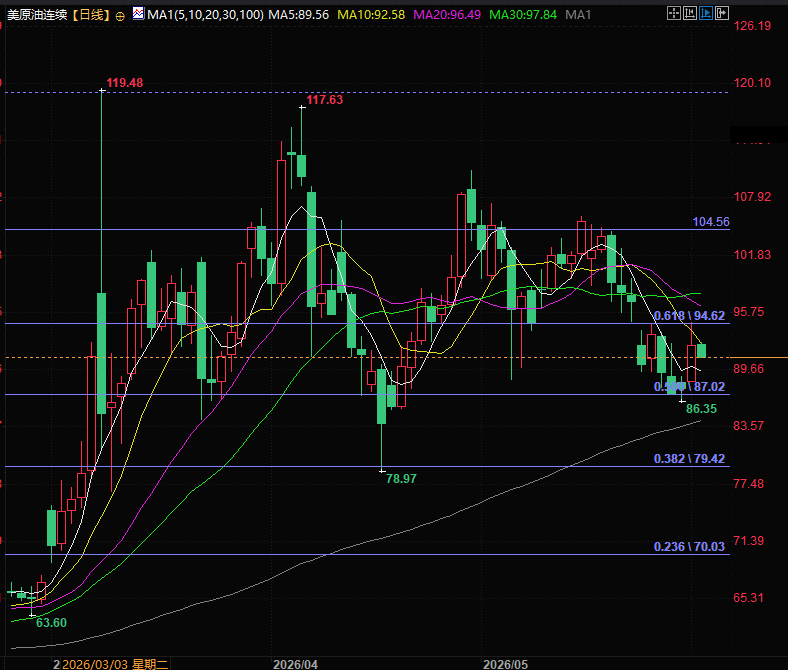
(WTI futures contract daily chart, source: EasyForex)
At 15:23 Beijing time, WTI futures contracts were trading at $91.16 per barrel.
On June 1, local time, US President Trump conveyed optimistic progress in the US-Iran negotiations during a telephone interview, saying that the communication between the two sides "looked good, very good," and that although there had been "minor hiccups" in the process, they had been quickly and properly resolved.
Trump went further ahead, predicting that the US and Iran will reach a memorandum of understanding within the next week, with key points including extending the current ceasefire and pushing for the reopening of the Strait of Hormuz.
However, he also made it clear that he has not yet formally approved the memorandum, and there are still a few details that need to be finalized, with negotiations entering the final sprint stage.
International Atomic Energy Agency Director General Grossi stated that transferring Iran's highly enriched uranium stockpile abroad is a "difficult but not impossible" task, and that transporting Iran's uranium stockpile abroad is an extremely sensitive and technically complex process.
Several options are currently being discussed, including transferring Iranian uranium abroad or diluting it to a lower enrichment level.
Although the IAEA is not directly involved, the association says its assistance in the process will make it feasible and efficient.
Trump's two-pronged approach: mediating a ceasefire between Israel and Lebanon + criticizing Israel for "overstepping its bounds".
Trump has adopted a dual strategy of "pro-peace and restraint" in dealing with the current situation.
On the one hand, through multiple channels, including Lebanese President Joseph Aoun and the US ambassador to Lebanon, he engaged in multiple rounds of communication and coordination with Hezbollah, ultimately pushing for a ceasefire agreement between Israel and Lebanon. Hezbollah formally pledged to cease attacks against Israel, while Israel abandoned its plan to deploy ground troops to Beirut, and previously deployed forces received orders to withdraw. This resulted in a reciprocal agreement of "no unprovoked attacks." This achievement was subsequently confirmed by a statement from the Lebanese presidential office.
On the other hand, Trump expressed strong dissatisfaction with Israel's military escalation.
According to foreign media reports, he used "strong language" in his call with Netanyahu, accusing the latter of "overdoing things" on the Lebanon issue, not only threatening airstrikes on Beirut but also expanding ground operations in southern Lebanon.
Trump even bluntly called Netanyahu "crazy" and "ungrateful," warning him that "if it weren't for me, you would be in jail by now," and angrily questioned, "What are you doing?" This was the most tense call between Trump and Netanyahu since Trump returned to the White House.
Israel's strong response: insisting on military plans and rejecting the "de-escalation" characterization.
Despite Trump's attempts to mediate and his criticism, Israeli Prime Minister Netanyahu confirmed the authenticity of the call but maintained a tough stance.
He did not regard this diplomatic communication as a "signal of easing tensions," but instead used the opportunity to issue a warning: if Hezbollah continues to launch cross-border attacks, Israel will directly bomb key targets in Beirut.
Meanwhile, Netanyahu made it clear that the Israeli military's operational plans in southern Lebanon would not be adjusted, and ground military operations would proceed at the original pace.
Previously, the Israeli cabinet had formally approved the operational plan to bomb the southern suburbs of Beirut, and Hezbollah simultaneously launched rockets into northern Israel, with the attack covering areas such as the outskirts of Haifa.
Netanyahu and Defense Minister Katz also issued a joint statement attributing the airstrikes to Hezbollah's repeated violations of the ceasefire agreement and attacks on Israeli cities and civilians, insisting that Israel's actions were a "self-defense counterattack."
The US's core concern: Israel's actions could lead to a breakdown in US-Iran negotiations.
Trump's harsh criticism of Israel stems at its core from concerns about US-Iran negotiations.
Iran has previously threatened to withdraw from negotiations with the United States if Israel continues its military operations in Lebanon.
A ceasefire in Lebanon is a necessary condition for the agreement proposed by Iran. Iranian Foreign Minister Abbas Araqchi has publicly defined any ceasefire agreement between the US and Iran as a "ceasefire across the entire front," including the Lebanese battlefield. "A breach of contract on any one front is equivalent to a simultaneous breach of contract on all fronts."
U.S. officials revealed that Trump explicitly warned Netanyahu in the call that bombing Beirut would "further exacerbate Israel's isolation in the international community."
It is worth noting that Trump does not oppose Israel's "legitimate self-defense actions." His core demand is to prevent the situation from getting out of control and interfering with the process of reaching a US-Iran agreement.
Lebanon's pragmatic choice: persist in diplomatic negotiations and promote a nationwide ceasefire.
Faced with the pressure of the conflict, Lebanon has consistently adhered to the diplomatic solution. In addition to Hezbollah's promise to stop its attacks, Lebanese President Joseph Aoun has repeatedly stated that the government is continuing to promote relief measures to alleviate the suffering of the people, especially civilians in the southern war zone, and reiterated the core position that "the risks of diplomatic consultations are far lower than those of a full-scale war."
Previously, the Lebanese government had facilitated Hezbollah's acceptance of US Secretary of State Rubio's buffer plan: Israel would abandon its airstrikes on the southern suburbs of Beirut, and Hezbollah would cease its rocket attacks on northern Israeli towns.
Despite the humanitarian crisis caused by Israeli airstrikes, including multiple deaths in southern Lebanon, severe damage to the Tyre hospital, and displacement of over a million people, the Lebanese negotiating delegation proceeded with its planned talks with Israel in Washington from June 2nd to 3rd. Their core demands were to expand the non-aggression zone and push for a permanent ceasefire agreement across the country.
Summary and Technical Analysis:
Traders continue to focus on the prospects for navigation in the Strait of Hormuz, the progress of the US-Iran ceasefire agreement, and whether Iran will compromise on the nuclear issue regarding enriched uranium.
If the US and Iran reach an agreement within a week, the Strait of Hormuz will reopen, and regional conflicts will ease, easing the global oil supply shortage and potentially leading to a significant drop in oil prices.
Conversely, if the situation spirals out of control again, the risk of supply chain disruptions will continue to push up oil prices, putting multiple pressures on global inflation and economic recovery.
Technical Analysis: Previous articles have repeatedly pointed out that oil prices have entered a consolidation phase. Ultimately, WTI oil prices fell to the important support level of 87 and then rebounded rapidly. Currently, we are observing whether oil prices can maintain above 91, which is also the breakthrough point for this rebound. If so, oil prices are expected to rebound further.
(WTI futures contract daily chart, source: EasyForex)
At 15:23 Beijing time, WTI futures contracts were trading at $91.16 per barrel.
- Risk Warning and Disclaimer
- The market involves risk, and trading may not be suitable for all investors. This article is for reference only and does not constitute personal investment advice, nor does it take into account certain users’ specific investment objectives, financial situation, or other needs. Any investment decisions made based on this information are at your own risk.