













The USD/JPY pair is approaching 160 again; why did the 11.7 trillion yen intervention fail to reverse the trend?
2026-06-02 17:56:40
On Tuesday, June 2nd, the USD/JPY pair approached the 160 level again, trading around 159.70. The US dollar index did not strengthen significantly in tandem, recently retreating slightly to around 99.12. However, the USD/JPY pair remained high, indicating that the current conflict is not merely about the strength of the US dollar, but rather a combination of interest rate differentials, intervention expectations, and the repricing of the Bank of Japan's policies.

The USD/JPY exchange rate is nearing 160, which is not merely a technical fluctuation around a round number, but rather a region where policy tolerance, liquidity pricing, and option positions converge. The latest disclosure from Japan's Ministry of Finance shows that the total amount of foreign exchange intervention from April 28 to May 27 was 11.7349 trillion yen, indicating that the authorities have used substantial funds to suppress the yen's rapid depreciation. The problem is that the pullback after the intervention has not changed the trend structure, with the price returning above 159. The market is testing whether the authorities are willing to continue expending ammunition.
For traders, what truly matters around 160 is not the individual price level, but rather the shift in the volatility surface. Once the price approaches the previous high, short-term implied volatility is typically supported by intervention risk, while long-term volatility depends on whether the Bank of Japan can provide a clearer path for interest rate hikes. If policy signals are insufficient, the exchange rate's sensitivity to verbal warnings decreases, and the market interprets intervention as a short-term liquidity event rather than a trend reversal factor.
The Bank of Japan is currently keeping interest rates at 0.75%, with its next monetary policy meeting scheduled for June 15-16. At its April meeting, the policy committee voted 6-3 to keep rates unchanged, but three members have already advocated raising the policy rate to 1.0%, naturally creating expectations of a compensatory rate hike at the June meeting.
The key shift in the Bank of Japan's recent policy language lies in the fact that a weak yen is no longer merely a currency issue, but has been incorporated into the framework of import costs, inflation expectations, and low real interest rates. The official policy summary states that with underlying inflation near 2% and real interest rates remaining significantly low, further increases in policy rates and adjustments to the degree of easing are justified; it also mentions a high probability of interest rate hikes starting from the next meeting.
This means that Governor Kazuo Ueda's speech on June 3rd will be interpreted and amplified by the market. If he continues to emphasize import price transmission, corporate price increases, and low real interest rates, the expectation of a 25 basis point rate hike to 1.0% will be harder to suppress. If the wording is more cautious, the pressure on the exchange rate around 160 may actually increase, as the market will reassess the Bank of Japan's tolerance range for currency depreciation.
The Federal Reserve's current target interest rate range is 3.50%-3.75%, while Japan's policy rate remains at 0.75%. Looking at long-term bonds, on June 2nd, the yield on 10-year US Treasury bonds was approximately 4.44%, while the yield on 10-year Japanese government bonds was approximately 2.57%, with a nominal spread of about 1.87 percentage points. This spread has narrowed compared to past extreme periods, but it is still sufficient to support the residual inertia of carry trades.
More importantly, the USD/JPY pair did not fully follow the decline in the US dollar index, reflecting that the market is pricing in Japanese risks separately. If the Bank of Japan only raises interest rates by 25 basis points, the narrowing of the interest rate differential will be limited; only if it simultaneously signals the pace of subsequent rate hikes will the market reassess the cost of holding short yen positions. In other words, whether the yen can escape its weakness depends not on a single rate hike, but on whether the policy path can change expectations of funding costs over the next 3 to 6 months.
The Bank of Japan's April outlook report showed a median forecast of 2.8% for core inflation in fiscal year 2026, significantly higher than the 1.9% forecast in January, with a median forecast of 2.3% for fiscal year 2027. This provides an inflationary basis for policy normalization, but also increases the difficulty of communication for the central bank, as energy prices, import costs, and pressure on consumption may coexist.
From a daily chart perspective, the USD/JPY pair has rebounded from a low of 155.025 and has returned above the Bollinger Middle Band, currently trading near 159.70. The previous high of 160.467 and the upper Bollinger Band at 160.720 form a dense resistance zone above. The Bollinger Middle Band is located around 158.414, meaning that while the short-term price hasn't lost its rebound structure, its proximity to the upper band increases both the potential for further upward movement and the risk of policy disruptions.
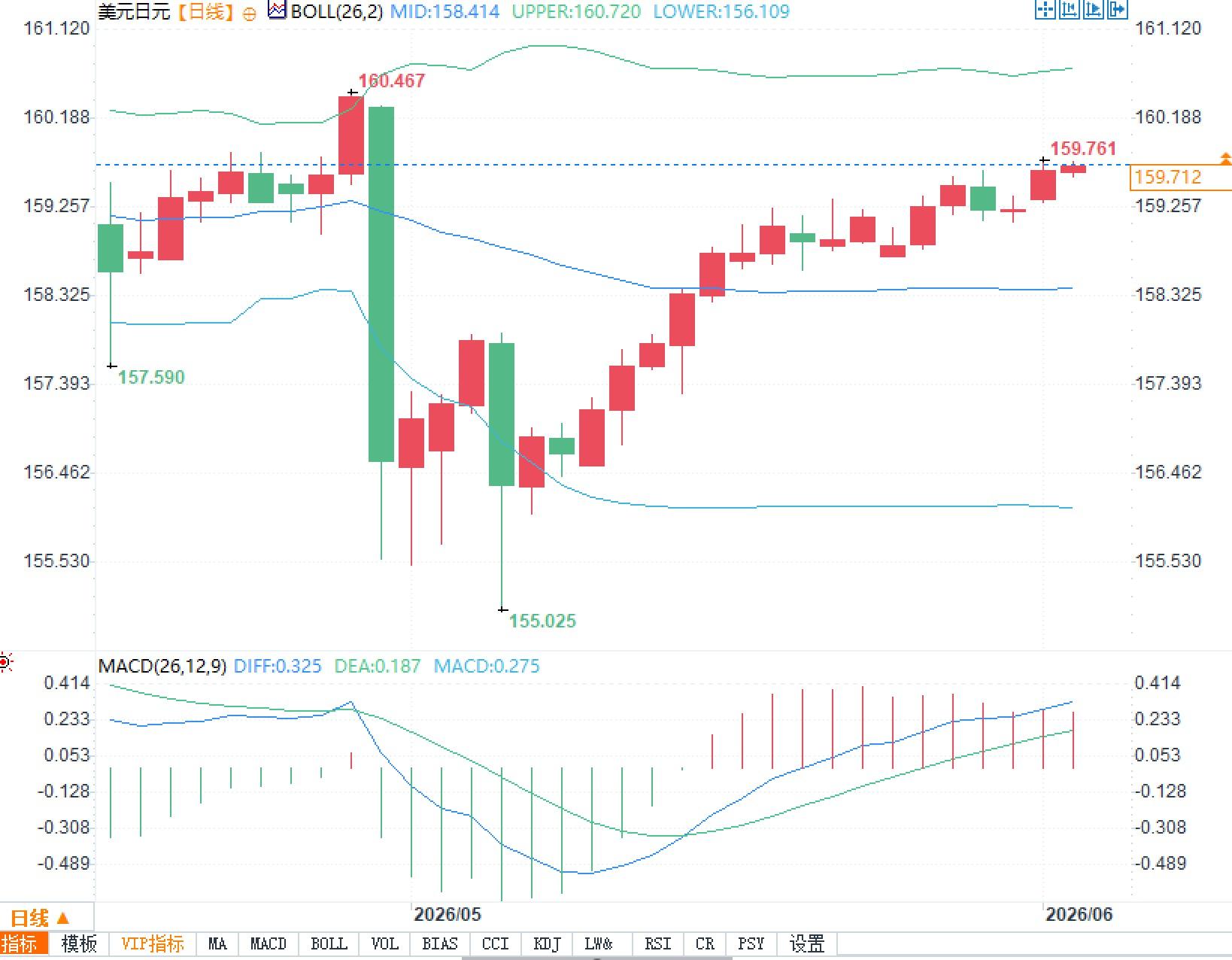
The MACD indicator shows that the DIFF is around 0.325 and the DEA is around 0.187, with the histogram still positive, indicating that the rebound momentum has not completely dissipated. However, the marginal convergence of the histogram suggests that the trend's driving force is beginning to weaken. If the price cannot effectively break through the previous high area, it is likely to enter a period of sideways trading at a high level. For institutional investors, this type of structure is often accompanied by two opposing forces: on one hand, they continue to hold carry trades, and on the other hand, they reduce their positions protectively in response to intervention and central bank signals.
Therefore, the current USD/JPY exchange rate is not simply a trend-driven movement, but rather a high-level repricing driven by policy events. If there is a lack of new logic for interest rate differential expansion above 160, the explanatory power for continued price increases will diminish; however, if the Bank of Japan's communication is insufficient, the market may still perceive intervention as a short-term shock, and the period of high-level exchange rate fluctuations will be prolonged.
The 160 mark has once again become a stress test for the market.
The USD/JPY exchange rate is nearing 160, which is not merely a technical fluctuation around a round number, but rather a region where policy tolerance, liquidity pricing, and option positions converge. The latest disclosure from Japan's Ministry of Finance shows that the total amount of foreign exchange intervention from April 28 to May 27 was 11.7349 trillion yen, indicating that the authorities have used substantial funds to suppress the yen's rapid depreciation. The problem is that the pullback after the intervention has not changed the trend structure, with the price returning above 159. The market is testing whether the authorities are willing to continue expending ammunition.
For traders, what truly matters around 160 is not the individual price level, but rather the shift in the volatility surface. Once the price approaches the previous high, short-term implied volatility is typically supported by intervention risk, while long-term volatility depends on whether the Bank of Japan can provide a clearer path for interest rate hikes. If policy signals are insufficient, the exchange rate's sensitivity to verbal warnings decreases, and the market interprets intervention as a short-term liquidity event rather than a trend reversal factor.
The Bank of Japan's interest rate hike expectations are entering a window of realization.
The Bank of Japan is currently keeping interest rates at 0.75%, with its next monetary policy meeting scheduled for June 15-16. At its April meeting, the policy committee voted 6-3 to keep rates unchanged, but three members have already advocated raising the policy rate to 1.0%, naturally creating expectations of a compensatory rate hike at the June meeting.
The key shift in the Bank of Japan's recent policy language lies in the fact that a weak yen is no longer merely a currency issue, but has been incorporated into the framework of import costs, inflation expectations, and low real interest rates. The official policy summary states that with underlying inflation near 2% and real interest rates remaining significantly low, further increases in policy rates and adjustments to the degree of easing are justified; it also mentions a high probability of interest rate hikes starting from the next meeting.
This means that Governor Kazuo Ueda's speech on June 3rd will be interpreted and amplified by the market. If he continues to emphasize import price transmission, corporate price increases, and low real interest rates, the expectation of a 25 basis point rate hike to 1.0% will be harder to suppress. If the wording is more cautious, the pressure on the exchange rate around 160 may actually increase, as the market will reassess the Bank of Japan's tolerance range for currency depreciation.
Interest rate differentials remain the core anchor for the USD/JPY exchange rate's high trading level.
The Federal Reserve's current target interest rate range is 3.50%-3.75%, while Japan's policy rate remains at 0.75%. Looking at long-term bonds, on June 2nd, the yield on 10-year US Treasury bonds was approximately 4.44%, while the yield on 10-year Japanese government bonds was approximately 2.57%, with a nominal spread of about 1.87 percentage points. This spread has narrowed compared to past extreme periods, but it is still sufficient to support the residual inertia of carry trades.
More importantly, the USD/JPY pair did not fully follow the decline in the US dollar index, reflecting that the market is pricing in Japanese risks separately. If the Bank of Japan only raises interest rates by 25 basis points, the narrowing of the interest rate differential will be limited; only if it simultaneously signals the pace of subsequent rate hikes will the market reassess the cost of holding short yen positions. In other words, whether the yen can escape its weakness depends not on a single rate hike, but on whether the policy path can change expectations of funding costs over the next 3 to 6 months.
The Bank of Japan's April outlook report showed a median forecast of 2.8% for core inflation in fiscal year 2026, significantly higher than the 1.9% forecast in January, with a median forecast of 2.3% for fiscal year 2027. This provides an inflationary basis for policy normalization, but also increases the difficulty of communication for the central bank, as energy prices, import costs, and pressure on consumption may coexist.
Technical analysis indicates the rebound has entered a highly sensitive zone.
From a daily chart perspective, the USD/JPY pair has rebounded from a low of 155.025 and has returned above the Bollinger Middle Band, currently trading near 159.70. The previous high of 160.467 and the upper Bollinger Band at 160.720 form a dense resistance zone above. The Bollinger Middle Band is located around 158.414, meaning that while the short-term price hasn't lost its rebound structure, its proximity to the upper band increases both the potential for further upward movement and the risk of policy disruptions.
The MACD indicator shows that the DIFF is around 0.325 and the DEA is around 0.187, with the histogram still positive, indicating that the rebound momentum has not completely dissipated. However, the marginal convergence of the histogram suggests that the trend's driving force is beginning to weaken. If the price cannot effectively break through the previous high area, it is likely to enter a period of sideways trading at a high level. For institutional investors, this type of structure is often accompanied by two opposing forces: on one hand, they continue to hold carry trades, and on the other hand, they reduce their positions protectively in response to intervention and central bank signals.
Therefore, the current USD/JPY exchange rate is not simply a trend-driven movement, but rather a high-level repricing driven by policy events. If there is a lack of new logic for interest rate differential expansion above 160, the explanatory power for continued price increases will diminish; however, if the Bank of Japan's communication is insufficient, the market may still perceive intervention as a short-term shock, and the period of high-level exchange rate fluctuations will be prolonged.
- Risk Warning and Disclaimer
- The market involves risk, and trading may not be suitable for all investors. This article is for reference only and does not constitute personal investment advice, nor does it take into account certain users’ specific investment objectives, financial situation, or other needs. Any investment decisions made based on this information are at your own risk.

