The euro is stuck below 1.1685 against the dollar: Why did Rennes' statement of a "safety rate hike" limit the euro's upside potential?
2026-06-02 19:58:43
On Tuesday, June 2nd, the euro traded around 1.1650 against the US dollar during the European session, rising slightly intraday. European Central Bank official Rehn recently defined a possible June rate hike as an "insurance" move, meaning it's not about initiating a continuous tightening cycle, but rather about buying a policy buffer in advance in response to rising risks in energy and inflation expectations. For the euro/dollar pair, this is more complex than a simple rate hike signal. While narrowing interest rate differentials are beneficial to the euro's valuation, the "insurance" wording also reduces market expectations for a second rate hike in July.
The European Central Bank's current deposit facility rate is 2.00%, its main refinancing rate is 2.15%, and its marginal lending rate is 2.40%. If the rate is raised by 25 basis points at the June meeting, the market's actual focus will not be on the increase from 2.00% to 2.25% itself, but rather on whether the policy statement, economic forecasts, and press conference acknowledge the persistence of inflationary pressures. The ECB's official schedule indicates that the June monetary policy meeting will be held on June 10-11, followed by a press conference on the 11th.
Rehn's description of the rate hike as "insurance" adds a layer of constraint to the policy path. If this is a defensive adjustment, the euro's interest rate support will be more biased towards the short end; only if subsequent data continues to show a spread in service prices, wages, and energy costs will the market revise upwards on the terminal interest rate. Traders need to distinguish between the two levels of "realizing rate hike expectations" and "reassessing the rate hike cycle." The former is often easily priced in by the price, while the latter is what changes the trend slope.
Eurozone inflation rose to 3.2% in May, with core inflation at 2.5% and services inflation at 3.5%, while energy prices rose by approximately 10.9% year-on-year. These figures indicate that the pressure is no longer solely due to a one-off energy shock; the rebound in services prices makes it more difficult for the European Central Bank to address the issue using a "temporary" framework.
More crucially, the outlook is mixed. In April, Eurozone households maintained their 12-month inflation expectations at 4.0%, while their three-year expectations slightly declined to 2.9%, and income growth expectations fell to 0.8%. This combination is atypical; residents expect prices to continue rising, but income expectations have not strengthened accordingly, meaning that actual purchasing power is under pressure. For exchange rates, this creates a two-way constraint: on the one hand, inflation forces the ECB to be more cautious, supporting the euro interest rate differential; on the other hand, eroded growth elasticity limits the potential for significant capital inflows into euro assets.
From the daily chart, the euro/dollar pair remains below the Bollinger Band's middle band, which is around 1.1676, the upper band around 1.1784, and the lower band around 1.1568. The price has repeatedly attempted to return to the 1.1660-1.1685 area but failed to establish a firm foothold, indicating that the resistance above is not simply a price level, but rather a densely traded area following previous clashes between bulls and bears.
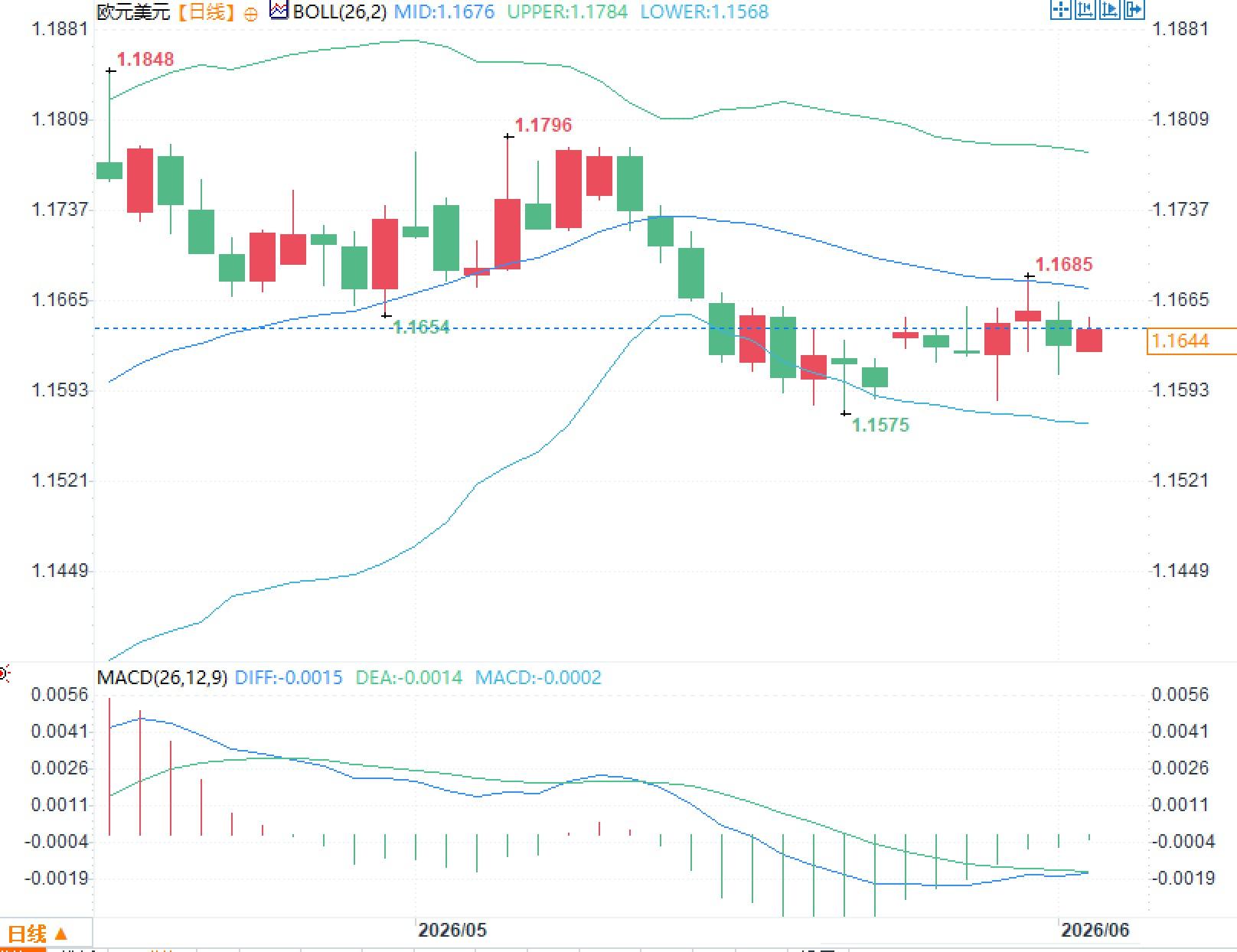
Regarding the MACD, the DIFF is approximately -0.0015, the DEA is approximately -0.0014, and the histogram is approximately -0.0002. The bearish momentum shows signs of convergence, but a clear positive expansion has not yet appeared. In other words, the market is not experiencing a strong one-sided decline, but rather a low-level correction after a downtrend. The low near 1.1575 and the lower Bollinger Band form a short-term risk boundary, while the high near 1.1685 and the area above the middle Bollinger Band form a rebound verification zone. If the fundamentals only deliver on one "insurance" rate hike, the exchange rate is more likely to remain within a range for repricing; only if inflation and official statements jointly increase the probability of consecutive rate hikes will the technical structure have the conditions for repricing.
The Federal Reserve's current interest rate range is 3.50% to 3.75%, meaning that even with the European Central Bank's 25 basis point increase in June, the policy interest rate differential between the US and Europe has not been completely reversed. The US dollar index is currently fluctuating slightly around 99.1, and has not shown any directional collapse in the short term.
Therefore, the core variable for the euro/dollar exchange rate is not whether there are positive factors for the euro, but whether these factors can outweigh the yield support on the dollar side. If US inflation remains sticky and the Federal Reserve continues to maintain a relatively high interest rate range, the euro's upward movement will require the European Central Bank to release clearer signals of further tightening. Conversely, if the easing of the Middle East conflict leads to a decline in energy prices and a reduction in European inflationary pressures, the ECB's "insurance-oriented" rhetoric could actually weaken the euro's interest rate premium. The current narrow range trading essentially reflects the fact that these two sets of logics have not yet determined a winner.
Question 1: Why didn't the euro make a significant breakthrough after Rennes proposed an "insurance" interest rate hike?
A: Because the market has already partially priced in a June rate hike, what truly drives a breakthrough is the subsequent path of the rate hike, not a single 25 basis point increase. If the ECB emphasizes monitoring data, the probability of further action in July will be reduced, thus weakening the positive impact on the euro.
Question 2: Will inflation rising to 3.2% necessarily benefit the euro?
A: Not necessarily. Rising inflation will increase expectations of interest rate hikes, but if it mainly comes from an energy shock and simultaneously suppresses consumption and growth, funds will reassess the returns and risk premiums of Eurozone assets.
Insurance-driven interest rate hikes do not change the single interest rate, but rather the path pricing.
The European Central Bank's current deposit facility rate is 2.00%, its main refinancing rate is 2.15%, and its marginal lending rate is 2.40%. If the rate is raised by 25 basis points at the June meeting, the market's actual focus will not be on the increase from 2.00% to 2.25% itself, but rather on whether the policy statement, economic forecasts, and press conference acknowledge the persistence of inflationary pressures. The ECB's official schedule indicates that the June monetary policy meeting will be held on June 10-11, followed by a press conference on the 11th.
Rehn's description of the rate hike as "insurance" adds a layer of constraint to the policy path. If this is a defensive adjustment, the euro's interest rate support will be more biased towards the short end; only if subsequent data continues to show a spread in service prices, wages, and energy costs will the market revise upwards on the terminal interest rate. Traders need to distinguish between the two levels of "realizing rate hike expectations" and "reassessing the rate hike cycle." The former is often easily priced in by the price, while the latter is what changes the trend slope.
Inflationary pressures have spread from the energy sector to core indicators.
Eurozone inflation rose to 3.2% in May, with core inflation at 2.5% and services inflation at 3.5%, while energy prices rose by approximately 10.9% year-on-year. These figures indicate that the pressure is no longer solely due to a one-off energy shock; the rebound in services prices makes it more difficult for the European Central Bank to address the issue using a "temporary" framework.
More crucially, the outlook is mixed. In April, Eurozone households maintained their 12-month inflation expectations at 4.0%, while their three-year expectations slightly declined to 2.9%, and income growth expectations fell to 0.8%. This combination is atypical; residents expect prices to continue rising, but income expectations have not strengthened accordingly, meaning that actual purchasing power is under pressure. For exchange rates, this creates a two-way constraint: on the one hand, inflation forces the ECB to be more cautious, supporting the euro interest rate differential; on the other hand, eroded growth elasticity limits the potential for significant capital inflows into euro assets.
Technical analysis suggests that the euro has not yet broken free from its central resistance level.
From the daily chart, the euro/dollar pair remains below the Bollinger Band's middle band, which is around 1.1676, the upper band around 1.1784, and the lower band around 1.1568. The price has repeatedly attempted to return to the 1.1660-1.1685 area but failed to establish a firm foothold, indicating that the resistance above is not simply a price level, but rather a densely traded area following previous clashes between bulls and bears.
Regarding the MACD, the DIFF is approximately -0.0015, the DEA is approximately -0.0014, and the histogram is approximately -0.0002. The bearish momentum shows signs of convergence, but a clear positive expansion has not yet appeared. In other words, the market is not experiencing a strong one-sided decline, but rather a low-level correction after a downtrend. The low near 1.1575 and the lower Bollinger Band form a short-term risk boundary, while the high near 1.1685 and the area above the middle Bollinger Band form a rebound verification zone. If the fundamentals only deliver on one "insurance" rate hike, the exchange rate is more likely to remain within a range for repricing; only if inflation and official statements jointly increase the probability of consecutive rate hikes will the technical structure have the conditions for repricing.
The US dollar remains the external ceiling for the euro's rebound.
The Federal Reserve's current interest rate range is 3.50% to 3.75%, meaning that even with the European Central Bank's 25 basis point increase in June, the policy interest rate differential between the US and Europe has not been completely reversed. The US dollar index is currently fluctuating slightly around 99.1, and has not shown any directional collapse in the short term.
Therefore, the core variable for the euro/dollar exchange rate is not whether there are positive factors for the euro, but whether these factors can outweigh the yield support on the dollar side. If US inflation remains sticky and the Federal Reserve continues to maintain a relatively high interest rate range, the euro's upward movement will require the European Central Bank to release clearer signals of further tightening. Conversely, if the easing of the Middle East conflict leads to a decline in energy prices and a reduction in European inflationary pressures, the ECB's "insurance-oriented" rhetoric could actually weaken the euro's interest rate premium. The current narrow range trading essentially reflects the fact that these two sets of logics have not yet determined a winner.
Frequently Asked Questions
Question 1: Why didn't the euro make a significant breakthrough after Rennes proposed an "insurance" interest rate hike?
A: Because the market has already partially priced in a June rate hike, what truly drives a breakthrough is the subsequent path of the rate hike, not a single 25 basis point increase. If the ECB emphasizes monitoring data, the probability of further action in July will be reduced, thus weakening the positive impact on the euro.
Question 2: Will inflation rising to 3.2% necessarily benefit the euro?
A: Not necessarily. Rising inflation will increase expectations of interest rate hikes, but if it mainly comes from an energy shock and simultaneously suppresses consumption and growth, funds will reassess the returns and risk premiums of Eurozone assets.
- Risk Warning and Disclaimer
- The market involves risk, and trading may not be suitable for all investors. This article is for reference only and does not constitute personal investment advice, nor does it take into account certain users’ specific investment objectives, financial situation, or other needs. Any investment decisions made based on this information are at your own risk.