From the Lebanese-Israeli airstrikes to the data test: Gold caught in geopolitical safe-haven demand and the Fed's data game.
2026-06-02 21:42:57
The recent situation between Lebanon and Israel has become a key variable affecting the precious metals market.
Previously, Trump intervened to mediate the conflict between Israel and Lebanon, officially announcing a verbal ceasefire agreement between Israel and Hezbollah, with both sides halting their offensives. The market was initially boosted by the de-escalation of geopolitical tensions, and the recovery in risk appetite led to a slight decline in the US dollar and international oil prices. Spot gold saw a short-term stabilization and rebound from below the $4,500 mark.
However, the ceasefire agreement encountered changes just hours after it was signed. The Israeli military continued airstrikes on multiple locations in southern Lebanon, and a series of drone strikes have resulted in five deaths. Neither Hezbollah nor Israel has formally and fully recognized the ceasefire agreement, and the market has widely questioned the ability of the ceasefire to be implemented.
Although Trump has publicly stated that the US-Iran negotiations are progressing steadily and that an agreement is expected to be finalized within a week, and that shipping through the Strait of Hormuz will be unblocked, the possibility of escalation in localized conflicts in the Middle East remains ever-present. The Israeli military once set a record for its largest incursion into Lebanon in more than 20 years, and Hezbollah continues to harass Israeli forces stationed in southern Lebanon. Geopolitical uncertainty continues to linger in the market, becoming a potential safe-haven bullish factor for gold prices.
This round of Middle East conflict has not deviated from the traditional logic of "war-induced price increases" for gold; instead, it has exerted significant downward pressure on gold prices through the energy chain.
Since the outbreak of military conflict between the US and Iran at the end of February, Brent crude oil prices have risen by 37% in stages. The continuous rise in oil prices has significantly increased global inflation stickiness. US inflation data has deviated significantly from the policy target of 2%. In April, the US CPI and PCE both rose to 3.8% year-on-year, and the core PCE rose by 3.3% year-on-year.
Due to the better-than-expected inflation data, the market's pricing logic for the Federal Reserve's monetary policy has been completely reversed: Previously, the market generally bet on the Fed to implement two rate cuts in 2026, but now CME interest rate futures data shows that funds have begun to price in the possibility of a rate hike at the end of the year, with the probability of a Fed rate hike in December rising to 46%.
Gold is a zero-interest safe-haven asset. A high-interest-rate environment increases the opportunity cost of holding gold, and funds tend to allocate to interest-bearing assets such as the US dollar and US Treasury bonds. At the same time, as the US dollar is the pricing currency, the rise in the US dollar index also puts downward pressure on gold. This is the core reason why spot gold fell rapidly after hitting a historical high of $5,602 per ounce in January, and fell below $4,500 by the end of May, a pullback of nearly 20% from its high.
FOMC hawkish regional Fed President Hammark stated that maintaining stable interest rates is reasonable at present. He added that if high inflation persists, a larger adjustment might be necessary, but he has not yet seen signs of rising inflation expectations. He also noted that the job market is stable, but new job creation is minimal.
In the short term, the Fed’s interest rate expectations and oil price inflation disturbances dominate gold price fluctuations, but the continuous gold purchases by global central banks have become the core force anchoring the bottom of gold prices, offsetting the downward pressure brought by high interest rates, and also preventing short sellers from dumping large amounts of gold, making it difficult for gold prices to experience a one-sided sharp decline.
According to data from the World Gold Council, global central bank net gold purchases reached 244 tons in the first quarter of 2026, rising both quarter-on-quarter and year-on-year, setting a new record for the quarterly average of the same period in the past five years. Central banks have now surpassed individual retail investors and futures speculators to become the largest source of demand in the current gold market.
The freezing of Russia's foreign exchange reserves in 2022 accelerated the diversification of global central bank reserves. Gold, with its unique attribute of not being subject to international sanctions, saw its value as a reserve asset rapidly increase, and central banks around the world have since accelerated their gold purchases.
Judging from the allocation pace of various countries, after the National Bank of Poland increased its gold holdings by 20 tons in February 2026, its gold reserves increased to 570 tons, accounting for 31% of the country's foreign exchange reserves. The country's long-term reserve target is 700 tons.
In the US, Germany, France, and Italy, long-established reserve-holding countries, gold reserves account for about 70% of their foreign exchange reserves, while my country's gold reserves account for less than 10% of its foreign exchange reserves, meaning that most economies around the world still have considerable room for increasing their gold reserves.
Currently, the annual net gold purchases by global central banks can absorb one-third of the world's annual mineral production. This type of essential allocation based on national foreign exchange security is not affected by short-term market fluctuations or investment sentiment, forming a long-term stable demand for physical assets.
The market is focused on this week's series of US employment data, including JOLTS job openings, ADP non-farm payrolls, and non-farm payrolls, which will directly affect changes in the Federal Reserve's interest rate expectations and influence short-term gold price fluctuations.
Meanwhile, the differences between the US and Iran, and between Lebanon and Israel, are unlikely to be resolved quickly. If the US-Iran negotiations break down or navigation in the Strait of Hormuz is obstructed, gold prices will be suppressed in the short term.
On the other hand, the continued high inflation and the prolonged high-interest-rate cycle of the Federal Reserve remain a negative factor hanging over gold prices.
The continued realization of the rigid demand for gold purchases by global central banks will become the most important safety net for gold prices, determining that the downside potential for gold prices is limited.
From a technical perspective, spot gold remains in a downward channel and is currently constrained by the middle band. As long as the gold price maintains its current level, it is expected to shift from a downward trend to range-bound trading.
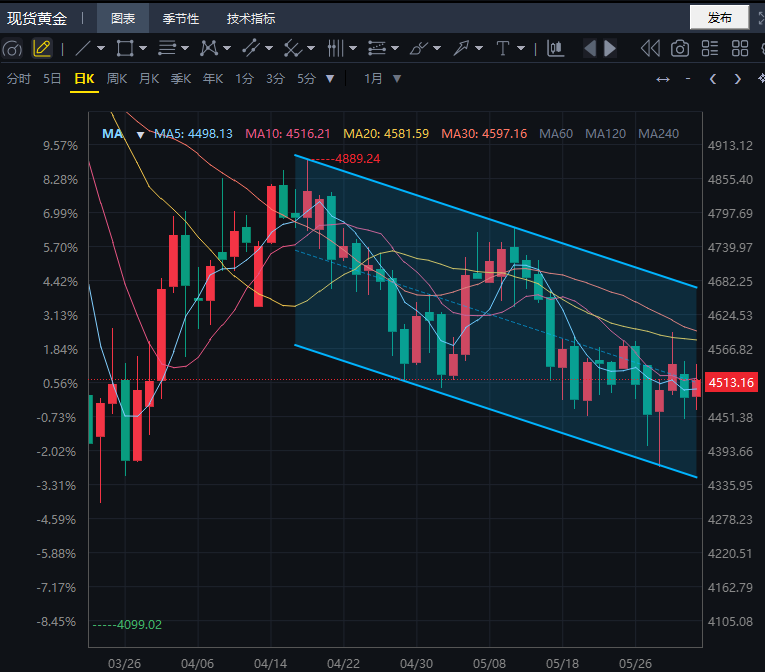
(Spot gold daily chart, source: FX678)
At 21:38 Beijing time, spot gold was trading at $4,508 per ounce.
Previously, Trump intervened to mediate the conflict between Israel and Lebanon, officially announcing a verbal ceasefire agreement between Israel and Hezbollah, with both sides halting their offensives. The market was initially boosted by the de-escalation of geopolitical tensions, and the recovery in risk appetite led to a slight decline in the US dollar and international oil prices. Spot gold saw a short-term stabilization and rebound from below the $4,500 mark.
However, the ceasefire agreement encountered changes just hours after it was signed. The Israeli military continued airstrikes on multiple locations in southern Lebanon, and a series of drone strikes have resulted in five deaths. Neither Hezbollah nor Israel has formally and fully recognized the ceasefire agreement, and the market has widely questioned the ability of the ceasefire to be implemented.
Although Trump has publicly stated that the US-Iran negotiations are progressing steadily and that an agreement is expected to be finalized within a week, and that shipping through the Strait of Hormuz will be unblocked, the possibility of escalation in localized conflicts in the Middle East remains ever-present. The Israeli military once set a record for its largest incursion into Lebanon in more than 20 years, and Hezbollah continues to harass Israeli forces stationed in southern Lebanon. Geopolitical uncertainty continues to linger in the market, becoming a potential safe-haven bullish factor for gold prices.
Inflation and interest rate hikes combined: Rising energy prices exert downward pressure, causing gold prices to retreat from their highs.
This round of Middle East conflict has not deviated from the traditional logic of "war-induced price increases" for gold; instead, it has exerted significant downward pressure on gold prices through the energy chain.
Since the outbreak of military conflict between the US and Iran at the end of February, Brent crude oil prices have risen by 37% in stages. The continuous rise in oil prices has significantly increased global inflation stickiness. US inflation data has deviated significantly from the policy target of 2%. In April, the US CPI and PCE both rose to 3.8% year-on-year, and the core PCE rose by 3.3% year-on-year.
Due to the better-than-expected inflation data, the market's pricing logic for the Federal Reserve's monetary policy has been completely reversed: Previously, the market generally bet on the Fed to implement two rate cuts in 2026, but now CME interest rate futures data shows that funds have begun to price in the possibility of a rate hike at the end of the year, with the probability of a Fed rate hike in December rising to 46%.
Gold is a zero-interest safe-haven asset. A high-interest-rate environment increases the opportunity cost of holding gold, and funds tend to allocate to interest-bearing assets such as the US dollar and US Treasury bonds. At the same time, as the US dollar is the pricing currency, the rise in the US dollar index also puts downward pressure on gold. This is the core reason why spot gold fell rapidly after hitting a historical high of $5,602 per ounce in January, and fell below $4,500 by the end of May, a pullback of nearly 20% from its high.
FOMC hawkish regional Fed President Hammark stated that maintaining stable interest rates is reasonable at present. He added that if high inflation persists, a larger adjustment might be necessary, but he has not yet seen signs of rising inflation expectations. He also noted that the job market is stable, but new job creation is minimal.
Central bank gold purchases provide a safety net: rigid reserve demand solidifies the gold price cushion.
In the short term, the Fed’s interest rate expectations and oil price inflation disturbances dominate gold price fluctuations, but the continuous gold purchases by global central banks have become the core force anchoring the bottom of gold prices, offsetting the downward pressure brought by high interest rates, and also preventing short sellers from dumping large amounts of gold, making it difficult for gold prices to experience a one-sided sharp decline.
According to data from the World Gold Council, global central bank net gold purchases reached 244 tons in the first quarter of 2026, rising both quarter-on-quarter and year-on-year, setting a new record for the quarterly average of the same period in the past five years. Central banks have now surpassed individual retail investors and futures speculators to become the largest source of demand in the current gold market.
The freezing of Russia's foreign exchange reserves in 2022 accelerated the diversification of global central bank reserves. Gold, with its unique attribute of not being subject to international sanctions, saw its value as a reserve asset rapidly increase, and central banks around the world have since accelerated their gold purchases.
Judging from the allocation pace of various countries, after the National Bank of Poland increased its gold holdings by 20 tons in February 2026, its gold reserves increased to 570 tons, accounting for 31% of the country's foreign exchange reserves. The country's long-term reserve target is 700 tons.
In the US, Germany, France, and Italy, long-established reserve-holding countries, gold reserves account for about 70% of their foreign exchange reserves, while my country's gold reserves account for less than 10% of its foreign exchange reserves, meaning that most economies around the world still have considerable room for increasing their gold reserves.
Currently, the annual net gold purchases by global central banks can absorb one-third of the world's annual mineral production. This type of essential allocation based on national foreign exchange security is not affected by short-term market fluctuations or investment sentiment, forming a long-term stable demand for physical assets.
Summary and Technical Analysis:
The market is focused on this week's series of US employment data, including JOLTS job openings, ADP non-farm payrolls, and non-farm payrolls, which will directly affect changes in the Federal Reserve's interest rate expectations and influence short-term gold price fluctuations.
Meanwhile, the differences between the US and Iran, and between Lebanon and Israel, are unlikely to be resolved quickly. If the US-Iran negotiations break down or navigation in the Strait of Hormuz is obstructed, gold prices will be suppressed in the short term.
On the other hand, the continued high inflation and the prolonged high-interest-rate cycle of the Federal Reserve remain a negative factor hanging over gold prices.
The continued realization of the rigid demand for gold purchases by global central banks will become the most important safety net for gold prices, determining that the downside potential for gold prices is limited.
From a technical perspective, spot gold remains in a downward channel and is currently constrained by the middle band. As long as the gold price maintains its current level, it is expected to shift from a downward trend to range-bound trading.
(Spot gold daily chart, source: FX678)
At 21:38 Beijing time, spot gold was trading at $4,508 per ounce.
- Risk Warning and Disclaimer
- The market involves risk, and trading may not be suitable for all investors. This article is for reference only and does not constitute personal investment advice, nor does it take into account certain users’ specific investment objectives, financial situation, or other needs. Any investment decisions made based on this information are at your own risk.