Silver hits $76 mark; is a supply gap forming behind this?
2026-06-02 22:04:22
On Tuesday, June 2nd, the spot silver market exhibited complex price fluctuations. Trading during the North American session, it hovered around $76.2 per ounce, rebounding from the previous trading day. Bollinger Bands indicate that the price is currently near the middle band, but the risk of a short-term correction remains.
The MACD indicator shows the DIFF line below the DEA line, indicating a slight downward trend and weak market momentum. Furthermore, the recent global fundamental environment has shown signs of moderate improvement, particularly with a recovery in industrial demand and adjustments in investor safe-haven demand, providing structural support for precious metal prices. TD Securities recently raised its medium- and long-term outlook for silver and platinum group metals (PGMs), despite the continued risk of short-term price corrections, providing a new analytical perspective for the market.
From a supply and demand perspective, silver and platinum group metals are gradually shifting towards a supply shortage. TD Securities points out that although prices may be under pressure in the short term, the supply and demand fundamentals are improving: on the one hand, global silver mine supply remains tight, with limited production growth; on the other hand, investor and industrial demand has increased due to geopolitical uncertainties following the Persian Gulf conflict. As a metal with both industrial and investment attributes, silver's consumption mainly comes from the electronics, photovoltaic, and jewelry industries, while also serving as a safe haven and asset allocation tool. The combination of tight supply and recovering demand makes it possible for silver to enter a supply deficit in the next two quarters, providing solid fundamental support for prices.
Platinum group metals (PGMs) face similar supply-demand imbalances. Platinum and palladium have a high proportion of industrial applications, especially in automotive exhaust catalysts and the electronics industry where they are irreplaceable. On the supply side, supply elasticity is low due to fluctuations in mine production and geopolitical factors. Increased strategic stockpiling demand triggered by conflicts further exacerbates the potential shortage. TD Securities predicts that silver and PMMs will experience a structural supply-demand imbalance in the future, supported by continued improvement in demand and constrained supply, thus supporting long-term price increases.
From a technical perspective, spot silver is showing short-term correction signals on the daily chart. The Bollinger Band middle line is around $77.1/oz, the upper line is at $85.7/oz, and the lower line is at $68.4/oz. Recent price fluctuations within the $76-$77 range indicate a relatively balanced power between buyers and sellers, but there is still about 10% upside potential before reaching the upper band. If the supply-demand gap materializes, there is potential for a rebound. The MACD indicator shows the DIFF line in negative territory and trending downwards, indicating short-term weakness, but the long-term trend is still supported by medium-term supply-demand improvements and the safe-haven appeal of precious metals. A break below the recent low of $71.7/oz would trigger further correction signals; otherwise, a rebound is still possible.
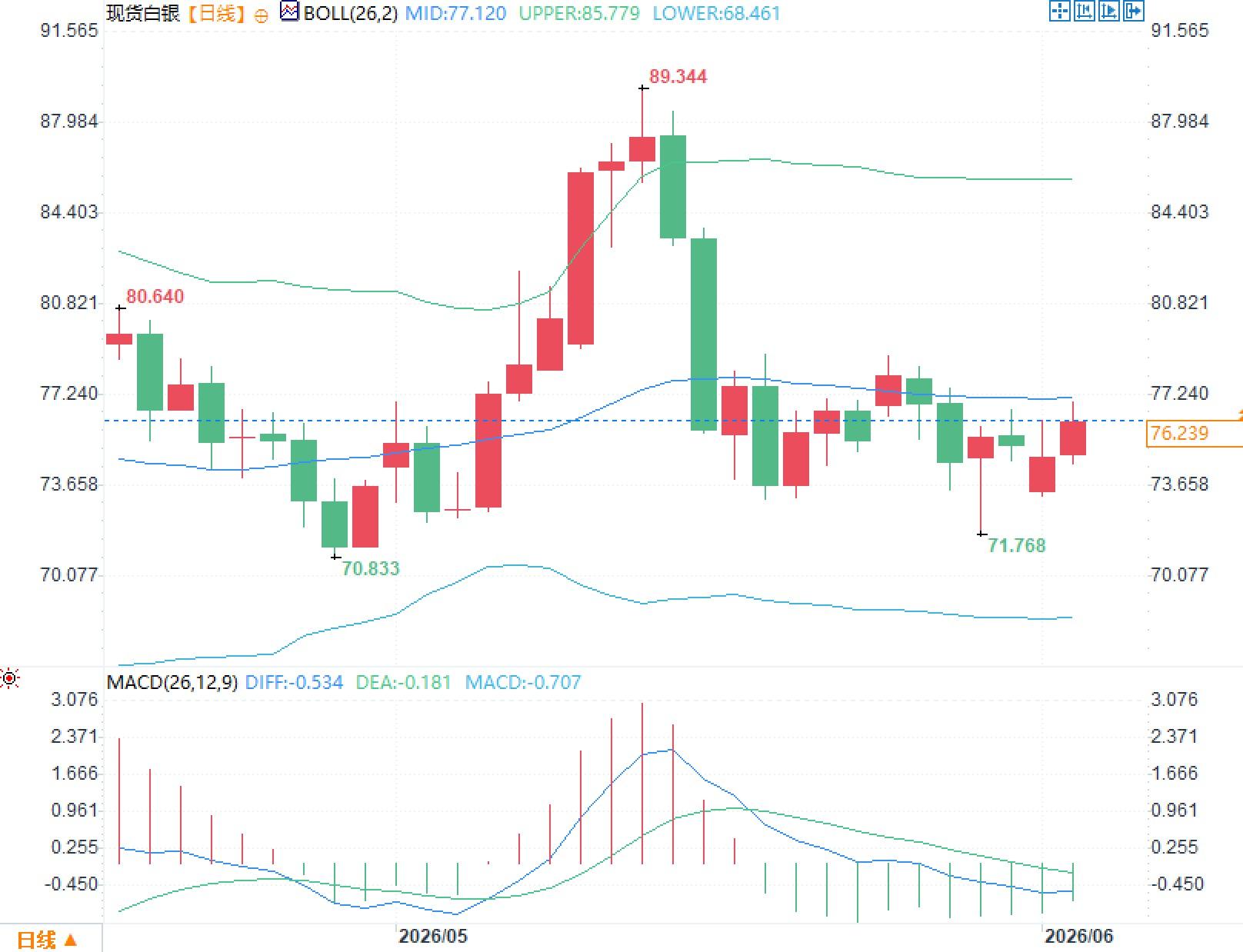
The price fluctuations in the chart also show a clear divergence between highs and lows. After reaching a high of $89.3/ounce, the price quickly fell back, forming a typical high-level consolidation pattern. Combined with momentum indicators, it can be judged that the current correction is mainly due to profit-taking and the release of short-term risk aversion, and has not changed the medium- to long-term fundamental logic of silver.
A moderate global macroeconomic recovery provides medium- to long-term support for silver. TD Securities specifically points out that rising gold price expectations and an improving global economy will drive demand growth for silver and PGMs. Although stable US economic data has somewhat limited safe-haven demand for silver, industrial demand continues to rise. Especially against the backdrop of geopolitical conflicts, increased market demand for precious metal reserves and strategic stocks has further highlighted the supply-demand imbalance.
Furthermore, supply chain constraints for silver and platinum group metals include fluctuations in mine capacity and rising transportation and logistics costs. These factors are expected to persist over the next two quarters, thereby strengthening price support. Investors should pay attention to the pace of industrial demand recovery and the latest developments in geopolitical conflicts, as these will directly affect the speed at which the medium-term gap in silver is filled.
Question 1: What are the main driving factors behind the recent fluctuations in silver prices?
A: Recent price fluctuations are mainly influenced by supply and demand dynamics and geopolitical factors. Silver supply remains tight, while increased industrial and investment demand following the conflict has created a supply-demand gap. Furthermore, the short-term price decline is primarily driven by profit-taking and fluctuations in risk aversion.
Question 2: What does the tight supply and demand of platinum group metals and silver mean for investors?
A: Tight supply and demand means that prices may be structurally supported. In the medium to long term, insufficient supply and rising demand may provide potential price support. However, investors need to pay attention to the impact of the macroeconomy and conflicts to judge the speed at which the gap is realized and market volatility.
The MACD indicator shows the DIFF line below the DEA line, indicating a slight downward trend and weak market momentum. Furthermore, the recent global fundamental environment has shown signs of moderate improvement, particularly with a recovery in industrial demand and adjustments in investor safe-haven demand, providing structural support for precious metal prices. TD Securities recently raised its medium- and long-term outlook for silver and platinum group metals (PGMs), despite the continued risk of short-term price corrections, providing a new analytical perspective for the market.
Market supply and demand structure analysis
From a supply and demand perspective, silver and platinum group metals are gradually shifting towards a supply shortage. TD Securities points out that although prices may be under pressure in the short term, the supply and demand fundamentals are improving: on the one hand, global silver mine supply remains tight, with limited production growth; on the other hand, investor and industrial demand has increased due to geopolitical uncertainties following the Persian Gulf conflict. As a metal with both industrial and investment attributes, silver's consumption mainly comes from the electronics, photovoltaic, and jewelry industries, while also serving as a safe haven and asset allocation tool. The combination of tight supply and recovering demand makes it possible for silver to enter a supply deficit in the next two quarters, providing solid fundamental support for prices.
Platinum group metals (PGMs) face similar supply-demand imbalances. Platinum and palladium have a high proportion of industrial applications, especially in automotive exhaust catalysts and the electronics industry where they are irreplaceable. On the supply side, supply elasticity is low due to fluctuations in mine production and geopolitical factors. Increased strategic stockpiling demand triggered by conflicts further exacerbates the potential shortage. TD Securities predicts that silver and PMMs will experience a structural supply-demand imbalance in the future, supported by continued improvement in demand and constrained supply, thus supporting long-term price increases.
Technical Analysis
From a technical perspective, spot silver is showing short-term correction signals on the daily chart. The Bollinger Band middle line is around $77.1/oz, the upper line is at $85.7/oz, and the lower line is at $68.4/oz. Recent price fluctuations within the $76-$77 range indicate a relatively balanced power between buyers and sellers, but there is still about 10% upside potential before reaching the upper band. If the supply-demand gap materializes, there is potential for a rebound. The MACD indicator shows the DIFF line in negative territory and trending downwards, indicating short-term weakness, but the long-term trend is still supported by medium-term supply-demand improvements and the safe-haven appeal of precious metals. A break below the recent low of $71.7/oz would trigger further correction signals; otherwise, a rebound is still possible.
The price fluctuations in the chart also show a clear divergence between highs and lows. After reaching a high of $89.3/ounce, the price quickly fell back, forming a typical high-level consolidation pattern. Combined with momentum indicators, it can be judged that the current correction is mainly due to profit-taking and the release of short-term risk aversion, and has not changed the medium- to long-term fundamental logic of silver.
Macroeconomic and fundamental impacts
A moderate global macroeconomic recovery provides medium- to long-term support for silver. TD Securities specifically points out that rising gold price expectations and an improving global economy will drive demand growth for silver and PGMs. Although stable US economic data has somewhat limited safe-haven demand for silver, industrial demand continues to rise. Especially against the backdrop of geopolitical conflicts, increased market demand for precious metal reserves and strategic stocks has further highlighted the supply-demand imbalance.
Furthermore, supply chain constraints for silver and platinum group metals include fluctuations in mine capacity and rising transportation and logistics costs. These factors are expected to persist over the next two quarters, thereby strengthening price support. Investors should pay attention to the pace of industrial demand recovery and the latest developments in geopolitical conflicts, as these will directly affect the speed at which the medium-term gap in silver is filled.
Frequently Asked Questions
Question 1: What are the main driving factors behind the recent fluctuations in silver prices?
A: Recent price fluctuations are mainly influenced by supply and demand dynamics and geopolitical factors. Silver supply remains tight, while increased industrial and investment demand following the conflict has created a supply-demand gap. Furthermore, the short-term price decline is primarily driven by profit-taking and fluctuations in risk aversion.
Question 2: What does the tight supply and demand of platinum group metals and silver mean for investors?
A: Tight supply and demand means that prices may be structurally supported. In the medium to long term, insufficient supply and rising demand may provide potential price support. However, investors need to pay attention to the impact of the macroeconomy and conflicts to judge the speed at which the gap is realized and market volatility.
- Risk Warning and Disclaimer
- The market involves risk, and trading may not be suitable for all investors. This article is for reference only and does not constitute personal investment advice, nor does it take into account certain users’ specific investment objectives, financial situation, or other needs. Any investment decisions made based on this information are at your own risk.