A chart shows that the large shipbuilding sector is weakening, and the Baltic Dry Index is slightly declining.
2026-06-02 22:25:58
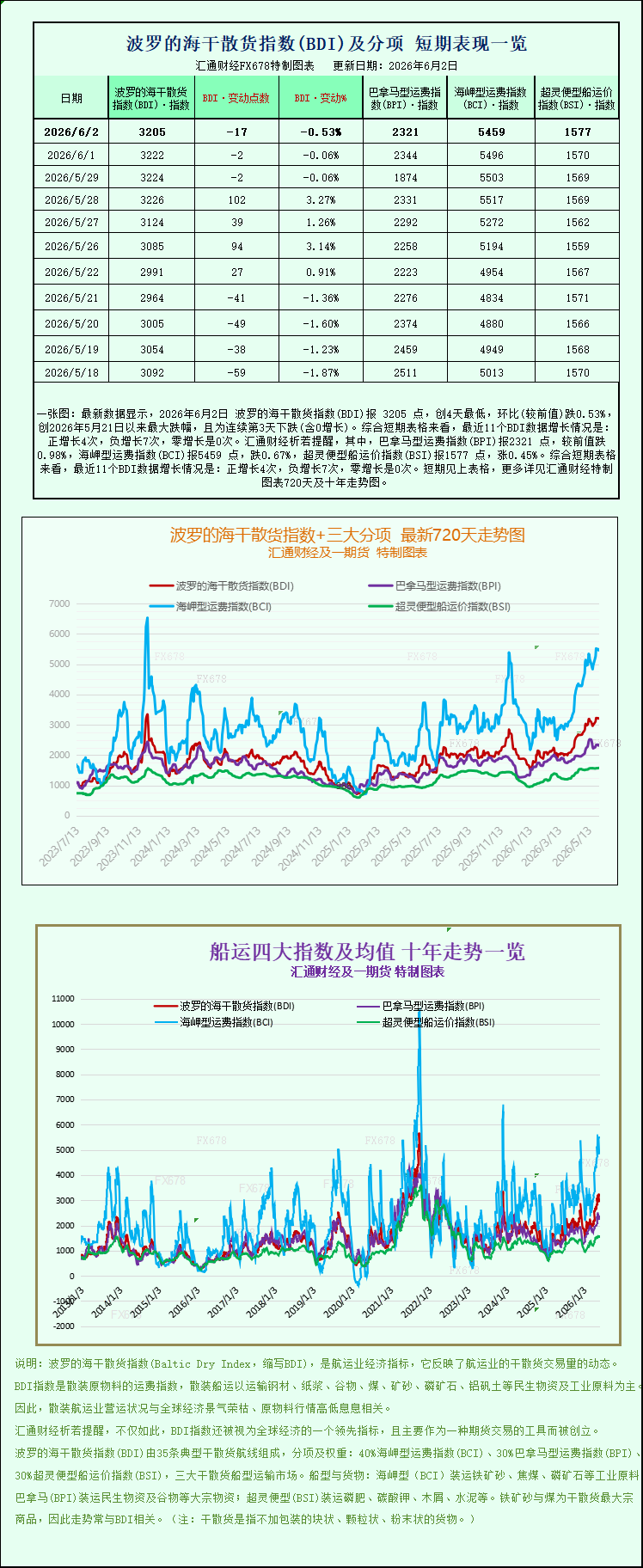
Latest data shows that the Baltic Dry Index (BDI) closed at 3205 points on June 2, 2026, a four-day low, down 0.53% from the previous day, marking the largest drop since May 21, 2026, and the third consecutive day of decline (including zero growth). Looking at the short-term charts, the recent 11 BDI data points show: 4 positive increases, 7 negative increases, and 0 zero increases. Specifically, the Panamax Freight Index (BPI) closed at 2321 points, down 0.98% from the previous day; the Capesize Freight Index (BCI) closed at 5459 points, down 0.67%; and the Supramax Freight Index (BSI) closed at 1577 points, up 0.45%. For detailed 720-day and 10-year trend charts of the Baltic Dry Index and its three main sub-indices, please refer to the specially designed charts.
The international shipping market experienced structural divergence, with the Baltic Dry Index (BDI) seeing a slight decline on Tuesday, indicating overall downward pressure. This decline was primarily driven by weak freight rates for large dry bulk vessels. Demand for Capesize and Panamax vessels cooled, leading to lower freight rates, which offset slight increases in rates for smaller vessels, resulting in a lower close for the overall index. The Baltic Dry Index is a key indicator of global dry bulk shipping trade, primarily covering ocean freight rates for industrial raw materials and commodities such as iron ore, coal, and grains, directly reflecting changes in global commodity trade and the shipping market's supply and demand.
Data shows that the Baltic Dry Index, which tracks freight rates for the three major dry bulk carrier types—Capesize, Panamax, and Supramax—fell 17 points, or 0.5%, to close at 3205 points, ending its previous stable and volatile trend and showing a slight decline.
As the mainstay of large ocean-going dry bulk carriers, the Capesize vessel market significantly dragged down the overall market performance. Specifically, the Capesize vessel index fell 37 points, a drop of 0.7%, closing at 5459 points. Correspondingly, profitability data for this vessel type weakened. Capesize vessels, primarily carrying 150,000 tons of bulk industrial raw materials such as iron ore and coal, saw their average daily operating revenue decrease by $338 to $46,008. Industry analysts indicate that the recent insufficient increase in global iron ore ocean shipping orders and weak demand from overseas steel mills are the core reasons for the decline in freight rates for large mining vessels.
It is worth noting that although the seaborne coal transportation market weakened, the domestic coal spot market showed independent trends. Affected by the upgraded safety supervision of coal mines in Shanxi Province, China, mines in the region have comprehensively strengthened safety inspections and suspended production for maintenance following fatal accidents. Market expectations of a tightening short-term coal supply have continued to rise, driving domestic coking coal prices to continue their upward trend on Tuesday, marking the second consecutive trading day of increases. The regional market characteristics under the supply-demand game are becoming increasingly apparent.
The medium-sized vessel market also continued its weak performance, with the Panamax index falling 23 points to close at 2321. This vessel type, primarily used for transporting bulk commodities such as coal and grain in the 60,000 to 70,000 tonne class, is one of the core vessel types in global energy and agricultural shipping. Its profitability declined accordingly, with average daily revenue for Panamax vessels decreasing by $206 to $20,889, reflecting overall weak demand for mid-range global shipping of grain and thermal coal.
The market exhibited a clear structural divergence, with the small and medium-sized vessel sector bucking the trend and rising slightly. The Supramax vessel index rose 7 points to 1577. Compared to large vessels, which rely on long-distance, bulk industrial raw material transportation, small and medium-sized vessels have more stable short-distance, small-batch ocean freight orders and are less affected by fluctuations in global bulk industrial demand. Therefore, they showed resilience when the overall market weakened, supporting the overall shipping index and preventing a significant decline.
The international shipping market experienced structural divergence, with the Baltic Dry Index (BDI) seeing a slight decline on Tuesday, indicating overall downward pressure. This decline was primarily driven by weak freight rates for large dry bulk vessels. Demand for Capesize and Panamax vessels cooled, leading to lower freight rates, which offset slight increases in rates for smaller vessels, resulting in a lower close for the overall index. The Baltic Dry Index is a key indicator of global dry bulk shipping trade, primarily covering ocean freight rates for industrial raw materials and commodities such as iron ore, coal, and grains, directly reflecting changes in global commodity trade and the shipping market's supply and demand.
Data shows that the Baltic Dry Index, which tracks freight rates for the three major dry bulk carrier types—Capesize, Panamax, and Supramax—fell 17 points, or 0.5%, to close at 3205 points, ending its previous stable and volatile trend and showing a slight decline.
As the mainstay of large ocean-going dry bulk carriers, the Capesize vessel market significantly dragged down the overall market performance. Specifically, the Capesize vessel index fell 37 points, a drop of 0.7%, closing at 5459 points. Correspondingly, profitability data for this vessel type weakened. Capesize vessels, primarily carrying 150,000 tons of bulk industrial raw materials such as iron ore and coal, saw their average daily operating revenue decrease by $338 to $46,008. Industry analysts indicate that the recent insufficient increase in global iron ore ocean shipping orders and weak demand from overseas steel mills are the core reasons for the decline in freight rates for large mining vessels.
It is worth noting that although the seaborne coal transportation market weakened, the domestic coal spot market showed independent trends. Affected by the upgraded safety supervision of coal mines in Shanxi Province, China, mines in the region have comprehensively strengthened safety inspections and suspended production for maintenance following fatal accidents. Market expectations of a tightening short-term coal supply have continued to rise, driving domestic coking coal prices to continue their upward trend on Tuesday, marking the second consecutive trading day of increases. The regional market characteristics under the supply-demand game are becoming increasingly apparent.
The medium-sized vessel market also continued its weak performance, with the Panamax index falling 23 points to close at 2321. This vessel type, primarily used for transporting bulk commodities such as coal and grain in the 60,000 to 70,000 tonne class, is one of the core vessel types in global energy and agricultural shipping. Its profitability declined accordingly, with average daily revenue for Panamax vessels decreasing by $206 to $20,889, reflecting overall weak demand for mid-range global shipping of grain and thermal coal.
The market exhibited a clear structural divergence, with the small and medium-sized vessel sector bucking the trend and rising slightly. The Supramax vessel index rose 7 points to 1577. Compared to large vessels, which rely on long-distance, bulk industrial raw material transportation, small and medium-sized vessels have more stable short-distance, small-batch ocean freight orders and are less affected by fluctuations in global bulk industrial demand. Therefore, they showed resilience when the overall market weakened, supporting the overall shipping index and preventing a significant decline.
- Risk Warning and Disclaimer
- The market involves risk, and trading may not be suitable for all investors. This article is for reference only and does not constitute personal investment advice, nor does it take into account certain users’ specific investment objectives, financial situation, or other needs. Any investment decisions made based on this information are at your own risk.