Analysts: Gold prices have fallen for three consecutive months, but the long-term bull market logic remains intact.
2026-06-03 10:37:54
Affected by the geopolitical situation in the Middle East, international gold prices experienced a three-month consecutive correction in May. The conflict with Iran pushed up the US dollar and US Treasury yields, reducing the Federal Reserve's room for interest rate cuts, which significantly suppressed gold prices in the short term.
In his latest research report released on Monday (June 1), Ole Hansen, head of commodity strategy at Saxo Bank, analyzed that the current decline in gold prices is a short-term structural adjustment. The four core supports—global debt risk, the de-dollarization process, persistent inflation, and continued gold purchases by central banks around the world—remain unchanged. The overall bull market for gold is still solid, and the short-term weakness will not change the medium- to long-term upward trend.
Data shows that gold prices fell for the third consecutive month in May, and short-term market sentiment continued to weaken. However, gold's medium- to long-term returns remain impressive, with a year-to-date increase of 5% in 2026, a year-to-date increase of 36%, and a cumulative increase of 91% over two years.
The disruption to shipping in the Strait of Hormuz has caused global oil and gas and refined oil prices to remain high, completely altering the current inflationary environment.
Hansen stated that this round of energy-driven inflation has not triggered the traditional safe-haven demand for gold. Instead, it has fueled market concerns about inflation, leading to higher US Treasury yields and a stronger dollar, while the market has simultaneously lowered its expectations for a Federal Reserve rate cut. For gold, which has zero interest rates, the combined strength of high US Treasury yields and a strong dollar has created significant downward pressure. This, coupled with global stock markets continuing to reach record highs and some central banks slightly reducing their gold holdings to stabilize their currencies and hedge against high energy expenditures, has further exacerbated the short-term downward pressure on gold prices.
This recent pullback in gold prices confirms the differentiated nature of gold as an inflation hedge. Hansen stated that while gold is considered an inflation hedge, different inflationary environments have drastically different impacts on its price. Inflation caused by traditional financial risks and economic downturns is often accompanied by declining real interest rates and a weakening dollar, which is most conducive to rising gold prices.
The current energy supply shock-driven inflation will simultaneously boost US Treasury yields and the US dollar index, creating a unique situation that is temporarily bearish for gold. Currently, the market is highly focused on the Federal Reserve's interest rate expectations. Rising yields and a cooling probability of rate cuts continue to suppress market sentiment, but this disturbance is only a short-term factor and cannot dominate the long-term pricing logic of gold.
Central bank gold purchases are the core supporting driver for gold prices. Hansen stated that the short-term gold sales by a few countries are merely tactical maneuvers, not strategic portfolio adjustments. The global trend towards diversification of foreign exchange reserves remains firmly established. The Russia-Ukraine conflict and the geopolitical rivalry between the US and Iran have further strengthened the demand from countries to mitigate sanctions risks and optimize their reserve structures. Global central banks will likely maintain a net purchase of gold for the foreseeable future.
Meanwhile, continued demand from major Asian markets supported gold prices, with investors in those countries increasing their gold holdings to diversify risks associated with real estate and traditional financial assets. The country's central bank increased its gold reserves for the 18th consecutive month in April. According to the Hong Kong Census and Statistics Department, mainland China's total gold imports via Hong Kong reached 99.327 tons that month, with net imports of 86.715 tons, representing an 81.2% increase month-on-month.
In addition, the continued expansion of fiscal deficits and debt in major global economies, along with substantial investments in areas such as electrification, artificial intelligence, and energy security, are driving up long-term inflation expectations, which is beneficial for hard assets like gold.
From a technical perspective, gold prices have repeatedly found strong support at the 200-day moving average of $4,400 per ounce. During this round of correction, the price tested this level twice, attracting long-term funds to enter the market and take over, demonstrating the firm intention of long-term funds to position themselves.
Most investors are currently waiting for the situation in the Middle East to become clearer before adding to their positions. Once the geopolitical disturbances subside, the market will return to fundamental pricing.
Overall, the recent three-day decline in gold prices is a short-term technical adjustment driven by geopolitical and energy shocks, not a trend reversal. Given the shift in geopolitical safe-haven dynamics and short-term interest rate pressures, gold's short-term outlook is weak.
With the continued positive effects of four core factors—de-dollarization, central bank gold purchases, high debt, and persistent inflation—the foundation for a gold bull market is solid in the medium to long term, and there is still ample room for further upward movement.
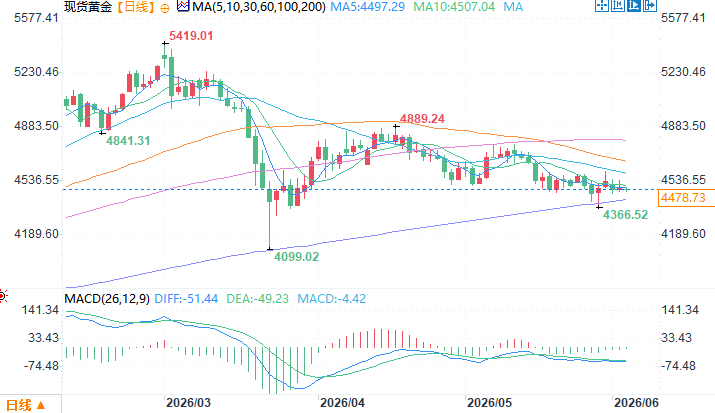
Spot gold daily chart source: EasyForex
At 10:37 AM Beijing time on June 3, spot gold was trading at $4480.03 per ounce.
In his latest research report released on Monday (June 1), Ole Hansen, head of commodity strategy at Saxo Bank, analyzed that the current decline in gold prices is a short-term structural adjustment. The four core supports—global debt risk, the de-dollarization process, persistent inflation, and continued gold purchases by central banks around the world—remain unchanged. The overall bull market for gold is still solid, and the short-term weakness will not change the medium- to long-term upward trend.
Geopolitical and energy shocks trigger short-term correction in gold prices
Data shows that gold prices fell for the third consecutive month in May, and short-term market sentiment continued to weaken. However, gold's medium- to long-term returns remain impressive, with a year-to-date increase of 5% in 2026, a year-to-date increase of 36%, and a cumulative increase of 91% over two years.
The disruption to shipping in the Strait of Hormuz has caused global oil and gas and refined oil prices to remain high, completely altering the current inflationary environment.
Hansen stated that this round of energy-driven inflation has not triggered the traditional safe-haven demand for gold. Instead, it has fueled market concerns about inflation, leading to higher US Treasury yields and a stronger dollar, while the market has simultaneously lowered its expectations for a Federal Reserve rate cut. For gold, which has zero interest rates, the combined strength of high US Treasury yields and a strong dollar has created significant downward pressure. This, coupled with global stock markets continuing to reach record highs and some central banks slightly reducing their gold holdings to stabilize their currencies and hedge against high energy expenditures, has further exacerbated the short-term downward pressure on gold prices.
The type of inflation determines market trends; short-term negative factors have unique characteristics.
This recent pullback in gold prices confirms the differentiated nature of gold as an inflation hedge. Hansen stated that while gold is considered an inflation hedge, different inflationary environments have drastically different impacts on its price. Inflation caused by traditional financial risks and economic downturns is often accompanied by declining real interest rates and a weakening dollar, which is most conducive to rising gold prices.
The current energy supply shock-driven inflation will simultaneously boost US Treasury yields and the US dollar index, creating a unique situation that is temporarily bearish for gold. Currently, the market is highly focused on the Federal Reserve's interest rate expectations. Rising yields and a cooling probability of rate cuts continue to suppress market sentiment, but this disturbance is only a short-term factor and cannot dominate the long-term pricing logic of gold.
Multiple fundamental factors solidify long-term support for gold.
Central bank gold purchases are the core supporting driver for gold prices. Hansen stated that the short-term gold sales by a few countries are merely tactical maneuvers, not strategic portfolio adjustments. The global trend towards diversification of foreign exchange reserves remains firmly established. The Russia-Ukraine conflict and the geopolitical rivalry between the US and Iran have further strengthened the demand from countries to mitigate sanctions risks and optimize their reserve structures. Global central banks will likely maintain a net purchase of gold for the foreseeable future.
Meanwhile, continued demand from major Asian markets supported gold prices, with investors in those countries increasing their gold holdings to diversify risks associated with real estate and traditional financial assets. The country's central bank increased its gold reserves for the 18th consecutive month in April. According to the Hong Kong Census and Statistics Department, mainland China's total gold imports via Hong Kong reached 99.327 tons that month, with net imports of 86.715 tons, representing an 81.2% increase month-on-month.
In addition, the continued expansion of fiscal deficits and debt in major global economies, along with substantial investments in areas such as electrification, artificial intelligence, and energy security, are driving up long-term inflation expectations, which is beneficial for hard assets like gold.
The technical indicators show clear signs of stabilization, and the outlook for the market is optimistic.
From a technical perspective, gold prices have repeatedly found strong support at the 200-day moving average of $4,400 per ounce. During this round of correction, the price tested this level twice, attracting long-term funds to enter the market and take over, demonstrating the firm intention of long-term funds to position themselves.
Most investors are currently waiting for the situation in the Middle East to become clearer before adding to their positions. Once the geopolitical disturbances subside, the market will return to fundamental pricing.
Summarize
Overall, the recent three-day decline in gold prices is a short-term technical adjustment driven by geopolitical and energy shocks, not a trend reversal. Given the shift in geopolitical safe-haven dynamics and short-term interest rate pressures, gold's short-term outlook is weak.
With the continued positive effects of four core factors—de-dollarization, central bank gold purchases, high debt, and persistent inflation—the foundation for a gold bull market is solid in the medium to long term, and there is still ample room for further upward movement.
Spot gold daily chart source: EasyForex
At 10:37 AM Beijing time on June 3, spot gold was trading at $4480.03 per ounce.
- Risk Warning and Disclaimer
- The market involves risk, and trading may not be suitable for all investors. This article is for reference only and does not constitute personal investment advice, nor does it take into account certain users’ specific investment objectives, financial situation, or other needs. Any investment decisions made based on this information are at your own risk.