The US-Iran conflict boosted the safe-haven dollar, while the yen approached the intervention "red line," with the 160 level within reach.
2026-06-03 10:46:58
On Wednesday (June 3), the US dollar rose to near the closely watched 160 level against the Japanese yen in early Asian trading, after Japanese authorities intervened near that level. This erased all the gains made a month ago when Tokyo intervened in the currency market with 11.7 trillion yen (approximately US$73.14 billion) to support the yen. The US dollar is currently trading around 159.85 against the yen.
As the dollar hovers around the 160 level against the yen, renewed escalation in Middle East geopolitical tensions has provided additional safe-haven support for the dollar.
According to Iranian media reports, the Iranian Revolutionary Guard issued a statement on Tuesday saying that in response to the US attack on Iran's Qeshm Island, it had carried out a "precise and concentrated missile strike" on a US military base in Kuwait.
The U.S. Central Command stated that Iran launched ballistic missiles at neighboring countries, none of which hit their targets; the U.S. military subsequently launched a strike on Qeshm Island in response to Tehran's attempted attack.
The latest round of military strikes comes as diplomatic negotiations between the US and Iran remain deeply stalled. Previously, the two sides had held multiple rounds of indirect talks on issues such as passage through the Strait of Hormuz, nuclear programs, and the situation in Lebanon, but failed to achieve any substantial breakthroughs. Iran insists on a complete lifting of US sanctions and a commitment not to seek regime change, while the US demands concrete concessions from Iran on its nuclear activities and regional influence. Against the backdrop of renewed military conflict, the likelihood of resuming diplomatic contact in the short term has further decreased, and market concerns about disruptions to Middle Eastern supply chains have intensified.

The escalating tensions in the Middle East have not only directly driven up oil prices and risk aversion, but have also put additional pressure on currencies such as the Japanese yen that rely on oil imports through the transmission of global energy prices.
Commerzbank analysts emphasize that the short-term macroeconomic environment is extremely unfavorable for the yen. High oil prices have not improved market expectations for the Bank of Japan's policy as much as they have for interest rate hikes by the Federal Reserve or the European Central Bank; instead, they have further widened the interest rate gap between the US and Japan, putting the yen at a disadvantage. The bank believes that as long as geopolitical uncertainty in the Middle East persists, fossil fuel prices are likely to remain high, which will continue to drag down Japan's trade balance and put pressure on the yen.
BNP Paribas points out that the Japanese economy is cooling down due to persistent energy headwinds. The energy shock will negatively impact Japan's economic momentum, and the yen is expected to stabilize near its historically weak level against the dollar, around the 160 mark.
Marito Ueda, CEO of SBI FX Trade, stated that the US dollar is likely to break through the 160 yen level, at which point the Japanese Ministry of Finance will have to intervene again. He also pointed out that the Ministry of Finance may combine interest rate hikes or other monetary tightening measures to enhance the effectiveness of the intervention in response to the excessive depreciation of the yen.
Hirofumi Suzuki, chief currency strategist at Sumitomo Mitsui Banking Corporation, analyzed that the Ministry of Finance of Japan used approximately 11.7 trillion yen to support the yen in late April and early May, with the trigger point being near the 160 level. If the USD/JPY pair clearly breaks through 160 and holds above that level in the next few trading days, market expectations for the Bank of Japan to intervene again will quickly rise, thereby curbing speculative short-selling of the yen to some extent.
The impact of high oil prices is not limited to the yen. Eurozone inflation data released on Tuesday further confirms this.
Data released on Tuesday showed that eurozone inflation climbed further in May, driven by rising energy and service prices, reinforcing the case for a modest interest rate hike by the European Central Bank later this month. Core inflation also accelerated, indicating that price pressures have spread from the energy sector to the broader services sector, leaving the ECB's "last mile" of inflation control a challenging task.
Meanwhile, the protracted conflict in the Middle East, coupled with persistently high energy prices, has prompted investors to increase their bets on tightening policies by major central banks this year, a clear reversal of the market's pre-conflict expectation of interest rate cuts.
From the Federal Reserve to the European Central Bank, from the Bank of England to the Reserve Bank of Australia, markets are repricing – high oil prices are forcing central banks to maintain or even strengthen their hawkish stances through inflation expectations and wage transmission. With the risk of a Strait of Hormuz blockade still present, a "higher and longer" interest rate environment is becoming the new market consensus.
Data released Tuesday showed that U.S. job openings surged in April, the largest increase in two years, but this surge may have exaggerated the health of the labor market. Therefore, Friday's nonfarm payroll report will provide more crucial confirmation.
“This unexpectedly large increase eliminates one of the key arguments supporting a recent rate cut. The Fed will likely see this as confirmation that labor demand remains too strong to justify further easing,” noted James Okafor, a macro analyst at Edgen. He further pointed out that the April JOLTS job openings data was a report that “completely shocked the market.” Before the data release, some investors still harbored the illusion that the labor market was cooling in an orderly manner, believing that the Fed might have room to cut rates later this year. However, the 7.618 million job openings not only far exceeded the market expectation of 6.87 million but also marked the largest increase in five years, fundamentally shaking the fundamental support for rate cut expectations.
Okafor believes the Fed's core concern has shifted from whether inflation will fall back to whether the labor market will overheat again. As long as job openings remain above 7 million, wage growth is unlikely to slow significantly, and the stickiness of service inflation will continue. From this perspective, the JOLTS data provides the most direct evidence that the Fed is maintaining a tight stance—interest rate cuts are not currently under discussion, and even the possibility of further rate hikes in the future cannot be ruled out.
The prospect described by Okafor, where the Federal Reserve "does not cut interest rates and may even raise them," means that the US dollar will remain strong for some time. This is undoubtedly the most unfavorable external environment for the yen, which is struggling to hold above the 160 level. Japanese Finance Minister Satsuki Katayama stated on Wednesday that the authorities are prepared to take appropriate action in the foreign exchange market. She emphasized that the Japanese government is closely monitoring exchange rate movements with a "high sense of urgency," especially the recent rapid and unilateral depreciation of the yen.
Katayama pointed out that exchange rate stability is crucial to economic and financial stability, and excessive volatility and disorderly trends are unacceptable to the authorities. She stated, "We will continue to monitor the market and take appropriate measures as necessary to prevent excessive volatility caused by speculative behavior." This statement echoes previous interventionist remarks by several Ministry of Finance officials, aiming to send a clear warning signal to the market.
It is noteworthy that Katayama did not explicitly define a specific exchange rate level as a "defense line," but his remarks coincided with the USD/JPY exchange rate approaching the 160 mark again. The market generally interprets this as: once the exchange rate clearly breaks through 160 and continues to rise, the Ministry of Finance will again intervene by buying yen. Previously, Japanese authorities had already intervened in the foreign exchange market with approximately 11.7 trillion yen (about US$73.14 billion) between late April and early May to support the yen's exchange rate.
Analysts believe that while Katayama's statement was strongly worded, given the macroeconomic backdrop of the US-Iran conflict driving up oil prices and the widening US-Japan interest rate differential, verbal intervention alone is unlikely to reverse the yen's weakness. If the pressure on the yen to depreciate continues to intensify, the Ministry of Finance may be forced to take more substantial actions, and the possibility of coordinated intervention with the Bank of Japan cannot be ruled out.
The USD/JPY pair is currently trading around 159.85, having stabilized above all short-, medium-, and long-term moving averages, which are in a bullish alignment, indicating a solid medium-term uptrend. After a slight pullback following a previous high of 160.47, the pair quickly rebounded after testing a low of 155.02 in May, and is now approaching its previous high again, with 160 serving as a key short-term resistance level. Supported by expectations of a Fed rate hike and the divergence in US-Japan monetary policies, the pair is expected to trade with a slightly bullish bias in the short term. A slight pullback to the previous high may occur, but as long as the short-term moving averages hold, the bullish trend remains intact.
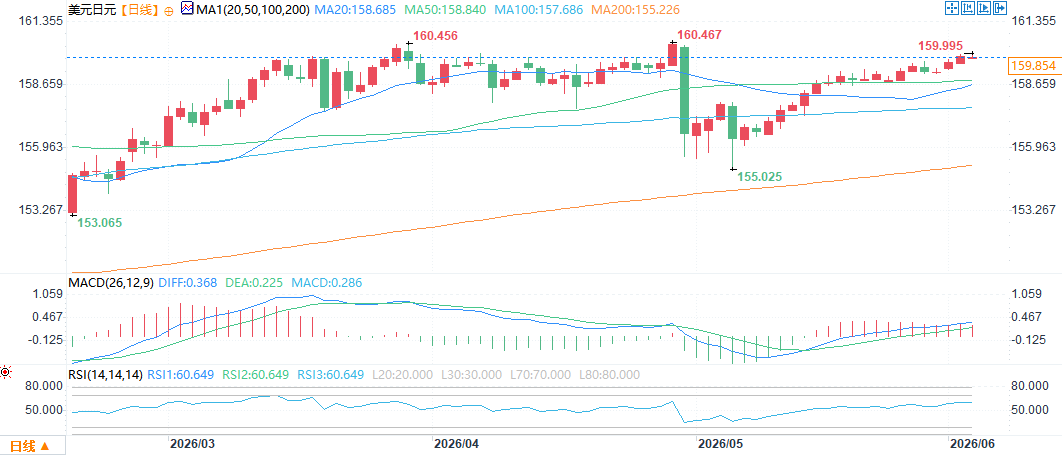
(USD/JPY daily chart, source: FX678)
At 10:46 AM Beijing time on June 3, the USD/JPY exchange rate was 159.86/87.
Geopolitical Context: Escalating US-Iran Military Conflict and Stalled Diplomatic Negotiations
As the dollar hovers around the 160 level against the yen, renewed escalation in Middle East geopolitical tensions has provided additional safe-haven support for the dollar.
According to Iranian media reports, the Iranian Revolutionary Guard issued a statement on Tuesday saying that in response to the US attack on Iran's Qeshm Island, it had carried out a "precise and concentrated missile strike" on a US military base in Kuwait.
The U.S. Central Command stated that Iran launched ballistic missiles at neighboring countries, none of which hit their targets; the U.S. military subsequently launched a strike on Qeshm Island in response to Tehran's attempted attack.
The latest round of military strikes comes as diplomatic negotiations between the US and Iran remain deeply stalled. Previously, the two sides had held multiple rounds of indirect talks on issues such as passage through the Strait of Hormuz, nuclear programs, and the situation in Lebanon, but failed to achieve any substantial breakthroughs. Iran insists on a complete lifting of US sanctions and a commitment not to seek regime change, while the US demands concrete concessions from Iran on its nuclear activities and regional influence. Against the backdrop of renewed military conflict, the likelihood of resuming diplomatic contact in the short term has further decreased, and market concerns about disruptions to Middle Eastern supply chains have intensified.
Oil price transmission: Increased upward pressure on crude oil intensifies selling pressure on the yen.
The escalating tensions in the Middle East have not only directly driven up oil prices and risk aversion, but have also put additional pressure on currencies such as the Japanese yen that rely on oil imports through the transmission of global energy prices.
Commerzbank analysts emphasize that the short-term macroeconomic environment is extremely unfavorable for the yen. High oil prices have not improved market expectations for the Bank of Japan's policy as much as they have for interest rate hikes by the Federal Reserve or the European Central Bank; instead, they have further widened the interest rate gap between the US and Japan, putting the yen at a disadvantage. The bank believes that as long as geopolitical uncertainty in the Middle East persists, fossil fuel prices are likely to remain high, which will continue to drag down Japan's trade balance and put pressure on the yen.
BNP Paribas points out that the Japanese economy is cooling down due to persistent energy headwinds. The energy shock will negatively impact Japan's economic momentum, and the yen is expected to stabilize near its historically weak level against the dollar, around the 160 mark.
Marito Ueda, CEO of SBI FX Trade, stated that the US dollar is likely to break through the 160 yen level, at which point the Japanese Ministry of Finance will have to intervene again. He also pointed out that the Ministry of Finance may combine interest rate hikes or other monetary tightening measures to enhance the effectiveness of the intervention in response to the excessive depreciation of the yen.
Hirofumi Suzuki, chief currency strategist at Sumitomo Mitsui Banking Corporation, analyzed that the Ministry of Finance of Japan used approximately 11.7 trillion yen to support the yen in late April and early May, with the trigger point being near the 160 level. If the USD/JPY pair clearly breaks through 160 and holds above that level in the next few trading days, market expectations for the Bank of Japan to intervene again will quickly rise, thereby curbing speculative short-selling of the yen to some extent.
Macroeconomic Background: Rising inflation and expectations of interest rate hikes are reshaping the market landscape.
The impact of high oil prices is not limited to the yen. Eurozone inflation data released on Tuesday further confirms this.
Data released on Tuesday showed that eurozone inflation climbed further in May, driven by rising energy and service prices, reinforcing the case for a modest interest rate hike by the European Central Bank later this month. Core inflation also accelerated, indicating that price pressures have spread from the energy sector to the broader services sector, leaving the ECB's "last mile" of inflation control a challenging task.
Meanwhile, the protracted conflict in the Middle East, coupled with persistently high energy prices, has prompted investors to increase their bets on tightening policies by major central banks this year, a clear reversal of the market's pre-conflict expectation of interest rate cuts.
From the Federal Reserve to the European Central Bank, from the Bank of England to the Reserve Bank of Australia, markets are repricing – high oil prices are forcing central banks to maintain or even strengthen their hawkish stances through inflation expectations and wage transmission. With the risk of a Strait of Hormuz blockade still present, a "higher and longer" interest rate environment is becoming the new market consensus.
Expectations of a Fed rate hike are rising.
Data released Tuesday showed that U.S. job openings surged in April, the largest increase in two years, but this surge may have exaggerated the health of the labor market. Therefore, Friday's nonfarm payroll report will provide more crucial confirmation.
“This unexpectedly large increase eliminates one of the key arguments supporting a recent rate cut. The Fed will likely see this as confirmation that labor demand remains too strong to justify further easing,” noted James Okafor, a macro analyst at Edgen. He further pointed out that the April JOLTS job openings data was a report that “completely shocked the market.” Before the data release, some investors still harbored the illusion that the labor market was cooling in an orderly manner, believing that the Fed might have room to cut rates later this year. However, the 7.618 million job openings not only far exceeded the market expectation of 6.87 million but also marked the largest increase in five years, fundamentally shaking the fundamental support for rate cut expectations.
Okafor believes the Fed's core concern has shifted from whether inflation will fall back to whether the labor market will overheat again. As long as job openings remain above 7 million, wage growth is unlikely to slow significantly, and the stickiness of service inflation will continue. From this perspective, the JOLTS data provides the most direct evidence that the Fed is maintaining a tight stance—interest rate cuts are not currently under discussion, and even the possibility of further rate hikes in the future cannot be ruled out.
Official statement: Japanese Finance Minister hints at possible further intervention
The prospect described by Okafor, where the Federal Reserve "does not cut interest rates and may even raise them," means that the US dollar will remain strong for some time. This is undoubtedly the most unfavorable external environment for the yen, which is struggling to hold above the 160 level. Japanese Finance Minister Satsuki Katayama stated on Wednesday that the authorities are prepared to take appropriate action in the foreign exchange market. She emphasized that the Japanese government is closely monitoring exchange rate movements with a "high sense of urgency," especially the recent rapid and unilateral depreciation of the yen.
Katayama pointed out that exchange rate stability is crucial to economic and financial stability, and excessive volatility and disorderly trends are unacceptable to the authorities. She stated, "We will continue to monitor the market and take appropriate measures as necessary to prevent excessive volatility caused by speculative behavior." This statement echoes previous interventionist remarks by several Ministry of Finance officials, aiming to send a clear warning signal to the market.
It is noteworthy that Katayama did not explicitly define a specific exchange rate level as a "defense line," but his remarks coincided with the USD/JPY exchange rate approaching the 160 mark again. The market generally interprets this as: once the exchange rate clearly breaks through 160 and continues to rise, the Ministry of Finance will again intervene by buying yen. Previously, Japanese authorities had already intervened in the foreign exchange market with approximately 11.7 trillion yen (about US$73.14 billion) between late April and early May to support the yen's exchange rate.
Analysts believe that while Katayama's statement was strongly worded, given the macroeconomic backdrop of the US-Iran conflict driving up oil prices and the widening US-Japan interest rate differential, verbal intervention alone is unlikely to reverse the yen's weakness. If the pressure on the yen to depreciate continues to intensify, the Ministry of Finance may be forced to take more substantial actions, and the possibility of coordinated intervention with the Bank of Japan cannot be ruled out.
The USD/JPY pair is currently trading around 159.85, having stabilized above all short-, medium-, and long-term moving averages, which are in a bullish alignment, indicating a solid medium-term uptrend. After a slight pullback following a previous high of 160.47, the pair quickly rebounded after testing a low of 155.02 in May, and is now approaching its previous high again, with 160 serving as a key short-term resistance level. Supported by expectations of a Fed rate hike and the divergence in US-Japan monetary policies, the pair is expected to trade with a slightly bullish bias in the short term. A slight pullback to the previous high may occur, but as long as the short-term moving averages hold, the bullish trend remains intact.
(USD/JPY daily chart, source: FX678)
At 10:46 AM Beijing time on June 3, the USD/JPY exchange rate was 159.86/87.
- Risk Warning and Disclaimer
- The market involves risk, and trading may not be suitable for all investors. This article is for reference only and does not constitute personal investment advice, nor does it take into account certain users’ specific investment objectives, financial situation, or other needs. Any investment decisions made based on this information are at your own risk.