USD/JPY hits 160 mark! Important speech by the Bank of Japan governor is imminent, June could be a window for interest rate hikes.
2026-06-03 13:16:58
As geopolitical conflicts drive up international fuel prices, Japan's imported inflation continues to spread, putting pressure on the yen exchange rate and pushing it to the key level of 160 yen to the dollar.
At 4:30 PM Beijing time on Wednesday (June 3), Bank of Japan Governor Kazuo Ueda will deliver a crucial speech, which is seen by the market as an important indicator of a potential June interest rate hike. Currently, the camp within the Bank of Japan advocating for a rate hike is growing, and the attitudes of the US and the Japanese cabinet are shifting towards a more accommodative approach to rate increases. However, geopolitical uncertainties present a dilemma for Ueda in conveying policy signals; either hawkish or dovish rhetoric will directly impact the yen and Japanese bond market.
The current conflict with Iran has driven up global refined oil prices, further exacerbating Japan's imported inflation. Japan's fragile domestic economic environment faces continued upward pressure on prices.
The yen touched the important psychological level of 160 during Wednesday's trading session. The market generally expects the Bank of Japan to raise the benchmark interest rate from 0.75% to 1% at its policy meeting on June 15-16. Kazuo Ueda's speech became the core basis for verifying this expectation.
From an internal policy perspective, the central bank's nine-member policy committee has shown a continued upward bias towards interest rate hikes. The decision to maintain interest rates in April was opposed by three members, and two more subsequently warned of inflation risks in public speeches. In April, Japan's wholesale price index hit a three-year high, with companies rapidly passing on raw material costs to downstream customers. This chain reaction of price increases is forcing monetary policy to return to normalcy more quickly.
On the external front, U.S. Treasury Secretary Scott Bessent previously signaled that the U.S. expects the Bank of Japan to proceed with its interest rate hike process, believing that, under the premise of independent decision-making, Kazuo Ueda will make reasonable adjustments based on fundamentals.
The political landscape in Japan has also shifted. Prime Minister Sanae Takaichi, who previously held a dovish stance and opposed rapid interest rate hikes, has recently stopped publicly opposing austerity measures. Finance Minister Satsuki Katayama stated in an interview on Wednesday that he had in-depth discussions with Kazuo Ueda during the G7 summit, and the two leaders reached a consensus on several economic issues, significantly weakening cabinet-level resistance to a June interest rate hike.
Geopolitical uncertainty has become the core obstacle preventing the central bank from making a clear statement. Sudden changes in the conflict situation could alter Japan's inflation trend at any time. If an interest rate hike is decided too early, subsequent reversals in the environment will put the central bank in a passive position.
Mari Iwashita, chief interest rate strategist at Nomura Securities, said that the minutes of the April policy meeting showed that some members were already unhappy with the central bank's direct disclosure of policy direction. Therefore, it is highly unlikely that Kazuo Ueda will directly mention a June rate hike. He added that as long as the governor signals an intention for gradual rate hikes, the market will still bet on a June rate hike; conversely, if the speech is entirely dovish and shows no intention to tighten interest rates, the central bank will need to explain in detail the underlying logic of postponing the rate hike.
Overall, high inflation, a sharp depreciation of the yen, and changes in domestic and international policy attitudes provide strong support for a June rate hike, while geopolitical risks are the only uncertain factor.
Kazuo Ueda's speech will balance the pros and cons of various parties. The mainstream market expectation is that the speech will be moderately hawkish . Subsequent changes in wording will directly affect the yen exchange rate and the direction of the domestic bond market.
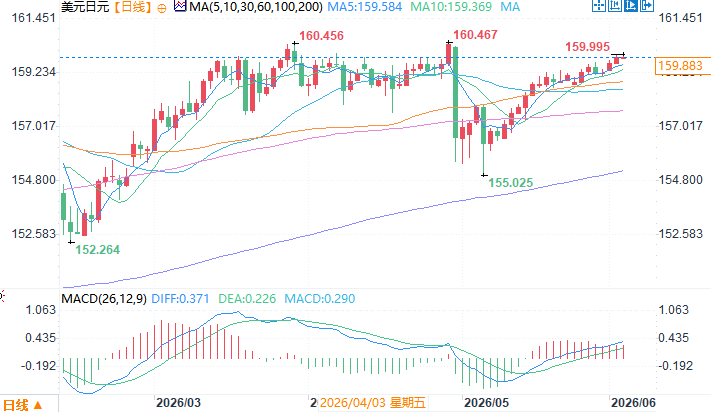
USD/JPY Daily Chart Source: EasyForex
At 13:15 Beijing time on June 3, the USD/JPY exchange rate was 159.88/89.
At 4:30 PM Beijing time on Wednesday (June 3), Bank of Japan Governor Kazuo Ueda will deliver a crucial speech, which is seen by the market as an important indicator of a potential June interest rate hike. Currently, the camp within the Bank of Japan advocating for a rate hike is growing, and the attitudes of the US and the Japanese cabinet are shifting towards a more accommodative approach to rate increases. However, geopolitical uncertainties present a dilemma for Ueda in conveying policy signals; either hawkish or dovish rhetoric will directly impact the yen and Japanese bond market.
A crisis in the foreign exchange market coupled with rising inflation is forcing the central bank to accelerate policy tightening.
The current conflict with Iran has driven up global refined oil prices, further exacerbating Japan's imported inflation. Japan's fragile domestic economic environment faces continued upward pressure on prices.
The yen touched the important psychological level of 160 during Wednesday's trading session. The market generally expects the Bank of Japan to raise the benchmark interest rate from 0.75% to 1% at its policy meeting on June 15-16. Kazuo Ueda's speech became the core basis for verifying this expectation.
From an internal policy perspective, the central bank's nine-member policy committee has shown a continued upward bias towards interest rate hikes. The decision to maintain interest rates in April was opposed by three members, and two more subsequently warned of inflation risks in public speeches. In April, Japan's wholesale price index hit a three-year high, with companies rapidly passing on raw material costs to downstream customers. This chain reaction of price increases is forcing monetary policy to return to normalcy more quickly.
Changes in the domestic and international policy environment have led to multiple parties tacitly approving the interest rate hike.
On the external front, U.S. Treasury Secretary Scott Bessent previously signaled that the U.S. expects the Bank of Japan to proceed with its interest rate hike process, believing that, under the premise of independent decision-making, Kazuo Ueda will make reasonable adjustments based on fundamentals.
The political landscape in Japan has also shifted. Prime Minister Sanae Takaichi, who previously held a dovish stance and opposed rapid interest rate hikes, has recently stopped publicly opposing austerity measures. Finance Minister Satsuki Katayama stated in an interview on Wednesday that he had in-depth discussions with Kazuo Ueda during the G7 summit, and the two leaders reached a consensus on several economic issues, significantly weakening cabinet-level resistance to a June interest rate hike.
Policy statements reflect a delicate balance; the wording of the governor's speech contains hidden meanings.
Geopolitical uncertainty has become the core obstacle preventing the central bank from making a clear statement. Sudden changes in the conflict situation could alter Japan's inflation trend at any time. If an interest rate hike is decided too early, subsequent reversals in the environment will put the central bank in a passive position.
Mari Iwashita, chief interest rate strategist at Nomura Securities, said that the minutes of the April policy meeting showed that some members were already unhappy with the central bank's direct disclosure of policy direction. Therefore, it is highly unlikely that Kazuo Ueda will directly mention a June rate hike. He added that as long as the governor signals an intention for gradual rate hikes, the market will still bet on a June rate hike; conversely, if the speech is entirely dovish and shows no intention to tighten interest rates, the central bank will need to explain in detail the underlying logic of postponing the rate hike.
Summarize
Overall, high inflation, a sharp depreciation of the yen, and changes in domestic and international policy attitudes provide strong support for a June rate hike, while geopolitical risks are the only uncertain factor.
Kazuo Ueda's speech will balance the pros and cons of various parties. The mainstream market expectation is that the speech will be moderately hawkish . Subsequent changes in wording will directly affect the yen exchange rate and the direction of the domestic bond market.
USD/JPY Daily Chart Source: EasyForex
At 13:15 Beijing time on June 3, the USD/JPY exchange rate was 159.88/89.
- Risk Warning and Disclaimer
- The market involves risk, and trading may not be suitable for all investors. This article is for reference only and does not constitute personal investment advice, nor does it take into account certain users’ specific investment objectives, financial situation, or other needs. Any investment decisions made based on this information are at your own risk.