Economic slowdown vs. strong iron ore prices – where is the Australian dollar headed?
2026-06-03 15:02:22
On Wednesday (June 3) during Asian trading hours, the Australian dollar encountered renewed selling pressure against the US dollar, reversing most of the previous trading day's gains and currently trading around 0.7150. Weaker-than-expected Australian first-quarter GDP data, coupled with geopolitical risks and expectations of a Federal Reserve rate hike, supported the US dollar, putting pressure on the Australian dollar.

Australia's first-quarter GDP growth was only half of what was expected (0.3% vs 0.5%), coupled with April inflation falling to 4.2% (lower than the previous value of 4.6%) and the unemployment rate rising to a four-and-a-half-year high, significantly cooling market expectations for a June rate hike by the Reserve Bank of Australia.
Bank of America economists noted, "The data confirms that the economy is losing momentum faster than the Reserve Bank of Australia anticipated, with the household sector remaining the weakest link."
However, the Reserve Bank of Australia has already implemented its third interest rate hike this year to 4.35% in May, and the market is currently pricing in further rate hikes at a low level. If the economy continues to slow down, the tightening cycle may be nearing its end.
Despite weak domestic economic data, the Australian dollar continues to receive multiple supports from the commodities sector.
Iron ore prices remain high, supported by strong cost factors. As of the end of May, the price of 62% iron ore futures on the Singapore Exchange was US$105.3 per tonne, while the price of imported iron ore in China (Fe:62%, CFR) was US$107.8 per tonne. One reason for the sustained high iron ore prices is the exceptionally high freight costs—currently accounting for nearly 15% of the iron ore price, the highest proportion in nearly five years, providing strong cost support for iron ore prices.
In addition, the share prices of major Australian miners are near record highs, and copper prices are also performing strongly. The overall strength of the commodities channel has effectively offset the negative impact of weak domestic data.
The Reserve Bank of Australia's commodity price index surged 16.8% year-on-year. Latest data shows that the RBA's commodity price index, measured in SDRs, rose 1.3% month-on-month in May and a significant 16.8% year-on-year, maintaining its peak level since December 2022.
It is noteworthy that the driving forces behind this round of price increases have undergone a structural change—strong growth in lithium, coking coal, and agricultural product prices has completely offset the decline in iron ore and gold prices. This structural price increase indicates that Australia's commodity export basket is becoming more diversified, with a reduced reliance on the price fluctuations of a single commodity, such as iron ore.
The Middle East conflict has a distinct "double-edged sword" effect on the Australian economy. On the positive side, as a major exporter of liquefied natural gas and coal, Australia has benefited from improved terms of trade due to the surge in global energy prices caused by the conflict, and the strength of commodity prices has provided a short-term buffer for the Australian dollar.
However, this benefit has clear boundaries – Australia is also a net importer of oil, with only two aging refineries remaining domestically, producing less than a quarter of its fuel needs. This means that the benefits of energy premiums may be offset by rising domestic inflationary pressures.
On the negative side, the conflict is accelerating the drag on the Australian economy through multiple channels. Soaring energy costs are directly pushing up petrol and diesel prices, and Westpac Bank predicts that Australia's overall CPI will peak at 4.6% in the second quarter of 2026; the S&P Global Australia Composite PMI fell to 48.7 in May, returning to contraction territory.
The agricultural sector is also under pressure. Australia typically imports more than half of its nitrogen fertilizer from the Middle East, and the disruption to shipping through the Strait of Hormuz has directly cut off this critical supply line. Coupled with the ongoing drought in the east, wheat production is expected to decrease by about a quarter in 2026-27.
Analysts generally point out that the first quarter GDP growth of only 0.3% was released too early to fully capture the substantial spillover effects of the conflict. Considering that it takes 20-30 days for an oil tanker to travel from the Persian Gulf to an Asian refinery, and an additional 10-20 days for refined fuel to reach Australia, there is a significant time lag in the full impact of the conflict on the real economy.
Modeling by Oxford Economics suggests that if the conflict drags on, the Australian economy will contract in both the second and third quarters of 2026, entering a technical recession. This means that the negative growth effects of the Middle East conflict on the Australian economy are more likely to become apparent in the data from the second quarter onwards.
The Australian dollar is in a state of equilibrium against the US dollar, consolidating within a short-term range around the moving averages. Currently, the exchange rate is trading around 0.7150, holding above the 50-day moving average (MA50) (0.7117) but facing resistance at the 20-day moving average (MA20) (0.7179). The previous high of 0.7277 forms a key resistance level, while the previous low of 0.7079 and the 100-day moving average (MA100) (0.7061) provide stepped support. The MACD indicator is close to the zero line, with the DIFF and DEA lines intertwined, indicating weak bullish and bearish momentum. The RSI is at 49.52, near the 50 level, offering no clear directional guidance. While the medium-term moving averages remain upward, indicating a bullish overall trend, short-term upward momentum is weak, and the pair is expected to fluctuate within the 0.7079-0.7277 range, awaiting a breakout.
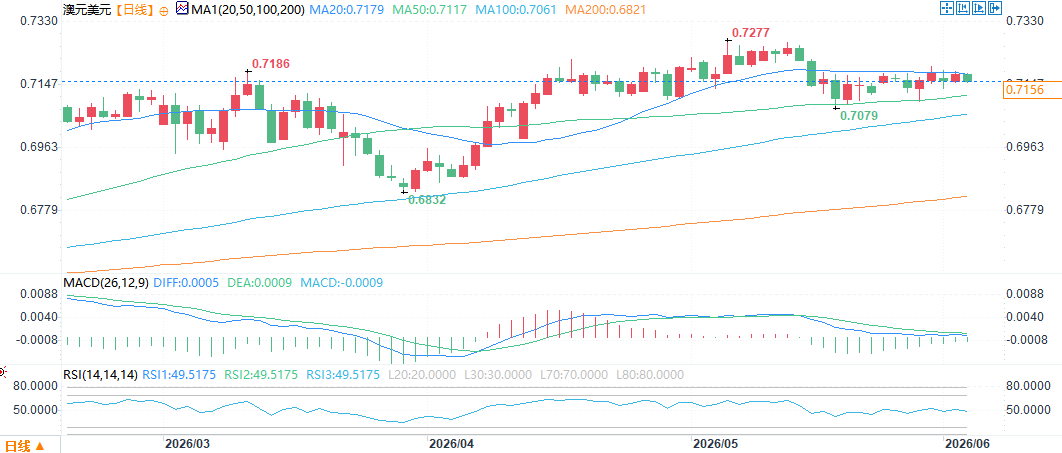
(AUD/USD daily chart, source: FX678)
At 15:02 Beijing time on June 3, the Australian dollar was trading at 0.7157/58 against the US dollar.
Fundamentals: Sharp GDP slowdown weighs on the Australian dollar.
Australia's first-quarter GDP growth was only half of what was expected (0.3% vs 0.5%), coupled with April inflation falling to 4.2% (lower than the previous value of 4.6%) and the unemployment rate rising to a four-and-a-half-year high, significantly cooling market expectations for a June rate hike by the Reserve Bank of Australia.
Bank of America economists noted, "The data confirms that the economy is losing momentum faster than the Reserve Bank of Australia anticipated, with the household sector remaining the weakest link."
However, the Reserve Bank of Australia has already implemented its third interest rate hike this year to 4.35% in May, and the market is currently pricing in further rate hikes at a low level. If the economy continues to slow down, the tightening cycle may be nearing its end.
Commodities provide hedging support
Despite weak domestic economic data, the Australian dollar continues to receive multiple supports from the commodities sector.
Iron ore prices remain high, supported by strong cost factors. As of the end of May, the price of 62% iron ore futures on the Singapore Exchange was US$105.3 per tonne, while the price of imported iron ore in China (Fe:62%, CFR) was US$107.8 per tonne. One reason for the sustained high iron ore prices is the exceptionally high freight costs—currently accounting for nearly 15% of the iron ore price, the highest proportion in nearly five years, providing strong cost support for iron ore prices.
In addition, the share prices of major Australian miners are near record highs, and copper prices are also performing strongly. The overall strength of the commodities channel has effectively offset the negative impact of weak domestic data.
The Reserve Bank of Australia's commodity price index surged 16.8% year-on-year. Latest data shows that the RBA's commodity price index, measured in SDRs, rose 1.3% month-on-month in May and a significant 16.8% year-on-year, maintaining its peak level since December 2022.
It is noteworthy that the driving forces behind this round of price increases have undergone a structural change—strong growth in lithium, coking coal, and agricultural product prices has completely offset the decline in iron ore and gold prices. This structural price increase indicates that Australia's commodity export basket is becoming more diversified, with a reduced reliance on the price fluctuations of a single commodity, such as iron ore.
Geopolitical conflicts bring dual impacts
The Middle East conflict has a distinct "double-edged sword" effect on the Australian economy. On the positive side, as a major exporter of liquefied natural gas and coal, Australia has benefited from improved terms of trade due to the surge in global energy prices caused by the conflict, and the strength of commodity prices has provided a short-term buffer for the Australian dollar.
However, this benefit has clear boundaries – Australia is also a net importer of oil, with only two aging refineries remaining domestically, producing less than a quarter of its fuel needs. This means that the benefits of energy premiums may be offset by rising domestic inflationary pressures.
On the negative side, the conflict is accelerating the drag on the Australian economy through multiple channels. Soaring energy costs are directly pushing up petrol and diesel prices, and Westpac Bank predicts that Australia's overall CPI will peak at 4.6% in the second quarter of 2026; the S&P Global Australia Composite PMI fell to 48.7 in May, returning to contraction territory.
The agricultural sector is also under pressure. Australia typically imports more than half of its nitrogen fertilizer from the Middle East, and the disruption to shipping through the Strait of Hormuz has directly cut off this critical supply line. Coupled with the ongoing drought in the east, wheat production is expected to decrease by about a quarter in 2026-27.
Analysts generally point out that the first quarter GDP growth of only 0.3% was released too early to fully capture the substantial spillover effects of the conflict. Considering that it takes 20-30 days for an oil tanker to travel from the Persian Gulf to an Asian refinery, and an additional 10-20 days for refined fuel to reach Australia, there is a significant time lag in the full impact of the conflict on the real economy.
Modeling by Oxford Economics suggests that if the conflict drags on, the Australian economy will contract in both the second and third quarters of 2026, entering a technical recession. This means that the negative growth effects of the Middle East conflict on the Australian economy are more likely to become apparent in the data from the second quarter onwards.
Australian Dollar to US Dollar Daily Technical Analysis
The Australian dollar is in a state of equilibrium against the US dollar, consolidating within a short-term range around the moving averages. Currently, the exchange rate is trading around 0.7150, holding above the 50-day moving average (MA50) (0.7117) but facing resistance at the 20-day moving average (MA20) (0.7179). The previous high of 0.7277 forms a key resistance level, while the previous low of 0.7079 and the 100-day moving average (MA100) (0.7061) provide stepped support. The MACD indicator is close to the zero line, with the DIFF and DEA lines intertwined, indicating weak bullish and bearish momentum. The RSI is at 49.52, near the 50 level, offering no clear directional guidance. While the medium-term moving averages remain upward, indicating a bullish overall trend, short-term upward momentum is weak, and the pair is expected to fluctuate within the 0.7079-0.7277 range, awaiting a breakout.
(AUD/USD daily chart, source: FX678)
At 15:02 Beijing time on June 3, the Australian dollar was trading at 0.7157/58 against the US dollar.
- Risk Warning and Disclaimer
- The market involves risk, and trading may not be suitable for all investors. This article is for reference only and does not constitute personal investment advice, nor does it take into account certain users’ specific investment objectives, financial situation, or other needs. Any investment decisions made based on this information are at your own risk.