Double negative factors besiege silver! Silver is trapped in a "negative correlation" curse, and the bulls surrender before the non-farm payrolls report?
2026-06-03 15:06:41
On Wednesday (June 3), during the European trading session, silver prices fell by more than 1.4% to around $74.00. Escalating tensions between the US and Iran pushed oil prices up for the third consecutive trading day, while the negative correlation between crude oil and precious metals was suppressing silver prices. Furthermore, stronger-than-expected US JOLTS job openings data for April further exacerbated the downward pressure on silver.
On Wednesday, WTI crude oil prices rose more than 2% to around $96.00, reaching their highest level in more than a week. The immediate catalyst for the price increase was the renewed escalation of the military conflict between the US and Iran—Iran launched missiles at Kuwait and Bahrain, while the US military carried out a defensive strike on Qeshm Island, reigniting market concerns about disruptions to Middle Eastern supply chains.
Since the outbreak of the Middle East wars, oil prices and precious metals have shown a clear negative correlation. The underlying logic is that rising energy prices drive up global inflation expectations, forcing traders to reassess the policy paths of major central banks. Specifically regarding the Federal Reserve, the market has gradually ruled out the possibility of an interest rate cut this year, with some institutions even beginning to price in the risk of a rate hike at the end of 2026. This shift in policy expectations directly weakens the attractiveness of non-interest-bearing assets such as silver—the opportunity cost of holding silver increases as real interest rate expectations rise.
Therefore, although geopolitical risks typically favor safe-haven assets, under the current transmission chain of "oil prices → inflation → interest rate hike expectations," silver is actually under pressure due to the relative strength of the US dollar and a hawkish shift in the interest rate outlook. As long as this logic remains intact, the negative correlation between oil prices and silver prices may continue to dominate short-term trends.
Tensions between the US and Iran escalated sharply on Tuesday night following mutual attacks. According to a statement from the Iranian Revolutionary Guard, the US attacked an Iranian oil tanker and conducted an airstrike on a communications station on Qeshm Island. Iran subsequently struck the headquarters of the US Fifth Fleet in Bahrain with missiles and drones. The US Central Command stated that missiles launched by Iran towards Kuwait and Bahrain were intercepted or destroyed, and that the US had conducted a defensive airstrike on Qeshm Island, denying any attack on the Fifth Fleet.
The conflict quickly spread to the Gulf region. Air raid sirens sounded nationwide in Kuwait, alarms blared in Bahrain, and airports in several countries suspended operations.
Escalating geopolitical risks directly pushed up oil prices. The rise in oil prices, in turn, indirectly suppressed silver prices through a transmission chain of "energy shock → inflation expectations → interest rate hike expectations": high oil prices reinforced market expectations that the Federal Reserve would maintain a hawkish stance, increasing the opportunity cost of holding non-interest-bearing assets such as silver, thus putting short-term pressure on silver prices.
Meanwhile, JOLTS job openings in the U.S. surged to 7.618 million in April, far exceeding market expectations of 6.88 million and marking the largest increase in five years. This data indicates that despite the Federal Reserve's continued tightening of monetary policy, labor demand remains strong.
Edgen macro analyst James Okafor noted, "This larger-than-expected magnitude eliminates one of the key arguments supporting the recent rate cut. The Fed will see this as confirmation that labor demand remains too strong to justify further easing." Market bets on a 2026 rate cut have cooled further, with some institutions even beginning to price in the possibility of a rate hike by the end of the year.
For silver, strong labor data implies rising real interest rate expectations, increasing the opportunity cost of holding non-interest-bearing assets. Under the dual pressure of the US-Iran conflict pushing up oil prices and JOLTS data reinforcing tightening expectations, silver faces significant resistance in the short term, and the market is awaiting guidance from Friday's non-farm payroll report.
Looking ahead, investors are focusing on Friday's U.S. May non-farm payrolls report. Following the unexpected surge in April's JOLTS job openings data, market attention to the labor market has reached new heights. The report is expected to show approximately 85,000 new jobs added in May, with the unemployment rate remaining unchanged at 4.3%.
This report is crucial for two reasons. First, it will verify whether the strong signals presented by the JOLTS data are sustainable—if non-farm payrolls also exceed expectations, it will completely dispel any remaining market illusions about a rate cut this year, and may even push rate hike expectations further forward. Second, the non-farm payroll report will directly influence the policy tone of the Federal Reserve's June meeting. With current high oil prices and ongoing geopolitical risks, if the job market continues to show resilience, the Fed will have stronger reasons to maintain or even strengthen its hawkish stance.
For silver, the direction of the non-farm payroll data will determine its short-term price trend. Strong data will likely lead to a rise in the US dollar and US Treasury yields, potentially pushing silver prices further down; weak data, on the other hand, could provide silver with a respite. Regardless of the outcome, Friday's non-farm payroll report will be the next key factor determining market direction.
In summary, silver is currently facing pressure from two sides: first, the rebound in oil prices has pushed up inflation expectations, weakening the likelihood of a Federal Reserve rate cut; second, stronger-than-expected US labor market data has reinforced tightening expectations. Against the backdrop of the ongoing US-Iran conflict, the negative correlation between oil and silver prices may continue to dominate short-term price movements. The market is awaiting Friday's non-farm payroll report to determine the next direction.
Technically, spot silver is currently under short-term pressure and consolidating within a range on the daily chart. Spot silver is currently trading around 74.30, below the 20-day and 50-day moving averages (MA20 and MA50), with short-term resistance at 76.12 and 78.12. Previous lows at 71.77 and the long-term MA200 (67.25) provide stepped support. Previous highs of 96.38 and 89.34 have gradually moved lower, with rebounds encountering resistance and subsequent declines. The MACD is below the zero line, indicating continued bearish momentum, while the RSI has fallen to 45.3, showing weakness but not oversold. With moving averages above suppressing gains and support levels below providing downside potential, the balance between bulls and bears is relatively even. Silver is expected to maintain a short-term range-bound movement between 71.78 and 76.12, with key attention focused on the direction of any breakout from the upper or lower limits of this range.
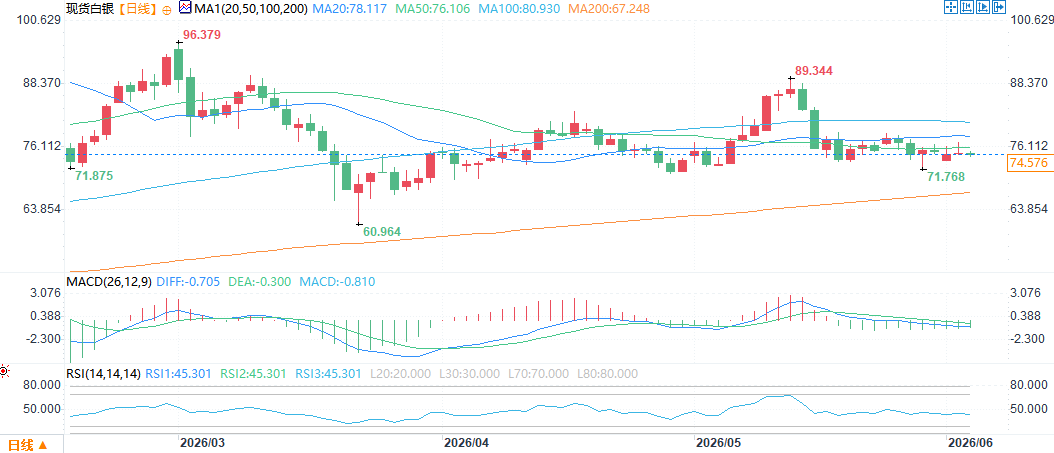
(Spot silver daily chart, source: EasyForex)
At 15:04 Beijing time on June 3, spot silver was trading at $74.30 per ounce.
Oil price rebound puts pressure on silver
On Wednesday, WTI crude oil prices rose more than 2% to around $96.00, reaching their highest level in more than a week. The immediate catalyst for the price increase was the renewed escalation of the military conflict between the US and Iran—Iran launched missiles at Kuwait and Bahrain, while the US military carried out a defensive strike on Qeshm Island, reigniting market concerns about disruptions to Middle Eastern supply chains.
Since the outbreak of the Middle East wars, oil prices and precious metals have shown a clear negative correlation. The underlying logic is that rising energy prices drive up global inflation expectations, forcing traders to reassess the policy paths of major central banks. Specifically regarding the Federal Reserve, the market has gradually ruled out the possibility of an interest rate cut this year, with some institutions even beginning to price in the risk of a rate hike at the end of 2026. This shift in policy expectations directly weakens the attractiveness of non-interest-bearing assets such as silver—the opportunity cost of holding silver increases as real interest rate expectations rise.
Therefore, although geopolitical risks typically favor safe-haven assets, under the current transmission chain of "oil prices → inflation → interest rate hike expectations," silver is actually under pressure due to the relative strength of the US dollar and a hawkish shift in the interest rate outlook. As long as this logic remains intact, the negative correlation between oil prices and silver prices may continue to dominate short-term trends.
The conflict between the US and Iran has escalated again.
Tensions between the US and Iran escalated sharply on Tuesday night following mutual attacks. According to a statement from the Iranian Revolutionary Guard, the US attacked an Iranian oil tanker and conducted an airstrike on a communications station on Qeshm Island. Iran subsequently struck the headquarters of the US Fifth Fleet in Bahrain with missiles and drones. The US Central Command stated that missiles launched by Iran towards Kuwait and Bahrain were intercepted or destroyed, and that the US had conducted a defensive airstrike on Qeshm Island, denying any attack on the Fifth Fleet.
The conflict quickly spread to the Gulf region. Air raid sirens sounded nationwide in Kuwait, alarms blared in Bahrain, and airports in several countries suspended operations.
Escalating geopolitical risks directly pushed up oil prices. The rise in oil prices, in turn, indirectly suppressed silver prices through a transmission chain of "energy shock → inflation expectations → interest rate hike expectations": high oil prices reinforced market expectations that the Federal Reserve would maintain a hawkish stance, increasing the opportunity cost of holding non-interest-bearing assets such as silver, thus putting short-term pressure on silver prices.
US labor force data exceeded expectations.
Meanwhile, JOLTS job openings in the U.S. surged to 7.618 million in April, far exceeding market expectations of 6.88 million and marking the largest increase in five years. This data indicates that despite the Federal Reserve's continued tightening of monetary policy, labor demand remains strong.
Edgen macro analyst James Okafor noted, "This larger-than-expected magnitude eliminates one of the key arguments supporting the recent rate cut. The Fed will see this as confirmation that labor demand remains too strong to justify further easing." Market bets on a 2026 rate cut have cooled further, with some institutions even beginning to price in the possibility of a rate hike by the end of the year.
For silver, strong labor data implies rising real interest rate expectations, increasing the opportunity cost of holding non-interest-bearing assets. Under the dual pressure of the US-Iran conflict pushing up oil prices and JOLTS data reinforcing tightening expectations, silver faces significant resistance in the short term, and the market is awaiting guidance from Friday's non-farm payroll report.
Market Outlook
Looking ahead, investors are focusing on Friday's U.S. May non-farm payrolls report. Following the unexpected surge in April's JOLTS job openings data, market attention to the labor market has reached new heights. The report is expected to show approximately 85,000 new jobs added in May, with the unemployment rate remaining unchanged at 4.3%.
This report is crucial for two reasons. First, it will verify whether the strong signals presented by the JOLTS data are sustainable—if non-farm payrolls also exceed expectations, it will completely dispel any remaining market illusions about a rate cut this year, and may even push rate hike expectations further forward. Second, the non-farm payroll report will directly influence the policy tone of the Federal Reserve's June meeting. With current high oil prices and ongoing geopolitical risks, if the job market continues to show resilience, the Fed will have stronger reasons to maintain or even strengthen its hawkish stance.
For silver, the direction of the non-farm payroll data will determine its short-term price trend. Strong data will likely lead to a rise in the US dollar and US Treasury yields, potentially pushing silver prices further down; weak data, on the other hand, could provide silver with a respite. Regardless of the outcome, Friday's non-farm payroll report will be the next key factor determining market direction.
In summary, silver is currently facing pressure from two sides: first, the rebound in oil prices has pushed up inflation expectations, weakening the likelihood of a Federal Reserve rate cut; second, stronger-than-expected US labor market data has reinforced tightening expectations. Against the backdrop of the ongoing US-Iran conflict, the negative correlation between oil and silver prices may continue to dominate short-term price movements. The market is awaiting Friday's non-farm payroll report to determine the next direction.
Technically, spot silver is currently under short-term pressure and consolidating within a range on the daily chart. Spot silver is currently trading around 74.30, below the 20-day and 50-day moving averages (MA20 and MA50), with short-term resistance at 76.12 and 78.12. Previous lows at 71.77 and the long-term MA200 (67.25) provide stepped support. Previous highs of 96.38 and 89.34 have gradually moved lower, with rebounds encountering resistance and subsequent declines. The MACD is below the zero line, indicating continued bearish momentum, while the RSI has fallen to 45.3, showing weakness but not oversold. With moving averages above suppressing gains and support levels below providing downside potential, the balance between bulls and bears is relatively even. Silver is expected to maintain a short-term range-bound movement between 71.78 and 76.12, with key attention focused on the direction of any breakout from the upper or lower limits of this range.
(Spot silver daily chart, source: EasyForex)
At 15:04 Beijing time on June 3, spot silver was trading at $74.30 per ounce.
- Risk Warning and Disclaimer
- The market involves risk, and trading may not be suitable for all investors. This article is for reference only and does not constitute personal investment advice, nor does it take into account certain users’ specific investment objectives, financial situation, or other needs. Any investment decisions made based on this information are at your own risk.