Gold Analysis: Is $4445 not the bottom, but rather an eerie calm before a bigger storm?
2026-06-03 18:00:02
On Wednesday, June 3rd, the pricing theme for spot gold shifted from simple safe-haven demand to a combination of conflict premiums and interest rate pressures. Spot gold traded around $4445 per ounce during the European session, down 0.95% on the day, while August gold futures settled at $4488.90 per ounce, down 1%, after rebounding by more than 1% in the previous trading day. Escalating tensions in the Gulf, with reports of missile and drone attacks and interceptions from Kuwait and Bahrain, continued to increase shipping risks in the Strait of Hormuz, contributing to the risk premium for gold prices. Meanwhile, Brent crude rose 3% to $98 per barrel, with inflation repricing limiting the upside potential for gold.
The key to this round of gold price decline is not that the market is ignoring geopolitical risks, but rather that the risk transmission path has changed. In the past, escalating conflicts typically directly boosted safe-haven buying, but when oil prices rapidly approached $100 per barrel, traders were more concerned with inflation stickiness, rising bond yields, and the probability of the Federal Reserve maintaining a tight policy. Gold does not generate interest, and its valuation is extremely sensitive to real interest rates; when energy prices drive inflation expectations upward, the safe-haven premium can easily be offset by a higher discount rate.
Cleveland Fed President Beth Hammark's latest remarks reinforce this point. She stated that maintaining stable interest rates is reasonable given the uncertain outlook, but action may be needed soon if recent trends continue; she also emphasized that decisive action is needed if rising inflation expectations threaten the 2% target. This means gold is facing not just geopolitical buying, but a dual pricing mechanism of "safe-haven buying against a high interest rate discount."
Iran's foreign ministry condemned the US strikes on oil tankers and Qeshm Island, and included countries that allow such actions to use their territory or airspace within the scope of potential responses. The US, however, claimed the actions were in self-defense, stating that the missile and drone attacks were intercepted or missed their targets. Regardless of the accounts, the most important factor from a trading perspective is the expansion of the conflict from a single incident to four fronts: energy transportation, flight suspensions, military facility security, and sanctions negotiations. The risk premium for gold is unlikely to disappear.
However, gold did not surge simply because oil prices became an intermediary variable. Brent crude oil approached $100 per barrel, and the market worried about the spread of energy input costs to commodity, transportation, and service prices. Once inflationary pressures are repriced, gold prices, while receiving safe-haven support, will simultaneously be suppressed by expectations of higher interest rates. US Secretary of State Rubio recently stated that the negotiating team did not offer sanctions relief in exchange for the reopening of the Strait of Hormuz, and that any relief would be linked to concessions on Iran's nuclear program. This statement reduced the certainty of a rapid resumption of the transportation corridor in the short term and further complicated the correlation between oil prices and gold.
From a technical perspective, the daily chart shows that spot gold is around $4445/oz, still close to the lower Bollinger Band. The middle Bollinger Band is at $4573.52/oz, the upper band is at $4749.36/oz, and the lower band is at $4397.69/oz. The price has been consistently trading below the middle band, indicating that the daily rebound has not yet regained the trend center. The previous highs of $4773.37/oz and $4595.01/oz form a progressively lower structure, while $4366.52/oz has become the recent low anchor point.
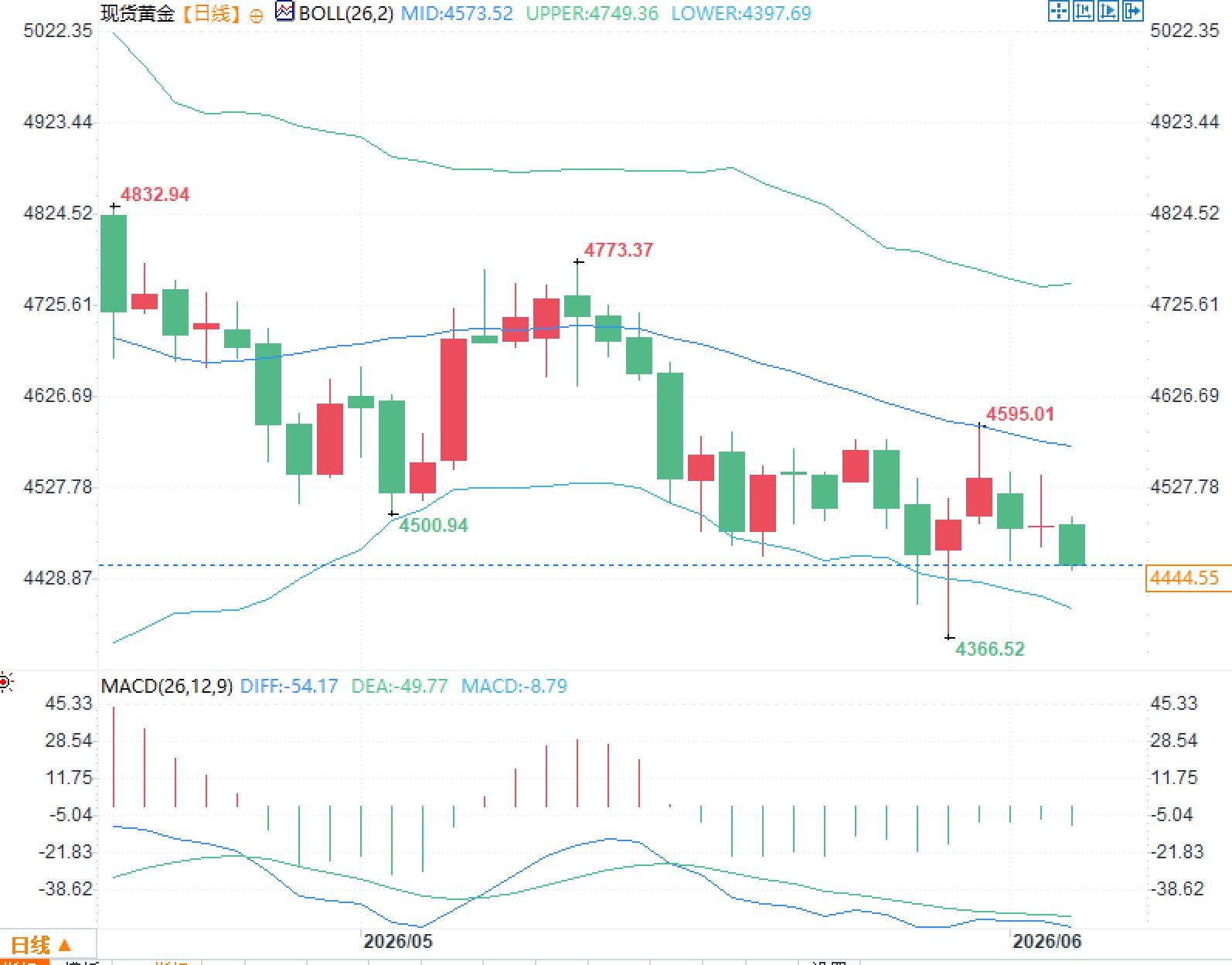
In terms of MACD, the DIFF is -54.17 and the DEA is -49.77, with the histogram still in negative territory, indicating that downward momentum has not yet fully recovered. The convergence near the lower Bollinger Band suggests that volatility may be reactivated, but the direction depends on whether fundamental catalysts can break the tug-of-war between "safe-haven support and interest rate suppression."
Going forward, the most crucial variable to watch for gold is not solely military news, but rather whether employment, inflation, and energy exert concerted pressure. The US May non-farm payroll report will be released on June 5th, and the May consumer price index will be released on June 10th. If employment data remains resilient while oil prices continue to rise, the downward pressure on gold's valuation from interest rates may persist. Conversely, if employment shows a significant slowdown, gold may regain support from expectations of declining real interest rates.
Therefore, the core issue for gold right now is not whether "safe haven exists," but whether "the safe-haven premium can outpace real interest rates." Before normal shipping resumes in the Strait of Hormuz, geopolitical risks will continue to provide underlying support for gold; before the Federal Reserve softens its anti-inflation stance, high interest rate expectations will continue to limit upside potential. The drop in gold prices below $4,500/ounce reflects the market's reluctance to pre-determine a directional premium before data releases.
Question 1: Why did gold prices fall despite escalating geopolitical risks?
A: Rising oil prices have fueled inflation concerns, leading the market to simultaneously increase the probability that the Federal Reserve will maintain a tight policy or even tighten it further. While gold has safe-haven appeal, it does not generate interest, and rising real interest rate expectations will weaken its valuation.
Question 2: Does a price below $4,500/ounce signify a trend reversal?
A: It cannot be simply judged as a trend reversal. The daily chart is still near the lower Bollinger Band, and the MACD is negative, indicating a weak short-term structure. However, geopolitical risks and central bank reserve demand still provide medium- to long-term support. The key is to see how employment and inflation data change interest rate expectations.
Question 3: What should we pay the most attention to going forward?
A: The key factors are whether gold can escape its lows: first, whether shipping through the Strait of Hormuz resumes; second, whether oil prices can fall; and third, whether the non-farm payroll data on June 5th and the inflation data on June 10th will alter the Federal Reserve's course. These three factors together determine whether gold can break free from its current lows.
The price decline does not indicate a failure of safe-haven demand, but rather a repricing of the discount rate.
The key to this round of gold price decline is not that the market is ignoring geopolitical risks, but rather that the risk transmission path has changed. In the past, escalating conflicts typically directly boosted safe-haven buying, but when oil prices rapidly approached $100 per barrel, traders were more concerned with inflation stickiness, rising bond yields, and the probability of the Federal Reserve maintaining a tight policy. Gold does not generate interest, and its valuation is extremely sensitive to real interest rates; when energy prices drive inflation expectations upward, the safe-haven premium can easily be offset by a higher discount rate.
Cleveland Fed President Beth Hammark's latest remarks reinforce this point. She stated that maintaining stable interest rates is reasonable given the uncertain outlook, but action may be needed soon if recent trends continue; she also emphasized that decisive action is needed if rising inflation expectations threaten the 2% target. This means gold is facing not just geopolitical buying, but a dual pricing mechanism of "safe-haven buying against a high interest rate discount."
The conflict premium is diluted inversely by the logic of oil price inflation.
Iran's foreign ministry condemned the US strikes on oil tankers and Qeshm Island, and included countries that allow such actions to use their territory or airspace within the scope of potential responses. The US, however, claimed the actions were in self-defense, stating that the missile and drone attacks were intercepted or missed their targets. Regardless of the accounts, the most important factor from a trading perspective is the expansion of the conflict from a single incident to four fronts: energy transportation, flight suspensions, military facility security, and sanctions negotiations. The risk premium for gold is unlikely to disappear.
However, gold did not surge simply because oil prices became an intermediary variable. Brent crude oil approached $100 per barrel, and the market worried about the spread of energy input costs to commodity, transportation, and service prices. Once inflationary pressures are repriced, gold prices, while receiving safe-haven support, will simultaneously be suppressed by expectations of higher interest rates. US Secretary of State Rubio recently stated that the negotiating team did not offer sanctions relief in exchange for the reopening of the Strait of Hormuz, and that any relief would be linked to concessions on Iran's nuclear program. This statement reduced the certainty of a rapid resumption of the transportation corridor in the short term and further complicated the correlation between oil prices and gold.
The daily chart structure exposes the fragile balance of the bulls' defenses.
From a technical perspective, the daily chart shows that spot gold is around $4445/oz, still close to the lower Bollinger Band. The middle Bollinger Band is at $4573.52/oz, the upper band is at $4749.36/oz, and the lower band is at $4397.69/oz. The price has been consistently trading below the middle band, indicating that the daily rebound has not yet regained the trend center. The previous highs of $4773.37/oz and $4595.01/oz form a progressively lower structure, while $4366.52/oz has become the recent low anchor point.
In terms of MACD, the DIFF is -54.17 and the DEA is -49.77, with the histogram still in negative territory, indicating that downward momentum has not yet fully recovered. The convergence near the lower Bollinger Band suggests that volatility may be reactivated, but the direction depends on whether fundamental catalysts can break the tug-of-war between "safe-haven support and interest rate suppression."
Data windows determine the direction of price fluctuations; gold enters a period of verification.
Going forward, the most crucial variable to watch for gold is not solely military news, but rather whether employment, inflation, and energy exert concerted pressure. The US May non-farm payroll report will be released on June 5th, and the May consumer price index will be released on June 10th. If employment data remains resilient while oil prices continue to rise, the downward pressure on gold's valuation from interest rates may persist. Conversely, if employment shows a significant slowdown, gold may regain support from expectations of declining real interest rates.
Therefore, the core issue for gold right now is not whether "safe haven exists," but whether "the safe-haven premium can outpace real interest rates." Before normal shipping resumes in the Strait of Hormuz, geopolitical risks will continue to provide underlying support for gold; before the Federal Reserve softens its anti-inflation stance, high interest rate expectations will continue to limit upside potential. The drop in gold prices below $4,500/ounce reflects the market's reluctance to pre-determine a directional premium before data releases.
Frequently Asked Questions
Question 1: Why did gold prices fall despite escalating geopolitical risks?
A: Rising oil prices have fueled inflation concerns, leading the market to simultaneously increase the probability that the Federal Reserve will maintain a tight policy or even tighten it further. While gold has safe-haven appeal, it does not generate interest, and rising real interest rate expectations will weaken its valuation.
Question 2: Does a price below $4,500/ounce signify a trend reversal?
A: It cannot be simply judged as a trend reversal. The daily chart is still near the lower Bollinger Band, and the MACD is negative, indicating a weak short-term structure. However, geopolitical risks and central bank reserve demand still provide medium- to long-term support. The key is to see how employment and inflation data change interest rate expectations.
Question 3: What should we pay the most attention to going forward?
A: The key factors are whether gold can escape its lows: first, whether shipping through the Strait of Hormuz resumes; second, whether oil prices can fall; and third, whether the non-farm payroll data on June 5th and the inflation data on June 10th will alter the Federal Reserve's course. These three factors together determine whether gold can break free from its current lows.
- Risk Warning and Disclaimer
- The market involves risk, and trading may not be suitable for all investors. This article is for reference only and does not constitute personal investment advice, nor does it take into account certain users’ specific investment objectives, financial situation, or other needs. Any investment decisions made based on this information are at your own risk.