USD/JPY Analysis: Hawkish comments from the Bank of Japan governor cause the yen to rise in the short term.
2026-06-03 18:23:15
On Wednesday (June 3), the USD/JPY pair had previously surged to the key psychological level of 160, driven by rising international oil prices, increasing US Treasury yields, and strong US economic data. The market was closely watching the risk of Japanese authorities intervening in the currency market throughout the rally. However, the situation changed dramatically during the European session on Wednesday. The yen rebounded sharply across the board, and non-US currencies in the Asia-Pacific region rose in tandem. The euro fell by more than 0.3% against the yen to around 185.40, putting pressure on the USD/JPY pair and causing it to turn downwards. The previous bullish momentum was temporarily reversed by the Japanese policy statement.

The original fundamental logic that previously drove the USD/JPY pair higher
Geopolitical factors and oil prices are bearish for the yen.
Tensions in the Middle East have escalated again, with tensions between the US and Iran rising. Iran launched missiles into the region, and the US launched an airstrike on Kish Island. These geopolitical tensions have fueled a rise in international oil prices. Japan is highly dependent on energy imports, and the surge in oil prices has continued to worsen Japan's trade balance, raising imported inflation and squeezing consumer spending and corporate profits, ultimately dragging down the yen's fundamentals in the long term.
The interest rate differential between the US and Japan is driving a stronger dollar and a weaker yen.
US economic data continues to exceed expectations, with JOLTS job openings reaching 7.62 million, significantly higher than the market expectation of 6.88 million and hitting a two-year high. This confirms the resilience of the US labor market after the Fed's rate hikes, reinforcing market pricing in a prolonged period of high interest rates and tight monetary policy from the Fed. The market is awaiting the US ISM Services PMI data; if the data is also positive, it will further strengthen the fundamental support for the US dollar.
The interest rate differential between the US and Japan is the core factor driving the USD/JPY exchange rate appreciation. Although Japan intervened in the foreign exchange market from April 28th to May 27th, spending 1.7 trillion yen, this large-scale intervention alone was insufficient to reverse the yen's depreciation trend caused by the interest rate differential. After the intervention, the yen fell back to the 160 yen warning level. Previously, the market had bet on the Bank of Japan raising interest rates at the end of the month to offset imported inflation and support the yen, which became a potential negative factor limiting further gains in the USD/JPY exchange rate.
Wednesday's market reversal: The latest driver of the yen's sudden surge
This round of strong short-term rebound in the yen is primarily driven by hawkish verbal intervention from both the Japanese political establishment and the central bank. There is currently no official confirmation of large-scale market intervention involving the purchase of yen and the sale of dollars.
Japanese officials have been making a series of statements about intervention, verbally supporting the yen.
Japanese Prime Minister Sanae Takaichi stated that the government will take appropriate measures to regulate the foreign exchange market at any time. Finance Minister Satoshi Katayama had previously warned that if the yen experiences irrational and drastic fluctuations or speculative short-selling, regulators would intervene in the foreign exchange market at any time. In recent weeks, several Japanese officials have issued intervention warnings, continuously deterring short sellers. Faced with market inquiries about whether the yen's surge stemmed from direct government intervention, the Ministry of Finance remained silent, further fueling speculation about implicit intervention. This forced short covering further contributed to the yen's appreciation.
Hawkish comments from the Bank of Japan governor fuel expectations of a rate hike at the end of the month.
Bank of Japan Governor Kazuo Ueda signaled a tight monetary policy stance at the European session meeting, stating that the bank would continue to raise policy rates based on changes in the domestic economy, inflation, and financial environment. This significantly boosted market bets on a rate hike by the Bank of Japan this month, narrowing expectations of a US-Japan interest rate differential through monetary policy, and becoming a key driver of the yen's short-term surge.
Looking at the performance of cross-currency pairs, the current strengthening of the yen has a broad spectrum, with the yen leading the gains against the New Zealand dollar among major currencies, and all Asia-Pacific currencies rising in tandem. The currency heat map visually reflects the overall appreciation of the yen in this round, with the yen as the base currency against the US dollar, euro, Australian dollar and other currencies, the yen has generally recorded positive gains against each currency.
USD/JPY Technical Analysis
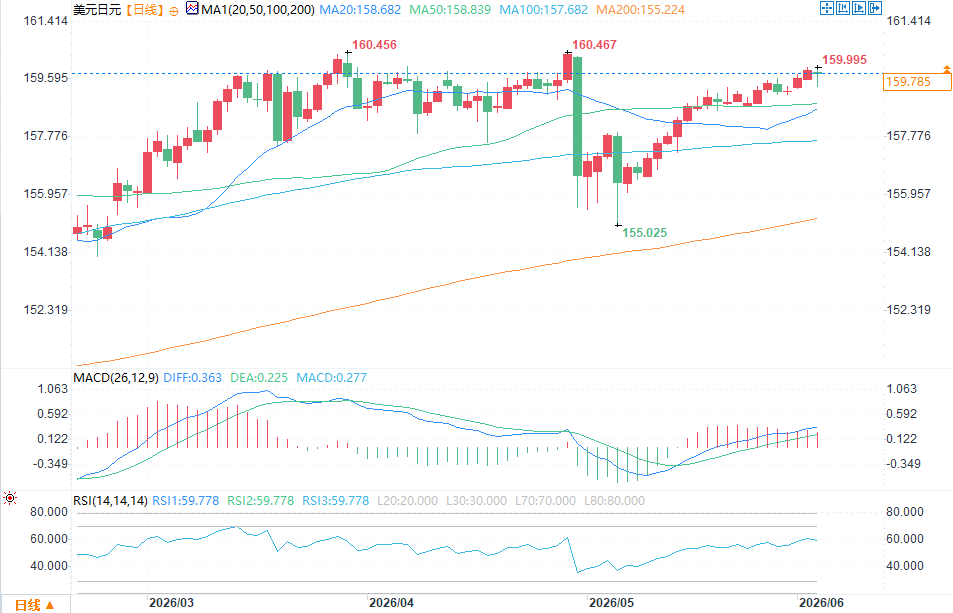
The USD/JPY pair previously maintained a bullish bias, supported by the medium-to-long-term upward trend line, the 50-day moving average, and the 200-day moving average. It rebounded strongly from the low of around 155 in May, testing the key psychological level of 160. The RSI indicator has stabilized above the 50 center, and the previous technical pattern suggests continued upward momentum. The next resistance levels to watch are the 2026 high of 160.70 and the 2024 high of 162.
Affected by the sudden positive news for the Japanese yen, the price fell back from the 160 level. The first short-term support is at the 50-day moving average around 158.90. If the bearish momentum continues and breaks through this level, the next support level will move down to the 158 level, followed by the 157 level where the medium-to-long-term upward trend line is located. If the price further breaks through 156 and the 200-day moving average at 155, it means that the bullish trend has come to a temporary end and the bears have regained control of the market.
Market Outlook
In the short term: verbal intervention by Japan and expectations of interest rate hikes dominated the market, with the yen relatively strong and USD/JPY under pressure and trending downwards. The key focus is on whether the Japanese government will actually implement foreign exchange intervention, and subsequent statements from the Ministry of Finance will directly affect short-term volatility.
In the medium term: the US-Japan interest rate differential remains the pricing anchor. If the US ISM Services PMI strengthens again beyond expectations, it will boost the US dollar and limit the decline of the USD/JPY. Only when the Bank of Japan implements an interest rate hike and substantially narrows the US-Japan interest rate gap can the yen achieve a trend reversal. Mere verbal intervention is unlikely to change the medium- to long-term depreciation trend. Middle East geopolitical factors and oil price fluctuations will continue to disrupt the yen's fundamentals, and the continued surge in oil prices still poses a risk of medium-term downside for the yen.
At 18:21 Beijing time, the USD/JPY exchange rate was 159.789/98, down 0.07%.
The original fundamental logic that previously drove the USD/JPY pair higher
Geopolitical factors and oil prices are bearish for the yen.
Tensions in the Middle East have escalated again, with tensions between the US and Iran rising. Iran launched missiles into the region, and the US launched an airstrike on Kish Island. These geopolitical tensions have fueled a rise in international oil prices. Japan is highly dependent on energy imports, and the surge in oil prices has continued to worsen Japan's trade balance, raising imported inflation and squeezing consumer spending and corporate profits, ultimately dragging down the yen's fundamentals in the long term.
The interest rate differential between the US and Japan is driving a stronger dollar and a weaker yen.
US economic data continues to exceed expectations, with JOLTS job openings reaching 7.62 million, significantly higher than the market expectation of 6.88 million and hitting a two-year high. This confirms the resilience of the US labor market after the Fed's rate hikes, reinforcing market pricing in a prolonged period of high interest rates and tight monetary policy from the Fed. The market is awaiting the US ISM Services PMI data; if the data is also positive, it will further strengthen the fundamental support for the US dollar.
The interest rate differential between the US and Japan is the core factor driving the USD/JPY exchange rate appreciation. Although Japan intervened in the foreign exchange market from April 28th to May 27th, spending 1.7 trillion yen, this large-scale intervention alone was insufficient to reverse the yen's depreciation trend caused by the interest rate differential. After the intervention, the yen fell back to the 160 yen warning level. Previously, the market had bet on the Bank of Japan raising interest rates at the end of the month to offset imported inflation and support the yen, which became a potential negative factor limiting further gains in the USD/JPY exchange rate.
Wednesday's market reversal: The latest driver of the yen's sudden surge
This round of strong short-term rebound in the yen is primarily driven by hawkish verbal intervention from both the Japanese political establishment and the central bank. There is currently no official confirmation of large-scale market intervention involving the purchase of yen and the sale of dollars.
Japanese officials have been making a series of statements about intervention, verbally supporting the yen.
Japanese Prime Minister Sanae Takaichi stated that the government will take appropriate measures to regulate the foreign exchange market at any time. Finance Minister Satoshi Katayama had previously warned that if the yen experiences irrational and drastic fluctuations or speculative short-selling, regulators would intervene in the foreign exchange market at any time. In recent weeks, several Japanese officials have issued intervention warnings, continuously deterring short sellers. Faced with market inquiries about whether the yen's surge stemmed from direct government intervention, the Ministry of Finance remained silent, further fueling speculation about implicit intervention. This forced short covering further contributed to the yen's appreciation.
Hawkish comments from the Bank of Japan governor fuel expectations of a rate hike at the end of the month.
Bank of Japan Governor Kazuo Ueda signaled a tight monetary policy stance at the European session meeting, stating that the bank would continue to raise policy rates based on changes in the domestic economy, inflation, and financial environment. This significantly boosted market bets on a rate hike by the Bank of Japan this month, narrowing expectations of a US-Japan interest rate differential through monetary policy, and becoming a key driver of the yen's short-term surge.
Looking at the performance of cross-currency pairs, the current strengthening of the yen has a broad spectrum, with the yen leading the gains against the New Zealand dollar among major currencies, and all Asia-Pacific currencies rising in tandem. The currency heat map visually reflects the overall appreciation of the yen in this round, with the yen as the base currency against the US dollar, euro, Australian dollar and other currencies, the yen has generally recorded positive gains against each currency.
USD/JPY Technical Analysis
The USD/JPY pair previously maintained a bullish bias, supported by the medium-to-long-term upward trend line, the 50-day moving average, and the 200-day moving average. It rebounded strongly from the low of around 155 in May, testing the key psychological level of 160. The RSI indicator has stabilized above the 50 center, and the previous technical pattern suggests continued upward momentum. The next resistance levels to watch are the 2026 high of 160.70 and the 2024 high of 162.
Affected by the sudden positive news for the Japanese yen, the price fell back from the 160 level. The first short-term support is at the 50-day moving average around 158.90. If the bearish momentum continues and breaks through this level, the next support level will move down to the 158 level, followed by the 157 level where the medium-to-long-term upward trend line is located. If the price further breaks through 156 and the 200-day moving average at 155, it means that the bullish trend has come to a temporary end and the bears have regained control of the market.
Market Outlook
In the short term: verbal intervention by Japan and expectations of interest rate hikes dominated the market, with the yen relatively strong and USD/JPY under pressure and trending downwards. The key focus is on whether the Japanese government will actually implement foreign exchange intervention, and subsequent statements from the Ministry of Finance will directly affect short-term volatility.
In the medium term: the US-Japan interest rate differential remains the pricing anchor. If the US ISM Services PMI strengthens again beyond expectations, it will boost the US dollar and limit the decline of the USD/JPY. Only when the Bank of Japan implements an interest rate hike and substantially narrows the US-Japan interest rate gap can the yen achieve a trend reversal. Mere verbal intervention is unlikely to change the medium- to long-term depreciation trend. Middle East geopolitical factors and oil price fluctuations will continue to disrupt the yen's fundamentals, and the continued surge in oil prices still poses a risk of medium-term downside for the yen.
At 18:21 Beijing time, the USD/JPY exchange rate was 159.789/98, down 0.07%.
- Risk Warning and Disclaimer
- The market involves risk, and trading may not be suitable for all investors. This article is for reference only and does not constitute personal investment advice, nor does it take into account certain users’ specific investment objectives, financial situation, or other needs. Any investment decisions made based on this information are at your own risk.